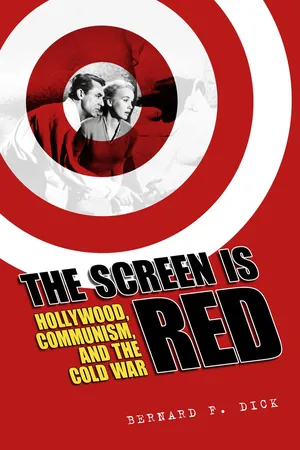
The Screen Is Red portrays Hollywood's ambivalence toward the former Soviet Union before, during, and after the Cold War. In the 1930s, communism combated its alter ego, fascism, yet both threatened to undermine the capitalist system, the movie industry's foundational core value. Hollywood portrayed fascism as the greater threat and communism as an aberration embraced by young idealists unaware of its dark side. In Ninotchka, all a female commissar needs is a trip to Paris to convert her to capitalism and the luxuries it can offer. The scenario changed when Nazi Germany invaded the Soviet Union in 1941, making Russia a short-lived ally. The Soviets were quickly glorified in such films as Song of Russia, The North Star, Mission to Moscow, Days of Glory, and Counter-Attack. But once the Iron Curtain fell on Eastern Europe, the scenario changed again. America was now swarming with Soviet agents attempting to steal some crucial piece of microfilm. On screen, the atomic detonations in the Southwest produced mutations in ants, locusts, and spiders, and revived long-dead monsters from their watery tombs. The movies did not blame the atom bomb specifically but showed what horrors might result in addition to the iconic mushroom cloud. Through the lens of Hollywood, a nuclear war might leave a handful of survivors ( Five ), none ( On the Beach, Dr. Strangelove ), or cities in ruins ( Fail-Safe ). Today the threat is no longer the Soviet Union, but international terrorism. Author Bernard F. Dick argues, however, that the Soviet Union has not lost its appeal, as evident from the popular and critically acclaimed television series The Americans. More than eighty years later, the screen is still red.
- 288 pages
- English
- ePUB (mobile friendly)
- Available on iOS & Android
eBook - ePub
About this book
Trusted by 375,005 students
Access to over 1.5 million titles for a fair monthly price.
Study more efficiently using our study tools.
Information
Publisher
University Press of MississippiYear
2016Print ISBN
9781496814937
9781496805393
eBook ISBN
9781496805409
Subtopic
Film History & CriticismChapter 1
THE ROAD NOT TAKEN
FEW BUSINESSES ARE AS MUCH A VALIDATION OF CAPITALISM AS THE film industry, created largely by Jewish immigrants and their sons. Moviemaking was the pinnacle of the American Dream, realizable with the right Machiavellian combination of initiative (virtù) and luck (fortuna). But during the Great Depression—especially in the early and mid-1930s—it seemed that capitalism’s potential had been exhausted. There were the one per centers and the rest, the victors and the victims: stars like Claudette Colbert, who could command $50,000 a picture, and the masses that had difficulty shelling out a quarter to see the film. William Manchester began his popular history The Glory and the Dream with a bleak picture of 1932, “the cruelest year of the Depression,” with its failing banks, burgeoning welfare rolls, foreclosure riots, bootleg coal, shoes with pasteboard soles, wedding rings sacrificed for instant cash, pawned furniture, “payless paydays” for teachers, students suffering from malnutrition, and men riding the rails in search of work. People scavenged for food in refuse dumps and garbage cans, even as farmers killed livestock that could not be sold as meat and dumped milk on the ground rather than sell it at two cents a quart when distributors charged eight.
Racist and anti-Semitic paramilitary groups—the Order of Black Shirts; the Silver Shirts, which emulated Hitler’s Brown shirts; and the Khaki Shirts or US Fascists—cast a shadow over the land, as if they were waiting in reserve for a crisis to happen. But the crisis would be a crisis of faith in an economic system that seemed to be working—until the crash. Was fascism the answer? Columbia University president and Nobel Prize winner Nicholas Murray Butler stopped short of saying so, although he extolled totalitarian regimes for producing “men of far greater intelligence, far stronger character, and far more courage than the system of elections.” The situation was so extreme that Clare Boothe—before she married Henry Luce and became a well-known playwright, journalist, and ambassador—exclaimed in exasperation, “Appoint a dictator,” even though she was hardly a fascist sympathizer. “Happy Days Are Here Again” had upbeat lyrics, but these days were nowhere in sight.
Perhaps a dictatorship—at least a benevolent one—was the solution, or “share the wealth” socialism. Maybe even American-style communism, more red than white and blue. Hollywood would endorse neither fascism nor communism, both of which would have subverted the free enterprise system on which the industry was founded. Still, a wavering faith in democracy was not a topic Hollywood could ignore, any more than it could ignore the disillusionment of the veterans of the Great War. A few films of the 1930s (Wild Boys of the Road, Dead End, Heroes for Sale, even King Kong, in which out-of-work Fay Wray is discovered by a director as she filches an apple) painted a bleak canvas of the period, a striking contrast to the upbeat WPA murals that were sprouting up in public places. In I Am a Fugitive from a Chain Gang (1932), James Allen (Paul Muni), a veteran of the Great War, returns to an indifferent America and an uncertain future. An unwitting participant in a robbery, Allen is sentenced to ten years on a chain gang, from which he escapes. Essentially a decent man wrongly accused of a crime he did not commit, Allen evolves into a model citizen, and he is persuaded to return to the chain gang for nine months, after which he supposedly will be released. But the prison commission refuses to act. Allen, realizing the situation is hopeless, breaks out again, this time embarking upon a life of crime. A man who wanted only to build bridges becomes a criminal because of a corrupt system.
I Am a Fugitive from a Chain Gang is not so much an indictment of the punitive system—with its “concentration-camp atmosphere,” which did not need an exposé—as it is a critique of a justice system, which is portrayed as a totalitarian bureaucracy where inmates serve as sport for sadistic wardens and guards. Road Gang (1936) went even further in its dramatization of prisoner abuse: Inmates are flogged, electrocuted on high-voltage fences, and sent off to the coalmines. In I Am a Fugitive from a Chain Gang, prison is an alternative America, an ever-expanding fascist microcosm.
Allen’s plight occasions editorials with accusatory headlines: “Where Is Civilization?” and “States Rights? What Has Become of Them?” But even a sympathetic press fails to secure his release. His sentence is a fait accompli. Allen must pay for a crime he did not commit. The moral is simple: Don’t be in the wrong place at the wrong time, or you’ll end up spending a decade on a chain gang—and you’ll be lucky if you’re not put in a sweat box. Justice is blindfolded, and her scales are imbalanced.
Heroes for Sale (1933) featured another lost soul abandoned by his country. Thomas Holmes (Richard Barthelmess), a World War I vet whose heroism has gone unrecognized, returns to civilian life, where he is befriended by a luncheonette owner. Holmes is on the road to reintegration when he is accused of instigating a workers’ demonstration that has turned violent. He is sentenced to five years in prison. Upon his release, he joins the ranks of the homeless. Even after he comes into some money, he hands it over to the luncheonette owner to feed his own kind, preferring to remain a man without a country and a home. In I Am a Fugitive from a Chain Gang and Heroes for Sale, the protagonists pay the price for serving in the war to end all wars and making the world safe for democracy, which seems to have vanished during their absence. Each is wrongly imprisoned and is never the same afterwards.
In crime movies, prisons are rarely humane, and wardens are rarely benevolent. There are exceptions, of course: the wardens in The Criminal Code (1931), 20,000 Years in Sing Sing (1932), and Crime School (1938). But portraying prisons as fascist fiefdoms with commandant wardens and their lackeys and chain gangs as a form of slave labor was not especially controversial. Moviegoers accepted the idea that in a republic that promised liberty and justice for all there was a colony known as the prison system, where liberty was suspended and justice often denied. They had become accustomed to prison-as-purgatory, in which prisoners are either purged of their sins or consumed in the process of purgation. Even in a movie from Poverty Row, PRC’s Lady in the Death House (1944), an off-screen voice turns grimly epigrammatic: “The state that cannot give life demands the right to take life.”
What was unsettling in the 1930s was the prospect of a fascist America, not a republic with a few pockets of fascism. American fascism was a subject the industry would have preferred to ignore, but it had “what if?” possibilities. The trick was to show what could happen. There would be an open-ended dénouement allowing some to believe that fascism—or at least benevolent fascism—would be acceptable if it featured a leader charismatic enough to inspire confidence, even if such a system resulted in curtailment or suspension of civil liberties in order to promote the common good. Others would regard the film as a cautionary tale, engrossing but implausible.
Gabriel over the White House (1933) qualified as both. In that film, after an automobile accident caused by reckless driving, President Judson Hammond (Walter Huston) awakens from a coma a changed man. Determined to solve America’s economic problems and rid the country of organized crime, he converts the republic into a dictatorship by dissolving Congress and imposing martial law, justifying his subversion of the Constitution by invoking the law of God as promulgated through him by the angel Gabriel. Apparently, angels were not just in the outfield, but also in the White House. Once the president accomplishes his goals—full employment, the execution of criminals, world disarmament—he peacefully expires, leaving America and the world a supposedly better place. Is the film implying that the president’s measures are temporary, remaining in force until order is restored, after which the country will revert to its old democratic self? Or that fascism is the only way of dispelling the miasma of the Great Depression? If so, the dictatorship would be permanent in case the same circumstances that brought it about should recur. The similarity between the president and the new chancellor of Germany, Adolf Hitler, was striking. Just as Hitler dissolved the Reichstag, President Hammond dissolves Congress. Both leaders were also committed to full employment, but was fascism the only way to achieve it? In Germany, Gabriel over the White House was regarded as a “fascist satire,” with a protagonist whose policies validated Hitler’s. Reactions were mixed in the United States, with “some calling it a satire [while] others agreed with its agenda.” There is another way of interpreting the film, as a utopian fantasy reflecting the desires of the unemployed who would accept a dictatorship—benevolent or otherwise, especially one that had God’s imprimatur—if it meant they could be guaranteed jobs. Chicagoans would be thrilled to live in a gangster-free city. Pacifists would have nothing to protest against in a world committed to disarmament. It would be the fulfillment of Isaiah’s prophecy (2:1–5), with swords beaten into plowshares, spears into pruning hooks, and nations no longer warring with each other. Eden had returned and taken root in American soil.
The President Vanishes (1934), less ambivalent but nonetheless utopian, arrived with an impressive pedigree: a script based on a Rex Stout novel; a prominent director, William Wellman; and an assistant director, Dorothy Arzner, who was establishing herself as a major filmmaker in her own right. The film was based on another fantasy premise: an isolationist president’s discovery that Americans equate isolationism with cowardice and expect him to involve the country in a war that has already started in Europe. Although the world was still five years away from war, The President Vanishes posed a real dilemma. Does national honor demand that a country become entangled in a foreign conflict to maintain its status as a super power, refusing to stand by while ignorant armies clash by night? The president, hoping to teach the people a lesson, allows himself to be kidnapped by the Grey Shirts, obviously modeled after William Pelley’s Silver Shirts. The president narrowly escapes getting murdered and, once freed, continues preaching the gospel of non-intervention, which was pretty much the status quo in America until the country was awakened from its lethargy on 7 December 1941. The President Vanishes is notable for its subtle conjunction of war and munitions manufacturers, who depend on wars to remain in business. At a banquet hosted by a lobbyist for a quintet of warmongers, the lobbyist’s wife (Rosalind Russell) compares the group to a flock of birds. When one of them asks what kind, Russell, with her signature disdain, replies, “Eagles.” It was a drawing room comedy exit line, delivered by an actress who had few peers when it came to acidic line readings. All The President Vanishes could do was jolt the complacent into accepting—or at least understanding—the issues: the folly of believing that war is the only way of validating a country’s honor; isolationism as the only way of avoiding a repeat of World War I; and munitions plants as the only defense against war. That each canceled the others out seemed unimportant. America could at least encase itself in the cocoon of isolationism for a few more years.
It was a confused—and confusing—era. The end seemed to justify the means. If a United States president could take the law into his hands, why not the youth of America? In Cecil B. De Mille’s This Day and Age (1933), a band of civic-minded youths, frustrated by their elders’ inability to prosecute a notorious gangster, decide to kidnap him, bring him to a brickyard, and lower him into a rat-infested pit to provoke a confession. The only charge brought against them is car theft (a female accomplice commandeered the automobile to summon the police). But whatever time the young vigilantes might serve will be spent in surroundings considerably more comfortable than those in which Allen and Holmes found themselves. The kids benefited the community by breaking the law, and their offense is treated like a minor infraction. Paul Muni’s Allen and Richard Barthelmess’s Holmes merely served their country.
In the films of the thirties, communism was pictured more as a nuisance than a threat. When communists weren’t spouting the party line, they were mouthing clichés. The parasitic Carlo (Mischa Auer) in My Man Godfrey (1936) inveighs against money, “the Frankenstein monster that devours souls,” but thinks nothing of sponging off his rich patrons. Two films dating from around the same time, Our Daily Bread (1934) and Red Salute (1936), addressed communism differently: the former by preaching collectivism; the latter, by lampooning campus radicalism. Our Daily Bread steered clear of ideology. There was no dialectic in the story of a husband without prospects and a wife with an uncle who offers the couple a farm in the appropriately named community of Arcadia. The farm swells into a cooperative, whose philosophy, in the vernacular, is “You help me, I help you. We help ourselves by helping others.” This attitude, unlike Marx’s “From each according to his ability, to each according to his needs,” is never expressed ideologically, although it amounts to the same thing. The rationale behind the cooperative harks back to Plato’s theory of the origins of society in Book 2 of The Republic: No one is self-sufficient, but all are co-dependent, relying on the skills and talents of others. In Our Daily Bread, a mason has trouble putting up the frame for a house, while a carpenter is similarly frustrated by his inability to lay a foundation. Once they realize each has a skill the other lacks, they exchange places, and the house gets built. The incident illustrates the principle of division and specialization of labor, the only way in which the farm can grow and thrive. When the husband first questions the men about their abilities, he is more favorably disposed towards farmers, carpenters, masons, plumbers, bricklayers, and tailors than towards the lone violinist, who nonetheless is welcomed into a community from which no one is excluded, including a potential home wrecker (Barbara Pepper at her blowziest).
When the issue of self-determination arises, the members argue about what form of government they should adopt. Someone suggests democracy and is roundly booed: “That kind of talk got us here in the first place.” Another proposes socialism, which would make sense in a collective, except that depicting the farm as a socialist enclave would have alienated moviegoers who could accept a community where people helped each other, but not one founded on an “ism” that many considered a diluted form of communism and no less inimical to free enterprise. Politically, the commune will be an anomaly: a democratic collective founded on group effort. A salt-of-the-earth type (the wonderful character actor, John Qualen) admits his ignorance of “isms,” but is clear about what is needed: “a big boss”—namely, the husband, “the FDR of Arcadia,” as Andrew Bergman dubbed him.
Our Daily Bread glorified collectivism at a time when similar measures enacted by the Soviet government led to famine in Ukraine, implying that the experiment that caused more than seven million people to die of starvation in the Soviet Union could succeed in the United States, where cooperative farming is a choice, not a mandate. The Arcadian farm was not a footnote to President Roosevelt’s New Deal; it was a new deal proposed and ratified by the people, not the government, a cooperative venture entered into freely—a distinction that makes all the difference between a social contract and formal legislation. Our Daily Bread, however, glossed over the downside of collectivism, the weakening of the competitive spirit. If everyone works for the good of the community, every individual’s talents are subsumed into the mass, with a corresponding loss of individuality and recognition. Collectivism—at least in America—is utopianism. Individuals may be willing to suppress the competitive instinct temporarily, but human nature will out. Pure communism, in which the individual subordinates him- or herself to a higher authority, is possible in religious communities where the higher good is divinely sanctioned. But after a time, even fervent believers have been known to defect. The selfless life is for saints who may realize they are superior to some of their peers, but who still choose to lay their talents on a communal altar.
The cooperative efforts are vindicated in the dizzying climax when the men form a pick and shovel brigade to dig an irrigation ditch. Director King Vidor timed their movements to the beat of a metronome: “The picks came down on the counts of one and three, the shovels scooped dirt on count two and tossed it on count four.” Vidor was actually following Sergei Eisenstein’s theory of rhythmic montage, in which a metrical pattern is imposed on the shots, with each succeeding the other like notes in a musical score. With drought no longer an issue, Arcadia looks as if it were blessed from above. Like the Greek pastoral with its Arcadian setting, Our Daily Bread partook of the purity of myth without providing the substance of reality.
Red Salute (1935), on the other hand, was moored in reality—specifically, in the 1930s college scene. The typical 1930s college movie was a musical (College Humor [1933], College Rhythm [1934], Collegiate [1936], College Swing [1938]), depicting campus life as a pre-hookup oasis where academics took a back seat to athletics and romance. Red Salute, however, portrayed college—in this case, one situated in the nation’s capital—as a haven for left-wing activists. Informed audiences would not have been surprised that college students, unable to find a satisfactory explanation for the Great Depression, looked to the Left for answers, which it gladly supplied. Excessive speculation in the stock market on the part of the wealthy was to blame. This scenario, the Left indicated, would not have occurred under socialism, where the means of production are government-owned. Although campus radicalism in the 1930s was not as widespread as it was during the Vietnam War, leftist college organizations did exist, such as the League for Industrial Democracy (LID), an offshoot of Upton Sinclair’s Intercollegiate Socialist Society and the inspiration for the film’s Liberty League—International Students. The latter was a clever title, implying that the malcontents were not Americans, but foreigners intent on imposing an alien sociopolitical “ism” on the United States.
However, one need not worry. Red Salute was a politicized screwball comedy that opened with a student proclaiming at a campus rally, “The world’s sick, and you’re going to pay the doctor’s bills.” Unsurprisingly, the announcement is greeted with laughter. The audience consists of red-blooded Americans, while the demagogue is just a Red—and an exchange student at that. A general’s daughter (Barbara Stanwyck), enamored of the firebrand and his “ism,” refuses to accept her father’s arguments about the good life she has enjoyed under capitalism. The father retaliates by shipping his daughter off to Mexico, where she encounters a brash American soldier (Robert Young). Once they dis...
Table of contents
- Cover
- Half title
- Title
- Copyright
- Dedication
- Contents
- Acknowledgments
- Introduction
- 1. The Road Not Taken
- 2. The Red Sextet
- 3. Calling Dr. Death
- 4. Creatures from the Id
- 5. Worlds Elsewhere
- 6. Amid the Alien Corn
- 7. Apocalypse Then
- 8. Red Skies over China
- 9. “Better Dead Than Red”
- 10. Commies, Commies Everywhere
- 11. Microfilm Mania
- 12. Madness Risen from Hell
- 13. Curtain Up!
- 14. Walking a Tightrope
- 15. The Forgotten War
- 16. Meanwhile, Back in the West . . .
- 17. Alfred Hitchcock and Cold War Espionage
- 18. Hollywood’s Cold Warrior: John Wayne
- 19. Home Front Liberals
- 20. The Year of Living Dangerously
- 21. After Such Knowledge
- Notes
- Filmography, Television, Radio
- Index
Frequently asked questions
Yes, you can cancel anytime from the Subscription tab in your account settings on the Perlego website. Your subscription will stay active until the end of your current billing period. Learn how to cancel your subscription
No, books cannot be downloaded as external files, such as PDFs, for use outside of Perlego. However, you can download books within the Perlego app for offline reading on mobile or tablet. Learn how to download books offline
Perlego offers two plans: Essential and Complete
- Essential is ideal for learners and professionals who enjoy exploring a wide range of subjects. Access the Essential Library with 800,000+ trusted titles and best-sellers across business, personal growth, and the humanities. Includes unlimited reading time and Standard Read Aloud voice.
- Complete: Perfect for advanced learners and researchers needing full, unrestricted access. Unlock 1.5M+ books across hundreds of subjects, including academic and specialized titles. The Complete Plan also includes advanced features like Premium Read Aloud and Research Assistant.
We are an online textbook subscription service, where you can get access to an entire online library for less than the price of a single book per month. With over 1.5 million books across 990+ topics, we’ve got you covered! Learn about our mission
Look out for the read-aloud symbol on your next book to see if you can listen to it. The read-aloud tool reads text aloud for you, highlighting the text as it is being read. You can pause it, speed it up and slow it down. Learn more about Read Aloud
Yes! You can use the Perlego app on both iOS and Android devices to read anytime, anywhere — even offline. Perfect for commutes or when you’re on the go.
Please note we cannot support devices running on iOS 13 and Android 7 or earlier. Learn more about using the app
Please note we cannot support devices running on iOS 13 and Android 7 or earlier. Learn more about using the app
Yes, you can access The Screen Is Red by Bernard F. Dick in PDF and/or ePUB format, as well as other popular books in Media & Performing Arts & Film History & Criticism. We have over 1.5 million books available in our catalogue for you to explore.