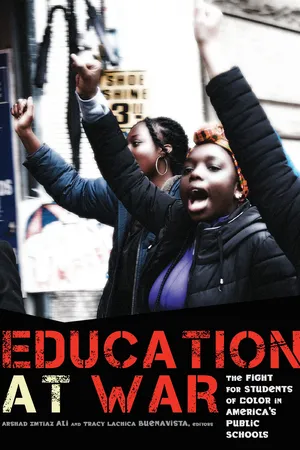
Education at War: The Fight for Students of Color in America's Public Schools, attempts to shape educational research and practice to more explicitly consider the relationship between education, capitalism and war, and more specifically, its' impact on students of color. The authors, as a whole, contend that the contemporary specter of war has become a central way that racism and materialism become manifested and practiced within education. In particular, this collection asserts that the contemporary neoliberal characterization of education and school-based reform is situated within the global political economy that has facilitated a growth in the prison and military industrial complex, and simultaneous divestment in education domestically within the U.S.
Education at War attempts to make research relevant by bringing the tensions within young people's lives to the fore. The heavy shadow cast by recent U.S. led wars re-organizes the sites of learning and teaching nationally, as well as differentially, within specific sites and upon particular communities. Nonetheless, the examination of this context is not enough. Rather, we consider how such a contemporary context can facilitate educational spaces for communities and youth to grow their vision for a different, and hopefully a more humanizing future. Thus, the book contributors will collectively explore how resistance can produce the opportunity for rich, diverse and transformative learning for marginalized students and communities.
The lives of People of Color are the forefront of Education at War: The Fight for Students of Color in America's Public Schools. Whereas there are many attempts to theorize about the global implications of war, less attention is paid to the ways that war shapes young lives in the U.S., particularly in an educational context. The book addresses the absence of youth-centered discussions regarding education during a political context of neoliberalism and war, and provides important perspectives on which to ground critical discussions among students and families, education scholars and practitioners, and policymakers.
eBook - ePub
Education at War
The Fight for Students of Color in America's Public Schools
- 288 pages
- English
- ePUB (mobile friendly)
- Available on iOS & Android
eBook - ePub
Education at War
The Fight for Students of Color in America's Public Schools
About this book
Information
Publisher
Fordham University PressYear
2018Print ISBN
9780823279098
9780823279081
eBook ISBN
9780823279104
Three Fronts in the Neoliberal Global War: Detroit, Baghdad, and Public Higher Education
Yousef K. Baker
War in the twenty-first century is not an exceptional state. It is built into everyday profit extraction and political control. In this war, geography has stopped being a barrier that separates or distinguishes. The effects of today’s war are never far. What goes on “over there” is part of the same structure operating “over here.” We see the same processes that have transformed Baghdad and Detroit working within the U.S. educational system. Like the rest of the public realm, education is being enclosed and forced to become a space where money can be extracted. After years of defunding and divestment, low educational performances are blamed on the very idea of public education (Newfield 2016, 3–7). Policy makers urge a business solution, one of efficiency, cost cutting, and bottom lines (Newfield 2016, 20–24). Using the catchphrases of “more with less,” “data-driven strategies,” and “student outcomes,” quality education is reduced to numbers on a spreadsheet and sold as accountability. All the while, the purpose of education is redefined as a way to channel people into the workforce. After all, within neoliberal global capitalism, we are all just servants of this thing called the market (Brown 2015, 30–35). The educational system trains us to serve that all-encompassing purpose.
Today, with few exceptions, the entire world is governed by and integrated within one type of economic system—capitalism. Capitalist economic relations have also come to dictate social relations and much of international politics (Robinson 2006). Today’s capitalism is a specific type of capitalism, different from previous iterations such as competitive capitalism, monopoly capitalism, or welfare capitalism (Magdoff 1982). This new form of capitalism, what I refer to as neoliberal global capitalism, emerged in the 1970s and is now the dominant political economic paradigm.
Neoliberal global capitalism is conditioned by war. Just as a parasite’s relationship to its host is predicated on constant struggle, so does the dialectic of capitalism and the masses of people under it. But as capitalism tries always to extend its exploitation, the exploited resist. This friction erupts in wars of many kinds, undertaken to impose endless extractions of resources and to repress any resistance thereto. In other words, Baghdad and Detroit are both battlefronts. So is the higher education system in California. While in some fronts the weapons are guns, tanks, and jets, in others they are drones and separation walls, in others they are police and SWAT teams, and yet in other places they are banks, ATMs, and utility bills. While the mechanism of suppression and the degree of brutality vary, do not let that get you twisted. Regardless of the tactics, the strategies are analogous, with the same goals implemented by similar actors.1
My purpose here is to describe some of this war’s main features and to provide some signposts that we can use to identify its effects throughout our lives. Through a discussion of events in Baghdad, Detroit, and the higher education system in California, I highlight four features of neoliberal global capitalism. The first is the prioritization of the interests, needs, and desires of global investors, the transnational capitalist class (TCC), over popular classes (Robinson 2004, Sklair 2001).2 Second, this prioritization occurs through undemocratic means, albeit with legal cover. Third, these undemocratic means are institutionalized through a separation of the political from the economic. Fourth, these measures continually push for the elimination of the final remnants of the public realm and force it under the power of the market. I will then demonstrate how these characteristics of “over there” are playing out in the seemingly mundane higher education policies in California, that is, “over here.”
What Is Neoliberal Global Capitalism?
The period between 1960 and 1980 inaugurated a reorganization of the global economy. This reorganization was partially an attempt to strike a blow against what by the late 1960s and early 1970s was arguably a global insurgency, an “international intifada” (Midnight Notes Collective 1992, viii) simultaneously brewing across the world. This was an intifada waged by colonized people across the world, by the “Muslim Third World” (Daulatzai 2012), Black radicals in the United States, leftist guerillas in the Americas, native peoples in settler-colonial societies, and exiled peoples across the planet. Vijay Prashad (2007) named the upsurge of these movements across the world the “Third World Project,” a movement demanding sovereignty, self-determination, peace, and a rebalancing of the colonial global economy. This project sent shock waves throughout the colonial capitals. Henry Kissinger famously threatened Third World leaders in 1976: “The United States, better than almost any other nation, could survive a period of economic warfare” (Gelvin 2012, 201).
In response, a brutal political, economic, cultural, and military campaign followed, one that relegated Third World demands to dreams and resulted in the emergence of neoliberal global capitalism. From an economic viewpoint, this new epoch is defined by a transnationalization of production and the emergence of an integrated transnational global economy, spearheaded by the maturation in certain places and emergence in others of transnationally oriented elite formations, the transnational capitalist class (Robinson 2004, Sklair 2001).
Transnationalization of production refers to assembly lines—previously contained within a nation-state’s borders—going global. New economic practices emerged: Products are now made all over the world, with component parts produced in different places; shipped across continents to assembly plants; and sold everywhere (Dicken 2007). Companies extended beyond the confines of the nation-state and gave rise to the transnational corporation (TNC).3
Neoliberalism modified the rules of the game. Capitalism structured by neoliberal logic subverts the state and its citizens to the needs of the market. The goal is to have a marketplace with no boundaries, spanning the entire world (Strange 1996, 3–8; Robinson 2014, 77–82). Neoliberalism rejects the idea of collective rights and holds that the state’s only responsibility is to individual citizens, ensuring their personal rights and guaranteeing their right to enter the market to fulfill their needs there. A neoliberal state’s primary function is to protect the market, guarantee property rights, and be the investor of first and last resort (Gill 1998, 23–24; Robinson 2004, 30–37). Within a neoliberal logic, the market is understood as operating like nature, with its own rhythms and whims that must not be meddled with. Hence government aid to poor people is seen as creating “artificial” demand because in “reality” poor people should not generate any demand, since they do not have access to money.4
Neoliberalism stands in contrast to embedded liberalism, or what is popularly known as New Deal economics (Krugman 2008), which governed U.S. policy from after the Second World War up to the 1970s. This policy promoted free trade globally but internally pursued Keynesian economic policies such as full employment, social welfare programs, and industrial expansion (Harvey 2005, 10–12; Ruggie 1982). Neoliberalism, on the other hand, sees such safety nets as unwelcome interventions into the market and consequently tries to eliminate the public realm and transfer all of social life to private enterprise. Privatization commodifies social relations that were not open to profit-making mechanisms, a process we have witnessed in education: More and more of the educational pipeline has become a business where someone makes money in return for providing some sort of schooling (Giroux 2014, 12–20; Hursh 2016, 3, 8–12). Perhaps most shocking is the privatization of things never previously considered commodities, including air and water. Cap-and-trade policies, a favorite of liberals in mainstream American politics, are examples of this (Adler 2000, Anderson and Leal 2015, Anderson and Libecap 2014).
Perhaps the most powerful ideological feature of neoliberalism is how those of us living under it internalize its rationality. Neoliberal ideology has turned business and economic relations into a metaphor for how we see ourselves and how we ought to live our lives. The protagonist of this era is the entrepreneur; his are the qualities to emulate.5 If our normative vision of the world is one where all aspects of life, including the social and familial, are to be subsumed and subordinated to the market, then it follows that the qualities deemed virtuous are those of the capitalists—the principal actors in the marketplace. And who is an entrepreneur but a budding capitalist, the quintessential bootstrapper? Neoliberalism as a metaphor tells us to live our everyday lives with nothing but the profit motive as our guide (Brown 2011, 23–24).
So far, what I have described is still an abstraction. What does the war state of neoliberal global capitalism actually look like on the ground?
Baghdad
Bombing Baghdad seems to have become a rite of passage for American administrations since Ronald Reagan. The 2003 invasion that began with “shock and awe” was outrageous in its ability to eclipse in its horror and magnitude the severity of the 1991 American bombings, which according to the United Nations sent Iraq to a “pre-industrial age” (Boutros-Ghali and the United Nations 1996, 187). The 2003 invasion leveled Iraq’s institutions and infrastructure once again,6 rolling out the red carpet for neoliberalism.
Neoliberalism was imposed on Iraq and codified in law by the signature of one man appointed in Washington, D.C., Lewis Paul Bremer III, appointed by President Bush as the head of the Coalition Provisional Authority (CPA) from May 2003 to June 2004. The CPA put in place laws and agreements with international financial and governing institutions that legally opened Iraq to transnational businesses without prejudice and without favoring businesses from countries that had actually led the invasion. Since most of these laws that relate to the economy remain in place today, perhaps Bremer will be remembered as the most consequential ruler of Iraq after Saddam Hussein. Indeed, for all the noise around “democracy promotion,” a foreigner hired in the United States and with no connection to Iraq or its people signed Iraq’s new state into law.
LEGISLATING NEOLIBERALISM
Through Orders 18, 56, and 94, the CPA legislated an open and deregulated financial market by decreeing a set of banking laws and the establishment of a new Central Bank of Iraq (CBI). The CBI law repeatedly asserted the independence of the CBI from “any person or entity, including government entities” (Article 2.2 of Order 56, 2004).
Order 18 gave the CBI the right not to inform the Ministry of Finance—or any other government entity—of loans it was giving out or of its broader activities (Order 18, 2003). Although the rationale given was that economic institutions needed to be buffered from political ambitions and interference in order to make sound decisions, in practice this separation masked the class interests that determine economic policies. The law also gave the bank the power to “conduct transactions in foreign assets and manage all official foreign reserves of the state” (Article 27 of Order 56, 2004). Since decision making over state reserves was given to the CBI, the bank could make decisions of great political consequence with no accountability to the political branches of the state, elected authorities, or the public. This could potentially allow pivotal governmental functions to remain strictly in the hands of a technocratic cadre ideologically allied with the TCC. This would enable them to control the very policies important to them without regard to social consequences.
This strategy of making economic institutions autonomous from political ones fundamentally shifts who the sovereign is away from the citizenry and toward the mobile investor or the TCC. It prioritizes one global class of people over local popular classes. Since those who make the decisions are not subject to elections or public scrutiny, it constrains popular movements from being able to seek redress or implement change economically. Moreover, this structural organization advances neoliberalism’s ideological position that the economy is not a terrain of political struggle but instead an objective science to be managed by experts in the field.
NEOLIBERALISM UNDER THE GUISE OF DEVELOPMENT
Neoliberalism under the guise of “development” was used to transform Iraq’s economy. “Development” programs operated to...
Table of contents
- Cover
- Half Title
- Title Page
- Copyright
- Dedication
- Contents
- Preface
- Half Title
- Introduction. Toward an Antiwar Pedagogy: Challenging Materialism, Militarism, and Racism in Education
- 1. Three Fronts in the Neoliberal Global War: Detroit, Baghdad, and Public Higher Education
- 2. Kony 2012 as Citizenship Education: A Grassroots Revolution or a Strategy of Warfare?
- 3. Reflections on the Perpetual War: School Closings, Public Housing, Law Enforcement, and the Future of Black Life
- 4. Caste Education in Neoliberal Society: Branding ADHD and Value-Added Students through the Tactics of “Population Racism”
- 5. Toward What Ends? A Critical Analysis of Militarism, Equity, and STEM Education
- 6. A Day at the Fair: Marketing Militarism to Students of Color in Elementary Schools
- 7. The Paradoxical Implications of Developing Youth in a Chicago Public Military Academy
- 8. Raza Communities Organizing against a Culture of War: Lessons from the Education Not Arms Coalition (ENAC) Campaign
- 9. Schools as Carceral Sites: A Unidirectional War against Girls of Color
- 10. Pedagogies of Resistance: Filipina/o “Gestures of Rebellion” against the Inheritance of American Schooling
- 11. Of Boxes and Pen: Forged and Forging Racial Categories at a Wartime U.S. University
- 12. War and Occupation
- Acknowledgments
- List of Contributors
- Index
Trusted by 375,005 students
Access to over 1.5 million titles for a fair monthly price.
Study more efficiently using our study tools.
Frequently asked questions
Yes, you can cancel anytime from the Subscription tab in your account settings on the Perlego website. Your subscription will stay active until the end of your current billing period. Learn how to cancel your subscription
No, books cannot be downloaded as external files, such as PDFs, for use outside of Perlego. However, you can download books within the Perlego app for offline reading on mobile or tablet. Learn how to download books offline
Perlego offers two plans: Essential and Complete
- Essential is ideal for learners and professionals who enjoy exploring a wide range of subjects. Access the Essential Library with 800,000+ trusted titles and best-sellers across business, personal growth, and the humanities. Includes unlimited reading time and Standard Read Aloud voice.
- Complete: Perfect for advanced learners and researchers needing full, unrestricted access. Unlock 1.5M+ books across hundreds of subjects, including academic and specialized titles. The Complete Plan also includes advanced features like Premium Read Aloud and Research Assistant.
We are an online textbook subscription service, where you can get access to an entire online library for less than the price of a single book per month. With over 1.5 million books across 990+ topics, we’ve got you covered! Learn about our mission
Look out for the read-aloud symbol on your next book to see if you can listen to it. The read-aloud tool reads text aloud for you, highlighting the text as it is being read. You can pause it, speed it up and slow it down. Learn more about Read Aloud
Yes! You can use the Perlego app on both iOS and Android devices to read anytime, anywhere — even offline. Perfect for commutes or when you’re on the go.
Please note we cannot support devices running on iOS 13 and Android 7 or earlier. Learn more about using the app
Please note we cannot support devices running on iOS 13 and Android 7 or earlier. Learn more about using the app
Yes, you can access Education at War by Arshad Imtiaz Ali, Arshad Imtiaz Ali, Tracy Lachica Buenavista in PDF and/or ePUB format, as well as other popular books in Education & Education Theory & Practice. We have over 1.5 million books available in our catalogue for you to explore.