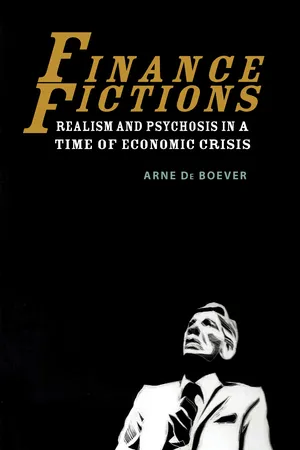
Finance Fictions takes the measure of what it means to live in a world ruled by high finance by examining the tension between psychosis and realism that plays out in the contemporary finance novel. When the things traded at the center of the economy cease to be things at all, but highly abstracted speculations, how do we come to see the real? What sorts of narrative can accurately approach the actual workings of a neoliberal economy marked by accelerating cycles of market crashes, economic and political crisis, and austerity?
Revisiting such twentieth-century classics of the genre as Tom Wolfe's Bonfire of the Vanities and Bret Easton Ellis's American Psycho, De Boever argues that the twenty-first century is witnessing the birth of a new kind of realistic novel that can make sense of complex financial instruments like collateralized debt obligations, credit default swaps, and digital algorithms operating at speeds faster than what human beings or computers can record. If in 1989 Wolfe could still urge novelists to work harder to "tame the billion-footed beast of reality," today's economic reality confronts us with a difference that is qualitative rather than quantitative: a new financial ontology requiring new modes of thinking and writing.
Mobilizing the philosophical thought of Quentin Meillassoux in the close reading of finance novels by Robert Harris, Michel Houellebecq, Ben Lerner and less well-known works of conceptual writing such as Mathew Timmons' Credit, Finance Fictions argues that realism is in for a speculative update if it wants to take on the contemporary economy—an "if" whose implications turn out to be deeply political. Part literary study and part philosophical inquiry, Finance Fictions seeks to contribute to a new mindset for creative and critical work on finance in the twenty-first century.
- 256 pages
- English
- ePUB (mobile friendly)
- Available on iOS & Android
eBook - ePub
About this book
Information
Publisher
Fordham University PressYear
2018Print ISBN
9780823279173
9780823279166
Edition
1eBook ISBN
9780823279180
ONE
Revisiting The Bonfire of the Vanities
Tom Wolfe’s Realisms
Although Tom Wolfe’s The Bonfire of the Vanities is now considered a classic finance novel, it actually has very little finance in it. At first sight, the financial part of the novel can be reduced to the chapter about the Giscard, a gold-backed bond that the novel’s protagonist, bondsman Sherman McCoy, is interested in.1 Some might say that such a focus on bonds (rather than stocks) already draws the supposed financial focus of the novel into question; certainly, the fact that the bond is gold-backed seems to throw Sherman back into a time before 1971, when (as I discuss in the introduction) the Nixon administration unilaterally abandoned the gold standard and the financial era took off. If “gold” calls up a certain referentiality—that is, the materiality of precious metal backing up the financial instrument of the bond—then Sherman’s interest in a gold-backed bond could be seen as a misguided and even comical attachment to “realism” at a time when the economy has abandoned it.
Indeed, much of the novel’s (nonfinancial) drama revolves around that problematic of realism, specifically around the question of what really happened to Sherman McCoy on that fateful night when, on his way back from JFK airport where he picked up his girlfriend Maria Ruskin, he ended up in the South Bronx and his car hit a young African American named Henry Lamb. In this case too, Sherman presents himself as a realist who struggles to steer clear from the various stories that the journalists and the politicians seek to spin about him. Wolfe continues the humor in this case as well: as I will discuss in detail later on, there is something comical about Sherman’s use of the Black Power salute at the end of the novel to mark his distance not only from Wall Street and Park Avenue where he used to live with his wife and daughter, but also from the various mediatic and political forces that risk to consume him.
In fact, we know from a manifesto that Wolfe published in 1989, two years after Bonfire came out, that realism was a central concern for Wolfe when he wrote his book. Titled “Stalking the Billion-Footed Beast,” the manifesto reveals that Bonfire was conceived not as a finance novel but as a big-city novel in which Wolfe sought to capture the entirety of New York City between the novel’s covers. However, the humor that Wolfe brings to Sherman’s attachment to realism—his misguided interest in a gold-backed bond; his absurd use of the Black Power salute—is absent from Wolfe’s own claim to realism. It’s not that “Stalking” is not funny; it has all the hallmarks of Wolfe’s other writing. But the humor is not directed at the project of realism itself. Instead, Wolfe defends the realism of what he calls “the new social novel,”2 arguing that novelists should engage in reporting and documentation if they want to capture a reality that, in its outrageousness—a Park Avenue man using the Black Panther salute—exceeds what we think of as realistic. The manifesto is a plea for novelists to bring the “billion-footed beast” of reality to terms in an era when creative writing traded in realism for postmodernism.
While Wolfe expresses admiration for certain antirealist experiments in writing, his manifesto reads like a spirited plea against the abandonment of realism and the rise of postmodernism—a plea that, even when considered only from the perspective of the historical account it offers, can be tied to the rise of finance. Indeed, Wolfe dates postmodernism’s take-over of reality in the early 1970s: that is when realism’s eclipse by postmodernism was pretty much complete.3 What’s interesting, of course, given that Bonfire was received as a finance novel, is that the early 1970s also mark the time when the gold standard is abolished, and finance takes off. Wolfe’s plea for a literary realism in this context could very well be tied to Sherman’s interest in the gold-backed bond; his interest in realism, in bringing the “billion-footed beast of reality” to terms,4 could very well be tied to Sherman’s insistence to tell what really happened in the Bronx. Those connections appear to be strengthened by the fact that when Bonfire was first published as serialized installments in Rolling Stone magazine, the story’s protagonist was not a bondsman but a writer, emphasizing the link between Sherman and Wolfe. However, none of the humor that is directed at Sherman’s realism appears to be directed at Wolfe’s; whereas Sherman’s realism is presented in Bonfire in the mode of satire, Wolfe’s realism takes the form of a manifesto. It is presented with so much conviction in fact that Michelle Chihara, in a recent review of two scholarly books about finance and literature, can refer to it as “big swinging dick realism,”5 thus characterizing Wolfe’s brand of realism with a moniker that was used on the Salomon Brothers trading floor (where some of the research for Wolfe’s novel was done). Chihara thus brings the satire of realism that pervades Wolfe’s novel to his manifesto and its bombastic program.
Given that Bonfire is considered not only a classic finance novel but a classic of financial realism, it seems odd that realism would appear to be a target of Bonfire’s satire. If anything, that would reveal Bonfire to have some affinity with the very postmodernism that Wolfe in his manifesto attacks (and Leigh Claire La Berge has pointed out that “there is something wonderfully postmodern about Wolfe’s project”6). On the other hand, if realism is the target of Wolfe’s “postmodern” satire, then it would also seem odd that the manifesto would defend it so seriously—that in the manifesto it would seem free from satire altogether. In this chapter, I will pursue the first point, namely the status of realism in Wolfe’s novel and in particular the novel’s postmodern aspects and how they are related to finance. While Wolfe’s manifesto will play a role in this, I will defer an in-depth engagement with the manifesto—and a serious pursuit of the limits of the manifesto that Chihara’s satire begins to expose—to chapter 4. My goal is to show that although Bonfire has become known as a classic work of financial realism, its central drama is ultimately one of psychosis that mobilizes the tension between realism and postmodernism, turning the novel’s realism into a higher-level aesthetic that is able to account for the very struggles in which it is caught up. In response to the psychotic situation it records, Bonfire’s project, then, is not to reassert reality; it is not to tell us what really happened to Sherman in the South Bronx. The novel’s realism seeks to give a realistic account of how that reality became caught up in its various representations, and it is that postmodern fracturing of reality that the novel’s realism captures.
This can be tied back to finance and to the realism of the gold standard: what Bonfire’s particular brand of realism accomplishes is not a return to the gold standard—a return that the shiny, gold-colored cover of my edition of the novel evokes; the novel looks like a brick of gold, not all that different from Kenneth Goldsmith’s work of conceptual writing, Capital (2015), which also seeks to write the totality of New York City and of course takes on realism in its experimentation.7 The novel’s project, rather, is a realistic representation of the various narratives that have been spun about gold. As I suggested in my introduction and will explore in more detail in chapter 2, that kind of realism is essential to the understanding of postmodern, psychotic finance and its relation to what I have characterized as the “immaterial” origins of money in debt and transferable credit. In other words, if Bonfire is a finance novel, it is not so much as an instance of “big swinging dick realism,” but as a peculiar postmodern take on realism that manages to turn the tension between realism and postmodernism into a key feature of finance.
Postmodern Realism
Bonfire chronicles the fall of the “fabled bondsman” Sherman McCoy, a self-dubbed “master of the universe.” This now famous phrase, which links Sherman’s work in finance to power and the cosmos, comes to Sherman “one fine day, in a fit of euphoria, after he had picked up the telephone and taken an order for zero-coupon bonds that had brought him a $50,000 commission, just like that.… On Wall Street he and a few others … had become precisely that … Masters of the Universe. There was … no limit whatsoever!”8 Resident of a multimillion dollar apartment on Park Avenue, and working in the bond-trading room at the investment-banking firm of Pierce and Pierce, Sherman wonders where “all of this astonishing new money [comes] from” (58)—and indeed, when asked at various points in the novel what he does for a living, he appears to have some difficulty explaining how it is that you can make money from bonds.
Pierce and Pierce’s executive officer, Eugene Lopwitz, offers this explanation: “In the Lopwitz analysis, they had Lyndon Johnson to thank. Ever so quietly, the U.S. had started printing money by the billions to finance the war in Vietnam. Before anyone, even Johnson, knew what was happening, a worldwide inflation had begun. Everyone woke up to it when the Arabs suddenly jacked up oil prices in the early 1970s. In no time, markets of all sorts became heaving crap-shoots: gold, silver, copper, currencies, bank certificates, corporate notes—even bonds” (58–59). The Democratic Johnson, who stepped in as president when John F. Kennedy was shot, would be succeeded by Republican Richard Nixon, whose decision to unilaterally abolish the gold standard immediately followed and intensified these developments. By the 1980s, when Bonfire is set, the “heaving crap-shoot” days of the early 1970s are over: “experienced salesmen such as [Sherman] were all at once much in demand” in a bond market that “had caught fire” (59). And whereas Sherman, when he was just starting out on Wall Street, “had enjoyed telling [his wife] Judy that while he worked on Wall Street, he was not of Wall Street and was only using Wall Street” (70), “this was a new era”: “This was a new Wall Street!” (71). And Sherman has very much become a part of it.9
However, what Sherman perceives as “mastery” (even though “he had never so much as whispered this phrase [‘Master of the Universe’] to a living soul” (11)) is about to collapse. His marriage to Judy will come apart because of his affair with the “ ‘foxy’ brunette” Maria Ruskin (502), wife of Arthur Ruskin, a Jew who has made a fortune chartering planes to fly Muslims to Mecca for the hadj. By the end of the novel, Arthur will be dead, and the “heiress of the Ruskin air-charter fortune” will be married to a young Italian painter she’s been seeing throughout the novel (683). In addition to these personal disasters—and probably partly in relation to them as well, as Sherman’s boss Lopwitz suggests—Pierce and Pierce’s top bondsman will lose several million dollars on a deal he has been working on involving a “gold-backed bond” (52), the Giscard. Whereas Sherman, at the beginning of the novel, confidently asserts that he has become a part of Wall Street, the novel will end with him insisting that he is not: “I have nothing to do with Wall Street and Park Avenue” (682), he tells reporters who are still following his case. If he can still think of himself as a master of the universe in the novel’s opening pages, he has become the universe’s excrement by the novel’s end—“an abject creature” (477), something closer to the actually existing masters of the universe: “a set of lurid, rapacious plastic dolls that his otherwise perfect daughter liked to play with” (11). No master but a toy.10
Sherman’s story is a classic tale of hubris, as one might read it in the newspapers. As such, any of its elements—the end of Sherman’s marriage, the end of his affair, his bonds deal gone sour—could probably have been overcome. However, it’s not these elements, or even their particular interplay, that do Sherman in: what kills him—or nearly kills him; what turns him into a creature—is an event that occurs early on in the novel, in a chapter titled “King of the Jungle.”11 In it, Sherman drives his black, two-seat sports roadster Mercedes to JFK Airport to pick up Maria. On their way back, the couple miss the off-ramp to Manhattan and end up in the Bronx. What happens then appears to be the following: finding their way back to the ramp to the expressway, they have to stop because something has been thrown “off the guardrail of the ramp” and is “lying in the road, blocking the way” (86). When Sherman gets out to remove it—it’s a wheel—he is approached by two young black men. One of them—the big one, Roland Auburn—asks if he needs some help; Sherman is nervous and suspects that the situation is a set-up (this appears to be confirmed by other versions of the story that are included in the novel later on). Meanwhile, Maria has taken the wheel of the car and is urging Sherman to get in. When they take off in a rush trying to get away from those whom they perceive to be their assailants, the car fishtails, hits the other young man—Henry Lamb—and knocks him over. Thanks to Sherman’s navigating, they ultimately manage to get out of the Bronx; but the memory of the situation they were in persists.
Sherman thinks they “ought to report this to the police” (92)—by reporting it, they will protect themselves against any follow-up. Maria disagrees: what would they tell the police? That “Mrs. Arthur Ruskin of Fifth Avenue and Mr. Sherman McCoy of Park Avenue happened to be having a nocturnal tête-à-tête when they missed the Manhattan off-ramp from the Triborough Bridge and got into a little scrape in the Bronx”? (94). “I’m gonna tell you what happened,” she tells Sherman. “I’m from South Carolina, and I’m gonna tell you in plain English. Two niggers tried to kill us, and we got away. Two niggers tried to kill us in the jungle, and we got outta the jungle, and we’re still breathing, and that’s that” (94). Sherman—master of the universe, and king of the jungle—heroically got himself and his girlfriend out of this mess. With that—with the explicit language and the metaphor of the jungle—the racial, and racist dimension of this event is foregrounded: it will also determine how the event will be spun by both the media and politics, and it will dominate Wolfe’s novel (and the criticisms it has received) as well.
As information—and most of the time, misinformation—about the event gets out, Sherman is construed as the face of evil, racist, upper-class white privilege, while Henry Lamb, the young man he hit, comes to stand in for good but poor and discriminated-against black people. Bonfire, which may start out as a finance novel, thus quickly becomes a novel about race and class in New York City. And with that, the phrase “master of the universe” that is launched in the opening pages of the novel to describe the influence of Wall Street begins to apply elsewhere—specifically in the realms of the media (fo...
Table of contents
- Cover
- Half Title
- Frontispiece
- Title Page
- Copyright
- Contents
- Epigraphs
- Introduction
- 1. Revisiting The Bonfire of the Vanities
- 2. Psychotic Realism in (American) Psycho
- 3. Financial Realism in The Fear Index
- 4. The Financial Universe (After Meillassoux)
- 5. Michel Houellebecq, Finance Novelist
- 6. Financing the Novel: Ben Lerner’s 10:04
- Conclusion
- Acknowledgments
- Notes
- Index
Trusted by 375,005 students
Access to over 1.5 million titles for a fair monthly price.
Study more efficiently using our study tools.
Frequently asked questions
Yes, you can cancel anytime from the Subscription tab in your account settings on the Perlego website. Your subscription will stay active until the end of your current billing period. Learn how to cancel your subscription
No, books cannot be downloaded as external files, such as PDFs, for use outside of Perlego. However, you can download books within the Perlego app for offline reading on mobile or tablet. Learn how to download books offline
Perlego offers two plans: Essential and Complete
- Essential is ideal for learners and professionals who enjoy exploring a wide range of subjects. Access the Essential Library with 800,000+ trusted titles and best-sellers across business, personal growth, and the humanities. Includes unlimited reading time and Standard Read Aloud voice.
- Complete: Perfect for advanced learners and researchers needing full, unrestricted access. Unlock 1.5M+ books across hundreds of subjects, including academic and specialized titles. The Complete Plan also includes advanced features like Premium Read Aloud and Research Assistant.
We are an online textbook subscription service, where you can get access to an entire online library for less than the price of a single book per month. With over 1.5 million books across 990+ topics, we’ve got you covered! Learn about our mission
Look out for the read-aloud symbol on your next book to see if you can listen to it. The read-aloud tool reads text aloud for you, highlighting the text as it is being read. You can pause it, speed it up and slow it down. Learn more about Read Aloud
Yes! You can use the Perlego app on both iOS and Android devices to read anytime, anywhere — even offline. Perfect for commutes or when you’re on the go.
Please note we cannot support devices running on iOS 13 and Android 7 or earlier. Learn more about using the app
Please note we cannot support devices running on iOS 13 and Android 7 or earlier. Learn more about using the app
Yes, you can access Finance Fictions by Arne De Boever in PDF and/or ePUB format, as well as other popular books in Literature & Modern Literary Criticism. We have over 1.5 million books available in our catalogue for you to explore.