Over the last few decades, vibrant debates regarding post-secularism have found inspiration and provocation in the works of Sigmund Freud. A new interest in the interconnection of psychoanalysis, religion and political theory has emerged, allowing Freud's illuminating examination of the religious and mystical practices in "Obsessive Neurosis and Religious Practices," and the exegesis of the origins of ethics in religion in Totem and Taboo, to gain currency in recent debates on modernity. In that context, the pivotal role of Freud's masterpiece, Moses and Monotheism, is widely recognized.
Freud and Monotheism brings together fundamental new contributions to discourses on Freud and Moses, as well as new research at the intersections of theology, political theory, and history in Freud's psychoanalytic work. Highlighting the broad impact of Moses and Monotheism across the humanities, the contributors hail from such diverse disciplines as philosophy, comparative literature, cultural studies, German studies, Jewish studies and psychoanalysis.
Jan Assmann and Richard Bernstein, whose books pioneered the earlier debate that initiated the Freud and Moses discourse, seize the opportunity to revisit and revise their groundbreaking work. Gabriele Schwab, Gilad Sharvit, Karen Feldman, and Yael Segalovitz engage with the idiosyncratic, eccentric and fertile nature of the book as a Sp?tstil, and explore radical interpretations of Freud's literary practice, theory of religion and therapeutic practice. Ronald Hendel offers an alternative history for the Mosaic discourse within the biblical text, Catherine Malabou reconnects Freud's theory of psychic phylogenesis in Moses and Monotheism to new findings in modern biology and Willi Goetschel relocates Freud in the tradition of works on history that begins with Heine, while Joel Whitebook offers important criticisms of Freud's main argument about the advance in intellectuality that Freud attributes to Judaism.
eBook - ePub
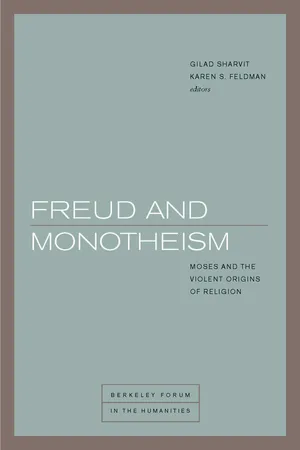
Freud and Monotheism
Moses and the Violent Origins of Religion
- 208 pages
- English
- ePUB (mobile friendly)
- Available on iOS & Android
eBook - ePub
Freud and Monotheism
Moses and the Violent Origins of Religion
About this book
Information
Publisher
Fordham University PressYear
2018Print ISBN
9780823280032
9780823280025
Edition
1eBook ISBN
9780823280049
Table of contents
- Cover
- Title Page
- Copyright Page
- Contents
- Introduction
- 1. “Why [the Jews] Have Attracted This Undying Hatred”
- 2. Geistigkeit: A Problematic Concept
- 3. Heine and Freud: Deferred Action and the Concept of History
- 4. Freud’s Moses: Murder, Exile, and the Question of Belonging
- 5. A Leap of Faith into Moses: Freud’s Invitation to Evenly Suspended Attention
- 6. Freud, Sellin, and the Murder of Moses
- 7. Creating the Jews: Mosaic Discourse in Freud and Hosea
- 8. Is Psychic Phylogenesis Only a Phantasy? New Biological Developments in Trauma Inheritance
- 9. Moses and the Burning Bush: Leadership and Potentiality in the Bible
- List of Contributors
- Index
Trusted by 375,005 students
Access to over 1.5 million titles for a fair monthly price.
Study more efficiently using our study tools.
Frequently asked questions
Yes, you can cancel anytime from the Subscription tab in your account settings on the Perlego website. Your subscription will stay active until the end of your current billing period. Learn how to cancel your subscription
No, books cannot be downloaded as external files, such as PDFs, for use outside of Perlego. However, you can download books within the Perlego app for offline reading on mobile or tablet. Learn how to download books offline
Perlego offers two plans: Essential and Complete
- Essential is ideal for learners and professionals who enjoy exploring a wide range of subjects. Access the Essential Library with 800,000+ trusted titles and best-sellers across business, personal growth, and the humanities. Includes unlimited reading time and Standard Read Aloud voice.
- Complete: Perfect for advanced learners and researchers needing full, unrestricted access. Unlock 1.5M+ books across hundreds of subjects, including academic and specialized titles. The Complete Plan also includes advanced features like Premium Read Aloud and Research Assistant.
We are an online textbook subscription service, where you can get access to an entire online library for less than the price of a single book per month. With over 1.5 million books across 990+ topics, we’ve got you covered! Learn about our mission
Look out for the read-aloud symbol on your next book to see if you can listen to it. The read-aloud tool reads text aloud for you, highlighting the text as it is being read. You can pause it, speed it up and slow it down. Learn more about Read Aloud
Yes! You can use the Perlego app on both iOS and Android devices to read anytime, anywhere — even offline. Perfect for commutes or when you’re on the go.
Please note we cannot support devices running on iOS 13 and Android 7 or earlier. Learn more about using the app
Please note we cannot support devices running on iOS 13 and Android 7 or earlier. Learn more about using the app
Yes, you can access Freud and Monotheism by Gilad Sharvit, Karen S. Feldman, Gilad Sharvit,Karen S. Feldman in PDF and/or ePUB format, as well as other popular books in Psychology & Literary Criticism Theory. We have over 1.5 million books available in our catalogue for you to explore.