Many military tactics during World War II were based on the assumption that new technologies would lead to decisive battlefield victories, demoralization of the enemy by intensive bombing, or even a quick surrender. Political and military leaders, Allies and Axis alike, believed that "blitzkrieg" was the best way to victory. But in The Blitzkrieg Myth, John Mosier argues that this was not the case.
Mosier examines the major European campaigns, including Germany's invasion of Poland in the fall of 1939 and the fall of France in 1940, and demonstrates that they were, in fact, not blitzkrieg victories. Mosier asserts that new technologies clashed with the realities of conventional military tactics, and battle outcomes often depended on traditional warfare, in this bold reassessment of the military history of World War II. John Mosier is the author of The Myth of the Great War. He is a professor of English at Loyola University in New Orleans. His background as a military historian dates from his role in developing an interdisciplinary curriculum for the study of the two World Wars, a program funded by the National Endowment for the Humanities. From 1989 to 1992, he edited the New Orleans Review. "Should be valued as essential reading on the great conflict." — Washington Times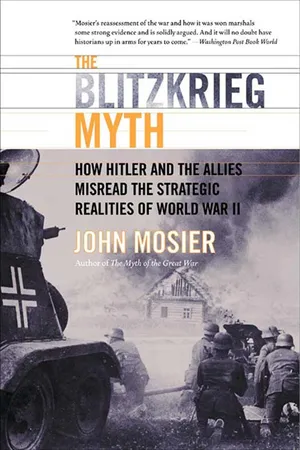
eBook - ePub
The Blitzkrieg Myth
How Hitler and the Allies Misread the Strategic Realities of World War II
- 352 pages
- English
- ePUB (mobile friendly)
- Available on iOS & Android
eBook - ePub
The Blitzkrieg Myth
How Hitler and the Allies Misread the Strategic Realities of World War II
About this book
Information
Topic
HistoireSubtopic
Première Guerre mondialeChapter 1 - War as Pseudoscience: 1920–1939
Nothing is more dangerous in war than theoreticians.
—MARSHAL PéTAIN1
—MARSHAL PéTAIN1
The Second World War was the complete opposite of the First. In the latter, Allied propagandists had been free to weave their fables, unchecked and unquestioned. The result was a highly consistent series of myths that foundered not because of any real internal inconsistencies but because they were based on a series of palpable untruths, facts about relative losses of men and territory that could ultimately be verified or proved false.
This was not possible in the Second World War, in which, from the very first, many of the claims of the combatants were subject to verification. Americans listening to William Shirer’s censored broadcasts from Berlin in 1939–40 received a surprisingly coherent and in many respects truthful account of what was happening—even under the worst censorship it far exceeded what had been available in 1914–15. Moreover there were men in Great Britain who had bitter memories of how their government had managed the truth. When, in 1940, the government attempted to lay all the blame for the collapse on the hapless Belgians, Adm. Sir Roger Keyes stood up in the House and exposed the government’s efforts for what they were—an attempt to find a scapegoat to cover up its own ineptitude. Like all slanders, bits and pieces of this one stuck, but the myth of how Belgium betrayed the Allied cause and brought it to ruin was quickly shattered.
It was precisely the lack of any central coherent myth to recast the narrative of World War II that made all the various accounts so full of internal contradictions and anomalies. It was easy to see that, but the very incoherence of the narrative of the war made it difficult to piece together what had actually happened.
The explanation is that military theory between the wars was dominated by the work of airpower enthusiasts and apostles of armored warfare. In both cases and in every country, the theoreticians resorted to rewriting the history of the Great War to vindicate their theories about how wars should be fought. When the Second World War actually broke out on September 1, 1939, both the military theorists and the propagandists of the combatants produced converging explanations of what had happened.
The invasion of Poland provides a perfect example. Hitler’s propagandists were eager to portray the Polish offensive as a terrifying German military triumph that glorified not only the achievements of the Luftwaffe, which from the first had been regarded as the most National Socialist of the services, but would glorify those achievements in such a way as to cower everyone else into submission.
The airpower enthusiasts and armored apostles were only too delighted to shape the Polish campaign so that it justified their emphasis on armor and airplanes. To the followers of Giulio Douhet (and to the airmen in the United States and Great Britain who hit on these same ideas independently) the Polish campaign was proof positive that the side that lost command of the air would be quickly destroyed—from the air. The misleading and simplistic belief that Warsaw was destroyed by the Luftwaffe was thus turned into a great symbol with all sorts of layers: on one level it represented the barbarism of Hitler’s ideas, on another it served as a sort of dissuasive bogeyman for timid Frenchmen and Englishmen. And on still another level it supported the arguments that more money needed to be spent on airplanes instead of other areas of national defense.
Since Poland had even fewer tanks than it had planes, much the same process occurred. The German successes, insofar as they were not exclusively caused by airplanes, were attributed to the fact (in reality not particularly true) that they deployed tanks en masse, organized as armored divisions. An army with no armored divisions was helpless in the face of this onslaught.
However, the primary reasons for Poland’s defeat were strategic, not tactical. When Erich von Manstein dissected the causes of Poland’s defeat, his concluding sentence was that “Poland’s defeat was the inevitable outcome of the Warsaw government’s illusions about the actions its allies would take, as well as of its over-estimation of the Polish Army’s ability to offer lengthy resistance.”2 As we shall see, even this oversimplifies the situation considerably, but then Manstein, a keen supporter of Hitler, forbore to do more than briefly mention Poland’s other strategic difficulties.3
The point is not to deny the importance either of technology or tactics on the battlefield, but simply to say that the fundamental error lies in elevating those two components above all other concerns. The Polish government believed, with justification, that it had a guarantee from both France and England to begin offensive operations against Germany if that country attacked Poland. If Poland’s army could hold out for two weeks, the Allied attack would force Germany to reallocate its army and air force to the defense of its own territory. That these agreements were actually made, and were not simply some illusion on the part of the Polish government, is incontrovertible. So is the fact that on September 14, 1939, Poland still had substantial armies in the field and was in control of a surprisingly large amount of its national territory. So although tactics and technology played an important part in the defeat, they were by no means the primary causes. In a war that pitched its army against Germany’s and the Soviet Union’s, Poland would have lost, whether the Germans deployed tanks and airplanes or not.
The Blitzkrieg as an Idea Both True and False
As the Germans occupied northern France and what we now call Benelux, demolished Yugoslavia and then Greece, and routed the Soviet armies in the summer of 1941, Allied analysts insisted that the cause was simple. The Germans were using a radically new kind of warfare, for which the vague and mystical word Blitzkrieg was simply a convenient shorthand.
To demystify the concept, and for want of a better term, we can speak of this new idea as that of the breakthrough, a term that in the military sense was probably first defined by the U.S. Army to denote a penetration through the depth of the defensive position, a penetration that theorists like J. F. C. Fuller had argued was only possible using masses of tanks operating under an aerial umbrella which involved command of the air.
During the Second World War, both sides pursued the idea of the breakthrough. An almost blind adherence to the concept, coupled with a refusal to examine the mounting contrary evidence, bedeviled Allied strategy from the North African landings on through the end of the war. It explains both why a prudent and experienced general like Montgomery would mount disastrous offensives like Goodwood in July and Market-Garden in September 1944 and why official U.S. Army doctrine was that tanks would not actually fight enemy tanks (and thus there was no need for a high-velocity main gun capable of destroying the enemy’s main battle tank with one shot).
I have used the term blind adherence because, at the highest levels, it certainly seems to be a fair characterization. Neither the armored apostles nor the airpower enthusiasts modified their views as a result of the experiences of the war. In this they were quite like Hitler, who—if we are to believe Manstein—failed to learn from Poland’s strategic failures and apply the lessons to German defensive operations.4 Instead Hitler would demand that his beleaguered troops go over to the offensive. In August 1944 they were to cut through the hinge between the British and American forces and destroy them; in December 1944 they were to do the same thing only on a grander scale, aiming at Antwerp. Whatever chance Hitler had of fighting the war to a stalemate of any sort died in those two offensive operations.
But Hitler was hardly the only major figure in the war to ignore the facts of the situation. Despite the horrific losses of German airborne units in their assaults on the Netherlands and Crete, the Allies repeated the same mistake, operating under the mistaken belief that airborne deployments would make the breakthrough an accomplished fact. But this was to be a war in which hardly anyone seemed to have learned anything at all. Senior British and American air force leaders were still insisting that bomber offensives could win the war outright as late as the summer of 1944. And as late as December 1944, American experts were still refusing to equip American tanks with a high-velocity gun, despite the fact that the Germans and the Russians had been deploying such weapons for several years.
Perhaps more troubling, senior commanders were judged not on the traditional basis for success—low casualties and high achievements—but on the extent to which they were willing and able to carry out these ambitious deep penetrations that had been determined to be the only successful way to conduct operations on the battlefield. Indeed, the vastly inflated reputations of both Patton and Rommel are almost totally a function of their successes in directing such operations.
Doubtless some readers will be delighted to hear the achievements of Rommel and Patton questioned, others will be simply surprised, and a few will be distressed. The purpose here is not a reevaluation of their careers but to suggest how our perceptions have been so decisively shaped by the blind acceptance of the breakthrough theory of military operations. Both men were first-rate commanders whose abilities had already been established, albeit at lower levels, on the battlefields of the Great War. Their fame in the next one, however, is more a function of the need to have great leaders whose ideas fit the current paradigm than of their actual achievements.
This mention of personalities suggests, however, the importance of the idea, as it allows us to see in a much different light the notorious conflicts that plagued the Allies. As is well known, there were serious divisions in the Allied command: disagreements based on national rivalries (British versus American), disagreements based on interservice rivalries (air force versus army), and disagreements based on personalities (Eisenhower and Montgomery). These personality problems have proved a vast and fruitful area for biographers, and as biographers have produced some of the most readable and serious work in recent military history, there is an almost inevitable tendency to see things through the prism of personality.
But the basic Allied conflict in the fall of 1944 was not primarily a function of personality clashes or national or service rivalries. Montgomery, no less than Patton or Bradley or Harris or Spaatz, was entirely dominated by the desire to defeat Germany. The real conflict was between Eisenhower (supported by his immediate superior, Marshall) and the senior Allied commanders, who, regardless of their nationality or branch of service, were convinced that the only proper way to win the war was to throw all the Allied resources into one powerful offensive operation. “Let us assemble a powerful force of forty or fifty divisions and strike into the heart of Germany,” Montgomery pleaded.5 The problem, of course, was that Churchill, Bradley, and Patton all had similarly convincing proposals, and the bomber barons, the commanders of the American and British strategic air forces, had their own ideas.
The received wisdom on this issue often seems to parallel Montgomery’s frustrations: Rather than making a decision in favor of option A, B, or C, Eisenhower simply let every option be exercised. The consequent weakening of the Allied efforts through dispersion made an extension of the war into 1945 inevitable.
But Eisenhower had a great advantage as a senior commander of a great coalition: He had never been in combat; he had never held any meaningful battlefield command. His military experience in the U.S. Army had been exclusively that of a staff officer, and one whose duties were mostly concerned with the higher levels of strategic planning. His appreciation of how to fight the war, therefore, was far removed from the actual battlefield.
In fact, his plan of 1944, usually called the “broad front” strategy, was pretty much the same plan that the Germans had used in September 1939, May 1940, and June 1941: a massive attack on a broad front that simply overwhelmed the enemy’s defenses. Given superiority in resources, the great advantage to this approach was that it had worked before.
The problem with what was being proposed by the advocates of the breakthrough approach was that their ideas couldn’t possibly work. Patton and Bradley wanted to attack up into the Saar, and Montgomery wanted to attack into the Ruhr. Subsequently all three—and their many defenders and apologists—marshaled impressive evidence to demonstrate that if only this had been done, the war would have been over in a few short months.
The problem is that in each case the operation was mounted, and in each case it failed. It is customary to say that it failed because of a lack of resources caused by Eisenhower’s unwillingness to support the most sensible plan. Thus Montgomery wasn’t given enough troops to make his breakthrough operations successful, and Patton wasn’t given enough gasoline for his. What this overlooks is the fact that the Germans, despite Hitler, were very adept at switching their forces around to counter Allied moves. In effect the more resources the Allies threw into any one operation, the more resources the Germans switched over to counter that attack. Claims that any one offensive, conducted with overwhelming force, would have been successful, are thus fatally flawed. They all ignore the most obvious counter: The Germans ...
Table of contents
- Cover
- Title Page
- Epigraph
- Contents
- Introduction: New Theories of Warfare
- Chapter 1 - War as Pseudoscience: 1920–1939
- Chapter 2 - The Maginot Line and Hitler’s Response
- Chapter 3 - The Tank Production Myths
- Chapter 4 - Lessons Mislearned: Poland and the Winter Wars
- Chapter 5 - The Germans and the Allies Prepare for War
- Chapter 6 - The German Assault and the Fall of France: May–June 1940
- Chapter 7 - The Uses and Misuses of Armor: North Africa, Italy, the Eastern Front
- Chapter 8 - The Failure of Strategic Airpower: 1940–1944
- Chapter 9 - Normandy and the Breakout at Saint-Lô: Summer 1944
- Chapter 10 - The Breakthrough Failures: Arnhem, Metz, Bastogne
- Chapter 11 - Conclusion: The Persistence of Failed Ideas
- Appendix: Researching the War
- Index
- Acknowledgments
- About the Author
- Also by John Mosier
- Copyright
- About the Publisher
Trusted by 375,005 students
Access to over 1.5 million titles for a fair monthly price.
Study more efficiently using our study tools.
Frequently asked questions
Yes, you can cancel anytime from the Subscription tab in your account settings on the Perlego website. Your subscription will stay active until the end of your current billing period. Learn how to cancel your subscription
No, books cannot be downloaded as external files, such as PDFs, for use outside of Perlego. However, you can download books within the Perlego app for offline reading on mobile or tablet. Learn how to download books offline
Perlego offers two plans: Essential and Complete
- Essential is ideal for learners and professionals who enjoy exploring a wide range of subjects. Access the Essential Library with 800,000+ trusted titles and best-sellers across business, personal growth, and the humanities. Includes unlimited reading time and Standard Read Aloud voice.
- Complete: Perfect for advanced learners and researchers needing full, unrestricted access. Unlock 1.5M+ books across hundreds of subjects, including academic and specialized titles. The Complete Plan also includes advanced features like Premium Read Aloud and Research Assistant.
We are an online textbook subscription service, where you can get access to an entire online library for less than the price of a single book per month. With over 1.5 million books across 990+ topics, we’ve got you covered! Learn about our mission
Look out for the read-aloud symbol on your next book to see if you can listen to it. The read-aloud tool reads text aloud for you, highlighting the text as it is being read. You can pause it, speed it up and slow it down. Learn more about Read Aloud
Yes! You can use the Perlego app on both iOS and Android devices to read anytime, anywhere — even offline. Perfect for commutes or when you’re on the go.
Please note we cannot support devices running on iOS 13 and Android 7 or earlier. Learn more about using the app
Please note we cannot support devices running on iOS 13 and Android 7 or earlier. Learn more about using the app
Yes, you can access The Blitzkrieg Myth by John Mosier in PDF and/or ePUB format, as well as other popular books in Histoire & Première Guerre mondiale. We have over 1.5 million books available in our catalogue for you to explore.