![]()
THE
Core
![]()
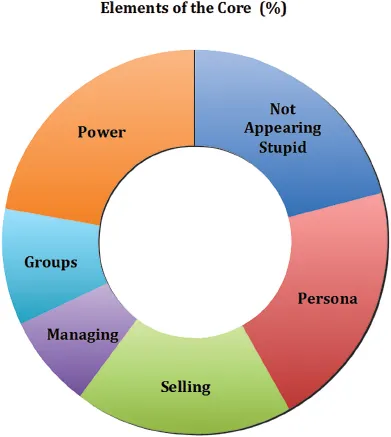
The Core Curriculum establishes a common language and foundation upon which a real-world business career can be mounted. Courses include:
101: Not Appearing Stupid
102: Fabricating a Business Personality
103: Selling, Marketing, and Negotiating
104: Managing
105: Group Interaction
106: Fundaments of Power
While the core is not in itself sufficient for mastery in the business arts, it must be completed before more sophisticated development is possible. Those who ignore the core and proceed directly to the helter-skelter world of daily business are essentially in the same position as monkeys given the assignment to type on a keyboard until they achieve Hamlet. There’s always a chance it may work out well, but if it does it will be by accident, and only after an unacceptable length of time.
All elements in the Core are of virtually equal importance, although the role of both management of others and group interaction is somewhat less critical to the armature of the whole. We begin with a first step that may seem simple but in fact makes all other steps possible. A trip on the way out of the starting gate has disqualified more than one runner on his or her way to glory.
![]()
COURSE 101: Not Appearing StupidThe workplace is accepting of all kinds of people, but not those who appear to be stupid. Looking stupid is almost always an impediment to success, and in certain fields it is a virtual roadblock. In this, the first layer of the Core, we will examine the implications of looking stupid and develop a clear strategy to avoid it.
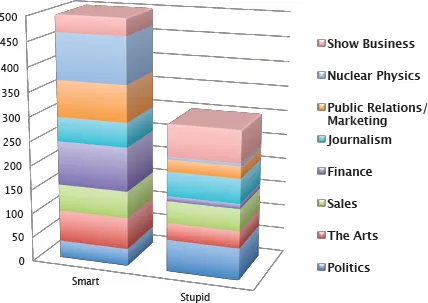
First, let’s look at how the appearance of being stupid can affect your chance of success. The following chart, based on proprietary data from a number of credible sources, illustrates dramatically how the appearance of stupidity has an impact on how one does in one’s chosen field. Each color bar represents the “chance of success” a man or woman may possess while demonstrating intelligence or the demonstrable lack of it. What is clear is that in all cases, the appearance of intelligence is an asset, and the inverse not so much.
Chance of Success
Notes, working vertically downward in the bar:
• In show business, perhaps more than any other field (shown in the pink bar at the top of the stack), the appearance of stupidity may not only be more readily accepted (most clearly among the beautiful) but may in fact build one’s chance of advancement, particularly if the appearance of stupidity is married to an aggressive, obnoxious personality;
• The appearance of stupidity all but wipes out the chance of success in nuclear physics (in light blue) but does not eradicate it entirely, thanks to the popularity of various nonsensical flavors of string theory;
• Interesting recent developments seem to indicate that the appearance of intelligence is more important in the field of public relations (burnt umber) than it is in journalism (aqua), thanks to advances made possible by the Internet;
• In finance, sales, and the arts, stupidity is a definite undesirable, although perhaps less so in sales, where enough people are drunk after noon to obscure the issue;
• In politics, the appearance of stupidity actually proves to be an asset in a measurable number of cases.
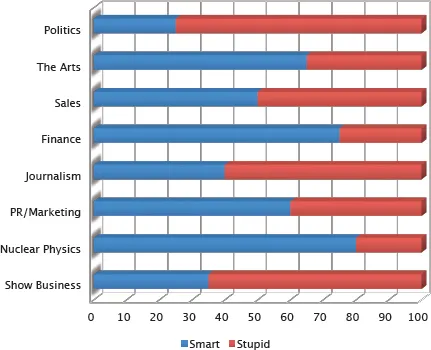
The punishment or reward for visible stupidity helps to shape the makeup of each of the professions examined above. This concept emerges quite clearly when the same data employed above is expressed as a function of profession. Here, in the first such review of its type, is a general breakdown of the mix between apparently stupid people and demonstrably smart people in these same businesses and vocations:
Smart vs. Stupid: Key Professions
Some interesting themes develop here. At the top, the impact on our political system is clearly evident from the makeup of those who have no problem evincing considerable stupidity. On the other hand, in the field of nuclear physics only the most evolved eggheads can abandon rational thought altogether and secure a spot on a PBS documentary. The remainder of practitioners must look smart, albeit not socially. The percentages in show business are somewhat skewed by the presence in the sample of talent agents.
The most important conclusion we reach from this data is that those who wish to succeed in the higher levels of business life—generally occupied by those in ultra-senior management as well as the upper regions of finance, sales, and communications (PR/marketing)—must appear to be the least stupid. While they most often are not smarter than anybody else, those who prosper and advance under the big tent are clearly more adept at appearing not stupid than the rest of us, not only in everyday life but, perhaps more important, in crucial business situations as well.
The punishment for the appearance of stupidity is immediate and irrevocable, and can undo a life of appearing relatively sentient. Some examples for further study:
• Marc Antony: Fabulous soldier, great orator, sexiest man alive circa 50 BC. Falls in love with Cleopatra, who then leads him around by his phallus for the rest of his life. At the Battle of Actium, he spends most of the engagement out of harm’s way on Cleopatra’s barge, looking stupid.
• Martha Stewart, one of the smartest and most aggressive self-marketers in history, with a fortune of her own and a multimillion-dollar empire built on selling her sagacity and taste, fiddles around with a small investment and is nabbed for it by the feds. Cornered, she fails to listen to her most loyal and intelligent advisors, hires new advisors who are stupid, and then tries to lie her way out of the situation and ends up going to jail. A stupid story all the way around, all the more stupid because it appears so stupid.
• And let’s not even talk about what the obviously most stupid merger in history, that of Time Warner with AOL, did to the reputations of everybody involved, but probably most disastrously to arguably one of the smartest men in media, Gerald Levin.
Ironically, the most harm comes to the most intelligent people when they do stupid things. Most recently, that phenomenon—people who are so smart they’re effectively stupid—was widespread among the group of pseudoscientists in the field of economics, where stupidity seems to be conferred on the formerly intelligent along with the diploma.
It’s difficult to appear nonstupid in the world of business. There are for certain many, many challenges, roadblocks, and disincentives along the way, including:
Too Many Topics: How can one appear informed, acute, and prepared to opine on the wide variety of subjects that arise in a business day?
Strategic and tactical conundrums
Menu selections in the presence of highly opinionated oenophiles and gustatory hedonists
Unplanned and unforeseen subjects that pop up with regularity—perhaps the most frightening eventuality of all, particularly in the tech sector, where the crazy blizzard of buzzwords, fancies, rumors, and blather associated with the constant, roiling sea of trends is all but insurmountable.
Too Many Agendas: The plethora of those more senior than you who utter stupid things to which you might be forced to give the appearance of agreement;
Not Enough Knowledge: Then there’s your own lack of training in the art of expressing yourself in an on-point and cogent way even when you have nothing to say and no means of expressing it.
This last issue—how to not get caught being stupid in all contexts—is what we now intend to address.
Mastering the Elements of Nonstupid Discourse
Fortunately, one does not have to be a genius to grasp and then successfully employ the tenets of excellent business discourse both written and verbal. A smattering of knowledge and the ability to exude confidence is key. Simple fundamentals and a battery of practice should help any student attain skills in this area that are completely appropriate in virtually any business context.
Here are the makings of the crucial foundation upon which the appearance of nonstupidity may be built:
A. Reading and writing basic business English. Further discussion on e-mail and texting technique is provided in later chapters in this Curriculum, but the basics of decent business writing, analog and digital, are relatively simple. Master these very few rules and you will distinguish yourself as, quite literally, among the 5 percent who don’t appear to be stupid when required to commit a thought to paper:
1. Say what you mean. Don’t be afraid to do so, within reason. Of course, “what you mean” may, in fact, be a reiteration of what someone else means, that is up to you, but don’t make people read a bunch of gibberish to finally ascertain what you intend to communicate. Possible “what you mean” statements include:
a. “I agree with Lenny.”
b. “I don’t agree with Lenny.”
c. “Okay by me.”
d. “There are three reasons I don’t like this. It’s against policy. It will annoy Mr. Roover. It will be hard to accomplish. Let’s talk about this in person.”
The thing that distinguishes all these utterances is that 1) they are clear, 2) they are in declarative form, and 3) you don’t have to be a genius to get it. Tha...