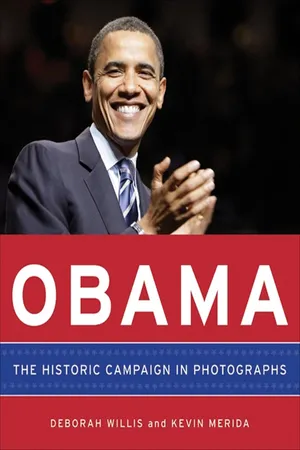
Through 150 striking color photographs, Obama: The Historic Campaign in Photographs charts the road to Barack Obama's nomination as the first African American to lead the presidential ticket of a major party. Announcing his campaign in Springfield, Illinois, on February 10, 2007, Obama stood on the grounds of the Old State Capitol, where Abraham Lincoln delivered his famous "House Divided" speech against slavery in 1858. During an eighteen-month campaign, from the snows of Iowa to the hunt for Democratic "superdelegates," this junior senator from Chicago confounded the party establishment and rewrote the playbook on modern presidential campaigning. This amazing collection of photographs captures the public and private moments of his journey, and offers a unique window into one of the great triumphs in American politics.
- 160 pages
- English
- ePUB (mobile friendly)
- Available on iOS & Android
eBook - ePub
About this book
Information
Portraits of candidates and candid shots of their supporters and detractors have traditionally comprised nineteenth-and twentieth-century photography of presidential campaigns. Through the years, political photography has been used for a variety of purposes—from documenting a candidate’s appeal by showcasing him or her amidst sizable crowds to highlighting their of-the-people appeal through pictures of them eating at mom-and-pop diners or holding babies. We also come to think of family portraits or childhood photos as ways of humanizing those who aspire to lead the free world. These kinds of images can be found in Obama: The Historic Campaign in Photographs and then some. Yet this collection also shows images of elements unique to Obama’s historic campaign: teeming crowds more notably multiracial than any other campaign’s in recent memory, the appeal to and inclusion of youth in the candidate’s successful bid for the Democratic Party nomination, and the candidate’s use of technology to build support, whether it be a photograph of Obama on a BlackBerry or an image of a campaign staffer who knew particularly well the power of the Internet.
Through 150 photographs, Obama: The Historic Campaign in Photographs highlights the road to Barack Obama’s groundbreaking nomination as the first black American to lead the presidential ticket of a major party. The images are politically contextualized by the Washington Post’s Kevin Merida, who covered the campaign for the paper. His essay charts Obama’s road to the nomination and places his achievement in the historical context of African American political advancement.
Photography has played a significant role in framing Obama, both as an icon and as a subject of curiosity. This unique collection documents the public and private moments of his campaign and includes photographs by professional photojournalists and portrait photographers as well as by volunteers, rallygoers, and young supporters who used their cell phones and video or digital cameras to capture his image. As a photohistorian, I decided to include images from amateur photographers because Obama’s ability to connect with people of all ages and classes and their desire to preserve his likeness for posterity is essential to the story of his nomination. Their desire to cheer for him, to listen to his every word, to lionize and accord him respect as if he’s already president, is palpable. As is traditional with presidential photography, whether he’s being photographed by a professional or an amateur, the images, at times, look almost biblical. This is not a new trend. As indicated in Lonnie G. Bunch’s The American Presidency: A Glorious Burden: “Presidents inhabit our collective memory in part because of an astonishing array of media. Portraits, photographs, film, television, folk songs, Broadway musicals, advertisements, and souvenirs have all served to celebrate, criticize, satirize, sell, legitimize, exploit, praise, and memorialize the holder of this office.”
I researched thousands of images—from picture agencies, individual photographers, and families who attended parties and campaign events. Many have a spirit of optimism and joy. Public interest in this book was encouraging as more and more photographs were given to me. Many people shared stories about the day they saw him or met him; one story was particularly memorable: Elise Jones Martin. Her son, Montez Martin, sent me a note and a photograph taken during Obama’s visit to South Carolina and enthusiastically gave me permission to use it in this book; Merida discusses it as well (see Begin Reading).
Rather than chronologically following the campaign from the initial announcement, the photographs are grouped thematically based on the subject, from intimate and personal shots of Barack Obama with his family to pictures of the candidate speaking to large crowds in grand public spaces. The book then moves on to images that show how Barack Obama is perceived as an iconic figure who is suspect, praised, and admired. Others show people using popular and material culture, including symbolic trinkets, mementos, T-shirts, and small gifts, such as JFK campaign buttons, a wristband honoring a deceased soldier, commemorative coins, and an Obama necklace made from pieces of a Scrabble game, to express their trust in the candidate. These collectibles reveal “much about changing notions of how a president can or should be remembered,” as described in The American Presidency: A Glorious Burden.

Annie Leibovitz catches Obama in a contemplative pose, relaxed but in reflection, during a Men’s Vogue photography session.
Barack Obama in his Chicago home office. © Annie Leibovitz/Contact Press Images, originally photographed for Men’s Vogue
Barack Obama in his Chicago home office. © Annie Leibovitz/Contact Press Images, originally photographed for Men’s Vogue
Photographers have documented Obama in various candid poses, from talking to one of his daughters on a cell phone or buying a kaleidoscope for his children in a tourist gift shop to imposing and striking portraits of a leader standing high on a flag-draped platform, a handsome, dapperly dressed man who exudes high moral character or the everyman wearing a white shirt with and without a tie. Photographs of the Obama family waving to crowds or with the Kennedys, the Clintons, Oprah Winfrey, and other celebrities and anonymous families are interspersed throughout the book as well as photographs of political leaders and rivals, religious figures, educators, and young children whose faces and bodies are decorated with the Obama logo. There are also photographs of broadcast news coverage of the debates as well as on-camera images before and after press conferences. These documentary photographs transfer inspirational messages from Obama’s campaign to the American Public.
Michelle Obama—wife, mother, and executive administrator—appears smartly dressed and fashionably aware whether in evening attire or everyday dress. She is shown in this book expressing love and respect with humor and support. Hugging her husband with her arms around his back, she exemplifies beauty, strength, and encouragement in one of the series of “fist bump” images that reveal a sense of camaraderie between the two. Viewed outside the stereotypes presented in some broadcast and print news stories, Michelle Obama’s photographs reveal that she is a highly poised woman who is prepared to take on the duties of First Lady.
Obama: The Historic Campaign in Photographs offers us a moment to pause and consider this campaign, one that instilled a sense of hope, joy, and dignity in unexpected places. The viewer will find ironic and iconic images that will shape the understanding of this landmark political season. The book also helps us understand how image and text are used in presidential campaigns. One revealing slogan shared the podium with Obama at a rally: built to Last.
Since the beginning of photographic history, photographs of presidential campaigns have had a special connection to the viewer. They can be viewed as evidence of a unique moment in the viewer’s history. This book shows us a unique moment in our national history. More, these images show not only the range of his supporters and how support escalated but also how photography was instrumental in galvanizing the public.
The broad array of images is transformative, as they express beauty, pathos, poignancy, emotion, and euphoria about the man Barack Obama and the presidential campaign.
About the Author
Named one of the 100 most Important People in Photography by American Pho...
Table of contents
- Cover
- Title Page
- Dedication
- Contents
- Begin Reading
- Acknowledgments
- About the Authors
- Credits
- Copyright
- About the Publisher
Trusted by 375,005 students
Access to over 1.5 million titles for a fair monthly price.
Study more efficiently using our study tools.
Frequently asked questions
Yes, you can cancel anytime from the Subscription tab in your account settings on the Perlego website. Your subscription will stay active until the end of your current billing period. Learn how to cancel your subscription
No, books cannot be downloaded as external files, such as PDFs, for use outside of Perlego. However, you can download books within the Perlego app for offline reading on mobile or tablet. Learn how to download books offline
Perlego offers two plans: Essential and Complete
- Essential is ideal for learners and professionals who enjoy exploring a wide range of subjects. Access the Essential Library with 800,000+ trusted titles and best-sellers across business, personal growth, and the humanities. Includes unlimited reading time and Standard Read Aloud voice.
- Complete: Perfect for advanced learners and researchers needing full, unrestricted access. Unlock 1.5M+ books across hundreds of subjects, including academic and specialized titles. The Complete Plan also includes advanced features like Premium Read Aloud and Research Assistant.
We are an online textbook subscription service, where you can get access to an entire online library for less than the price of a single book per month. With over 1.5 million books across 990+ topics, we’ve got you covered! Learn about our mission
Look out for the read-aloud symbol on your next book to see if you can listen to it. The read-aloud tool reads text aloud for you, highlighting the text as it is being read. You can pause it, speed it up and slow it down. Learn more about Read Aloud
Yes! You can use the Perlego app on both iOS and Android devices to read anytime, anywhere — even offline. Perfect for commutes or when you’re on the go.
Please note we cannot support devices running on iOS 13 and Android 7 or earlier. Learn more about using the app
Please note we cannot support devices running on iOS 13 and Android 7 or earlier. Learn more about using the app
Yes, you can access Obama by Deborah Willis,Kevin Merida in PDF and/or ePUB format, as well as other popular books in Politics & International Relations & Political Biographies. We have over 1.5 million books available in our catalogue for you to explore.