A Polish Girl Comes of Age in a Jewish Ghetto
ALEXANDRA ZAPRUDER
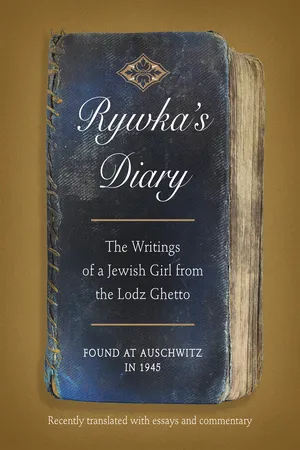
Rywka Lipszyc began the sole surviving volume of her Lodz ghetto diary shortly after her fourteenth birthday. She filled more than 100 handwritten pages over six months from October 1943 to April 1944, and then suddenly stopped. A year later, a Soviet doctor, accompanying the Red Army’s liberating forces, found it near the ruins of the crematoria in Auschwitz-Birkenau. If the diary’s journey suggests the path Rywka took toward almost certain death, its pages tell a far deeper story, for in it Rywka struggled to understand and express herself, capturing both the physical hardships of life in the ghetto and the emotional turmoil of coming of age during the Holocaust.
Born on September 15, 1929, Rywka was the eldest of Yankel and Miriam Sarah Lipszyc’s four children. A son, Abram, called Abramek, was born in 1932, followed quickly by a daughter, Cypora, known as Cipka, in 1933. The baby of the family, Estera, nicknamed Tamarcia, came along in 1937. Rywka’s parents were both natives of Lodz, Poland. Yankel—the fifth son of eight children born to Avraham Dov and Esther Lipszyc—lived with his family in close proximity to his siblings and extended relatives in Lodz. Through his older brother Yochanan’s wife, Hadassah, the family was distantly connected to Moshe Menachem Segal, the famous “last rabbi” of the Lodz ghetto. He was terrorized and tortured after the Germans invaded Lodz and was murdered in 1942 near Kielce.*
As Orthodox Jews, the family was devoutly observant. In the diary, Rywka reveals her strong attachment to the rituals of the Jewish Sabbath and holiday calendar and her unwavering faith in God. “I love God so much!” she wrote on February 2, 1944:
By the time Rywka began her diary, she had lived in the Lodz ghetto for more than three years, and she had already lost both of her parents. The Germans had ruthlessly beaten her father on the street one day, causing severe and lasting injuries, from which he never fully recovered. He died on June 2, 1941, as a result of lung disease and his other ailments. This is a memory that Rywka vividly recalled toward the end of the diary.
Her mother cared for her four children in the ghetto alone for a year before she died on July 8, 1942. The exact details of her death are not known, but she likely succumbed, like tens of thousands in the ghetto, to illnesses related to malnutrition and exhaustion. Rywka’s father was buried in the Jewish cemetery in Marysin at the northeastern periphery of the ghetto; the final resting place of her mother’s body remains unknown. Even so, Rywka was from time to time possessed with an urgent desire to visit their graves. “For a few days something has been drawing me to the cemetery,” she wrote on February 4, “. . . apparently some unconscious force. I’d like so much to go there! To Mommy, to Daddy. I’m so drawn to it!”
Entrance to the Lodz ghetto. (Courtesy of Yad Vashem Photo Archive, Archival Signature 4062/200)
The surviving family adopted the orphaned Lipszyc children. An uncle took in Abramek and Tamarcia while Yochanan and Hadassah Lipszyc opened their home to Rywka and Cipka. A scant two months later, Rywka and her siblings endured one of the most traumatic events in the ghetto’s history, the infamous szpera (Polish for “curfew”) of September 1942. The German authorities demanded that the ghetto surrender for deportation 15,000 Jews under the age of ten and over sixty-five, in addition to the sick and infirm.
Mordechai Chaim Rumkowski, the so-called Eldest of the Jews, conveyed this appalling order to the ghetto population. In his speech, he exhorted parents to do the unthinkable in order to avoid a still worse fate for the entire ghetto population. He implored an assembled crowd of thousands of wailing and weeping parents:
Rywka Lipszyc’s Lodz ghetto registration card. (Courtesy of Archiwum Państwowe w Łodzi)
During the szpera, Yochanan and a desperately ill Hadassah tried to save not only themselves and their three daughters (Estusia, Chanusia, and Minia) but also Rywka, Cipka, and another cousin named Esther, who was only three. Somehow, the German authorities only seized Yochanan, leaving Hadassah with six girls at home. By the time the weeklong roundup ended, however, Abramek and Tamarcia had also been wrenched away from their adopted uncle. Only Rywka and Cipka survived from a family that less than a year before had numbered six. The szpera remained an open wound for Rywka and indeed for the entire ghetto population from that point forward. In January 1944, at a friend’s apartment, the conversation turned to this painful memory:
Poster announcing the infamous szpera (curfew) on September 5, 1942. (Courtesy of Yad Vashem Photo Archive, Archival Signature 4062/189)
While the exact fate of the unfortunates was not known at the time, the ghetto population feared the worst. Rywka repeatedly expressed her dread—her gnawing suspicion, in fact—that she would never see her siblings again. It was not until after the war that the truth became known. The German authorities trucked the deportees to the killing center at Chelmno—the destination for 70,000 Lodz Jews prior to the final liquidation in August 1944. Here they were stripped of their clothing and valuables, loaded into rudimentary “gas-vans,” and asphyxiated by carbon monoxide poisoning. The SS murdered over 152,000 Jews from Lodz and neighboring areas in Chelmno between 1941 and 1944.*
Hadassah, still gravely ill and now widowed, continued to care for all six girls until she, too, died of illness on July 11, 1943. At that point, Estusia, the eldest at age twenty, took on the extraordinary responsibility of caring for her two siblings and the Lipszyc daughters—all of whom were minors. (Another aunt adopted the youngest cousin, Esther.) They shared an apartment at 38 Wolborska Street, under circumstances of tremendous hardship and tension.
Children about to be deported, parting with their relatives. (Courtesy of Yad Vashem Photo Archive, Archival Signature 4062/410)
The Juvenile Protection Committee, which had been established to care for orphans in the ghetto, provided a small measure of aid for Rywka and Cipka. This entity offered such services as tickets to see a dentist, coupons for warm clothing, and other basic necessities. In addition, the girls received an extra food ration, a so-called bajrat, or B ration, which supplemented their otherwise meager portion. In spite of these forms of aid, it is clear from the diary that Rywka and her cousins lived—like most of the ghetto inhabitants—under the ever-tightening vise of extreme hunger and deprivation that characterized life in this harshest and longest-lasting of German ghettos.
Rywka was one of several young diarists whose notebooks have come down to us from the Lodz ghetto. Dawid Sierakowiak, a brilliant young student, wrote the longest and best-known of the Lodz ghetto diaries. His five volumes—with gaps due to lost notebooks—span the period from June 1939 to April 1943. In them, Dawid recounted his agonizing decline from an intellectually curious, shrewdly observant, and often wickedly funny young man to a mere shadow of himself—bereft of his parents, unable to work or study, barely enduring his daily agony of starvation and hopelessness. His diary ended a few months before he himself succumbed to tuberculosis in August 1943. An anonymous girl wrote a fragmentary diary over the months of February and March 1942. In her diary, she describes the ruthless grip of starvation on herself and her family, capturing its brutally reductive nature and the personal, social, spiritual, mental, and moral costs attendant to it.
Pupils dancing during a break at the Franciszkańska secondary school in Lodz. (Courtesy of Yad Vashem Photo Archive, Archival Signature 4062/53)
Finally, an anonymous young man, writing in four languages (Polish, Yiddish, Hebrew, and English) in the margins and end pages of a French novel entitled Les Vrais Riches, recorded the final moments of the ghetto’s existence in the summer of 1944, when the few remaining survivors—Rywka among them—waited helplessly and urgently for the arrival of the Red Army and deliverance. His diary is filled with the desperation of that moment and the despair that arose with news of the final liquidation of the ghetto in August 1944.
Rywka wrote from October 1943 to April 1944, filling a gap in time not covered by any of these diarists and thereby providing a young writer’s perspective on the major events of the ghetto that transpired in that period. It is not only the timeframe but also Rywka’s perspective as an Orthodox Jewish girl that set her writing apart from the other young writers’ diaries from Lodz. While each diarist grappled in some way with existential questions, most writers asked and answered their questions within a secular framework. By contrast, Rywka viewed the world through a religious lens: she believed fervently in God’s benevolence and she strived to live according to Jewish law and ethical teaching. At the same time, Rywka was a modern young person, intellectually ambitious, curious about the world and her place in it, and blessed (or cursed) with a strong personality that did not allow her to quietly absorb indignity. Rather, she would stand her ground, protest, and fight for herself when needed.
Rywka’s diary is characterized by an ebb and flow between her internal and external worlds. She described the practical matters of her life: the mechanics of survival in the ghetto, unremitting work and the momentary reprieves provided by school and other activities, and the outside events that affected the ghetto at large and her in particular. Within this structure, however, Rywka dwelled primarily in her interior world—focusing on her efforts to write; her emerging identity; her friendships, especially her deep attachment to her mentor Surcia; her philosophy of life (that is, her attempts to make meaning of the world through the lens of her experience); her grief for her family; her effort, under constant assault from exhaustion, despair, hunger, and fear, to hold on to her strength; and her faith. Rywka’s entries are an intermingled, sometimes even jumbled, combination of reports, reflections, feelings, news, sensations, and ideas. When untangled, her diary not only provides a fresh perspective on daily life and survival in the Lodz ghetto, but—perhaps more importantly—reflects the impossible struggle to come of age within this crucible of imprisonment, deprivation, and oppression. Above all, Rywka sought comfort and salvation in writing her diary. Its survival testifies to the anguish of her doomed struggle.
“It is after the first holiday,” Rywka writes in her first entry on October 3, 1943, beginning, fittingly, with Rosh Hashanah, the Jewish New Year. At that time, Rywka moved from a job in the Central Accounting Office to a position in the Clothing and Linen Workshop, managed by Leo...