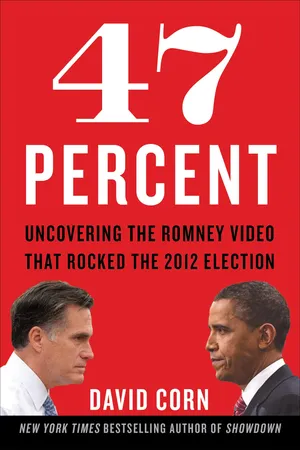
From the reporter who broke the Romney video story, 47 Percent reveals for the first time the dramatic tale of how David Corn, Washington Bureau chief at Mother Jones, MSNBC analyst and author of the New York Times bestseller Showdown, learned of its existence, located the source, authenticated the video, and persuaded the source to let him release it. In 47 Percent, Corn recounts how the 47 percent video fit into the ongoing narrative of the 2012 election and greatly changed the course of the campaign. This instant, on-the-news book also features an astute review of the first debate between President Barack Obama and Governor Mitt Romney and assesses the strengths and weaknesses of each candidate as they head into the final stretch of this historical election.
- English
- ePUB (mobile friendly)
- Available on iOS & Android
eBook - ePub
About this book
Information
Subtopic
Governo americano47 PERCENT
IT ALL BEGAN with the disposal of aborted fetuses.
That was what led to one of Mitt Romney’s worst moments in the 2012 election and possibly his downfall as a presidential candidate: the revelation of a secretly recorded video at a private fundraiser that captured Romney denigrating 47 percent of the electorate as “victims” and moochers who rely upon government handouts, who do not pay income taxes, and, perhaps most insulting of all, who do not “take personal responsibility and care for their lives.”
This story, which generated headlines around the world, hit as Romney was slogging through the final stretch of a presidential contest that was not proceeding as Romney had once hoped it would. Instead of a referendum on President Barack Obama’s handling of the sluggish economy, the election had become a choice between the two candidates and their respective visions—or perhaps a referendum on Romney’s character.
IN LATE JUNE, three months before I revealed the 47 percent video on the Mother Jones website, I received an email from an investigator I’ve known for years: “Got a sec for a quick chat?” My answer: “Sure.”
As a reporter, I receive tips and leads from a number of sources. Some have an obvious motive. (Say, a political campaign will point out something odd in the campaign disclosure filing of an opponent.) In most cases, the tipster is presenting me with material already in the public domain—not undercover video or a diary pilfered from someone’s home. The stuff simply has not been noticed. Usually the most important task at hand is determining whether the proffered material is factually correct and actually newsworthy.
This source—whom I’ll call Luke—and I spoke that night, and he told me about a Bain Capital investment that could be bad news for Romney. Luke wasn’t with the Obama reelection campaign or the White House, but he didn’t say who his client was.
The deal was this: in late 1999, Bain Capital—the private equity firm Romney had founded and managed—and another private equity company had invested $75 million in Stericycle, a medical waste disposal firm that in more recent years has been attacked by anti-abortion groups for disposing of aborted fetuses collected from family planning clinics.
The Huffington Post earlier in the year had run an article reporting on this Bain investment. But when the HuffPo piece came out, Bain tamped down the potential controversy. The company’s official line was that Romney left the firm in February 1999 to run the troubled 2002 Winter Olympics in Salt Lake City. That seemed to mean he had not been directly involved in the deal. Romney’s connection to a firm that disposed of aborted fetuses—indirect or not—never became a campaign issue.
Luke encouraged me to take another look, noting that my colleagues at the Washington bureau of Mother Jones and I had a reputation for digging and producing articles that went beyond the daily (and sometimes silly) give-and-take of political campaigns. He emailed me an electronic pile of documents, including news stories that chronicled Stericycle’s spotty safety record in its early years.
Included in the material were documents Bain had filed with the Securities and Exchange Commission. After I quickly confirmed that these SEC records were real, I read them and saw that Romney was listed as an active participant in the Stericycle investment, which occurred in November 1999. This fact was significant; it undercut the claim that Romney had departed Bain in early 1999 and had had nothing to do with the firm’s actions after that point.
The February cut-off date was important for Romney. The Washington Post, on June 21, 2012, had published a story reporting that Romney’s Bain Capital had “invested in a series of firms that specialized in relocating jobs done by American workers to new facilities in low-wage countries like China and India.” With the presidential campaign focused on jobs creation—here in the United States, not abroad—this was a major slam on Romney: he had profited by outsourcing jobs.
His campaign pushed back hard, insisting that Romney had left from Bain before several of the key episodes cited in the Post article (though there was no denying Romney had retained a deep ownership stake in the private equity firm).
FOR WEEKS PRIOR to the Post piece, the Obama camp had been pounding on Romney’s days at Bain—focusing on the firm’s acquisition of businesses that later underwent bankruptcies or job losses, even as Romney and his colleagues still reaped a profit. This was part of the Obama campaign’s effort to portray the GOP presidential candidate as a 1 percenter who was out of touch with average Americans and, thus, not a politician who could be expected to advance policies that would boost the economic prospects of middle-class voters.
The goal for Obama and his reelection team based in Chicago was to define Romney for the general election—especially for undecided voters who had not paid much attention during the Republican primaries—before the multimillionaire former Massachusetts governor could do so himself. In April, David Axelrod, Obama’s chief strategist, had told me that the campaign would move fiercely in the coming weeks—during the lull between the end of the GOP primary contest and the summer (when fewer voters would be following the campaign and, instead, be watching the Olympics)—to influence how voters perceived Romney. With Romney touting his private sector experience as the top reason he should be hired as America’s CEO, bashing Romney’s Bain record was critical for Obama’s squad.
This was but one facet of the president’s grand strategy. Ever since the Democrats took a drubbing in the 2010 congressional elections, the president had been attempting to cast the 2012 election not as an up-or-down vote on his management of the economy, but as a fundamental clash between his vision of progressive government (which invests in education, innovation, and infrastructure to enhance the economy; which protects and strengthens the social safety net; and which pursues a deficit reduction strategy that includes a bit more taxes from the well-to-do) and the stark vision of the Tea Party-ized Republicans (who contend that government is the problem, not the answer, and who call for slashing government spending on social programs and freeing businesses and wealthy Americans from such government interventions as higher taxes, environmental and safety regulations, and health care reform). My book Showdown: The Inside Story of How Obama Battled the GOP To Set Up the 2012 Election, published earlier this year, told much of that story.
While waging this ideological war, Obama had used the budget proposed by Rep. Paul Ryan, the GOP chairman of the House budget committee, as his foil—a stand-in for whomever the Republican presidential nominee would be. Ryan’s plan would eviscerate spending on such programs as Head Start, Pell Grants for college students, federal law enforcement, food safety monitoring, environmental protection, medical research, and school lunch programs. It would reduce taxes for the rich even beyond the tax cuts implemented by President George W. Bush and end the Medicare guarantee. Such radical change, Obama insisted, was out of step with American values—and it would produce a darker and more Darwinian society. And as Romney, who had embraced the Ryan budget (long before tapping Ryan to be his running mate), emerged as the likely GOP nominee, Obama and his aides began redirecting this values-based as...
Table of contents
- Contents
- 47 Percent
- Acknowledgments
- About the Author
- Also by David Corn
- Copyright
- About the Publisher
Trusted by 375,005 students
Access to over 1.5 million titles for a fair monthly price.
Study more efficiently using our study tools.
Frequently asked questions
Yes, you can cancel anytime from the Subscription tab in your account settings on the Perlego website. Your subscription will stay active until the end of your current billing period. Learn how to cancel your subscription
No, books cannot be downloaded as external files, such as PDFs, for use outside of Perlego. However, you can download books within the Perlego app for offline reading on mobile or tablet. Learn how to download books offline
Perlego offers two plans: Essential and Complete
- Essential is ideal for learners and professionals who enjoy exploring a wide range of subjects. Access the Essential Library with 800,000+ trusted titles and best-sellers across business, personal growth, and the humanities. Includes unlimited reading time and Standard Read Aloud voice.
- Complete: Perfect for advanced learners and researchers needing full, unrestricted access. Unlock 1.5M+ books across hundreds of subjects, including academic and specialized titles. The Complete Plan also includes advanced features like Premium Read Aloud and Research Assistant.
We are an online textbook subscription service, where you can get access to an entire online library for less than the price of a single book per month. With over 1.5 million books across 990+ topics, we’ve got you covered! Learn about our mission
Look out for the read-aloud symbol on your next book to see if you can listen to it. The read-aloud tool reads text aloud for you, highlighting the text as it is being read. You can pause it, speed it up and slow it down. Learn more about Read Aloud
Yes! You can use the Perlego app on both iOS and Android devices to read anytime, anywhere — even offline. Perfect for commutes or when you’re on the go.
Please note we cannot support devices running on iOS 13 and Android 7 or earlier. Learn more about using the app
Please note we cannot support devices running on iOS 13 and Android 7 or earlier. Learn more about using the app
Yes, you can access 47 Percent by David Corn in PDF and/or ePUB format, as well as other popular books in Politica e relazioni internazionali & Governo americano. We have over 1.5 million books available in our catalogue for you to explore.