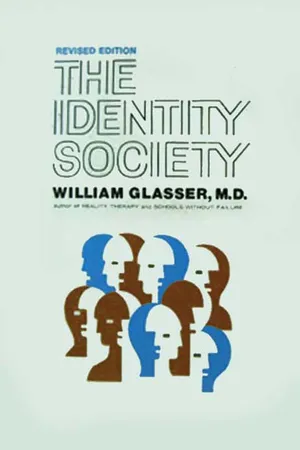
This interesting societal study by the father of Reality Therapy presents a view that since survival is no longer the major issue for humans, development of self and identity is a normal social quest.
- 272 pages
- English
- ePUB (mobile friendly)
- Available on iOS & Android
eBook - ePub
Identity Society
About this book
Information
Subtopic
Education CounselingIndex
Social SciencesChapter One
The Identity Society
Led by the young, the half-billion people of the Western world have begun a rapid, turmoil-filled evolution toward a new role-dominated society that I call the identity society. Less anxious than formerly about fulfilling goals to obtain security within the power hierarchy, people today concern themselves more and more with an independent role—their identity. Of course, people still strive for goals; increasingly, however, they are goals, vocational or avocational, that people believe will reinforce their concept of themselves as persons. For example, not everyone can work at a job that gives him a lot of satisfaction such as that of doctor, artist, or teacher, but anyone can pursue a recreational goal, such as bowling or playing bridge, or a volunteer goal, such as working in a hospital or fund raising, that reinforces his view of himself as someone.
In the countries that have moved into the new identity society, there is now suddenly enough security so that personal fulfillment seems possible for almost everyone. It is not whether it is possible but that it seems possible that has led almost everyone to overcome the traditional survival fears and look for happiness. Rather than work for a goal and then search for personal satisfaction, young people today strive first for a fulfilling role, for something to do that has personal significance and promises pleasure. They may then work hard for a goal that can establish this role. A young doctor’s view of himself in the new identity society illustrates this change:
I am a doctor not because I can make money and find a very secure, prestigious place for myself high in the power structure but because I think I can practice medicine to become involved with my fellow man. I’d like to work in an inner city hospital, in the Peace Corps, in a “free” clinic, in research, or for the Public Health Service. I expect to get paid enough to live, perhaps to be comfortable; but to me being a doctor is much less to gain money, prestige, and power than it is to reinforce my own role, my belief in myself as a human being. As I struggle helping others, I will enjoy the satisfaction that comes when I do this well.
The dean of my medical school has remarked that students who before 1950 answered the standard question, “Why do you want to become a doctor?” with “For the pleasure of working with people” (the role answer) were often refused admission, suspect as some kind of a nut or troublemaker; the student who answered that he wanted a secure profession (the goal answer) was accepted. Since about 1950, Western Reserve University Medical School, for one, has been admitting many students who say they are interested in public service.
Today, everyone tries to use work, service, or play to gain a successful identity through involvement with others and through goals that help him to be successfully involved. Many people fail, however, in the difficult task of achieving a successful identity. Unable to do so, to do something with their lives that gives them fulfillment, but still desperate to be somebody, they settle for a failure identity: emotional disturbance, antisocial behavior, crazy thinking, or sickness—all attempts to reduce the pain of their failure.
An analogy may help explain the new identity society. Many people find that it is like going to a party when there is plenty of food but you are not hungry. You try to make contact with some of the other guests but no one is interested in you. You cannot leave because you came with someone who is having a good time and who does not want to leave. As the evening goes on and you cannot get into a good conversation, you begin to get anxious. You are in a painful situation. Although you believed you had no serious social problems, the evening was a nightmare of rejection. You were willing to give of yourself to others but there were no takers. No loneliness is more acute than the loneliness that exists in a crowd where most of the people are obviously enjoying each other’s company.
What happened to you at the party represents failure in the identity society. You already have security; now you need frequently to be verified as a person by your fellow man. When you do not get the involvement that gives you this verification, you suffer. You want the people, not the food, because the only way you can maintain a successful identity is to accept and be accepted by others whom you respect and who believe you are worthwhile. A successful identity, therefore, is gained through involvement, not through a full stomach. But because no one can demand involvement, it is easier to leave and be alone than to suffer. Being alone may be temporarily less painful, but in the end if you stay alone because you fear rejection you suffer as much or more. This suffering is important to understand; it is explained in the two following chapters.
A married woman who works further illustrates the change from emphasis on survival to emphasis on identity. Does she work because she needs people or because she needs money? And if she needs money, is it for survival or to give her a better way of life? Would she continue to work if her husband got a large raise? Suppose she is a young school teacher about to marry a wealthy young man. For several years she was careful to succeed as a school teacher. Following the principal’s lead she stayed close to the curriculum as well as to the written rules. Because she had little security, she needed her job and the praise possible from doing a good job. Praise from the principal gave her security but now she no longer needs her job for security. After marriage she and her husband decide that she will continue to teach school. Now the situation is different. She teaches because she enjoys the children, because she has friends on the faculty, and because she is happy and successful. If the principal criticizes her bulletin boards or her control of the class when the children are a little exuberant, she smiles to let him know that he should not worry. She is here because she wants to be here, not because the job gives her security. She now gently demands to be considered a more independent, less predictable person. Today in the identity society she is usually a better teacher because of her altered role.
An engineer in a large firm that fills government contracts works hard. He is concerned with his status because he considers status a good indication of security. He is interested in the size of his office, the number of men with whom he shares a secretary, the dining room to which he has access, and whether or not he has his name on a parking place. When layoffs start, he makes countless calculations about his position in the layoff hierarchy. If his skill is narrow, he is very insecure and may encourage his wife to work to increase the family security. If pushed too far, with a little show of independence, he will defend himself as a human being with human rights; always fearful of the boss, however, he worries when he does so. Gaining an illusion of independence when times were good and government contracts plentiful, he lives up to his income and has changed jobs frequently to get raises.
The engineer was and is goal-oriented, but his children, raised in security, are role-oriented. Like many successful men in their forties and older, he cannot understand why they are so different from him. Yet both he and his wife asked their children to contribute much less to the family security than their parents asked of them. They encouraged their children to achieve their own potential and enjoyed seeing them do so. But because they wanted their children to work toward a security profession, the parents fretted when they did not quickly start to do so.
Their attitude caused their children to think more about themselves (as many people did in the new and comparatively affluent society that followed World War II). Valuing themselves, the children cared less about goals than their parents had. They were concerned, rather, with their role, with their human potential, and with their happiness. No longer squelched as it had been for 10,000 years, the need for identity revealed itself freely and strongly in the children born since 1940. When they work for a goal, as many do, the goals they work for are those that now or later will reinforce their role.
Once the economically secure child overtly started his search for an independent role by growing a beard or by participating in a peace march or in a voter registration drive or, at a different level, by using drugs or dropping out of school, many parents attempted to deny that the security they gave their child could have led to the present behavior that they deplored. Because the children’s behavior is not goal behavior and is thus not acceptable to most older parents, some parents have rejected or even attacked their children, quickly causing a wide gap between parent and child.
Rather than the well-advertised generation gap, this is a cultural gap. Today in many families there are two cultures: the parents, who are goal-oriented, live in one and their children, who are role-oriented, live in the other. Less than thirty years into the new identity society, we find most families with older children to be divided culturally. In the next generation, as the identity society children become parents, the cultural gap should narrow. Although there are some indications that this narrowing is already occurring, much conflict still exists between parents and children. As a result the growing child who strongly expresses his new role may lose the support of his parents, support provided so freely when he was younger. He needs parental involvement more than ever when he is an adolescent and a young adult if he is to achieve a successful role. If he cannot find involvement within his family, he will look outside his family. If he fails to find involvement readily, as he often will, he may give up on human involvement the way the fox gave up on the grapes. Rather than bringing him back to a goal orientation, his parent’s rejection only isolates him further, an isolation that leads to failure in the identity society. To make his human failure less painful, he may develop painful physical symptoms and then perhaps turn to drugs to relieve the pain. Those who cannot find involvement today are almost always doomed to failure and misery.
Unlike the cultural gap, a generation gap always existed; although questioning their parents’ values was normal for children, rejecting their parents’ values was unusual. In earlier times children argued that they wanted to achieve a goal in a different way or that they wanted to try for a new goal foreign to their parents. For example, they may have wanted to leave the farm and seek their fortune in the city. They rarely questioned the traditional sequence of goal before role. A child learned from his parents that hard work was necessary and that he was unrealistic if he thought the world would let him search for fulfillment. A few young people who were secure in their family probably went through a limited struggle attempting to find a fulfilling role before they attained a goal. As soon as they went out into the world away from the security of their home, however, they gave up trying to establish an independent role. Knowing that the children were behaving as they had, or wish they had, behaved when they were young, adults encouraged them with amused toleration in the mild rebellion. Children were allowed their high jinks and their wild oats as long as they did not threaten the established and secure order.
Now it is different. Our present younger generation was raised by an older generation that itself has become secure enough to begin to be concerned about fulfillment. The older generation has moved this far because most of them feel secure; this security, together with increased communication and political enlightenment, has allowed the younger generation to move even further and to assert early their desire for identity. They refuse to put aside this desire just because in the past young people did so. The power structure and the family, both weakened by increased security, are in trouble partly because they attempt to stand in the way of young people as they struggle for a successful role. Because the young have had security and freedom within their family, they believe that an independent role is possible; they do not hear their family’s admonition that the security and freedom are temporary because they are provided not by the society but by the family. They hope the government or private enterprise will provide role-reinforcing work. If they are unable to find such work, they struggle to find a successful identity in some other way. Should they fail, as many do, they fight or become apathetic and give up. They then become a burden both to themselves and to society.
The shift to the identity society is not limited to the more publicized young—the hippies, the demonstrators, and the social drop-outs. Although it is not so obvious in other young people, many of whom work hard, it is a rare young person today who is willing to subordinate his identity to security. Almost all are working primarily to support a satisfying concept of themselves. The more successful this concept is, the harder they work. The motivation is positive—gaining a stronger feeling of self, rather than the old negative motivation—the fear of insecurity.
The precedence of role over goal present in most young people today is by no means limited to the young. For example, in the traditional sequence a middle-aged corporate executive adopts the corporate goals, works hard, moves often, and obeys all the rules. He finally gains enough security to refuse a higher-salaried job in a new city because he and his family enjoy the human satisfactions that are part of his present community. In the new society, the young man starting to work for a corporation asks immediately about the potential for human satisfaction on the job. Although he may not always dress, look, or even act the part according to traditional corporate practice, he may work hard to attain the personal, as well as the financial, reward of the job. As he moves up in the company, he may give up superficial nonconformities such as dress style, not because he is afraid or insecure, but because it is easier for him to fight more important battles without wasting his energy on small irritations produced by his nonconformity. Now conforming superficially, he has time and energy for activities both at work and elsewhere that reinforce his independent role.
In the old society a student might never question a professor until he had completed all of his work. Then, with some trepidation, he might question his professor and give his opinion; if the professor listened, the student might begin to achieve a role. He did the work first, however; goal preceded role. Today’s student may sometimes (with little knowledge) question his professor immediately. His challenge to the teacher’s authority supports his idea of himself as a person even before he has done the work to gain recognition. A patient, tolerant, and attentive professor may motivate this student to work as hard as ever for a goal by listening to him and then pointing out that doing the work will further support his new role. An intolerant or impatient professor may cause the student to lose interest and settle for goals that reinforce failure, not success.
Many older people accept the importance of role. They firmly believe, however, that a role should be achieved through traditional pathways. That is, a person should first work hard to gain security and only then try to attain a role. Older people maintain that everyone should be primarily goal-oriented. They still venerate goals even though, once successful, they no longer spend much time working for them.
The young say that this traditional order is inhuman and degrading. They maintain that our identity is as basic as our humanity and that we should, therefore, reject goals that do not immediately and directly reinforce our basic human role. Seeing little value in power or property for its own sake, they believe that power, property, and technology should support and reinforce people and their roles as human beings. They should not be so expanded that they prevent people from achieving a role. Young people deny the value of any goal that does not reinforce humanity.
Let us now examine the three primary reasons for the recent, sudden emergence of the identity society. Affluence, one of the three driving forces for change, affects the half-billion people of the Western world. Of the three and a half billion on earth, only these half-billion people are affluent or, equally important, believe they soon may be. In the Western world we have almost entirely eliminated the fear of nonsurvival. The starving are so few that they do not affect the thinking of the society. Also, some poor people make little trouble because, with the loosening of the power hierarchy and with the narcotizing influence of TV, they do not realize they are on the bottom. They are so bombarded with the possibilities of affluence that they gain the illusion that somehow they will soon share in the abundance around them. Even if they think that they are not likely to share in the wealth that they see, they tend to become dissatisfied more as personal failures than as economic failures. Their pain is more social than economic. And even people on the bottom or close to it know that the bottom is better than it was in the past. With more money and more education, young people and all people in the Western world have greater opportunities than ever before. In the United States, the GI Bills, both for education and for housing, exemplify political thinking that led to the affluence that caused the identity society to emerge.
The second important force to lead us into the identity society is political enlightenment for human rights. Freedom has expanded in most of the Western world. Even in countries with less freedom, such as Spain and Korea, the young are protesting and, to some extent, being heard. Although many role-dominated young people think that any infringement on total personal freedom is political oppression, that they can protest so freely and loudly that people all over the world listen to them, partly belies the charge that they have no real freedom.
The protests, however, do threaten the power structure especially when those in power believe that some of the older, more goal-oriented people, upon whom the power structure depends, will listen. Although the protestors usually do not want to become violent, the power structure, in order to reduce the support of older people who abhor violence, sometimes provokes it. As governments begin to understand the implications of the identity society—that human rights cannot be easily put aside—and as protestors discover that violence robs them of much of their support, more progress toward giving people a chance for an independent role will occur.
Because the protests are a manifestation of the cultural gap between the old and young, frustration will sometimes lead to violent demonstrations. As long as the Vietnam war continued, the protests continued because war is incompatible with an independent human role. Although an identity society could fight a war either to defend itself or to extend human freedom, no American soldiers in Vietnam believed that they were fighting for either of these goals. They were fighting only for their own survival. Although some soldiers with a successful identity at times refused to risk their lives, the identity society army did not often court-martial them. Instead the army command talked to them and tried to persuade them to obey orders, using coercion as little as possible because it recognized that on any large scale coercion would not work.
The Vietnam war, the first war fought in part by an identity society and its soldiers, provided daily evidence of the erratic and inconsistent support given it by our government. Little concerned with the professed goals of the country—and many did not know what they were—the soldiers became concerned with the practical goal of making their forced servitude as painless and safe as possible. Although many soldiers took easily available drugs because they felt failure, frustration, and intense fear, few became addicted. When they returned home to a society where they could gain some value, the pain and frustration disappeared. Most were able to give up even large doses of drugs because they no longer had need for them.
In addition to permitting protests, additional examples of political enlightenment are laws and court decisions liberalizing divorce and abortion as well as those protecting civil rights and the rights of accused criminals. Laws guaranteeing individual freedom, if implemented, can provide more people the chance to live successfully in a new society.
The media, especially television, are a final and perhaps most important factor causing the emergence of the identity society. Since the early 1950's most people have grown to depend on television for much of their evening and weekend pleasure. Young children are estimated to watch television more than two thousand hours befor...
Table of contents
- Cover
- Title Page
- Dedication
- Contents
- Introduction: Evidence of Change
- Chapter One: The Identity Society
- Chapter Two: Pleasure and Pain
- Chapter Three: Loneliness and Failure
- Chapter Four: Reality Therapy
- Chapter Five: The Family in the Identity Society
- Chapter Six: Failure in Children: School Failure
- Chapter Seven: Failure in Children: Drug Use and Sex
- Chapter Eight: Sexual Behavior
- Chapter Nine: Criminal Justice, Hospitals, and Welfare
- Chapter Ten: The Community Involvement Center
- Appendix
- Conclusion
- Index
- Acknowledgments
- About the Author
- By the same author:
- Copyright
- About the Publisher
Trusted by 375,005 students
Access to over 1.5 million titles for a fair monthly price.
Study more efficiently using our study tools.
Frequently asked questions
Yes, you can cancel anytime from the Subscription tab in your account settings on the Perlego website. Your subscription will stay active until the end of your current billing period. Learn how to cancel your subscription
No, books cannot be downloaded as external files, such as PDFs, for use outside of Perlego. However, you can download books within the Perlego app for offline reading on mobile or tablet. Learn how to download books offline
Perlego offers two plans: Essential and Complete
- Essential is ideal for learners and professionals who enjoy exploring a wide range of subjects. Access the Essential Library with 800,000+ trusted titles and best-sellers across business, personal growth, and the humanities. Includes unlimited reading time and Standard Read Aloud voice.
- Complete: Perfect for advanced learners and researchers needing full, unrestricted access. Unlock 1.5M+ books across hundreds of subjects, including academic and specialized titles. The Complete Plan also includes advanced features like Premium Read Aloud and Research Assistant.
We are an online textbook subscription service, where you can get access to an entire online library for less than the price of a single book per month. With over 1.5 million books across 990+ topics, we’ve got you covered! Learn about our mission
Look out for the read-aloud symbol on your next book to see if you can listen to it. The read-aloud tool reads text aloud for you, highlighting the text as it is being read. You can pause it, speed it up and slow it down. Learn more about Read Aloud
Yes! You can use the Perlego app on both iOS and Android devices to read anytime, anywhere — even offline. Perfect for commutes or when you’re on the go.
Please note we cannot support devices running on iOS 13 and Android 7 or earlier. Learn more about using the app
Please note we cannot support devices running on iOS 13 and Android 7 or earlier. Learn more about using the app
Yes, you can access Identity Society by William Glasser, M.D. in PDF and/or ePUB format, as well as other popular books in Social Sciences & Education Counseling. We have over 1.5 million books available in our catalogue for you to explore.