- 352 pages
- English
- ePUB (mobile friendly)
- Available on iOS & Android
eBook - ePub
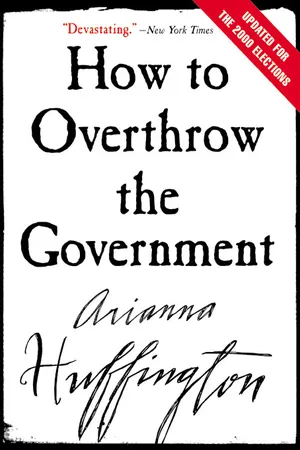
How to Overthrow the Government
About this book
Powerful and enlightening. How to Overthrow the Government is an impassioned call to arms from one of America's sharpest and most independent commentators. In its pages Huffington breaks away from the party-line platitudes of Republicans and Democrats alike while challenging Amerians to rise up and take back their government. From the power of special interests to the ravages of the war on drugs, Huffington offers radical yet viable strategies for reclaiming our nation from the corporate and political powers that hold it hostage. For, as she argues, if We the People are to preserve and protect our more perfect union, we must stand up and fight for our country -- before it's too late.
Information
1
A TALE OF TWO NATIONS
We live in a democracy universally acknowledged to be the greatest governing system in the world. But a democracy is only as strong as it is responsive to all of its citizens. While our current government crows about the endless rain of profit on Wall Street, average Americans are sitting back and wondering, What about me? What about my children? What about their lousy school? What about my retirement, our health care?
And we have no faith in our elected leaders to do anything about it. The economic boom of the ’90s has masked a looming national crisis: a corrupt political system that auctions off public policy to the highest bidder, and leaves the overwhelming majority of Americans feeling alienated from their own government.
American politics is broken—under the thumb of a small corporate elite using its financial clout to control both parties’ political agendas. The founding democratic principle of “one man, one vote” has been replaced by the new math of special interests: thousands of lobbyists plus multimillions of dollars equal access and influence out of the reach of ordinary citizens.
From 1997 to 1999, according to the Center for Responsive Politics, the number of registered lobbyists in Washington grew by 37 percent, to more than 20,000, while the amount of money they spent reached $1.42 billion. Crunch the numbers: That’s roughly 38 lobbyists for each member of Congress. Like a swarm of ravenous termites reducing a house to sawdust, they are making a meal out of the foundations of our democracy.
And what are we ordinary Americans doing about it? Not much—at least not yet.
Almost two out of three Americans didn’t even bother to vote in the last election—115 million eligible voters failed to exercise a right for which a few months later people were willing to die in East Timor, where the turnout was 98.6 percent.
Back at home, among the 36 percent who did vote, many held their noses while voting for the candidate they abhorred the least. According to the Committee for the Study of the American Electorate, since the 1960s national voter participation has fallen more than 25 percent, the largest and longest slide in our country’s history. Twenty-five million Americans who used to vote now choose not to.
And if a democracy is only as healthy as its voters, then its life expectancy depends on the involvement of its youngest voters. So it’s especially troubling that young people, together with poor people, have the lowest turnout and the steepest decline in participation. Only 20 percent of Americans aged eighteen to twenty-four voted in the 1998 elections. Despite the Rock the Vote campaign, and MTV’s growing political forays, as of 1996 fewer than half of America’s eighteen- to twenty-four-year-olds had even registered to vote.
Even the idealists are getting discouraged—they’re pushing a product no one likes. “How do you sell political participation,” Rock the Vote director Seth Matlins asked, “when the state of politics is just so repulsive?” The group’s founder, Jeff Ayeroff, concurs: “If 1992 was about enlightenment, then we’re in the dark ages now.”
When turnout among the young shrinks from 50 percent in 1972 to 32 percent in 1996, it’s foolish to keep pretending our democratic future is safe. With that rate of decline, in forty years nobody will be voting.
It’s a stinging repudiation of the rotten spectacle our elections have become that despite a Motor Voter—fueled surge in voter registration—a net increase of 5.5 million from 1994 to 1998—voter turnout declined by 2.5 million. Registration drives have only increased the number of eligible people choosing not to vote.
The American people aren’t satisfied by this—and they aren’t stupid. Since 1964, the University of Michigan’s National Election Studies has regularly asked eligible voters a simple question: whether, in their opinion, the U.S. government is run “for the benefit of all” or “by a few big interests.” In 1998, nearly two-thirds—64 percent—answered “a few big interests,” a complete reversal of the electorate’s opinion in 1964. Sixty-two percent—compared to 36 percent in 1964—agreed with the statement, “Public officials don’t care much what people like me think.”
The Michigan study also found that attitudes toward government are clearly divided along lines of class and education. The least-educated respondents agreed much more often (58 percent) than the most-educated (24 percent) that people have no say in their government. The same was true in terms of income. About half of all lower-income Americans feels disenfranchised from the political process, compared with only 18 percent of those whose income is in the top 5 percent. And unskilled workers are nearly twice as likely to feel this way as professionals—64 percent to 33 percent.
Shouldn’t the opposite be the case? Shouldn’t those with the most have the least to expect from our collective efforts, and those with the least have the most to expect? Isn’t that what’s meant by comforting the afflicted? If the least educated and the poorest among us—those at society’s margins—have the lowest expectations of government accountability and responsiveness, what does that say about our society?
Millions of voters are feeling ignored by politicians more concerned with staying in power than with serving the people. And when a candidate wins, it becomes increasingly unlikely that he or she will ever lose. In 1998, House incumbents ended up running unopposed in 95 districts, while in 127 they faced only token opposition. It’s no surprise then that a record 98.5 percent of them were reelected, collecting an average of more than 70 percent of the vote. In an ideal world, a people that reelects almost 99 percent of its leaders would seem to be happy with them. But in the real world, you only have to win once to become a permanent fixture in a rotting political establishment.
Of course, our politicians pay plenty of lip service to reform. But in reality, under our current system, actual efforts to overhaul government last about as long as Bill Clinton’s and Newt Gingrich’s famous handshake in New Hampshire, when they assured the nation that they were ready to enact reform.
Our political world is divided into two camps: those who consider plummeting turnout and high disengagement a serious threat to our democracy, and those who do not. The problem is that almost every elected official and political consultant is in the latter camp. Which isn’t so surprising when you consider how many of them owe their jobs to the worst aspects of the system.
More interesting is what’s happening in the first camp, where an ad hoc alliance is bringing together such unlikely bedfellows as Democratic power broker Robert Strauss, perennial activist Ralph Nader, Republican presidential candidate John McCain, and conservative Congressman Peter Hoekstra. Strauss has warned his party-mates about the “brutal truth” of an “unprecedented disengagement from politics by the American people,” while Nader notes that “citizens are staying away from the polls in droves because of their disgust, distrust, despair and disillusionment with tweedle-dum, tweedle-dee politics.” Hoekstra is even bleaker: “Voter satisfaction and participation are at or near all-time lows. Why should a person vote? And what for? Candidates who prefer smear over substance, money over principle and length of service over tangible action?”
The defenders of the status quo have no problem with disaffected citizens dropping out—it keeps them from making waves. Better that they get out than care enough to stay in and vote against them. In many ways, it is easier to play to, control, and manipulate a smaller audience. The key is to keep giving them no alternatives until they give up. “In general, the public is satisfied,” former Rep. Vic Fazio (D-Calif.) has said, “or as satisfied as they will ever be.” No candidate who demonstrates such blithe complacency should be allowed to retire comfortably after twenty years in office, as Fazio did in 1998. He should be kicked to the curb at the next election.
So should any candidate who waxes lyrical about our “unprecedented prosperity” without acknowledging that millions are being left out of it. “Xers may well be the first generation whose lifetime earnings will be less than their parents’,” writes Ted Halstead, president of the New America Foundation. “Already they have the weakest middle class of any generation born in this century.” Adjusted for inflation, the weekly earnings of men aged twenty to thirty-four have fallen by nearly one-third since 1973.
Getting a college education used to be a ticket out of financial insecurity. But no longer. The current crop of college graduates has seen its earnings from 1989 to 1995 fall by nearly 10 percent in relation to the previous generation—the first time that’s ever happened.
At the same time, personal debt has skyrocketed. Americans from twenty-two to thirty-three years old have the greatest personal debt level of any age group. This includes over $2,000 per person in credit card debt, which is carried by 62 percent of Xers. They also suffer the greatest anxiety over debt, with nearly half reporting that it “concerns them a lot.”
In fact, up to 60 percent of all Americans carry some credit card debt. In what they proudly term the “democratization of credit,” credit card companies in 1998 extended over $2.5 trillion in debt. Americans’ personal credit card debt level has increased to over half a trillion dollars in 1998. All that personal debt has turned our economy into a ticking bomb. One family in sixty-eight filed for bankruptcy in 1998—more than saw a child graduate from college. Meanwhile, Congress has proposed legislation that would make it much harder for consumers to erase their debt by declaring bankruptcy.
Not only is this era of prosperity built on a house of cards, the crisis goes much deeper than just the immediate concerns of middle class debtors. “Most things are going right for our country,” the president has said—but it’s a disturbing statement to anyone who’s keeping an eye on the other America: nearly 700,000 layoffs in 1998, 56 percent more than the year before; the biggest one-month surge in unemployment claims in six years; and a study of four Northwest states that revealed more than half of the available jobs do not pay a living wage.
While conventional wisdom holds that America is thriving, it’s hard to escape the notion that the United States has been torn in two—divided between a moneyed elite getting rich from globalization and an increasing number of citizens left choking on the dust of Wall Street’s galloping bulls. Corporate America has never been more robust; in fact, since 1990—the supposed end of the Greed Decade—the pay of CEOs has gone up more than 440 percent. At a time when the wealth is supposedly spreading, income inequality is higher than ever.
In 1964, 36 million Americans lived in poverty. Thirty-five years and a War on Poverty later, 35.6 million remain below the poverty line.
In the spring of 1999, the Casey Foundation’s “Kids Count” report identified 9.2 million children “growing up with a collection of disadvantages that are cause for exceptional alarm,” and focused on “the persistent exclusion of far too many of our children and families from the full promise of American life.” “Kids Count” directly contradicts the rosy data being spun from both ends of Pennsylvania Avenue, drawing attention to the burgeoning number of children—5.6 million—in families of the working poor. Despite the economic boom and an unemployment rate at a twenty-five-year low, the U.S. child poverty rate remains at 21 percent—the highest in the developed world.
Around the same time, the United Way of Los Angeles released its “Tale of Two Cities” report, spotlighting the growing disparities in the richest city in the nation and concluding that “economic conditions for children have not been so precarious since the Great Depression.” One out of three children in Los Angeles lives below the poverty level; the number of abused children placed in foster care has risen 86 percent in the past decade; and even with the recent drop in violent crime, homicide is still the largest single cause of death for children under eighteen.
The story isn’t much different around the rest of the country. According to officials of thirty major cities surveyed by the U.S. Conference of Mayors “the strong economy has had very little positive impact on hunger and homelessness.” Ninety-three percent of those responding expected the demand for emergency shelter to increase further next year. Second Harvest, the biggest national network of food banks, says its clientele is growing by 10 percent a year—a rate not yet rivaling Starbucks, but demonstrating the growing divide.
A flurry of reports last summer further documented the split between the country’s rich and poor:
According to the Center on Budget and Policy Priorities, the poorest fifth of single-mother families lost an average of $577 a year in income and benefits between 1995 and 1997. The Center also projected that the poorest fifth of Americans will be left with 9 percent less than they had in 1977 and the richest fifth with 43 percent more—a record level for the after-tax income gap between rich and poor.
A Children’s Defense Fund study, meanwhile, showed that in one year—from 1996 to 1997—the number of children living in extreme poverty (that is, making less than half of poverty-level income) rose by 26 percent among single-mother families.
According to the Urban Institute, the median annual income of welfare recipients—including those with children—who left the rolls for jobs between 1995 and 1997 was $13,788. They may have escaped welfare, but they certainly haven’t shaken poverty.
During a recent speech at the Congressional Faith and Politics Institute, I was asked what we could do to raise the profile of poverty in this country. “Put a Republican back in the White House,” I replied—not because he would do more for the poor, but because it might inspire the champions of the Left to reunite with their estranged consciences and regain their voices.
During the 1980s, Democrats were quick to deride Ronald Reagan’s claims of “Morning in America,” with New York Governor Mario Cuomo famously, and rightly, chiding the Great Communicator’s vision of “a shining city on a hill” by saying, “There is despair, Mr. President, in faces you never see, in the places you never visit in your shining city.” But Cuomo, and many of the most vocal Democrats of the ’80s, suddenly came down with laryngitis in the ’90s, their cries of outrage replaced by cocktail chatter about the soaring NASDAQ. How many of the faces ignored by Reagan have Democratic leaders seen lately? If the answer is more than zero, they’ve kept it to themselves.
It was the original “compassionate conservative,” Teddy Roosevelt, who called the presidency a “bully pulpit.” Unfortunately, the president has failed to use that pulpit to rally Americans on behalf of the poor. Overnight hospital stays, car safety belts, and school uniforms have all merited bully pulpit time, but not the poor. Talk about poverty has been replaced by the assertion that, as Clinton put it in a 1999 radio address, “Finally the rising tide of our economy is lifting all boats.”
Like one of those single-issue cable networks, the White House has given us the twenty-four-hour Boom Channel—All Prosperity, All The Time (with, of course, lots and lots of commercial sponsors). Prosperity is the theme of Campaign 2000; the candidates are dishing it out like burgers and watermelon at a straw-poll picnic. Listening to them talk, it’s as if they’re auditioning not for leader of the free world, but for Regis Philbin’s gig on Who Wants to Be a Millionaire?
In announcing his candidacy last September (candidates are now allotted, apparently by federal law, roughly half a dozen “announcements,” which the media obligingly cover), Bill Bradley repeatedly used the P-word. First he said he was running “to guard the economic fundamentals of our prosperity,” presumably the way he used to cover players in the NBA. He then called for “a deeper prosperity…a prosperity that makes us feel rich inside as well as out.”
What that means is anybody’s guess, but even as platitude it’s notable. Do you remember the days when campaign rhetoric at least tended to reach for the noble, the inspirational? But “making us feel rich inside and out”? That’s more Tony Robbins than Bobby Kennedy.
Al Gore wants us to know that he, too, can pander to our love of money. “I want to keep our prosperity going,” Gore said in New Hampshire, “and I know how to do it.” He even vowed to make America the “world capital of prosperity.” Where does he suppose the capital is now? Russia? North Korea?
Not wanting to seem soft on prosperity, George W. Bush has gone on a prosperity jag himself, determined not to cede one inch of the humming economy to his Democratic rivals. “Some in this current administration think they’ve invented prosperity,” he said. “But they didn’t invent prosperity any more than they invented the Internet.” In his announcement speech (his third, I believe), Bush used the words “prosperous” or “prosperity” fifteen times. To hear him tell it, prosperity is a panacea. “We must be prosperous to keep the peace,” he said, suggesting that econo...
Table of contents
- Cover
- Title Page
- Dedication
- Epigraph
- Contents
- A Note on the Paperback
- Preface
- 1
- 2
- 3
- 4
- 5
- 6
- A Case Study in Corruption
- 7
- 8
- 9
- 10
- 11
- 12
- Coda
- Appendix A
- Appendix B
- Acknowledgments
- About the Author
- Praise
- Copyright
- About the Publisher
Trusted by 375,005 students
Access to over 1.5 million titles for a fair monthly price.
Study more efficiently using our study tools.
Frequently asked questions
Yes, you can cancel anytime from the Subscription tab in your account settings on the Perlego website. Your subscription will stay active until the end of your current billing period. Learn how to cancel your subscription
No, books cannot be downloaded as external files, such as PDFs, for use outside of Perlego. However, you can download books within the Perlego app for offline reading on mobile or tablet. Learn how to download books offline
Perlego offers two plans: Essential and Complete
- Essential is ideal for learners and professionals who enjoy exploring a wide range of subjects. Access the Essential Library with 800,000+ trusted titles and best-sellers across business, personal growth, and the humanities. Includes unlimited reading time and Standard Read Aloud voice.
- Complete: Perfect for advanced learners and researchers needing full, unrestricted access. Unlock 1.5M+ books across hundreds of subjects, including academic and specialized titles. The Complete Plan also includes advanced features like Premium Read Aloud and Research Assistant.
We are an online textbook subscription service, where you can get access to an entire online library for less than the price of a single book per month. With over 1.5 million books across 990+ topics, we’ve got you covered! Learn about our mission
Look out for the read-aloud symbol on your next book to see if you can listen to it. The read-aloud tool reads text aloud for you, highlighting the text as it is being read. You can pause it, speed it up and slow it down. Learn more about Read Aloud
Yes! You can use the Perlego app on both iOS and Android devices to read anytime, anywhere — even offline. Perfect for commutes or when you’re on the go.
Please note we cannot support devices running on iOS 13 and Android 7 or earlier. Learn more about using the app
Please note we cannot support devices running on iOS 13 and Android 7 or earlier. Learn more about using the app
Yes, you can access How to Overthrow the Government by Arianna Huffington in PDF and/or ePUB format, as well as other popular books in Politics & International Relations & Social History. We have over 1.5 million books available in our catalogue for you to explore.