![]()
1
THE AMERICAN
LONG RIFLE
“I never in my life saw better rifles (or men who shot better) than those made in America.”
—Colonel George Hanger, a British officer
On the morning of October 7, 1777, a young rebel named Timothy Murphy spat on his hands and began climbing up a tree in a field not far from Saratoga, New York. His progress was slowed by the weapon he gripped in his hand, but the gun was entirely his reason for getting up in that tree in the first place. Murphy was a Continental Army sergeant and a master marksman—a sniper in so many words. His weapon, a long rifle, was one of the few technologically advanced weapons the ragtag Continentals possessed during the Revolutionary War. His mission: to find and eliminate high-value targets in the ranks of the Red Coats mustering for attack a few hundred yards away.
Now, I may be a bit partial to Mr. Murphy, who like me was a sniper. But I think it’s not much of an exaggeration to say that the good sergeant and the other marksmen with him had the potential to change the Battle of Saratoga, and with that, the whole Revolution. They’d already harassed the daylights out of British General John Burgoyne and his troops. Burgoyne had a master plan to cut the American rebellion in two, slicing down New York’s Hudson River Valley. He was marching south; another general was coming north. If the two forces met in the middle, the Revolution was done.
But Burgoyne was having tough going. The Americans were better fighters than he thought. One reason they were whipping him was their tactics. The British army depended on close coordination on the battlefield. It was a thing of beauty to look at, assuming the Red Coats weren’t shooting at you. Groups of men marched in perfect precision, took their shots together, and made their bayonet charges like a well-oiled machine. But it all relied on well-trained officers and well-timed orders to keep things moving smoothly.
The Americans aimed to mess that all up by targeting those officers. In modern terms, we’d say they were zeroing in on Burgoyne’s command and control. Burgoyne couldn’t lead his army without its officers. That’s where Murphy and his fellow snipers came in. Their long-range shots sought to leave the Red Coat units headless.
If they could do that in this battle, the whole Revolution might turn around for them. The French king was looking on from the sidelines, wondering if he should support the Americans. If the Americans stopped the Brits here, not only would they have a huge victory, but maybe get some French guns and money to boot.
Not that Murphy was thinking about all that as he climbed the tree. He was just looking for a nice target to fire at.
Very soon, one rode into view: a British officer, buttons gleaming on his red coat. It was General Simon Fraser, the best British leader on the field, and the man commander John Burgoyne was counting on to save the British bacon today.
Murphy aimed, and fired. . . .
While that bullet is sailing toward General Fraser—carrying with it the fate not just of the battle but maybe the entire American Revolution—let’s take a look at the weapon that fired it.
American long rifles were adapted for the demands of the New World from designs first produced by European-born gunsmiths in the 1720s. These had grown from the shorter-barreled, larger-caliber Swiss-German Jaeger hunting rifle used in the forests of central Europe. The lighter Americanized guns featured barrels of up to four feet, and often were adorned with nicknames and personalized designs and inscriptions. The biggest difference between muskets and rifles was the “rifling” in the barrels. Rifling is the series of spiraling grooves cut into the bore of the barrel, which cause the projectile to spin on its axis. This spinning would give the projectile enough stability to dramatically enhance the overall accuracy of the gun.
Gun-making was small manufacturing at its best. It was literally a cottage industry: you might have a single master with an apprentice or two creating a weapon for a customer he knew very well from church and the local market. It was a downright poetic activity, as John Dillin put it in his 1924 book The Kentucky Rifle: “From a flat bar of soft iron, hand forged into a gun barrel; laboriously bored and rifled with crude tools; fitted with a stock hewn from a maple tree in the neighboring forest; and supplied with a lock hammered to shape on the anvil; an unknown smith, in a shop long since silent, fashioned a rifle which changed the whole course of world history; made possible the settlement of a continent; and ultimately freed our country of foreign domination. Light in weight; graceful in line; economical in consumption of powder and lead; fatally precise; distinctly American; it sprang into immediate popularity; and for a hundred years was a model often slightly varied but never radically changed.”
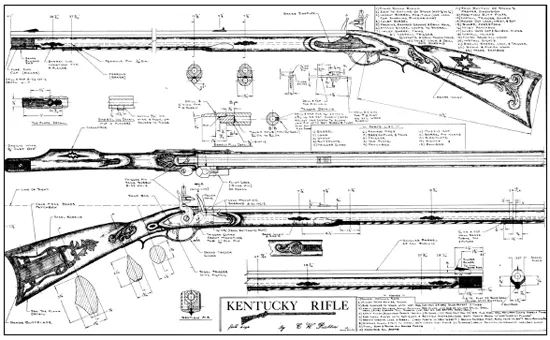
Diagrams of a Kentucky rifle, aka the American long rifle.
The long rifle was so called because of its lengthy rifled barrel. It was also known as “the Kentucky rifle” (“Kentucky” was once the catch-all word used to describe much of the little-known western wilderness of the Appalachians and beyond) and “the Pennsylvania rifle” (Lancaster and other Pennsylvania towns were a Silicon Valley of innovation and creativity for gunmakers in the 1700s).
When I first fired a vintage “black-powder” flintlock long rifle, I was struck by two things. As a Navy SEAL sniper, I was used to handling weapons weighing in the area of fifteen or sixteen pounds. But the typical American long rifle was around nine pounds, a sleek, surprisingly lightweight gun, more like a precision combat surgical instrument than a battlefield weapon. The process of firing the gun, on the other hand, is incredibly slow. You line up your shot through the superb sighting system and pull the trigger. Sparks shower as the flint strikes the frizzen pan. There’s a quick flash as the sparks ignite the powder in the pan, and a delayed sensation of contact in the gun. A little bit of smoke puffs from the pan as it ignites. A flash of flame passes through a hole into the breech of the barrel, which kicks off the powder charge behind the patched lead ball. Then a mass of gray smoke blasts out of the end of the barrel. The smoke fills the shooter’s whole field of vision. The rifle is so light that the recoil feels more like a push against the shoulder.
Long rifles were first designed and used primarily to kill small-to-medium-sized game on the frontier. Precision was at a premium—a rabbit or deer gave a hunter a relatively short time to fire; by the time you got the weapon reloaded, it would be gone. But rifles would also prove their worth against Indian raids. The bullet—actually a round ball anywhere from .25 to .75 caliber, though usually around .40 to .50—could do a good piece of damage to any target.
(Should I explain what we mean by caliber? In theory it’s the measurement of the barrel’s bore diameter, or in a rifle the size of the grooved interior hole, expressed in fractions of an inch—for instance, 32/100s of an inch equals .32 caliber. But when we’re talking about guns in the Revolutionary War era, it’s best to remember that the measurements and calibers were not anywhere near as standard as they are today. Bullet making was as much of an art as gun making; precision standardization and mass production were about a hundred years in the future.)
The weapon’s long barrel, extending from 35 inches to over 48 inches, gave the black powder extra time to burn, boosting the rifle’s accuracy and velocity. The long rifle had adjustable sights for long-distance accuracy; like modern rifles, the gun would be “sighted in” by its owner, tuning it not only to his needs and circumstances, but the weapon’s own distinct personality.
Since they were made by hand, no two long rifles were exactly alike. Granted, the majority might appear very similar to anyone except their rightful owner. But look closer, and each weapon’s uniqueness became obvious. Small variations in the wood furniture or the fittings were of course to be expected. Much larger innovations were also common—Sergeant Murphy, for instance, was believed to have had a double-barreled rifle. It was an over-under design, with one barrel above the other. The arrangement would have made it quicker for him to get off a second shot, a key asset in battle as well as hunting.
Warfare in the late eighteenth century was dominated by a very different gun, the smooth-bore musket. While the firing mechanisms used by muskets and rifles were pretty much the same, the barrels were decidedly not. As the name implies, a smooth-bore musket had a barrel that was smooth, not rifled; fire the gun and its bullet traveled down the tube as quick as it could. By design, the bullet was smaller than the inside of the barrel. This was necessary because deposits of burnt powder and cartridge tended to form on the inside as the weapon was fired. Gunmakers had learned from experience that under battlefield conditions, too tight a fit might lead to the gun misfiring—not a good situation. They designed their bullets to be snug, but not tight.
There was a downside to that. A bullet flying from a musket could only go so far on a given charge. Some of its energy was wasted in that open space around the ball. It also wasn’t necessarily that accurate. The farther the bullet got from the gun, the more likely it was to move in any direction but the one the shooter intended. Now, this wasn’t a problem at ten feet. But put yourself on a battlefield and engage an army at a few hundred yards, and you begin to see the limitations. Still, the musket was a considerable weapon. Contemporary tactics were organized around it; that’s why you see all those lines of soldiers in the historic paintings and reenactments. Truth be told, every important battle in the Revolution centered around those lines of men and their muskets.
The firearms the British used were generally Land Pattern Muskets, known informally as the “Brown Bess.” There were a number of variations on the same basic design; the most important was the Short Land Pattern, used by cavalry and other horsemen. Oftentimes, especially early in the war, the Americans used the Brown Bess, too. Later the French shipped large numbers of their various Charleville models. Like the long rifle, the muskets were flintlocks. Pulling the trigger released the flint to strike the frizzen; the spark ignited the gunpowder in the barrel and off went the bullet.
So why didn’t everyone use rifles, given their superior accuracy? The biggest problem had to do with how all guns were loaded in those days—through the muzzle. Pushing a bullet straight down a smooth, or nearly smooth, tube is a heck of a lot easier than getting it past one that’s rifled, particularly after the fouling caused by firing several rounds without time to clean. Now, I’ll give it to you that someone like our friend Murph could get the job done quickly under battle conditions, but Sergeant Murphy and his fellow riflemen were master marksmen, and something of an exception. They also had the advantage of not having to coordinate their fire (shooting on command in one group). A line of riflemen working at different paces would be quickly decimated by the most ragged row of musketmen all firing at the same time. They would load their weapons slower, and without time to clean them, have guns much more likely to jam.
Finally, while they were shorter, muskets generally had the advantage of being outfitted with bayonets. Rifles, originally designed for an entirely different type of job, did not. In many if not all battles, bayonet charges proved more deadly and more decisive than several rounds of gunfire.
But used in the right circumstances, a precision weapon like the rifle could be quite important. Traditionally, snipers have been deployed to take high-value targets at long range. And that’s exactly how they were employed in the Revolutionary War.
Which brings us back to our friend Sergeant Murphy, up there in that tree.
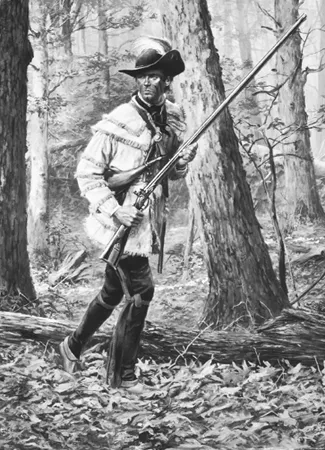
Murphy was a member of an elite brigade of riflemen under the command of Daniel Morgan. Colonel Morgan’s unit specialized in picking off British officers while they mustered their men on the battlefield. The idea was pretty simple: cut off the enemy’s head, and he floundered. The massed firing tactics that were so favorable to muskets depended on good coordination, which generally could only be provided by the officers in the field.
A member of Morgan’s Riflemen, with his tool: the American long rifle.
{Don Troiani (www.historicalimagebank.com)}
Throughout the war, British officers were horrified to see American riflemen like Timothy Murphy intentionally aiming at them. This went beyond even the guerilla tactics that had so decimated the British supply lines down from what is now Canada. To many British officers, deliberately aiming at them rather than firing generally at the mass of men on the front line was nearly akin to a war crime. The upper class that filled the officer ranks had never heard of such behavior before, and they were astounded. To them it seemed repulsive, very un-European tactic.
But it was definitely effective. The British feared the colonial riflemen so much they called them “widow-makers.” The best picture of the American long-riflemen comes from the unfortunate British troops who had to face them in battle. British Army Captain Henry Beaufoy wrote that his combat-hardened troops, “when they understood they were opposed by riflemen, they felt a degree of terror never inspired by general action, from the idea that a rifleman always singled out an individual, who was almost certain of being killed or wounded.” Another British officer reported that an expert rifleman could hit the head of a man at two hundred yards, and if he “were to get perfect aim at 300 yards at me, standing still, he would most undoubtedly hit me unless it were a very windy day.”
But their leaders had not fully absorbed the implications of the tactic, and on this day on the battlefield at Saratoga, several were sitting ducks out in the open, mounted on horses where they could be easily targeted. The most important of them was Simon Fraser, a Scottish aristocrat and British brigadier general who was massing his troops for a fresh charge on what would become known to historians as the Battle of Bemis Heights. Fraser’s commander, General Burgoyne, had launched a desperate attempt to break himself free of the rebels surrounding him. Hoping to lure the Americans ...