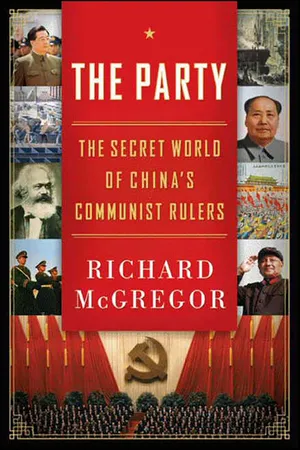
Nine men strode on to the stage in the Great Hall of the People, the imposing Soviet-style structure on the west side of Tiananmen Square, in the heart of Beijing, at the close of the 2007 congress of the Chinese Communist Party. Once they were assembled, an untrained eye might have had difficulty telling them apart.
The nine all wore dark suits, and all but one sported a red tie. They all displayed slick, jet-black pompadours, a product of the uniform addiction to regular hair-dyeing of senior Chinese politicians, a habit only broken by retirement or imprisonment. If anyone had had the chance to check their biographies, they would have noticed other striking similarities. All but one had trained as engineers, and all but two were in their mid-sixties. In any jobs they had occupied after graduation, the nine men had invariably doubled in party roles, making them full-time politicians for their entire working lives, even if that included undertaking or overseeing professional tasks for brief interludes. Their backgrounds varied slightly. Some had worked their way up from poverty. Others were princelings, the privileged offspring of former senior leaders. Their personal networks varied, but any fundamental political differences between them had been purged on their ascent through the ranks by the Party’s remorseless strictures.
In the time-honoured fashion of communist-era stage entrances, the nine had gently clapped themselves on to the podium as they walked into position for the up-coming ceremony. For the mass of media and government officials assembled to witness the ritual, carried out with a dark theatrical pomp, the most important thing was not how they walked on to the stage, nor the striking similarity of their appearance and career history. The key was in the order in which they appeared, as it cemented the hierarchy of the top leadership for the next five years, and laid out a line of succession for the entire decade to come, until 2022. Against the backdrop of a 20-metre-wide painting of an autumnal scene on the Great Wall, the nine stopped and stood to attention. Standing stiffly, they were ready to be introduced by the man at the head of the line, Hu Jintao, the General Secretary of the Communist Party, as the elected leaders of their country.
Ahead of the congress, the authorities had executed the well-honed security routines reserved for major political events. The guard on diplomatic compounds was doubled; police were stationed at highway intersections; and scores of scowling, plain-clothes security men materialized in the streets around the Great Hall of the People. Local scholars received circulars reminding them to keep their opinions to themselves. In September, a month before the congress, internet data centres were raided, with servers keeping literally thousands of websites shut down for weeks. On the fringes of the city, the authorities had set about demolishing the Petitioners’ Village area where many out-of-towners with grievances congregated.
For centuries, the central government has maintained a national petitions office in the capital to which citizens take complaints about official misconduct. Ahead of the congress, though, Beijing threatened to mark down the careers of local leaders if residents from their cities managed to get to the capital to make use of it. In case anyone got past the security cordon, the provinces maintain a last line of defence to protect the Politburo from the public, a string of ‘black jails’, or unregistered prisons, where local complainants can be held before being sent home. Detaining protesters according to this formula is akin to winning political points in the west for keeping the crime rate down.
State security, local activists, government officials and the foreign and Chinese media alike have all learnt over time to internalize the seasonal rhythms of repression that turn with the political calendar. Television interviews with important dissidents are best done months ahead of time. By the time the day itself comes around, physical access and even phone contact to critics of the Party is cut off. Wan Yanhai, an outspoken AIDs campaigner, was one of many activists whisked off the streets and taken into temporary custody. Wan was picked up and detained without charge for twelve hours ahead of the anniversary of the 4 June 1989 military crackdown, and again for a few days in August. ‘My freedom was restricted,’ he said, echoing the deadpan phrase that state security uses when they haul people off the streets. Wan had riled the Health Ministry by attempting to sue the government over a contaminated blood scandal. He kept himself on the radar of state security through his unabashed friendships with dissidents. On each occasion, Wan was kept in a hotel room while the authorities counselled him about his views on the Party. ‘They still care very much about controlling our thoughts,’ he said later.
In the years and months leading up to the choice of the leadership, there had been no public primaries, pre-selections or run-offs, and none of the noisy, blood-and-thunder clashes that are familiar events in the lead-up to western electoral contests. Following this drama for much of the time had been like standing outside a large, fortified castle surrounded by moats and guards, watching as lights were turned on and off and visitors whisked in and out. Raised voices could occasionally be heard from behind the thick walls. Once in a while there was hard evidence of conflict, as the casualties of corruption scandals, factional clashes or plain mismanagement were thrown out on to the street, to be carted off into retirement or prison. In the lead-up to the 2007 congress, the party boss of Shanghai, China’s commercial capital, had been toppled–the highest-level corruption scandal in a decade, and one that had taken years of tense negotiations among top leaders before it could be settled.
The Party has unveiled its new leadership and, by definition, the leadership of the government and the country, in the same way for decades. As in any high-stakes political showdown, the leadership candidates had been locked in complex, private negotiations, and in some cases bitter battles, long beforehand, directly, or through proxies and policy debates, over the economy, political reform and corruption. The Hong Kong and foreign press tracked the infighting as best they could, but the local media, naturally far better informed, were ordered to keep silent. The shroud pulled over the event turned the announcement into something rare in modern China, a live and public moment of genuine political drama and suspense. For ordinary Chinese, the precise identity and ranking of their new leadership was for all intents and purposes a secret until the moment they walked on to the stage into a blaze of television and flashing camera lights.
After leading the procession on stage, Hu spoke briefly, introducing each of the nine men by name. A Foreign Ministry official had described the event beforehand as a ‘meeting’ with the Politburo. ‘So can we ask questions?’ queried a reporter. ‘No,’ the official replied. ‘It’s a kind of one-way press conference.’ The next day, the local media reported it strictly in accordance with the Party’s dictates, along with the approved, sanitized biographies of the new Politburo members distributed by the official news agency. For anyone who lined up the Chinese newspapers side by side the next morning, or took snapshots of the home pages of websites, the effect was almost hallucinatory. The wording of the headlines and articles, and the choice, size and placement of photos, were all exactly the same.
Chinese leaders periodically express bafflement when critics suggest their ascension is somehow not democratic. A few months later, in May 2008, when visiting a school for Chinese children in Yokohama, Japan, Hu Jintao was asked by a guileless eight-year-old why he wanted to be president, a title that comes to him by rights these days, after being chosen as the head of the Party. After the nervous laughter in the classroom died down, Hu replied that he had not wanted the job. ‘It was the people in the whole country who voted me in, and wanted me to be the president. I should not let the people throughout the whole country down,’ he replied. Similarly, Jiang Zemin, Hu’s predecessor both as party secretary and president, told a US current affairs show in 2000, that ‘he was elected too’, although he did concede the two countries’ electoral systems ‘were different’.
During the 2007 congress, delegates were allowed, or in some cases ordered, to talk to the media in an effort to fashion a more transparent, friendly image for the Party in the outside world. It is not as though the Party does not have an interesting story to sell and, in recent years, a broader class of member to present to the world. Many of the private businessmen and women who joined the Party, or were able to acknowledge their existing membership, after Jiang Zemin pushed through approval for their presence in 2002, are ebullient figures with stirring rags-to-riches life stories. But even when the Party tries to force its best foot forward, it is evasive and suspicious.
When I met Chen Ailian, one of China’s newly minted millionaires, and a party member and delegate, she initially delighted in telling me about her business. Chen had the kind of mad and wonderful entrepreneurial story you hear often across China. She said she had entered the automotive business in the early 1990s, because she ‘loved cars’. Many millions of dollars in sales later, her private company had become the largest aluminium alloy wheel manufacturer in Asia and had opened offices in the US. Chen owned a Rolls-Royce (for special occasions), a Mercedes (for everyday use) and an Isuzu sports utility vehicle (for road trips). But once our conversation turned to the Party, she became more automaton than entrepreneur. To even the gentlest of questions, she adopted a reverential, whispering-in-church tone. Her answers became sombre, restrained and drained of life, consisting of little other than official slogans.
Atop of the system sits Hu. As General Secretary of the Communist Party, a position which ranks above his two other titles, as President and head of the military, he retains enormous power to set the parameters for government policy. An enigmatic figure even to political insiders, Hu had attempted to fashion an imperial-era image for himself in his first five-year term, starting in 2002, as a kind of benevolent emperor, whose interventions in policy and politics were as wise and weighty as they were rare. At one time identified with the reform camp, the clarity that marked his personal politics clouded over as he rose through the ranks as the heir-apparent in the early nineties.
The tools to enforce the refurbishment of his image were close at hand for a man of his office. His elderly aunt who had raised him from the age of five, and who had been, for a handful of foreign interviewers, a rare source of unfiltered information, had been stopped by local officials from talking to reporters soon after he was first named party secretary. The officials had even visited her house to remove pictures of him as a child and youth, lest they be handed out to reporters and the like, and become part of an independent narrative of his life not dictated by the Party itself. The pictures of a young Hu posted on the internet in 2009, seven years after his appointment, were harmlessly charming, of a fresh-faced high school student on class outings, but local officials at the time of his ascension did not want to take responsibility for their publication.
Hu had been careful not to flesh out any broader picture of himself, never granting an interview to either the local or foreign press in his first term. In the lead-up to the Beijing Olympics in August 2008, Hu did give a short press conference to twenty-five foreign journalists, only after all their questions had been carefully screened. His pronouncements that appear regularly in the People’s Daily, the Party’s mouthpiece, provided few firm clues about his personal views. One Chinese commentator likened his policy pronouncements to a duck walking, with one foot pointed to the right and the other to the left, maintaining an ungainly balance which looked stable only from a distance.
Hu’s severe image-management might have seemed like a conservative throwback to an earlier age of more authoritarian communism. In fact, compared to his predecessors, Hu was a bland figure, determinedly drained of flesh and blood. Deng Xiaoping, by contrast, had a revolutionary prestige, overlaid by the battle scars of years of struggle against Mao Zedong’s insane political campaigns. He proudly displayed his earthy Sichuanese roots, notoriously expectorating loudly into his spittoon while delivering to Margaret Thatcher an intimidating lecture about Hong Kong at a meeting in the early eighties in Beijing. Jiang Zemin, Hu’s immediate predecessor, delighted in singing in public and reciting extracts from the Gettysburg Address and other western canons in English. Mao, for all the horrors he inflicted on the Chinese people, was a charismatic figure renowned for his pithy aphorisms, which endure in China’s literary, political and business landscape.
Hu displayed neither Deng’s down-to-earth vigour, Jiang’s clownish chumminess nor Mao’s terrifying, homespun authority. He has no distinctive accent signalling his regional roots, nor any memorable quotes which have passed into everyday lore. A British diplomat arranging Hu’s presence at a session of the G-8 meeting in Gleneagles, Scotland, in 2005, designed to be an informal and free-flowing meeting between leaders, was given short shrift about the proposed format by his Chinese interlocutor. ‘President Hu does not do free-flowing,’ he was told. The apotheosis of the professional party bureaucrat, Hu was a cautious, careful consensus-builder, a ‘hao haizi’ or ‘good boy’, according to his more cutting local critics. But far from being old-fashioned, Hu’s low-key, self-effacing qualities made him very much a man for the times. China’s modern complexities mean the Party, Hu’s peers and even the people themselves can no longer stomach strong-man rule of the likes of Mao and Deng. In Mao’s and Deng’s days, the leaders towered over the Party. For all his power, Hu lived in the Party’s shadow, rather than the other way round.
The way the Party has grown at the expense of its leaders dictated Hu’s low profile long before his promotion to party secretary. After he emerged as the heir-apparent on his elevation to the Politburo Standing Committee in 1992, Hu’s lack of a Politburo power base afforded him no room for error in the competition for the party secretary’s job. By the time he took office ten years later, he had few of his loyalists in place as a result and no detailed political programme pre-positioned, which the bureaucracy could internalize and act on. Hu did not begin to gain genuine ascendancy over the vast party apparatus, both in Beijing and in the rest of the country, until well into the second of his two five-year terms. Most US presidents become lame ducks in the last years of their final term. So topsy-turvy is the Chinese political system that Hu, like Jiang Zemin before him, only really consolidated power by the time he was approaching the end of his period in office.
With the public shut out of formal politics, few ordinary citizens could even recognize most of the nine men in the Politburo’s inner circle who lined up on stage at the congress’s closure. Hu, of course, was a familiar face, if not a familiar personality. Wu Bangguo, at number two, and head of the legislature, was a colourless Shanghai functionary who had risen without a trace to the near-top of the leadership. Wen Jiabao, the Premier, ranked number three, had skilfully cultivated an image as a man of the people, in contrast to the hard-earned notoriety of his wife and son for their business dealings.
Jia Qinglin, who strode out in fourth position, was a big man, tall and flush, and bursting out of his suit like someone who had enjoyed too many banquets. Unlike most of his colleagues, Jia was well known, only because of his alleged corruption. Jia presided over Fujian province during one of China’s worst graft scandals, the Yuanhua case, a $6 billion customs fraud. Numerous officials have already been executed and jailed for their crimes, but Jia, and his wife, also the target of allegations, have never been called to account, either because there is not enough evidence against them, or, more likely, because they have been protected by political allies. As he stood on stage and stared out at the assembled media, many of whom had expected him to be toppled and disgraced in the lead-up to the congress, Jia’s ruddy face had the defiant sneer of a triumphant, well-nourished political survivor.
Other members of the Standing Committee, including two in their fifties, who are Hu’s designated successors, were only vaguely recognizable in the provinces they once governed. By the time he joined the Standing Committee, Xi Jinping, ranked number six, and anointed as the heir-apparent, was less well known than his wife, a famous singer with a military rank in the People’s Liberation Army. Some of the men on stage had profiles in the sectors, such as the media and policing, that they had presided over. But for most Chinese, the Politburo was a distant body, bloated with power, but devoid of character and personality.
Hu’s speech was brief and couched in the arcane political slogans that dominate all official public political discussion, about ‘scientific development’, the ‘harmonious society’, an ‘advanced socialist culture’, and so on. Heavy with import inside the Party and intellectual circles as the branding buzzwords of Hu’s administration, they are largely meaningless to the population at large. After concluding his remarks, Hu led his eight colleagues off stage. In the coming years, the Politburo’s inner circle would rarely ever appear in public as a group again. The whole ceremony had lasted about ten minutes.
On the desks of the heads of China’s fifty-odd biggest state companies, amid the clutter of computers, family photos and other fixtures of the modern CEO’s office life, sits a red phone. The executives and their staff who jump to attention when it rings know it as ‘the red machine’, perhaps because to call it a mere phone does not do it justice. ‘When the “red machine” rings,’ a senior executive of a state bank told me, ‘you had better make sure you answer it.’
The ‘red machine’ is like no ordinary phone. Each one has just a four-digit number. It connects only to similar phones with four-digit numbers within the same encrypted system. They are much coveted nonetheless. For the chairmen and women of the top state companies, who have every modern communications device at their fingertips, the ‘red machine’ is a sign they have arrived, not just at the top of the company, but in the senior ranks of the Party and the government. The phones are the ultimate status symbol, as they are only given out to people in jobs with the rank of vice-minister and above. ‘They are very convenient and also very dangerous,’ said an executive of a large state resources company. ‘You want to be sure of your relationship with whichever person you call.’ Down the corridor from the executive offices is an additional tool for ranking officials, an internal communications room which receives secure faxes from Zhongnanhai, the leadership compound, and other sections of the party and government system.
‘Red machines’ are dotted throughout Beijing in offices of officials of the requisite rank, on the desks of ministers and vice-ministers, the chief editors of party newspapers, the chairmen and women of the elite state enterprises and the leaders of innumerable party-controlled bodies. The phones and faxes are encrypted not just to secure party and government communications from foreign intelligence agencies. They also provide protection against snooping by anyone in China outside the party’s governing system. Possession of the ‘red machine’ means you have qualified for membership of the tight-knit club that runs the country, a small group of mainly men, with responsibility for about one-fifth of humanity.
The modern world is replete with examples of elite networks that wield behind-the-scenes power beyond their mere numerical strength. The United Kingdom had the ‘old boy network’, originally coined to describe connections between former students of upper-class, non-government schools; France has ‘les énarques’, the alumni of the exclusive Ecole Nationale d’Administration in Paris who cluster in the upper levels of commerce and politics; and Japan has the Todai elite, graduates of the law school of Tokyo University, an entry point into the longtime ruling Liberal Democratic Party, the Finance Ministry and business. In India, the exclusive Gymkhana Club symbolizes the English-educated elite. The US has the Ivy League, the Beltway, K Street and the military-industrial complex, and a host of other labels to signify the opaque influence of well-connected insiders.
None can hold a candle to the Chinese Communist Party, which takes ruling-class networking to an entirely new level. The ‘red machine’ gives the party apparatus a hotline into multiple arms of the state, including the government-owned companies that China promotes around the world these days as independent commercial entit...