![]() THE DRESSES
THE DRESSES![]()
SAFETY-PIN GOWN
Gianni Versace | 1994
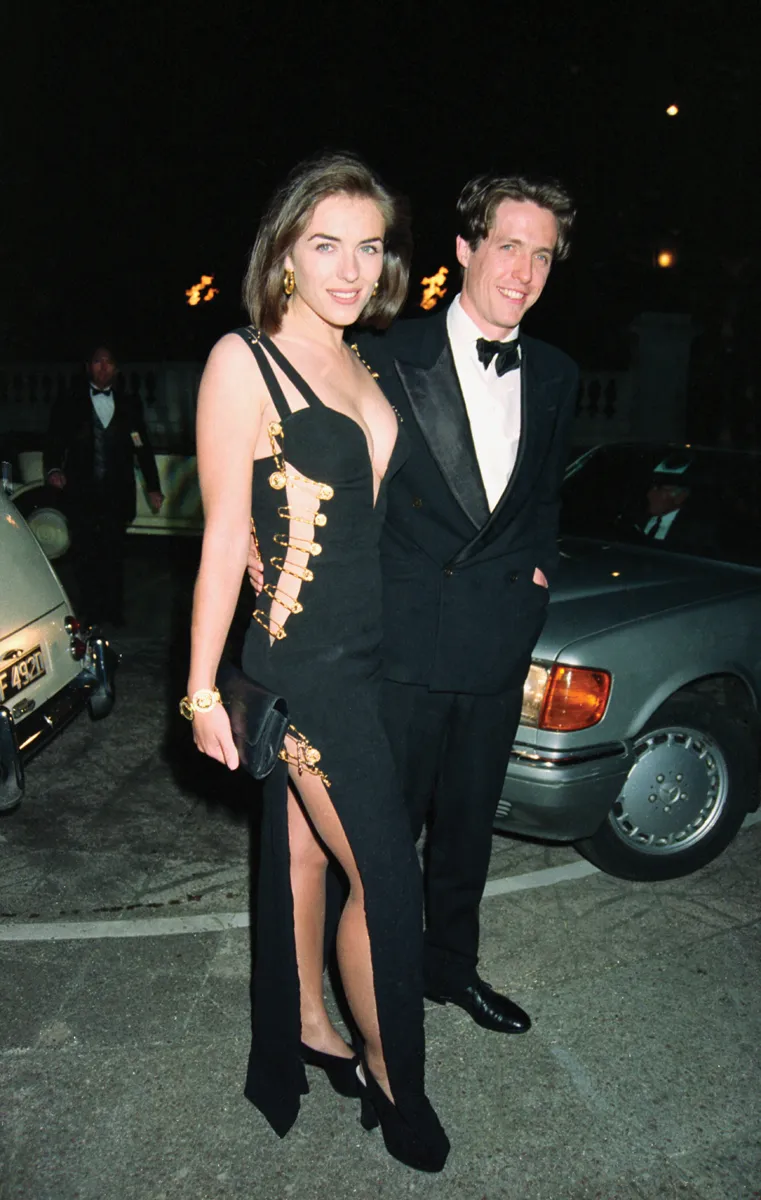
Quick, name five Elizabeth Hurley movies. All right, then, can you name three? The truth is not a single screen performance is responsible for branding Elizabeth Hurley into our collective memory. And yet, she is emblazoned there, thanks to her having stepped out one night in the sartorial equivalent of the shot heard ’round the world. All it took was one dress—“That Dress”—as it was tagged by the media the morning after Hurley’s appearance at the world premiere of Four Weddings and a Funeral in London. Upending her usual tabloid-captioned capacity as Hugh Grant’s girlfriend, Hurley stepped out of a limo and into the paparazzi’s viewfinders. Suddenly, Grant, his soon-to-be-hit romantic comedy, his costars—in fact, every other rival—fell out of favor and focus. Instead, the twenty-nine-year-old sassy beauty and Gianni Versace’s devilishly engineered safety-pin gown were instantly rendered inseparable, incredible, combustible, derisible, and ultimately, globally inescapable.
Hurley didn’t pick the dress from endless racks of stylists’ options herself, nor was it deliberately chosen for maximum shock effect (though there was no doubt she savored the outcome, and the lack of fallout, so to speak). Gianni Versace, whom Hurley knew through their mutual friend Elton John, had selected and shipped it off to Hurley fresh from his Milan Fashion Week runway. The premiere was just weeks after Versace had presented his spring 1994 collection, in which Hurley’s chosen gown was but one in a series of similarly brilliantly precarious looks climaxing a deliciously, progressively taunting runway parade in which Medusa-headed safety pins (the Versace logo is a representation of Medusa) dominated. The show had started simply enough, with tailored daytime suits: the skirts closed with a single pin, invoking the innocence commonly associated with pleated plaid parochial-school uniforms. But as the show proceeded, the pins grew larger and more numerous, less designed to preserve virtue than to hold together the increasingly risqué slits and slashes strategically set into Versace’s dresses and gowns.
Any devoted buyer or knowing critic was hardly surprised and, in fact, often relished the designer’s sexual bravado at this point in his career. Nevertheless, virtually everyone at the show, from the front row to the last, was either wide-eyed or drop-jawed, if only in admiration for the collection’s brilliant engineering. But Versace had repeatedly insisted that there was nothing inherently sexy about his clothes. “On a hanger, no dress is sexy,” he said. “It’s just fabric on a hanger. My clothes only come alive on the woman who knows how to be sexy in them.” In a post-premiere-frenzy interview, where he went so far as to deny that there’d even been a fitting, Versace claimed he “knew Elizabeth would look simply bellissima, perfetto in that dress. Liz has this intelligent face attached to that very naughty body. So seeing a woman like her in this gown was a guarantee that everyone would go pozzo [nuts].”
As for the secret as to how the silk crepe gown’s ravine-deep neckline, thigh-high slit, double-fastened straps, and open rib cage, secured by a half dozen pronged Medusas, managed to stay in place long enough for Hurley to become legendary overnight instead of arrested for indecent exposure, Versace insisted, “There was never any danger.” Brushing aside all doubt with a flick of his wrist and a coy smile, he added, “That’s why you call them safety pins, my dear.”
![]()
MING-VASE GOWN
Roberto Cavalli | 2005
In 2010 Roberto Cavalli celebrated his fortieth anniversary in fashion by presenting a collection of over forty looks, every one of them the equivalent of a finale gown, and for Cavalli, there is no finale without laser-cut pony skin, crystals cross-stitched into leather, gold leafing on python, feathers woven into chiffon, hand-painted floral lace, and brilliants trapped in a silk-net overlay—sometimes all in the same dress. The only thing Roberto Cavalli loves more than extravagance is women.
Roberto Cavalli is fashion’s Guido Anselmi, Fellini’s alter ego in 8½, but with a thimble instead of a camera and none of the tormented angst. A show-off with a smile, Cavalli sees no point in making a gesture unless it’s grand. He spent two million dollars on the anniversary party that followed his show; he owns both a yacht and a vintage Mercedes with iridescent paint jobs so intense they change from light pink at sunrise to teal at high noon to royal purple at sunset and to navy in moonlight. He got tired of waiting for a table at a favorite industry restaurant in Milan, so he designed and opened his own place in the middle of a Milanese park, with soaring glass walls and a bar stocked with rows of Roberto Cavalli Vodka. He seeks technological innovation in fabric painting, leather tanning, and weaving techniques and has a weakness for exotic skins, but all of the above is on track with a man who started his career in 1971 by being the first designer to patchwork glove-soft leather into full-length jackets, now a common practice. “When you come from Florence,” he says, “you can’t help but breathe in art as if it’s air. It affects your brain and makes you want to do incredible things.” By the way, he made the jacket in a fit of inspiration, “to impress a woman I was seeing that night.”
Given all that, it’s easy to imagine the designer fixating on a rare Ming vase that he had bought at an auction for one of his homes. “I kept staring at it, thinking, this is too beautiful to keep to myself.” He took pictures of the vase and sent them to several textile factories, finally finding one willing to silk-screen the delicate intricacy of its multiblue-hued floral and dragon-framed landscape. (Cavalli loves serpents and things that slither. An embossed-glass snake encircles his eponymous frosted-bottled vodka.) The result is a gown that nearly approximates the shape and asymmetrical balance of his prized antique. “The only problem,” says Cavalli, “is that it took so long to weave the manufacturer would only give me enough material to make one dress.” To his own surprise, Cavalli resisted adding beading, embroidery, or crystals. “I wanted it pure. For me, this was restraint.” The gown was the standout of his spring 2005 collection.
Not one for understatement either, Victoria Beckham begged Cavalli to let her wear it to her friend Elton John’s annual White Tie & Tiara Ball in London. Cavalli was utterly tickled with the idea of someone whom most people perceive as being hard wearing a version of something so fragile. “The truth is, Victoria is funny and very sweet, and if anyone is ever going to have the last laugh, it’s going to be her. She knows exactly what she is doing.” Happily, she also happens to be sample size. Cavalli credits Beckham with making the dress even better than when it was first shown on the runway. After trying on the dress, “Victoria insisted on one change. In order to make it really appear more like the shape of a vase, she insisted I take the dress in at the bottom so tightly that she wouldn’t be able to sit down. She wouldn’t wear the dress otherwise. I did exactly what she asked me to do, and she stood the whole night.”
“I really don’t understand minimalism. It’s so polite and boring. If you don’t want anyone to notice you, you should stay home and grow your own vegetables.”
—ROBERTO CAVALLI
![]()
YELLOW CHIFFON GOWN
Jean Dessès | c. 1955
There was a time when the term “vintage” was never applied to any garment less than fifty years old. Then it was fudged to twenty-five. Now the word is meaningless, used to cite anything that isn’t current, a euphemism for turning something old and something borrowed into something special. A true vintage dress on a red carpet is as rare as a film about middle-aged romance. So when a rare sighting of authentic vintage does come along, it really is a treat.
The Egyptian-born, Paris-based clothing designer Jean Dessès first made his name in jersey, then became famous for his work in chiffon in the 1950s. His canary-yellow gown, worn by Renée Zellweger to the Oscars in 2001, dates back to about 1955 (four years shy of an official vintage “diploma,” but in light of what passes for vintage, it’s downright ancestral) and represents one of the actress’s most winning trips down the red carpet and one of the designer’s most successful experiments in finding ways to drape and gather chiffon without increasing volume or weight.
What is striking about the dress is not only how contemporary it looks but the way the bust is so perfectly fitted and that the silhouette appears so lean despite the fact that, from the sternum, two arcs of curtain-draped chiffon sweep down the front, then around to the back to form a modest train—all without adding bulk.
In addition to that elegantly innovative engineering, Zellweger offset the vintage aura by wearing her hair down and loose, making the total effect sexy, carefree, and modern. By contrast, whoever got zipped into this dress first, most likely wore her hair in a French twist or in a prim Grace Kelly–esque pageboy for a more temple-goddess effect. Wearing the Dessès was one of the few times Zellweger broke from her unofficial public appearance alliance with Carolina Herrera, but even Herrera would have to forgive her having strayed, since Renée looked as smashing at thirty-two as the dress did at nearly fifty.
![]()
BLACK GOWN WITH WHITE STRIPES
Valentino | 1982
Julia Roberts has never been one to run to a stylist every time she has to go outside. She happily admits to not being a clotheshorse, not fretting over what she is going to wear to events. One of the reasons why she has favored tuxedoes for big nights out is because they are “easier.” Yet, to accept her Best Actress Academy Award in 2001 for Erin Brockovich, she chose one of the most starkly sophisticated and enduringly populist gowns of all time. And in typical throwaway fashion, Roberts took no credit for the idea; she says her niece, actress Emma Roberts, chose it for her.
Pulled from the Valentino archives from his fall 1982 couture collection, stripped of ornamentation, the strapless black velvet is basic. But the gown is divided in half by a white satin stripe that goes straight up the torso, splitting into a V at the neckline to form a thin-strapped halter. However, once over the shoulder, the two straps join five other straps to form multiple chevrons that go down the back like a trellis. At the waist, the stripes multiply yet again, into over a dozen paths down the back of the full skirt with train. The stark geometry of the dress was made even more dramatic by Roberts’s choice to wear her hair in an uncharacteristically formal series of knots atop her head.
Even prior to Roberts’s appearance, the gown was always one of Valentino’s best sellers, so much so that variations of it appeared in his collections for several seasons after its initial presentation. In fact, the reason publications have often pegged Roberts’s gown incorrectly to 1992 is that Valentino presented an almost line-for-line copy of it that year. However, seeing the Oscar winner looking so elegant ensured that Valentino would let those lines go on and on, at least for a few years more.
![]()
BALL GOWN FOR THE KING AND I
Irene Sharaff | 1956
Naturally, credit must go to Rodgers and Hammerstein for the glorious score, as well as to the citizens of nineteenth-century Bohemia who thought it might be fun to dance a hop-step-close-step in 2/4 time. But if you love The King and I, each time the brass section slows to swell as Yul Brynner finally takes Deborah Kerr firmly by the hand to lead her around the highly polished vast floor of his epically large palace, you hold your breath in anticipation, knowing at the first downbeat on the kettle drum you are about to witness one of the most exuberant yet unaffected dance numbers in the history of film.
There is nothing amazing about the choreography in “Shall We Dance?” The dance is a basic polka, devoid of the dexterity with which it would be manically performed almost weekly on The Lawrence Welk Show, too banal a routine to be atop the leaderboard on Dancing with the Stars. Neither of the film’s stars was a trained dancer. (Kerr didn’t even do her own singing. Ma...