![]()
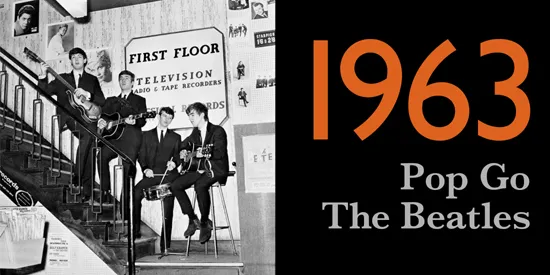
POP GO THE BEATLES. The group did not choose the title for their fifteen-part series broadcast during the summer of 1963 and they had reluctantly recorded the corny theme tune simply because they had to. After all, some compromise was acceptable to make their way in the show business world. Yet what made The Beatles so irresistible in their breakthrough year was how quickly they were changing the game. Aside from the energy of the music they created, their BBC broadcasts are characterized by send-ups, laughs, cheeky irreverence. This was new.
Their youthful exuberance was exactly what the UK needed as an alternative to news of a sleazy scandal engulfing the Conservative government. Revelations regarding the behaviour of MP John Profumo emerged from March onwards. Call girl Christine Keeler had a brief affair with the Secretary of State for War in 1961. She also had a liaison with a USSR diplomat Captain Yevgeny Ivanov who was, in fact, a Soviet spy. Profumo’s impropriety, it was argued, had endangered national security. Having knowingly misled the House of Commons about his relationship with Keeler, he was forced to resign on 4 June 1963.
In America, The Beatles were largely unknown. Capitol Records, although owned by EMI Records, declined to release the group’s material in the US. Licensed to independent labels, the records made no impact on the air or in the charts during 1963. The most successful pop groups in the States were The Beach Boys from the West Coast and The 4 Seasons from the East. There was also a burgeoning US folk movement with singers writing topical songs. On 28 August 1963, when 250,000 people in the ‘March on Washington for Jobs and Freedom’ reached the Lincoln Memorial, Bob Dylan, Joan Baez, and Peter, Paul and Mary sang for them. Martin Luther King, Jr. made his epochal ‘I have a dream’ speech on that day. He outlined his vision that ‘my four little children will one day live in a nation where they will not be judged by the colour of their skin, but by the content of their character. I have a dream today.’ The year ended in tragedy. President John F. Kennedy was assassinated on 22 November 1963. The USA entered a 30-day period of official mourning.
In 1963, The Beatles left Liverpool to live in London. The capital city was a vibrant centre for new ideas in music, fashion, theatre, art and cinema. They embraced it all. In the early years of the 1960s, provincial life had been portrayed in powerful ‘kitchen sink’ dramas such as Saturday Night and Sunday Morning and The Loneliness of the Long Distance Runner . Another in the sequence, Billy Liar , was released in 1963. In the final scene, Tom Courtenay’s title character continues to live his life in a northern town; his girlfriend played by Julie Christie boards the train for London and new horizons. Black and white realism on film was making way for colourful flamboyance, as seen in the Oscar-winning Tom Jones and the most expensive movie ever made to this point – the epic Cleopatra starring Richard Burton and Elizabeth Taylor.
While the UK was still in a sombre mood following the assassination of President Kennedy, the first episode of Doctor Who was broadcast on 23 November. Earlier, in the summer, ITV had commissioned the pop show Ready Steady Go! – bringing the latest chart records, dances and stylish clothes to the screen every Friday evening, the programme assured viewers, ‘The weekend starts here.’ The Beatles made their first Ready Steady Go! appearance on 4 October 1963 to mime to ‘Twist And Shout’, ‘I’ll Get You’ and their current number one ‘She Loves You’. Just a few days before, the Leader of the Opposition, Harold Wilson, made a forward-looking speech at the Labour Party Conference promising that Britain under his premiership would be ‘forged in the white heat of the . . . scientific revolution’. His message was clear: out with the old, in with the new.
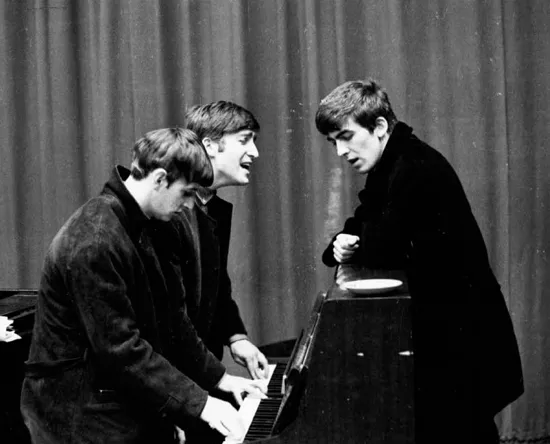
Relaxing during a recording session for Side By Side at the BBC Paris Theatre in Lower Regent Street, London – 4 April 1963. None of The Beatles’ songs recorded for the BBC featured piano playing.
AT THE BEGINNING OF 1963, Britain was experiencing its worst winter weather since 1947. The country shivered through freezing temperatures at a time when few houses had the luxury of central heating. Most of the land was covered in deep snow, making transport difficult. Undaunted, The Beatles spent many hours during those cold early months of 1963 in a van driven by their friend Neil Aspinall. They journeyed up and down the country to appear onstage at theatres and ballrooms and to perform in radio and TV studios. Before this breakthrough year, the group had worked hard at their craft – particularly at all-night sessions in the clubs of Hamburg – getting better all the time. The pressure of The Beatles’ schedule never eased for a moment in 1963, but they were match-fit. Their musical expertise combined with the discipline and stamina to work incessantly proved to be an unbeatable formula. BBC radio and television embraced the group. The Beatles’ voices and faces became familiar through the wireless and the telly.
‘At the moment, the majority of The Beatles’ fans are in their home town of Liverpool and I have a very strong suspicion it won’t be long before they’re all over the country.’ So predicted Brian Matthew during Saturday Club on 26 January 1963 – the first time The Beatles were heard performing songs on the Light Programme’s premier pop show. From ten o’clock to noon every Saturday, ‘your old mate’ Brian Matthew introduced a range of musical styles represented by artists ranging from Terry Lightfoot and his New Orleans Jazzmen (who were really from the suburban town of Potters Bar) to a genuine rock ’n’ roll star like Eddie Cochran. Saturday Club reached an enormous audience of aro...