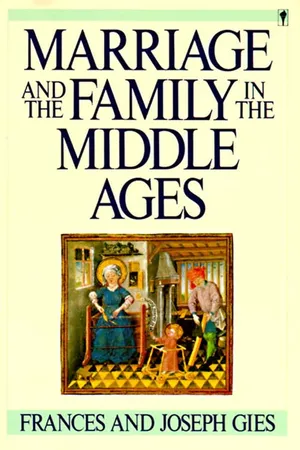
Marriage and the Family in the Middle Ages
eBook - ePub

Marriage and the Family in the Middle Ages

  1. 384 pages
  2. English
  3. ePUB (mobile friendly)
  4. Available on iOS & Android
eBook - ePub

Marriage and the Family in the Middle Ages

About this book

From bestselling historians Frances and Joseph Gies, authors of the classic “Medieval Life” series, comes this compelling, lucid, and highly readable account of the family unit as it evolved throughout the Medieval period—reissued for the first time in decades.

“Some particular books that I found useful for Game of Thrones and its sequels deserve mention. Life in a Medieval Castle and Life in a Medieval City, both by Joseph and Frances Gies.” —George R. R. Martin, author of Game of Thrones

Throughout history, the significance of the family—the basic social unit—has been vital. In Marriage and the Family in the Middle Ages, acclaimed historians Frances and Joseph Gies trace the development of marriage and the family from the medieval era to early modern times. It describes how the Roman and barbarian cultural streams merged under the influence of the Christian church to forge new concepts, customs, laws, and practices. Century by century, the Gies follow the development—sometimes gradual, at other times revolutionary—of significant components in the history of the family including:

  • The basic functions of the family as a production unit, as well as its religious, social, judicial, and educational roles.
  • The shift of marriage from private arrangement between families to public ceremony between individuals, and the adjustments in dowry, bride-price, and counter-dowry.
  • The development of consanguinity rules and incest taboos in church law and lay custom.
  • The peasant family in its varying condition of being free or unfree, poor, middling, or rich.
  • The aristocratic estate, the problem of the younger son, and the disinheritance of daughters.
  • The Black Death and its long-term effects on the family.
  • Sex attitudes and customs: the effects of variations in age of men and women at marriage.
  • The changing physical environment of noble, peasant, and urban families.
  • Arrangements by families for old age and retirement.

Expertly researched, master historians Frances and Joseph Gies—whose books were used by George R.R. Martin in his research for Game of Thrones—paint a compelling, detailed portrait of family life and social customs in one of the most riveting eras in history.

Frequently asked questions

Yes, you can cancel anytime from the Subscription tab in your account settings on the Perlego website. Your subscription will stay active until the end of your current billing period. Learn how to cancel your subscription.
No, books cannot be downloaded as external files, such as PDFs, for use outside of Perlego. However, you can download books within the Perlego app for offline reading on mobile or tablet. Learn more here.
Perlego offers two plans: Essential and Complete
  • Essential is ideal for learners and professionals who enjoy exploring a wide range of subjects. Access the Essential Library with 800,000+ trusted titles and best-sellers across business, personal growth, and the humanities. Includes unlimited reading time and Standard Read Aloud voice.
  • Complete: Perfect for advanced learners and researchers needing full, unrestricted access. Unlock 1.4M+ books across hundreds of subjects, including academic and specialized titles. The Complete Plan also includes advanced features like Premium Read Aloud and Research Assistant.
Both plans are available with monthly, semester, or annual billing cycles.
We are an online textbook subscription service, where you can get access to an entire online library for less than the price of a single book per month. With over 1 million books across 1000+ topics, we’ve got you covered! Learn more here.
Look out for the read-aloud symbol on your next book to see if you can listen to it. The read-aloud tool reads text aloud for you, highlighting the text as it is being read. You can pause it, speed it up and slow it down. Learn more here.
Yes! You can use the Perlego app on both iOS or Android devices to read anytime, anywhere — even offline. Perfect for commutes or when you’re on the go.
Please note we cannot support devices running on iOS 13 and Android 7 or earlier. Learn more about using the app.
Yes, you can access Marriage and the Family in the Middle Ages by Frances Gies in PDF and/or ePUB format, as well as other popular books in History & European History. We have over one million books available in our catalogue for you to explore.

Information

Publisher
Harper
Year
2010
Print ISBN
9780060914684
eBook ISBN
9780062016737
Notes
Chapter 1. Historians Discover the Family
1. Donald R. Bender, “A Refinement of the Concept of Household: Families, Co-Residence, and Domestic Function,” American Anthropologist 69 (1967), pp. 495–504.
2. Michael Mitterauer and Reinhard Sieder, The European Family: Patriarchy to Partnership from the Middle Ages to the Present, trans. Karla Oosterveen and Manfred Hörzinger, Chicago, 1982, pp. 6–7.
3. FrĂ©dĂ©ric Le Play, L’Organisation de la famille selon le vrai modĂšle signalĂ© par l’histoire de toutes les races et tous les temps, Paris, 1871.
4. Philippe AriĂšs, Centuries of Childhood: A Social History of Family Life, trans. Robert Baldick, London, 1962.
5. Peter Laslett and Richard Wall, eds., Household and Family in Past Time, Cambridge, 1972; Peter Laslett, “The Comparative History of Household and Family,” Journal of Social History 4 (1970), pp. 75–87; Peter Laslett, “La Famille et le mĂ©nage: approches historiques,” Annales: Economies, SociĂ©tĂ©s, Civilisations 27 (1972), pp. 847–872; E. A. Hammell and Peter Laslett, “Comparing Household Structure over Time and Between Cultures,” Comparative Studies in Society and History 16 (1974), pp. 73–109.
6. Mitterauer and Sieder, The European Family; Jean-Louis Flandrin, Families in Former Times: Kinship, Household, and Sexuality, trans. Richard Southern, Cambridge, 1979; Robert Wheaton and Tamara K. Hareven, eds., Family and Sexuality in French History, Philadelphia, 1980.
7. David Herlihy, Medieval Households, Cambridge, Mass., 1985.
8. Georges Duby and Jacques le Goff, eds., Famille et parentĂ© dans l’Occident mediĂ©val, Rome, 1977.
9. Georges Duby, Medieval Marriage: Two Models from Twelfth-Century France, trans. Elborg Foster, Baltimore, 1978; and The Knight, the Lady, and the Priest: The Making of Modern Marriage in Medieval France, trans. Barbara Bray, New York, 1983.
10. Heath Dillard, Daughters of the Reconquest: Women in Castilian Town Society, 1100–1300, Cambridge, 1985; Christiane Klapisch-Zuber, Women, Family, and Ritual in Renaissance Italy, Chicago, 1985; Christine Fell, Women in Anglo-Saxon England and the impact of 1066, Bloomington, Ind., 1984; Suzanne Fonay Wemple, Women in Frankish Society: Marriage and the Cloister, 500 to 900, Philadelphia, 1981; Barbara Kenner, ed., The Women of England from Anglo-Saxon Times to the Present, Hamden, Conn., 1979; Frances and Joseph Gies, Women in the Middle Ages, New York, 1978.
11. David Herlihy and Christiane Klapisch-Zuber, Tuscans and Their Families: A Study of the Florentine Catasto of 1427, New Haven, 1985.
12. David Nicholas, The Domestic Life of a Medieval City: Women, Children, and the Family in Fourteenth-Century Ghent, Lincoln, Nebr., 1985.
13. Barbara A. Hanawalt, The Ties That Bound: Peasant Families in Medieval England, Oxford, 1986.
14. Lawrence Stone, The Family, Sex and Marriage in England, 1500–1800, New York, 1977.
15. Laslett, “Comparative History of Household and Family.”
16. Robert Wheaton, “Family and Kinship in Western Europe: The Problem of the Joint Family Household,” journal of Interdisciplinary History 5 (1975), pp. 601–628. Also Tamara K. Hareven, “The Family as Process: The Historical Study of the Family Cycle,” Journal of Social History 7 (1974), pp. 322–329.
17. Marion J. Levy, Jr., “Aspects of the Analysis of Family Structure,” in Ansley J. Coale et al., eds., Aspects of the Analysis of Family Structure, Princeton...

Table of contents

  1. Cover
  2. Title Page
  3. Dedication
  4. Contents
  5. I. Origins
  6. II. The Early Middle Ages
  7. III. The High Middle Ages
  8. IV. The Late Middle Ages
  9. V. The End of the Middle Ages
  10. Bibliography
  11. Notes
  12. Index
  13. P.S. Insights, Interviews & More . . .*
  14. Also by Frances Gies
  15. Copyright
  16. Copyright Acknowledgments
  17. About the Publisher