![]()
CHAPTER 1
THE POSTMODERNIST
On the night of September 9, 2009, a still highly popular President Barack Obama spoke spiritedly to a joint session of Congress. He had summoned the members of both parties to introduce his plan to transform American health care. The promises he made that night were many and, to most in the television audience at least, sounded fresh. “Nothing in this plan will require you or your employer to change the coverage or the doctor you have,” said the president. “Let me repeat this: Nothing in our plan requires you to change what you have.”
If the assembled Democrats found reason to applaud, the Republicans did not. There was little about the proposals that appealed to any of them. Nor could they have liked being scolded by Obama for the “scare tactics” they had presumably used to block reform and the “partisan spectacle” they had presumably created. “Well, the time for bickering is over,” Obama warned the presumed bickerers sternly. “The time for games has passed.”
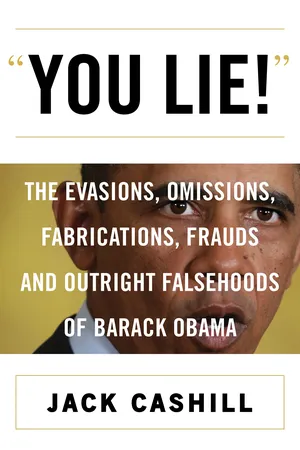
Simmering throughout this public spanking was an obscure five-term South Carolina congressman named Joe Wilson. He had taken abuse long enough. When Obama denounced as false the claim that this proposed health care system “would insure illegal immigrants,” Wilson could hold his tongue no longer. “You lie,” he said, but widespread Republican grumbling drowned him out.
Obama elaborated, saying, “The reforms—the reforms I’m proposing would not apply to those who are here illegally.” Now Wilson burst out even louder, “You lie!” and this time there was no crowd noise to cover him. A distracted Obama turned his head to the source of the outburst, and as he did, the Democrats erupted in the kind of indignant gasp one hears in a playground before the cry of “I’m telling.”
For his part, Wilson promptly apologized. “While I disagree with the president’s statement,” said Wilson soon after the speech, “my comments were inappropriate and regrettable. I extend sincere apologies to the president for this lack of civility.” Apology or not, respectable Republicans rushed to the microphones to denounce Wilson’s remarks, and Democrats rushed to their direct mail vendors to exploit them.
Forgetting for the moment that Senate Majority Leader Harry Reid had admittedly called President George W. Bush a “liar” on multiple occasions and a “loser” at least once, the Beltway punditry convinced itself that Wilson had done something unprecedented, had led his party across a rubicon of coarseness into a brash new world. Unaware perhaps that a Democratic congressman from his home state had once clubbed a Republican senator nearly to death, House Majority Whip James Clyburn from South Carolina called Wilson’s behavior “embarrassing” and “a new low” for the state’s congressional delegation.
Missed in the hubbub over Wilson’s remark, however, was the particular nature of his locution, “You lie.” He might have said, “That’s a lie” or, “You’re lying,” but, in fact, Obama’s health care reforms did not apply to illegal aliens. No one really expected that promise to hold, but technically Obama was not lying. As history records, Wilson could have safely shouted out “That’s a lie” on at least five other occasions during that same speech. He did not. Instead he made the existential declaration “You lie.” So saying, Wilson spoke to what he saw as the very essence of the man: Sinatra sings, Astaire dances, Obama lies.
Five years later, almost all Republicans and more than a few Democrats would agree with Wilson’s assessment. Obama has subjected America to what Marc Thiessen described in the Washington Post as “a fundamentally dishonest presidency.” This was not easily accomplished. It took a near perfect alignment of environmental factors to elevate to the White House a man who, in the words of the veteran civil libertarian Nat Hentoff, “doesn’t give a damn, because he can get away with whatever he wants.”
Get away Obama does. Before his second term was halfway through, Obama would be caught in major lies on any number of critical issues, such as the terrorist assault on the Benghazi consulate, the IRS’s targeting of the Tea Party, the Fast and Furious gunrunning operation, and Obamacare, among others. Yet it has almost always been Fox News or the conservative blogosphere that has done the catching. The major media, excluding Fox News, have done their best not to notice. The Obama faithful have done their best not to know. And Obama has kept on fabulating.
Obama’s distinctive upbringing had much to do with making him the serial fabulist he has become. Many who have studied the president have been led astray by trusting Obama’s own accounts of that upbringing. Like Obama himself, they have focused on his father and Obama’s “dreams” thereof and slighted the parent who really shaped him, his mother, Stanley Ann Dunham. Although she indulged the young Obama in many ways, Dunham failed to give him a genuine sense of who he was. The parent of a mixed-race child in a world with monolithic expectations, she could have infused him with the most powerful and compelling of all identities—that of an “American.” She did the opposite.
In one of the more believable passages in his 1995 memoir, Dreams from My Father, Obama told one revealing story about his mother’s allegiances. During their years together in Indonesia, Dunham’s then-husband, Lolo Soetoro, asked Dunham to meet some of “her own people” at the American oil company where he worked. She shouted at him, “They are not my people.” Obama absorbed the attitude. Even as a boy, he saw his fellow citizens abroad as “caricatures of the ugly American,” and they would not grow prettier over time.
Obama and Dunham—“a lonely witness for secular humanism,” according to her son—were hardly unique among liberals in their shared disdain. Condescension, in fact, may be the most enduring of liberal traits. Sinclair Lewis had his Babbitts. H. L. Mencken had his booboisie. Obama would have those benighted souls in backwater Pennsylvania who “cling to guns or religion or antipathy to people who aren’t like them or anti-immigrant sentiment or anti-trade sentiment as a way to explain their frustrations.”
When he returned to Hawaii as a ten-year-old, Obama struggled to define who he was. Given what he knew about Americans, he could hardly have wanted to be one. As to being an African American, all he knew was what he saw on TV. And so he told his new schoolmates that his father was a prince and his grandfather a chief of a great African tribe. The story worked on his classmates and almost on himself. “But another part of me knew that what I was telling them was a lie,” he writes, “something I’d constructed from the scraps of information I’d picked up from my mother.” For the next forty years, Obama would continue constructing identities for himself: high school stoner, college Marxist, New York intellectual, Chicago Alinskyite, Harvard cosmopolitan, African American ward heeler, all-American presidential candidate. He would continue constructing identities for himself into his presidency, and it is around these identities that this book is structured.
By the time Dreams from My Father was written, Obama had picked up enough postmodern patois to rationalize these identity shifts and the lies needed to ease the transitions among them. Like pornography, postmodernism is hard to define but easy to spot. In Dreams, Obama showed all the symptoms. He acknowledged spending much of his life “plugging up holes in the narrative”—one of the many references to “narratives,” “fictions,” “poses,” and “grooves” that constitute the “stitched-together” nature of his life. The result is a biography that cannot be trusted.
Even a supportive Obama biographer like David Remnick called Dreams a “mixture of verifiable fact, recollection, re-creation, invention, and artful shaping.” An equally friendly biographer, David Maraniss, agreed. “The character creations and rearrangements of the book are not merely a matter of style, devices of compression, but are also substantive,” wrote Maraniss, four years after his protective 2008 biographical piece in the Washington Post helped Obama get elected. “We didn’t understand why his politically calculating chameleon nature was never discussed,” an aide to Hillary Clinton told Remnick. “We were said to be the chameleons, but he changed his life depending on who he was talking to.”
Obama’s early influences—such as his communist mentor in Hawaii, Frank Marshall Davis; and his Marxist professors and friends at Occidental College—did not encourage truth telling. Although leftists are not uniquely guilty of lying, they are uniquely guilty of lying as a conscious strategy. As Vladimir Lenin once reportedly said, “A lie told often enough becomes the truth.” Although Obama did not drink deeply at this well, he drank deeply enough to be intoxicated with its spirit.
Obama’s appearance mattered at least as much as his influences. He had the good fortune of growing up thinking and acting much as white liberals do but in the body of a black man. He believed what they believed and spoke as they spoke. They noticed, they approved, they marveled. “I mean, you got the first mainstream African-American presidential candidate who is articulate and bright and clean and a nice-looking guy,” said Joe Biden of Obama in early 2007. In still another unwittingly honest revelation, Senate Majority Leader Harry Reid found comfort in Obama’s having “no Negro dialect.”
By the time Obama emerged as a national candidate, every major newsroom in America—save one—was chockablock with people who thought like Biden and Reid or Maraniss and Remnick. All serious surveys of journalists’ political preferences have shown a leftward skew, one that has been only getting sharper over time. It is harder to calculate newsroom attitudes toward race, but the collective media indulgence of well-spoken black liberals—black conservatives get no such pass—is impossible to deny. As the beau ideal of the progressive wish-dream, Obama would enjoy an unprecedented immunity from major media criticism. This did not encourage truth telling, either by him or by the media.
Obama’s first public controversy is worth revisiting, as it shows just how early in his political career he adopted lying as strategy. At the time, late 1999, Obama found himself challenging two black candidates for Congress, each of whom favored gun control as conspicuously as he did. One was the former Black Panther Bobby Rush, whose seat in the US House of Representatives Obama coveted; the other a fellow state senator, Donne Trotter.
His opponents sensed the same vulnerability that Jesse Jackson would exploit years later, namely Obama’s felt lack of authenticity as a black man. “He went to Harvard and became an educated fool,” said Rush during the campaign. “Barack is a person who read about the civil-rights protests and thinks he knows all about it.” Trotter was rougher still. “Barack is viewed in part to be the white man in blackface in our community,” he said. “You have only to look at his supporters. Who pushed him to get where he is so fast? It’s these individuals in Hyde Park, who don’t always have the best interest of the community in mind.”
Shortly after Christmas in 1999, Obama missed a critical vote on the Safe Neighborhoods Act, a gun control measure in the Illinois state senate. Rush and Trotter promptly let the voting public know that Obama had abandoned Chicago in its hour of need. The front-page headline of the January 5, 2000, edition of the Hyde Park Herald, a community newspaper, captured the spirit of the brouhaha: “Obama Misses Gun Law Vote, Draws Criticism from Rivals.” What made the missed vote so awkward for Obama was that when Governor George Ryan desperately tried to find him, he was doing some holoholo time in the Aloha State. His opponents seized the opportunity to show how very unblack such a sojourn was. Trotter, for one, described Obama’s absence as “irresponsible” and a “dereliction.” Rush’s campaign spokeswoman meanwhile pointed out that while some public officials were trying to get guns off the streets of Chicago, “other public officials are on a beach in Hawaii.”
When contacted by the Herald, Obama swore that he intended to be in Springfield for the special session, but his “18-month old daughter had a bad cold,” and he “determined it was too difficult to make a nine-hour flight.” Said the Herald in something of an understatement, “Rush didn’t buy Obama’s explanation.” Apparently, not many others did either. A week later, Obama felt the need to employ his monthly Herald column in his own defense.
Obama titled the column “Family Duties Took Precedence.” It was so maudlin and misleading that he might as well have titled it “How Checkers Ate My Homework.” To undo the narrative laid down by his opponents, Obama had to create a counternarrative that positioned him not as the self-serving outsider Rush and Trotter imagined but as the very incarnation of responsible fatherhood. To make this plotline work, Obama would ground his excuse in a foundation of half-truths and flat-out lies.
As to the first issue, why he went to Hawaii on this “extremely short trip,” Obama claimed, “Our visit is the only means to assure my grandmother does not spend the holidays alone.” He traced the solitude of his grandmother, Madelyn Dunham, to the deaths of her daughter and husband. Obama neglected to say, of course, that the daughter—his mother—spent little time in Hawaii and had died four years prior, and that the husband—his grandfather—had died four years before that. To account for his grandmother’s not coming to Chicago, Obama endowed her with a “variety of ailments.”
As to the second issue, why he stayed once the vote was scheduled, Obama sensed correctly that ten-footers on the North Shore would not impress his South Side constituency. So he cited once again the illness of baby Malia, now elevating her “cold” to a “flu.” This was a necessary adjustment to explain why Michelle could not have stayed with the baby. “We hear a lot to [sic] talk from politicians about the importance of family values,” Obama pontificated at the saga’s end. “Hopefully, you will try to understand when your state senator tries to live up to those values as best he can.” If no one else did, the individuals in Hyde Park bought the story. Obama got the editorial support of the Hyde Park Herald and the majority of white votes, but even with that support, he secured only 30 percent of the votes district-wide. “I was completely mortified and humiliated,” Obama would later tell Remnick.
In the future, Obama would improve his storytelling. To sell himself to America, black and white, he would have to. He would further refine his pitchman’s talents to sell a center-right nation a variety of unwanted left-of-center nostrums. As Obama sensed, his line of goods would have forever remained on the political shelf had he honored truth-in-labeling laws, but he did not feel the need. His allies on the left had been finessing labels for years: racial preferences to affirmative action to diversity; abortion rights to pro-choice to reproductive rights; global warming to climate change; gay marriage to marriage equality; liberal to progressive.
Obama has been able to advance this ignoble tradition for two reasons. One is obvious: the media let him. The second needs explanation. Like any gifted sleight-of-hand artist, Obama has had his audience focus on the wrong object. The pundits debated his ideology—Marxist, socialist, progressive, pragmatist—and even his religion—Christian, Muslim, atheist—but they rarely questioned his commitment. Yes, those ten-footers in Hawaii likely did mean more to Obama than gun control laws in Illinois. Although immersed in leftism since childhood, he never left the shallow end of the pool. He proved so adept at breaking promises because he did not care deeply enough to keep them. What mattered more was that he be seen striking the right pose, finding the right groove, spinning the right narrative.
For a quick example, one need look no further than the first major promise he broke as a national candidate. Back in September 2007, when his candidacy was still a long shot, Obama vowed, “If I am the Democratic nominee, I will aggressively pursue an agreement with the Republican nominee to preserve a publicly financed general election.” This promise appeared virtuous and cost him nothing. It was classic Obama.
By June 2008, Obama had renounced the pledge. Like everyone else with eyes, the Washington Post attributed the renunciation to his “groundbreaking success in raising money.” Still, in spite of the evidence, Obama hoped to maintain the reformer’s pose. This meant, as it often did, creating a complex fiction. So he told the Post that, of course, he still supported the idea of public financing. Unfortunately, though, the current system was “broken” and favored Republicans who had “become masters at gaming” it. Given these circumstances, he would carry the banner of reform into the breach as virtuously as the rules of war allowed. In this instance, even before his party nominated him for president, Obama had set the pattern: make a promise, break it if need be, find a high-minded excuse, blame the Republicans. The media would move on quickly. They almost always did.
READ MY LIPS: NO NEW TAXES
All presidents exaggerate their accomplishments. All presidents finesse the truth on national security issues. Many presidents, perhaps most, lie about their personal life. But few presidents get really and truly nailed on a lie. In the modern era, President Dwight Eisenhower may have been the first. He lied about the mission of a U-2 spy plane over the Soviet Union, and he publicly owned up to it only after the Russians produced the plane and the captured pilot. At the time, the lie itself was a major news story, in no small part because Eisenhower did not have a reputation as a liar.
The first president since Eisenhower to draw intense fire for a specific “lie” was George H. W. Bush. To fend off his conservative primary challengers during his 1988 campaign, Bush promised not to raise taxes or introduce new ones. He solidified the promise at the Republican National Convention when he said memorably and defiantly, “The Congress will push me to raise taxes and I’ll say no. And they’ll push, and I’ll say no, and they’ll push again, and I’ll say, to them, ‘Read my lips: no new taxes.’” Bush was not intent...