A Harvard psychiatrist uses biology, genetics, psychology, and advances in molecular neuroscience and neuroimaging to examine what it means to be normal.
"Move over Oliver Sacks—I couldn't put this fascinating book down! Path-breaking and witty, as entertaining as it is informative,
The Other Side of Normal is filled with insights into why we behave as we do and how biology determines so much of our emotional makeup." —Amy Chua, Yale Law Professor and
New York Times–bestselling author of
Battle Hymn of the Tiger Mother
Psychiatry has ignored the normal. The focus on defining abnormal behavior has obscured what turns out to be a more fundamental question—how does the biology of the brain give rise to the mind, which in turn gives rise to everything we care about: thoughts, feelings, desires, and relationships?
In
The Other Side of Normal, Harvard psychiatrist Jordan Smoller shows us that understanding what the mind was designed to do in the first place demystifies mental illness and builds a new foundation for defining psychiatric disorders—from autism to depression. Smoller argues there are no bright lines between normal and abnormal. Psychiatric disorders are variations of the same brain systems that evolved to help us solve the challenges of everyday life. Smoller explains where our personalities come from and how the temperaments we had as infants actually stay with us into adulthood. Why do we choose to date, love, and marry the people we do? Why do some of us form healthy relationships while others form unstable ones?
Based on the author's groundbreaking research and personal experiences treating psychological disorders,
The Other Side of Normal changes the way we think about the human condition.
"Exciting . . . provocative . . . Clearly and articulately, he ties evolutionary psychology, biological psychiatry, animal behavior, and related fields into a package of rare coherence." —
Publishers Weekly (starred review)
"Highly interesting and accessible study of brain science and behavior. . . . This thoroughly documented work provides enough information to satisfy the science-savvy without leaving the rest of us behind. . . . Readers will be fascinated." —
Library Journal
"An informative overview of research in neuroscience that provides a scientific foundation for understanding mental disorders." —
Kirkus Reviews
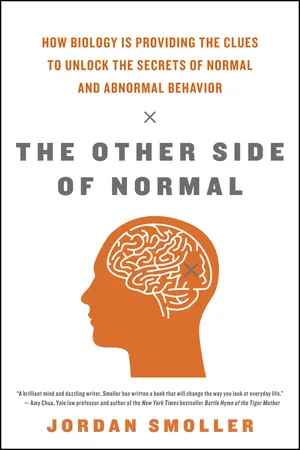
eBook - ePub
The Other Side of Normal
How Biology Is Providing the Clues to Unlock the Secrets of Normal and Abnormal Behavior
- 400 pages
- English
- ePUB (mobile friendly)
- Available on iOS & Android
eBook - ePub
The Other Side of Normal
How Biology Is Providing the Clues to Unlock the Secrets of Normal and Abnormal Behavior
About this book
Information
Topic
PsicologíaSubtopic
Psicología del desarrolloCHAPTER ONE
“WE’RE ALL MAD HERE”
BY THE LATEST ACCOUNTING, MORE THAN HALF OF ALL Americans meet criteria for a psychiatric disorder at some time in their lives.1 The current system of diagnosing mental disorders contains hundreds of labels, ranging from well-known standards like schizophrenia to less familiar ones like hypoactive sexual desire disorder. But what is a psychiatric disorder? Does normal become meaningless if most of us have an abnormality of mind? Where do we draw the line between normal and abnormal?
In 2007 two reports were released documenting alarming increases in the diagnosis of childhood psychiatric disorders that were previously thought to be rare. Both reports triggered a public outcry. But the nature of the outcry was quite different.
The first report, from the U.S. Centers for Disease Control, examined the prevalence of autism among eight-year-old children in the year 2002. Based on data from fourteen sites, the CDC found that 1 in 150 children (0.66 percent) had an autism spectrum disorder. That number was more than ten times higher than prevalence estimates of autism in the 1980s and seemed to validate a growing concern that the nation was in the midst of an epidemic.
The response among families, advocacy groups, and the media was, understandably, one of unmitigated alarm. Alison Singer, spokeswoman for the advocacy organization Autism Speaks, captured the sense of urgency felt by many: “This data today shows we’re going to need more early-intervention services and more therapists, and we’re going to need federal and state legislators to stand up for these families.”2 Singer and others called for a vast increase in research funding “so we can find a cause and understand what is fueling this high prevalence.”3
Some families, and certain celebrities, insisted that vaccines were to blame; others weren’t so sure but worried that some kind of environmental toxin might be contributing to the rise in prevalence. Many scientists and educators cautioned that the apparent epidemic might simply be a product of greater awareness and a broadening of the definition of autism (to include a larger “autism spectrum”). But few doubted the urgent need to help affected children and their families.
The outcry over the second report was equally strong but dramatically different in its tone. The study, published in the Archives of General Psychiatry, examined trends in the diagnosis of child and adolescent bipolar disorder using data from a large survey conducted by the National Center for Health Statistics. The authors found that between 1994 and 2003 the rate of bipolar disorder diagnoses in children up to age nineteen increased fortyfold, from 0.025 percent to 1.0 percent of the population (approximately half the rate of bipolar disorder among adults).4 This time, the jump in prevalence was widely interpreted not as a public health emergency but a scandal. For many, the findings confirmed the suspicion that psychiatry itself was deeply flawed. The blogosphere lit up with critics who claimed that psychiatry was pathologizing normal behavior, medicalizing childhood, and even colluding with pharmaceutical companies to create a market opportunity for drugging children. Many in the medical community were also suspicious that a lot of misdiagnosis was going on.
Two numbers, two very different reactions. Considered side by side, these two episodes dramatize the charged and complicated nature of defining psychiatric disorders. There are some remarkable parallels: in the same year, the public learned that two often disabling childhood disorders, once thought to be rare, were now being diagnosed in about 1 percent of children. In both cases, part of the story seemed to be an increasing public awareness of the condition and an expansion of diagnostic labels. The new autism estimates captured the broader autism spectrum including Asperger syndrome. And the bipolar estimates reflected a broadened spectrum as well. Since the mid-1990s, some researchers and clinicians argued for expanding the diagnosis beyond the classic symptoms of manic highs and depression to include children who exhibited chronic and explosive anger and irritability.
But there were important differences. Autism had always been a disorder of childhood while, prior to the 1990s, many psychiatrists believed that bipolar disorder did not exist in children. The broadening of the autism spectrum may have been less controversial because it had a longer history. But there was another key difference. At the time the reports were published, there were few if any established drug treatments for autism. On the other hand, medications are a cornerstone of treating bipolar disorder. And many of these medicines—lithium, valproate, and antipsychotics—can have serious side effects. The idea that such powerful drugs would be increasingly used to treat bipolar disorder in young children was clearly part of what was alarming to many people. Some saw the expansion of the diagnosis as psychiatric imperialism and “disease-mongering.” Scientists who collaborated with pharmaceutical companies were accused of nefarious conflicts of interest, with the implication that psychiatric research was motivated by financial self-interest.
We still don’t know exactly why the prevalence of autism and bipolar disorder has been growing, but the controversy forces us to confront an important question: How do we draw the line between normal and disorder when it comes to how the mind functions? At what point are we just pathologizing normal as some critics of psychiatry charge? Answering those questions requires that we first answer another question: What do we mean by normal?
Determining what is normal is a surprisingly difficult task, and that may explain why academic science has rarely tried to address it. But the definition of abnormal has been investigated and debated over and over again—perhaps in part because of a notion articulated a century ago by the great American psychologist William James, who believed that “the best way to understanding the normal is to study the abnormal.”5
Modern psychiatry has largely tried to define the abnormal without much reference to the normal. And as we’ll see, that’s created some problems. For the most part, we have described disorders by starting at the edges of human experience—identifying syndromes from the most striking and dramatic symptoms that people express. Working our way inward from those edges, normal becomes something of an afterthought—the ill-defined residual.
But without a basic map of how the mind and brain function, our definitions of abnormal and normal depend heavily on what behaviors we decide are unusual, bizarre, or problematic. And those decisions can easily be influenced by cultural trends, historical tradition, or the opinions of “authorities.”
A REVOLUTION IN PSYCHIATRY
SEVERAL YEARS AGO ONE OF MY COLLEAGUES POSED A QUESTION during a staff luncheon in our Department of Psychiatry: “Who do you think was the most influential psychiatrist of the last fifty years?”
The answer seemed obvious: Robert Spitzer. Robert Spitzer? Probably an unfamiliar name to most people; but the revolution he led transformed the way we view mental illness.
As recently as the 1970s, psychiatrists had no reliable criteria for making a diagnosis. A patient who reported hallucinations and bizarre behavior might receive a diagnosis of schizophrenia from one psychiatrist, borderline personality from another, or manic-depressive illness from a third. At the same time, the field began to acknowledge that its disorders were sometimes based on archaic views of human behavior. In 1973 the Board of Trustees of the American Psychiatric Association voted to remove homosexuality from its official manual of psychiatric disorders.
That same year, Science, a top-tier scientific journal, published an article challenging the foundations of “sane” and “insane.”6 The author, psychologist David Rosenhan, asked seven confederates to join him in a deception. They were each to present themselves to psychiatric hospitals with the complaint that they had been hearing voices. All eight of these “pseudopatients” were admitted to psychiatric hospitals and held for weeks. Their mission was to get discharged. “Each was told that he would have to get out by his own devices,” Rosenhan explained, “essentially by convincing the staff that he was sane” (p. 252). This turned out to be very difficult, and it took nearly three weeks for the pseudopatients to be discharged. Even though they exhibited no psychiatric symptoms during their hospital stays, all eight were initially diagnosed with schizophrenia and their “normal” behavior was interpreted as evidence of illness.
In the early 1970s, another indictment of psychiatric diagnosis highlighted the need to change the way psychiatrists practiced. A study of hospital admission records revealed that a patient was much more likely to be diagnosed with schizophrenia (rather than an affective disorder, such as manic-depressive illness and depression) if he were admitted to a hospital in New York than if he were admitted to a hospital in London.7 Could mental illness in America really be so different from mental illness in the UK?
One obvious way to answer this is to show the same set of patients to psychiatrists in both countries and see if they agree on diagnosis. As part of the U.S./UK Cross-national Project, researchers showed videotapes of patient interviews to groups of psychiatrists in the United States, United Kingdom, and Canada.7 The results clearly showed that it was the psychiatrists not the patients that explained the transatlantic differences in diagnoses. When faced with the same patients, American psychiatrists were far more likely to make a diagnosis of schizophrenia than were the British psychiatrists. If small cultural differences among psychiatrists could have such big effects on the way they labeled symptoms, what hope was there of defining the boundaries of normal and abnormal?
The unreliability of psychiatric diagnosis led Robert Spitzer and his colleagues to overhaul the system. In 1980 they rolled out the third edition of the Diagnostic and Statistical Manual of Mental Disorders, or DSM-III, as it is better known. The two previous editions of the DSM (published before 1970) had been heavily influenced by Freudian concepts of psychopathology and offered few specifics about the definition of mental illnesses.
The third edition provided the field, for the first time, with an explicit set of criteria for diagnosing disorders. DSM-III also debuted a raft of conditions that are now familiar fixtures of popular culture: attention deficit disorder, panic disorder, posttraumatic stress disorder, borderline personality disorder, and others. Over successive editions of the manual, psychiatry has engaged in a cycle of lumping and splitting its diagnoses. Between the publication of DSM-I in 1952 and the latest major revision, DSM-IV, in 1994, the number of diagnostic labels in the book has swelled from just over 100 to more than 350.
Today, the DSM is the most influential book in psychiatry. It is the reference manual every psychiatrist-in-training must learn to use before being considered competent to practice. Among other things, it provides the definitions of mental disorders that insurance companies use to determine whether psychiatric treatment is reimbursable. In many ways, DSM-III and its successors also fueled the modern era of medication treatment of mental illness. With clearly defined disorders to study, researchers and pharmaceutical companies could test whether new compounds were effective treatments for these conditions. Indeed, before a pharmaceutical company launches a psychiatric drug, they usually must demonstrate its effectiveness for a “DSM-defined” disorder. More than any other psychiatrist, Spitzer (and his colleagues) shaped the way we talk about mental illness.
But it’s no secret that the DSM has its limitations. Right up front, the manual acknowledges “that no definition adequately specifies precise boundaries for the concept of ‘mental disorder.’ ”8
The primary goal of the DSM, since 1980, has been to provide a practical and useful set of criteria—a common language—for diagnosing mental disorders in clinical practice and research. In essence, it presents a description of syndromes—agreed upon by a consensus of experts—that are associated with distress, disability, or “a significantly increased risk of suffering death, pain, disability, or an important loss of freedom.” Still, despite the claims of some critics, the DSM was never intended to be an authoritative statement about what’s normal and what isn’t. As Robert Spitzer himself noted, “It does not pretend to offer precise boundaries between ‘disorder’ and ‘normality.’ ”9
By design, the DSM also doesn’t attempt to tie disorders to the basic functioning of the mind and the brain. And so, as useful as it’s been in providing a common language for drawing a line between mental health and illness, the application of DSM’s categories can be subject to the vagaries of cultural trends in how we label behavior. That’s something I witnessed in the course of my own training as a psychiatrist.
FROM EPIDEMIC TO ODDITY
“YOUR NEXT ADMISSION’S IN 314.”
I stopped by the nurses’ station on the way to room 314 and picked up a copy of Sarah Crane’s chart. It was 2:30 in the morning, and she would be my fourth admission of the night—I needed a quick summary of her history. I glanced at the note from the resident who had admitted her last month and skimmed a story that was by now a familiar one.
“Hello, Ms. Crane, I’m Dr. Smoller.”
A woman in her late twenties sat, with a blank stare, in the corner of the interview room, wrapped in a powder-blue wool blanket. She didn’t make eye contact.
“Can you tell me what brings you in tonight?”
“One of my alters tried to kill me,” she answered, matter-of-factly.
“Tried to kill you?”
“Yes.”
“Who tried to kill you?”
She didn’t respond.
“Ms. Crane, who tried to kill you?”
We sat there in silence for two or three minutes.
Then her eyes narrowed, and her face took on a stern scowl; she spoke in a voice that was low and gruff. “I did.”
In the late 1980s an alarming but previously obscure mental illness began to reach epidemic proportions in the United States. To accommodate the victims, psychiatric hospitals were driven to divert their inpatient resources by opening “units” specializing in the treatment of this disorder. The disorder was called “multiple personality disorder” (MPD) and was believed to be due to early traumatic sexual abuse, which itself was being recognized as vastly mo...
Table of contents
- Cover
- Title Page
- Dedication
- Contents
- Prologue
- Chapter One - “We’re All Mad Here”
- Chapter Two - How Genes Tune the Brain: The Biology of Temperament
- Chapter Three - Blind Cats and Baby Einsteins: The Biology of Nurture
- Chapter Four - Dogs, Poker, and Autism: The Biology of Mind Reading
- Chapter Five - “Sole Mates”: The Biology of Attachment and Trust
- Chapter Six - The Brain of the Beholder: Beauty and Sexual Attraction
- Chapter Seven - Remembering to Forget
- Chapter Eight - The New Normal
- Acknowledgments
- Sources
- Index
- About the Author
- Credits
- Copyright
- About the Publisher
Trusted by 375,005 students
Access to over 1.5 million titles for a fair monthly price.
Study more efficiently using our study tools.
Frequently asked questions
Yes, you can cancel anytime from the Subscription tab in your account settings on the Perlego website. Your subscription will stay active until the end of your current billing period. Learn how to cancel your subscription
No, books cannot be downloaded as external files, such as PDFs, for use outside of Perlego. However, you can download books within the Perlego app for offline reading on mobile or tablet. Learn how to download books offline
Perlego offers two plans: Essential and Complete
- Essential is ideal for learners and professionals who enjoy exploring a wide range of subjects. Access the Essential Library with 800,000+ trusted titles and best-sellers across business, personal growth, and the humanities. Includes unlimited reading time and Standard Read Aloud voice.
- Complete: Perfect for advanced learners and researchers needing full, unrestricted access. Unlock 1.5M+ books across hundreds of subjects, including academic and specialized titles. The Complete Plan also includes advanced features like Premium Read Aloud and Research Assistant.
We are an online textbook subscription service, where you can get access to an entire online library for less than the price of a single book per month. With over 1.5 million books across 990+ topics, we’ve got you covered! Learn about our mission
Look out for the read-aloud symbol on your next book to see if you can listen to it. The read-aloud tool reads text aloud for you, highlighting the text as it is being read. You can pause it, speed it up and slow it down. Learn more about Read Aloud
Yes! You can use the Perlego app on both iOS and Android devices to read anytime, anywhere — even offline. Perfect for commutes or when you’re on the go.
Please note we cannot support devices running on iOS 13 and Android 7 or earlier. Learn more about using the app
Please note we cannot support devices running on iOS 13 and Android 7 or earlier. Learn more about using the app
Yes, you can access The Other Side of Normal by Jordan Smoller in PDF and/or ePUB format, as well as other popular books in Psicología & Psicología del desarrollo. We have over 1.5 million books available in our catalogue for you to explore.