"Extraordinary. . . . takes the reader into the overlap of medicine, ecology, and evolutionary biology to reveal an important domain of the human condition." —Edward O. Wilson, Pulitzer Prize–winning author of
Anthill and
The Future of Life
We evolved in a wilderness of parasites, mutualists, and pathogens, but we no longer see ourselves as being part of nature. In the name of progress and clean living, we scrub much of nature off our bodies and try to remove whole kinds of life—parasites, bacteria, mutualists, and predators—to allow ourselves to live free of wild danger. Nature, in this new world, is the landscape outside, a kind of living painting that is pleasant to contemplate but nice to have escaped.
The truth, though, according to biologist Rob Dunn, is that while "clean living" has benefited us in some ways, it has also made us sicker in others. As Dunn reveals, our modern disconnect from the web of life has resulted in unprecedented effects that immunologists, evolutionary biologists, psychologists, and other scientists are only beginning to understand. Diabetes, autism, allergies, many anxiety disorders, autoimmune diseases, and even tooth, jaw, and vision problems are increasingly plaguing bodies that have been removed from the ecological context in which they existed for millennia.
In this eye-opening book, Dunn considers the crossroads at which we find ourselves. Through the stories of visionaries, Dunn argues that we can create a richer nature, one in which we choose to surround ourselves with species that benefit us, not just those that, despite us, survive.
"A pleasure to read." —
Boston Globe
"[Dunn's] sure use of language, scientific research, and humor . . . keep the reader highly engaged." —
New York Journal of Books
"Not merely interesting but gripping." —
Booklist, starred review
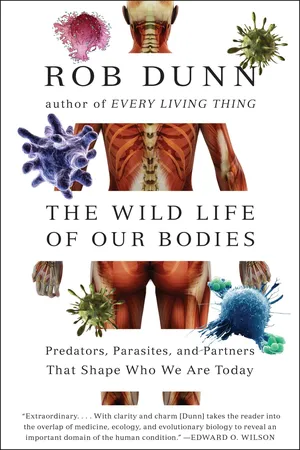
eBook - ePub
The Wild Life of Our Bodies
Predators, Parasites, and Partners That Shape Who We Are Today
- 304 pages
- English
- ePUB (mobile friendly)
- Available on iOS & Android
eBook - ePub
About this book
Information
Part I
Who We All Used to Be
1
The Origins of Humans and the Control of Nature
In the summer of 1992, Tim White saw the remains that changed his life. The first thing he saw was a tooth, a single molar. And then as he approached the spot in the clay bed, there was more. He could not be sure what he was looking at. They could have been the remains of a dog almost as easily as those of a teenage girl. He could not even be sure whether there was just one body or several. A search party was staged and every bit of potential evidence began to be collected. Soon, a little farther away, other clues were discovered—more teeth, and an arm bone. The flesh was long gone, yet in their precise geography, these parts seemed to tell a story.
White stepped back from the bones and walked around them to gain perspective. The more he looked, the more he was able to sort out what he was seeing. But it took time. It was not until 1994, two years later, that enough bones turned up to reconstruct the body, or at least more of its parts. Ultimately, several individuals would be discovered, but it was this first one that called to him. All these years removed from her last breath, she still commanded attention. He could scarcely look away. She stirred a feeling in him—maybe it was the heat mixing with his ego, a kind of psychological indigestion—yet he began to imagine it was something else. Every scientist who studies fossils hopes that one day his walk in the desert will be interrupted by a find everyone else missed, a find so important that the desert itself seems to increase in worth. With time, White began to believe that this was what had happened to him.1
Tim White, a professor of biological anthropology at the University of California, Berkeley, has been working with the bones of human ancestors and other primates for decades. He knows the bones of monkeys, apes, and men as intimately as anyone knows anything. He has run his fingers over millions of bones, drawn them, tapped them, dug them out. Time and intuition suggested to White that these bones in the sand were not quite a woman. Nor were they quite an ape. White could not prove where they belonged on the tree of life, not as they lay disordered in the desert, but he felt in some deep and primitive part of his brain that they were significant. Not the missing link connecting humans and apes, but something more. Perhaps they were the bones that made the entire search for a missing link irrelevant. So much of fossil work has to do with native intuition, sorting the ordinary from the extraordinary upon a quick glance or a feel. White’s gut knew this was extraordinary. The skull was unusual. The feet were unusual. And when White and his colleagues looked at the sediment in which they were found, it was a thin layer sandwiched between two volcanic events, events of known ages, between which played out the life of their quarry, a life whose date of birth was 4.4 million years ago.2 The bones had been left there long before the origin of humans or that famous fossil Lucy, on which so much of our existing understanding hinged. If White was right, this find would immortalize him. If he was wrong, well, he might be just one more anthropologist left half mad in the dust of his own imagination.
Certainly there were things that pointed to White’s madness. The odds of finding a fossil as unique and important as he thought this one might be were extraordinarily low, a billion to one, if not worse. Yet, if White was looking for affirmation, he could also find it. The context of this discovery alone suggested he could be on to something. He and his colleagues were working in Ethiopia’s Afar desert. Their site, called Aramis, was not far from a place where other early-hominid bones had been found in 1974. Nor was it far from where he and colleagues had discovered the very earliest bones of humans, some 160,000 years ancient.3 If White was going to excavate these bones, he wanted to do it right. “Right,” though, is expensive in both time and money. The temptation to do it quickly, to make a surgical but dirty strike, would have been great. He resisted. Credibility in the study of human evolutionary history is hard to come by but easy to lose. What would come next—the many tiny bones and fragments of bones, each one picked from the ground, treated, and pieced together slowly and carefully—would have to be done perfectly. A single fragment of jaw would come to occupy months of an anthropologist’s time. A shard of pelvis, weeks more. And there were just so many bones. It seemed as if this body had been trampled on by ancient hippos, only to be punished a little more each year by the grinding movement of the earth, the tunneling of termites and ants and, more simply and less forgivingly, the passage of time.* These bones had 4.4 million years to fall apart. He hoped it would not take quite that long to put them back together. All of Tim White’s assistants and all of his colleagues struggled. It was not just that the bones had been smashed to pieces. The pieces themselves were brittle. When handled incautiously, they would turn to dust. A few did.
One hopes for a breakthrough, a great and leaping moment of “Aha!” None came. White published a small paper on the find in 1994, more to spray his territory than as a revelation.4 At that point, nothing yet seemed done. What seemed particularly unresolved was the broader story of who these bones belonged to—what she ate, how she moved, and, more generally, how she lived. White and his colleagues would have to have all the bones in place to see that. Once they did, they would be able to compare this skeleton to other younger ones and, of course, to their own bodies. What White and company wanted to see were the differences. Some things in particular would be telling: the size of the skull and hence the brain, the shape of the hips and thus how this woman walked, and the feet. (It could be said that biological anthropologists have a thing for feet; the point of a toe can mean the difference between a foot that clings to a branch and one that sprints.) Nor were the intricate bones all that White and his crew sought. They also gathered the other fossils they found around this woman, all of them—other animals, even the remains of plants. They wanted to see this whole world for what it was, whatever that might be. Jamie Shreeve, a National Geographic editor, has described White as being “hard and thin as a jackal,”5 but maybe he is more like a hyena, an animal that gathers all that it can from each broken-down piece of bone.
White and his team scarcely talked to anyone about what they were doing. No one outside the group knew exactly what had been discovered. Details were leaked one year to the next, but the details seemed to conflict, almost as though false clues were being left intentionally. Meanwhile, what White was beginning to think was that the woman in the sand—Ardi, as he would affectionately come to call her—was the earliest complete skeleton of a human ancestor.6 If so, hers would arguably be the most important hominid fossil ever discovered. This was enough to keep White ardently at his work. In fact, ardent does not begin to be a strong enough word.
As White and his team worked, it was clear that the bones they were assembling looked, in many ways, human. The differences between what White and his team had found and the bones of modern humans were, in the broader context of evolution, tiny. She may have been 4.4 million years old, but much of her was like a human child. The same would have been true for her organs and cells, had they lasted. She was like us for the simple reason that the main features of our bodies evolved far earlier than the earliest hominid or even the earliest primate. To find the bones of animals with much different parts, you must go far deeper into the layers of dirt. By the time Ardi was born, we were almost completely who we are today, minus a few bells and whistles, or perhaps better said, big brains, tools, and words.
Most of our parts evolved in some context not only different from that in which we use them today but different even from that in which the fossil woman discovered by White would have used them. We share nearly all our genes with chimpanzees and, even more, Tim White would come to argue, with the bearer of the bones he discovered. But we also share most of our traits and genes with fruit flies, a fact upon which modern genetics depends for its succor and funding. We even have many genes in common with most bacteria, genes that exist in each of our cells.
The layer in which Tim White was studying his fossil find was, at its deepest, about two feet beneath the surface of the desert sand and sediment. Two feet is the depth of sediment that built up across 4.4 million years, sometimes a few grains at a time, sometimes more. The layers of sediment in which fossils and history are trapped are not laid down evenly, but if they were, the layer in which the story of life begins would be nearly half a mile in the earth. At the bottom of that sand pile, one can find the era of the first living cell. Already it was a little bit like each of us. It had genes that we still have, genes necessary for the basic parts of any cell. Between that moment and Ardi was the origin of the mitochondria, the tiny organs in our cells that render energy from non-energy, the first nucleus in a cell, the first multicellular organisms, and the first backbone. When primates show up, just thirty feet below the surface, the depth of a well, they were small, runty even, and, no offense, not very smart, but they were already nearly identical to us genetically.
When the individual that White found had evolved, our hearts had been beating, our immune systems had been fighting, our joints clicking and clacking, and our parts otherwise being tested in our vertebrate ancestors against the environment for several hundred million years. Across these vast stretches of time, climates waxed and waned, continents moved against each other. Yet a few realities remained unperturbed by these machinations of dirt and sky. The sun rose and fell. Gravity pulled every action and inaction to the earth. Parasites attached themselves. No animal has ever been free of them. Predators ate everything; no animal has ever been free of them either. The pathogens that cause disease were common, though perhaps less predictably present than parasites and predators. Every species existed in mutual dependency with other species, in relationships that evolved essentially with the origin of life. No species was an island. No species had ever, in all of that time, gone it alone.
All these things were true not just across most of Ardi’s life, or most of primate evolution, but since the very first microbial cells evolved and another cell realized the possibility of taking advantage of them. The interactions among species are life’s gravity, predictable and weighty. Beginning in the layers of earth in which Tim White was digging, or perhaps slightly more recently, these interactions would begin to change. For the first time in the entire history of life, our lineage began to distance itself from other species on which it had once depended. This change would make us human. We were not the first species to use tools or to have big brains. We were not even the first species to be able to use language. But once we had big brains, language, culture, and tools, we were the first species that set out to systematically (and at least partially consciously) change the biological world. We favored some species over others and did so each place we raised a home or planted a field. Anthropologists have been arguing for a hundred years about what makes a modern human, but the answer is unambiguous. We are human because we chose to try to take control. We became human when the earth and all of its living things began to look like wet clay, when our hands, meaty with flesh, began to look like tools.
When five years had passed and Tim White still had not published any more results from his find, rumors circulated that he had gone a little mad. One can imagine the scenario. After piecing together thousands of bones, White could have easily become obsessed with going back to find those last missing pieces out in the sand. So White might have dug and dug until he spent his life out in the desert, in a hole. Then, in 2009, Tim White came out of his hole and submitted, along with his tribe of colleagues, eleven separate papers to the prestigious scientific journal Science, all of which were published. In the papers, White and his colleagues introduced the young female Ardipithecus ramidus they called Ardi. To White, it was as if he had made Ardi and her kin. She stood at about four feet. Her nose was flat, and in the reconstruction, she gazes permanently ahead. Her fingers are long and her big toe sticks out to the side like a thumb. She was not quite beautiful and yet to White she was lovely.
When the results were published, Ardi was on the front pages of newspapers around the world, always looking out wide-eyed, as if she had just been surprised. White may or may not have been immortalized, but Ardi was. National Geographic prepared a full-color series on her. She is the new Lucy, though both older and, at least in White’s telling, more significant. Her body seemed to be an ancestor of our lineage or at the very least close kin, and she is unlike anything else that has ever been found. She seems to have traits, splayed toes for example, for walking four-legged among trees, and other traits for walking two-legged on the ground, although even that much is speculative. What is not speculative is that these bones are the most complete reconstruction of an early humanlike creature.
Nor are her circumstances debatable. She was found among other bones and evidence that, when pieced together, clearly show that she and her kin were living in a damp, tropical woodland, not a desert. Based on the animal bones and other evidence found around her, there would have been antelopes, monkeys, and palm trees. Ardi’s bones indicate that they were nourished on figs and other fruits and nuts, but also some meat, both of insects and other animals. She would have once stood on a branch not far from where White found her, nibbling at figs and perhaps even wondering about her place in the broader scheme of things.* She used sticks as tools to help her eat when she was hungry, but she had no fire, no stone tools. She had not yet tried to take control of the land. She was like the other species, still wild, still covered in microbes and worms, and still more likely to die in a large cat’s mouth than of old age.
With White’s publications, Ardi went from unknown to famous in a remarkably short time. It is unknown where Ardi’s reassembled remains will end up. In the standard arrangement, she would be placed in the lineup of our ancestors, the one that starts out with a microbe or a fish and then culminates with a man typing on a computer. In such an arrangement, Ardi would be presented looking forward. Given, though, that she was found with her bones pointed in many directions, it isn’t any more right or wrong to think of her as lying on top of her own (and our) long history and looking up from that point of view. She would stare up at the shallow sand above her. In those few feet of dirty history modern humans evolved. As they did, the enduring presence of parasites, pathogens, predators, and mutualists was about to change, for the very first time.
Initially, the layers of sediment and bone laid down over Ardi’s body were essentially unchanged from the one in which she was born and died. The forests persisted for generations, replete with monkeys and palms. It took 2 million years for big changes to happen. By the time the grains of those years had fallen over Ardi, the first tools were being made by our ancestors, perhaps her descendants. They were crude—pounding rocks, sharp-edged stones, scrapers, and diggers—but useful and used. Ardi was a million years deep before the next stage began. It was a stage during which hominids such as Homo erectus, who used these crude tools, would give way to those who used hand axes—larger blades with a tear-drop shape—to chop up bodies, though perhaps still not yet to kill them. Amazingly, six more inches of sand would accumulate, 500,000 years, before anything really changed. Across these generations, hand axes were made a 100,000 times in as many places, nearly always in exactly the same way.
Two hundred thousand years ago, with just an inch or so of sand left to accumulate before the modern age, Neanderthals and early humans began to tie their stones to sticks. Tying stones to sticks was brilliant, at least from the perspective of our ability to kill other animals. When you had to run up to a lion and hit it with a hand ax, the odds were stacked against success. But with a stick attached to that sharp rock, the odds looked at least a little bit better. One imagines that there was, when our ancestors first figured out how to tie sticks to rocks, a high demand for long sticks. These tools were clumsy but served their purpose. With them, we began to kill animals, many of them. Their bones piled up in our early caves, but we had not yet caused the extinction of any other species. We were still just one species among many, although starting to get some attitude and starting to see, perhaps, the possibility of getting some more.
Twenty-eight thousand years ago, all that was left to lay down was a layer of sand and sediment as thin as powdered sugar. In that sprinkling of time would come everything else that has happened to us—you, me, and the rest of humans. If we want to look for what makes us different as humans, it comes in this slice of time during which Neanderthals, that last holdout of...
Table of contents
- Dedication
- Contents
- Introduction
- Part I: Who We All Used to Be
- 1: The Origins of Humans and the Control of Nature
- Part II: Why We Sometimes Need Worms and Whether or Not You Should Rewild Your Gut
- 2: When Good Bodies Go Bad (and Why)
- 3: The Pronghorn Principle and What Our Guts Flee
- 4: The Dirty Realities of What to Do When You Are Sick and Missing Your Worms
- Part III: What Your Appendix Does and How It Has Changed
- 5: Several Things the Gut Knows and the Brain Ignores
- 6: I Need My Appendix (and So Do My Bacteria)
- Part IV: How We Tried to Tame Cows (and Crops) but Instead They Tamed Us, and Why It Made Some of Us Fat
- 7: When Cows and Grass Domesticated Humans
- 8: So Who Cares If Your Ancestors Sucked Milk from Aurochsen?
- Part V: How Predators Left Us Scared, Pathos-ridden, and Covered in Goose Bumps
- 9: We Were Hunted, Which Is Why All of Us Are Afraid Some of the Time and Some of Us Are Afraid All of the Time
- 10: From Flight to Fight
- 11: Vermeij’s Law of Evolutionary Consequences and How Snakes Made the World
- 12: Choosing Who Lives
- Part VI: The Pathogens That Left Us Hairless and Xenophobic
- 13: How Lice and Ticks (and Their Pathogens) Made Us Naked and Gave Us Skin Cancer
- 14: How the Pathogens That Made Us Naked Also Made Us Xenophobic, Collectivist, and Disgusted
- Part VII: The Future of Human Nature
- 15: The Reluctant Revolutionary of Hope
- Acknowledgments
- Notes
- Index
- About the Author
- Also by Rob Dunn
- Credits
- Copyright
- About the Publisher
- Footnotes
Trusted by 375,005 students
Access to over 1.5 million titles for a fair monthly price.
Study more efficiently using our study tools.
Frequently asked questions
Yes, you can cancel anytime from the Subscription tab in your account settings on the Perlego website. Your subscription will stay active until the end of your current billing period. Learn how to cancel your subscription
No, books cannot be downloaded as external files, such as PDFs, for use outside of Perlego. However, you can download books within the Perlego app for offline reading on mobile or tablet. Learn how to download books offline
Perlego offers two plans: Essential and Complete
- Essential is ideal for learners and professionals who enjoy exploring a wide range of subjects. Access the Essential Library with 800,000+ trusted titles and best-sellers across business, personal growth, and the humanities. Includes unlimited reading time and Standard Read Aloud voice.
- Complete: Perfect for advanced learners and researchers needing full, unrestricted access. Unlock 1.5M+ books across hundreds of subjects, including academic and specialized titles. The Complete Plan also includes advanced features like Premium Read Aloud and Research Assistant.
We are an online textbook subscription service, where you can get access to an entire online library for less than the price of a single book per month. With over 1.5 million books across 990+ topics, we’ve got you covered! Learn about our mission
Look out for the read-aloud symbol on your next book to see if you can listen to it. The read-aloud tool reads text aloud for you, highlighting the text as it is being read. You can pause it, speed it up and slow it down. Learn more about Read Aloud
Yes! You can use the Perlego app on both iOS and Android devices to read anytime, anywhere — even offline. Perfect for commutes or when you’re on the go.
Please note we cannot support devices running on iOS 13 and Android 7 or earlier. Learn more about using the app
Please note we cannot support devices running on iOS 13 and Android 7 or earlier. Learn more about using the app
Yes, you can access The Wild Life of Our Bodies by Rob Dunn in PDF and/or ePUB format, as well as other popular books in Biological Sciences & Ecology. We have over 1.5 million books available in our catalogue for you to explore.