"A damning indictment of the airline industry, and the lax oversight and economic and political pressures that are jeopardizing the safety of everyone." —Capt. Chesley "Sully" Sullenberger
A
Fast Food Nation for the airline industry,
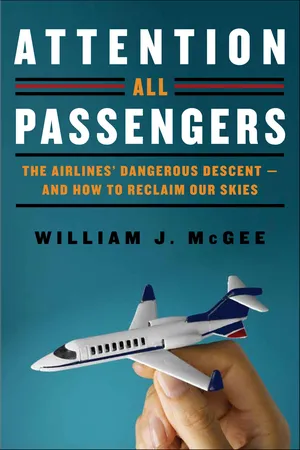
Attention All Passengers is a shocking and important exposé revealing the real state of the "friendly skies" in which we fly. Award-winning
Consumer Reports travel journalist William McGee, a former editor of the
Consumer Reports Travel Letter, spent nearly seven years in airline flight operations management, and what he learned was less than uplifting. From TSA power grabs and an endemic lack of oversight to legislative battles and lobbying boondoggles to antiquated flight patterns and outsourced maintenance workers, the airlines and the government are in cahoots, conspiring to turn a profit any way they can, no matter who has to pay the price. A provocative and hard-hitting call to action,
Attention All Passengers will explode all our previous misconceptions about the airline industry.
"This eye-opening book should be required reading for anyone who flies, as well as airline employees and government officials." —
Chicago Tribune
"McGee is making a serious and important argument, and he ends with a series of suggestions . . . that reflect both insider knowledge and common sense." —
The Boston Globe
"
Attention All Passengers deserves to be heeded for its discussion of airline safety. Mr. McGee addresses areas of serious concern that have largely remained off the radar screen." —
The Wall Street Journal
"[A] provocative new book… McGee makes a compelling argument that minor annoyances such as baggage fees and shrinking seats are symptoms of deeper problems that are eroding the bottom line and, eventually, the safety of passengers." —
Cleveland Plain Dealer
eBook - ePub
Attention All Passengers
The Airlines' Dangerous Descent—and How to Reclaim Our Skies
- 368 pages
- English
- ePUB (mobile friendly)
- Available on iOS & Android
eBook - ePub
Attention All Passengers
The Airlines' Dangerous Descent—and How to Reclaim Our Skies
About this book
Information
1
Sit Down and Shut Up or We’ll Turn This Plane Around:
Why Airline Service Has Collapsed and Air Rage Is Soaring
Hi, I’m Jenn, your virtual assistant for the Alaska Airlines Web site. If you need help or have a question, simply type it below.
—AlaskaAir.com
For many airline passengers, a big fear is that our checked luggage will turn up in a place most of us have never heard of—a place like, say, Scottsboro, Alabama. In fact, that’s exactly what has happened with millions of suitcases over the years. According to federal regulations, the airlines have ninety days to reunite passengers and lost bags, and they usually manage to do it. However, on Day 91 a large truck will tote the unwanted belongings off to the Unclaimed Baggage Center. Before long, your iPod, your paperback Harlequin, and even your underwear will be up for sale.
You have to really work to find the Unclaimed Baggage Center (UBC), because Scottsboro is not convenient for anyone outside of northeastern Alabama (and is primarily known as the site of the infamous and racially charged “Scottsboro Boys” trial in the 1930s). The nearest commercial airport is a distant forty miles away in Huntsville. The UBC has been dispatching trucks to airline bag facilities since 1970 and now works exclusively with all major domestic carriers. Once the goodies arrive sight unseen in Scottsboro, they’re unlocked, unpacked, sorted, and cleaned (UBC boasts of laundering more loads than anyone in Alabama); then 100 employees stock 5,000 to 7,000 items on the shelves every day. Here’s the breakdown: 40 percent of what’s found inside the bags goes to charity, 30 percent is recycled or tossed out, and the remaining 30 percent fills the 40,000-square-foot retail store in Scottsboro.
Talk about a niche market. There are a few wannabes along Willow Street, but you can’t miss UBC’s giant neon suitcase. Since there are no online transactions, the parking lot boasts license plates from around the South (830,000 visitors in 2010). And UBC—which perhaps fittingly abuts a cemetery—has become a bona fide tourist attraction, the type you learn about in brochures stocked in the lobby of the Days Inn up at Highway 35.
Inside, you’ll encounter everything imaginable. As you roam the endless aisles, you’ll find more ski boots than at Sports Authority, more cameras than at Best Buy, and more bras than at Victoria’s Secret. There are crossbows and arrows. A full set of weights. A digital drum set. You can pick up a Balzac short story collection for a buck. Sure, occasionally there will be a quirky, newsworthy treasure: a 41-karat emerald, a full suit of armor, a 1934 French newspaper, a shofar, a hand-hammered cross. But UBC sold four thousand iPods last year, the supply of baby strollers and baggage wheelies is endless, and new wedding dresses arrive every day. The feeling I have gazing at a toddler’s Scooby Doo clogs is not unlike viewing NTSB accident scene photos: Who were all these passengers? And why didn’t someone want that oversized photo of Mickey Mantle back?
“The airlines get a bad rap,” said Brenda Cantrell, UBC’s director of marketing, when we sat down just as Alabama was recovering from its worst snowfall in a decade. She acknowledged that many passengers feel the airlines don’t care, but said she supports her supply chain: “I think they do the best that they can.” In fairness, Cantrell also pointed out the high incidence of passenger fraud, since many dishonest airline customers do not want their bags returned; dirty socks be damned if an insurance claim for jewelry and electronics is approved instead. An old airline maxim: Every lost watch was a Rolex, every necklace was from Tiffany’s.
As for baggage fees, Cantrell is no fan, since they are just about the worst thing that ever happened to the UBC business model: “It’s definitely in decline because more people are not checking bags.” But despite the long odds, imagine her satisfaction when a suitcase was pried open recently and inside was clothing still price tagged by UBC—come full circle.
As for how the airlines are doing, this is one aspect of customer service in which they are not completely at fault, because in November 2002 the industry happily abdicated responsibility for baggage screening to the federal government, and specifically to the newly formed Transportation Security Administration. For Free Market versus Government watchers, this was epic. The result? According to the U.S. Department of Transportation’s monthly mishandled baggage reports, such filings soared after the TSA took over and air traffic started picking up again after 9/11. There were 3.84 mishandled bag reports per 1,000 passengers in 2002, and that number rose every year for six consecutive years, before peaking at 7.05 in 2007, just prior to the economic collapse of 2008 and the resulting drop in passengers.
One aspect the DOT stats do not fully capture is customer satisfaction, and how the airlines respond when passengers complain about what the DOT terms “lost, damaged, pilfered, and stolen” luggage. That’s why it’s worth noting that after the TSA started screening bags the DOT’s monthly database of consumer complaints saw a marked spike in gripes generated by baggage handling. In fact, as a percentage of total grievances, complaints over luggage nearly tripled between the summers of 2002 and 2004.
I wrote about this topic after numerous arrests of TSA screeners for pilfering were reported in Detroit, Fort Lauderdale, Miami, New Orleans, New York City, and Philadelphia (and famous victims such as Chevy Chase and Joan Rivers made the news). By September 2004, the TSA finally addressed the mounting backlog of complaints by adjudicating more than 17,600 passenger filings, at about $110 each, for “property damaged or lost when their checked baggage was screened for explosives.”
Now that more passengers are flying again, the number of mishandled bags is increasing again. SITA, a Geneva-based aviation communications organization, released Baggage Report 2011 and confirmed that an increase in passenger traffic has led to a 6 percent increase in mishandled baggage, with North America among the regions “most affected.” However, there are important points to be made that highlight systemic problems with baggage handling.
“Baggage has never been a priority for airlines,” says Scott Mueller, an expert on the topic. “If the airlines were held accountable, then at least they would refund the fee if the bag is mishandled.” Mueller is a man with a passion for reuniting passengers and their baggage. He’s a seventeen-year industry veteran who headed up baggage services for Midwest Airlines, and during one five-year stretch not a single passenger on his carrier filed a complaint over mishandled bags.
For one thing, the rate of checked bags has decreased since U.S. airlines began charging fees for this service, so this factor needs to be considered when comparing mishandled baggage rates across several years.
These DOT monthly statistics on mishandled baggage are problematic. For starters, it’s a self-reporting system, and traditionally airlines have not posted an impressive track record under such programs. I know from firsthand experience that airlines can be “creative” with their flight delay reporting, and there is ample evidence that self-reporting safety issues to the FAA has not worked well. As Mueller explains, “The DOT does have the right to do a random audit. They can do that, but I don’t think it’s a high priority. You can easily fudge your numbers.”
In addition, he notes the statistics are skewed because the DOT’s monthly rankings are based on passengers boarded, not baggage checked. Mueller states: “The end results are based on the assumption that all 1,000 passengers that board an airplane checked a bag. Now if only 500 passengers out of 1,000 who board an aircraft actually checked a bag, then the airline’s statistic of 4.5 bags mishandled per 1,000 passengers boarded would actually be double.” What’s more, there are four classifications of mishandled baggage—lost, damaged, delayed, and pilfered—but airlines are not required to break out the percentages on these subcategories, so consumers do not know if Airline A has a rampant problem with baggage break-ins while Airline B has a chronic issue with losing bags.
Mueller is equally critical of the TSA and the airlines. At Midwest, pilferage claims quadrupled after the government assumed responsibility for screening, and he has seen TSA employees stealing in Orlando. He explains that the TSA is the only entity authorized to open a passenger’s checked bag, and in many cases such screening is performed in a private room with only two employees, a scenario conducive to theft.
Then there is the customer service component. Passenger rights advocate Kate Hanni says, “The way the airlines handle claims is they summarily reject them the first time through. It’s a real racket. There’s no pressure on them to make the system better for passengers.” Mueller concurs, and says this “absolutely” happens every day: “There definitely are a lot of claims that fall on deaf ears.”
However, a bigger issue is that most passengers are playing in a rigged game without having read the fine print about how to file, when to file, and where to file a claim when their bag and/or its contents is missing or damaged. “There are a lot of issues with how bag claims are filed,” explains Mueller. “The airlines don’t do a good job of explaining all this to their customers. People always say, ‘How am I supposed to know that?’ Well, you bear the burden.”
Considering all the problems passengers encounter with checked luggage, it’s worth noting that baggage agreements don’t cover carry-ons left behind in the aircraft cabin; carriers are not required to ensure that the BlackBerry you tucked into the seatback pocket finds its way back to you. “The airline has no responsibility whatsoever,” Mueller says. “It’s considered lost-and-found. Chances are you won’t see it again.” He notes that his employees have found watches, cameras, laptops, and even $3,600 in cash in the cabins of empty airplanes—but not all airline and outsourced workers do the right thing. In fact, some do the absolute wrong thing, as was made clear by a news story that hit the wires in the summer of 2010. French police arrested a forty-seven-year-old Air France flight attendant named “Lucie R.” and charged her with stealing thousands of dollars in cash and jewelry from passengers while they slept.
In March 2011, Congressman Michael Capuano, a Massachusetts Democrat, introduced legislation that would “require refunds [of fees] for baggage that is lost, damaged, or delayed.” The Congressional Record shows that after ten minutes of debate, the “Capuano Amendment” was defeated on a voice vote. Interestingly, around that time I received an internal document prepared by the Air Transport Association, renamed Airlines for America (A4A), addressing talking points on the Capuano Amendment. Here’s the airline trade group’s reasoning: “The amendment is unnecessary given [the] historically low mishandled bag rate and competing baggage handling and fee policies.” Huh? Carriers are charging customers for a service they are not providing—prompt and safe delivery of your luggage. How is this affected by the overall mishandling record or “competing” fee policies? One month later, Secretary LaHood announced this policy had been adopted by the DOT, Congress be damned. But unfortunately, refunding fees won’t improve airline baggage handling.
Declining Customer Concern in a “Service Industry”
The airlines claim that the number of passengers who are inconvenienced is quite small considering the millions carried. But beleaguered passenger Dave Carroll notes that such percentages don’t mean much to those whom the system fails: “You have airline executives who quote statistics—but they don’t seem to care about those on the margins of the statistics.” He adds, “If there’s no integrity in the policies, then it’s open season.”
Of course, few carriers are competing on customer service these days. Charlie Leocha of the Consumer Travel Alliance explains: “As the low-cost carriers and as the comparability made everyone more competitive, the first thing to go was differentiation in customer service. It’s not only executive management—it runs through the fabrics of the companies. The managers, the gate agents, the flight attendants working without contracts. The front-line employees are under the most stress.”
For airline passengers in recent years, customer service has gotten worse. That’s not opinion—that’s documented fact. According to statistics, there have been more mishandled bags (despite the added baggage fees), more consumer complaints, more congestion, and more passengers bumped off flights.
But other key elements of poor customer service can’t be encapsulated in statistics, though they have been captured by dozens of polls, surveys, and rankings. In June 2011, for example, a Consumer Reports survey of fifteen thousand readers found a “low opinion of today’s flying experience.”
There is so much bad juju surrounding airline customer service that sometimes I need to step back and wonder if hyperbole is overtaking reality. Could so many pissed-off passengers possibly be wrong? Luckily, one of the best barometers I know happens to be a trusted friend and colleague. Linda Burbank was the ombudsman for Consumer Reports Travel Letter when I was editor, and a few years later she joined me at USAToday.com, where she continues to serve as a consumer travel advocate. I’ve seen the way she fights for readers who have been wronged by airlines and other travel companies. (On behalf of a CRTL reader, Burbank once secured a $29,833 refund from Royal Caribbean and Expedia, an unprecedented action from the laissez-faire and largely unregulated cruise industry.)
I sat with her in a café in San Francisco and asked her if airline service has really gotten worse. Burbank considered this and said: “I think I’m seeing fewer complaints, but I don’t think it’s because service is better. Everyone is so beaten down. We’ve all just become resigned to bad service. We’re in the flip-flop generation.”
It’s worth noting that Burbank sees customers at their worst. As she explained, “When I hear from people they’re already over-the-top angry. First, there was the original problem. Second, they have not gotten a suitable response. They don’t feel they have been heard. It’s not about the money—I have had people who are as angry about one hundred dollars as about three thousand dollars.” With airlines, she’s often able to secure discounts for future travel for her wronged readers, but cash refunds are much harder.
As for what passengers are complaining about, there’s little surprise in learning that baggage fees top Burbank’s list. Another trend line is how the airlines respond to “big problems” such as widespread weather delays. She noted that masses of people are angry, yet it seems no one is available to provide assistance—at the airpo...
Table of contents
- Cover
- Title Page
- Dedication
- Contents
- Authors Note
- Prologue: Flying Sucks
- Chapter 1: Sit Down and Shut Up or We’ll Turn This Plane Around: Why Airline Service Has Collapsed and Air Rage Is Soaring
- Chapter 2: What Happened to the Airlines?
- Chapter 3: Collusion and Confusion: How Airlines Don’t Play by the Rules—and How Passengers Pay
- Chapter 4: So You Think You’ve Found the Lowest Fare
- Chapter 5: A Mad Race to the Bottom: How Airlines Mistreat Employees, Outsource, and Ignore Passengers
- Chapter 6: When Your Airline Isn’t Your Airline: Regional Carriers Provide Lower Levels of Service and Safety
- Chapter 7: Outrageous Outsourcing: The Single Greatest Threat to Airline Safety
- Chapter 8: Unsafe at Any Altitude? Facing Unprecedented Dangers
- Chapter 9: Threats to Survival: Why Many Air Crashes Need Not Be Fatal
- Chapter 10: Lights, Camera, Strip Search: The Tragicomedy of Airline Security
- Chapter 11: Cloudy Skies: Aviation’s Carbon Footprint
- Chapter 12: InkStained Wreckage: How Airlines Manipulate the Media
- Epilogue: Fighting the Clock
- Conclusion: A Manifesto for Taking Back Our Skies
- Appendix A: Domestic Mainline Airline Partnerships with Regionals
- Appendix B: Domestic Regional Airline Partnerships with Mainlines
- Glossary
- Selected Bibliography
- Notes
- Index
- Acknowledgments
- About the Author
- Credits
- Copyright
- About the Publisher
Trusted by 375,005 students
Access to over 1.5 million titles for a fair monthly price.
Study more efficiently using our study tools.
Frequently asked questions
Yes, you can cancel anytime from the Subscription tab in your account settings on the Perlego website. Your subscription will stay active until the end of your current billing period. Learn how to cancel your subscription
No, books cannot be downloaded as external files, such as PDFs, for use outside of Perlego. However, you can download books within the Perlego app for offline reading on mobile or tablet. Learn how to download books offline
Perlego offers two plans: Essential and Complete
- Essential is ideal for learners and professionals who enjoy exploring a wide range of subjects. Access the Essential Library with 800,000+ trusted titles and best-sellers across business, personal growth, and the humanities. Includes unlimited reading time and Standard Read Aloud voice.
- Complete: Perfect for advanced learners and researchers needing full, unrestricted access. Unlock 1.5M+ books across hundreds of subjects, including academic and specialized titles. The Complete Plan also includes advanced features like Premium Read Aloud and Research Assistant.
We are an online textbook subscription service, where you can get access to an entire online library for less than the price of a single book per month. With over 1.5 million books across 990+ topics, we’ve got you covered! Learn about our mission
Look out for the read-aloud symbol on your next book to see if you can listen to it. The read-aloud tool reads text aloud for you, highlighting the text as it is being read. You can pause it, speed it up and slow it down. Learn more about Read Aloud
Yes! You can use the Perlego app on both iOS and Android devices to read anytime, anywhere — even offline. Perfect for commutes or when you’re on the go.
Please note we cannot support devices running on iOS 13 and Android 7 or earlier. Learn more about using the app
Please note we cannot support devices running on iOS 13 and Android 7 or earlier. Learn more about using the app
Yes, you can access Attention All Passengers by William J. McGee in PDF and/or ePUB format, as well as other popular books in Technology & Engineering & Transportation Industry. We have over 1.5 million books available in our catalogue for you to explore.