A
New York Times Notable Book: A particle physicist's "engaging and remarkably clear" look at the dimensions that may exist beyond the ones we know (
The New York Times Book Review).
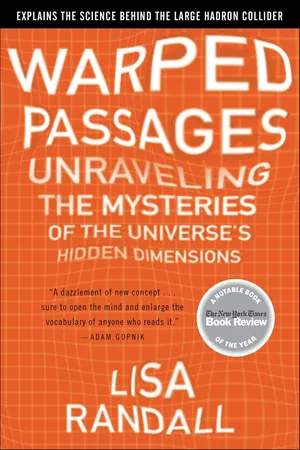
The universe has many secrets. It may hide additional dimensions of space other than the familiar three we recognize. There might even be another universe adjacent to ours, invisible and unattainable . . . for now.
Warped Passages is a brilliantly readable and altogether exhilarating journey that tracks the arc of discovery from early twentieth-century physics to the razor's edge of modern scientific theory. One of the world's leading theoretical physicists, Lisa Randall provides astonishing scientific possibilities that, until recently, were restricted to the realm of science fiction. Unraveling the twisted threads of the most current debates on relativity, quantum mechanics, and gravity, she explores some of the fundamental questions posed by Nature—taking us into the warped, hidden dimensions underpinning the universe we live in, demystifying the science of the myriad worlds that may exist just beyond our own.
"Randall brings much of the excitement of her field to life as she describes her quest to understand the structure of the universe." —
Publishers Weekly
"A great read . . . I highly recommend it." —Ira Flatow, host of NPR's
Science Friday
"Randall, a professor of physics at Harvard, offers a tour of current questions in particle physics, string theory, and cosmology, paying particular attention to the thesis that more physical dimensions exist than are usually acknowledged . . . She's honest about the limits of the known, and almost revels in the uncertainties that underlie her work—including the possibility that some day it may all be proved wrong." —
The New Yorker
eBook - ePub
Warped Passages
Unraveling the Mysteries of the Universe's Hidden Dimensions
- 512 pages
- English
- ePUB (mobile friendly)
- Available on iOS & Android
eBook - ePub
About this book
Information
Print ISBN
9780060531096
Subtopic
Cosmologia1
Entryway Passages: Demystifying Dimensions
You can go your own way.
Go your own way.
Fleetwood Mac
“Ike, I’m not so sure about this story I’m writing. I’m considering adding more dimensions. What do you think of that idea?”
“Athena, your big brother knows very little about fixing stories. But odds are it won’t hurt to add new dimensions. Do you plan to add new characters, or flesh out your current ones some more?”
“Neither; that’s not what I meant. I plan to introduce new dimensions—as in new dimensions of space.”
“You’re kidding, right? You’re going to write about alternative realities—like places where people have alternative spiritual experiences or where they go when they die, or when they have near-death experiences? * I didn’t think you went in for that sort of thing.”
“Come on, Ike. You know I don’t. I’m talking about different spatial dimensions—not different spiritual planes!”
“But how can different spatial dimensions change anything? Why would using paper with different dimensions—11" × 8" instead of 12" × 9", for example—make any difference at all?”
“Stop teasing. That’s not what I’m talking about either. I’m really planning to introduce new dimensions of space, just like the dimensions we see, but along entirely new directions.”
“Dimensions we don’t see? I thought three dimensions is all there are.”
“Hang on, Ike. We’ll soon see about that.”
The word “dimension,” like so many words that describe space or motion through it, has many interpretations—and by now I think I’ve heard them all. Because we see things in spatial pictures we tend to describe many concepts, including time and thought, in spatial terms. This means that many words that apply to space have multiple meanings. And when we employ such words for technical purposes, the alternative uses of the words can make their definitions sound confusing.
The phrase “extra dimensions” is especially baffling because even when we apply those words to space, that space is beyond our sensory experience. Things that are difficult to visualize are generally harder to describe. We’re just not physiologically designed to process more than three dimensions of space. Light, gravity, and all our tools for making observations present a world that appears to contain only three dimensions of space.
Because we don’t directly perceive extra dimensions—even if they exist—some people fear that trying to grasp them will make their head hurt. At least, that’s what a BBC newscaster once said to me during an interview. However, it’s not thinking about extra dimensions but trying to picture them that threatens to be unsettling. Trying to draw a higher-dimensional world inevitably leads to complications.
Thinking about extra dimensions is another thing altogether. We are perfectly capable of considering their existence. And when my colleagues and I use the words “dimensions,” and “extra dimensions,” we have precise ideas in mind. So before taking another step forward or exploring how new ideas fit into our picture of the universe—note the spatial phrases—I will explain the words “dimensions” and “extra dimensions” and what I will mean when I use them later on.
We’ll soon see that when there are more than three dimensions, words (and equations) can be worth a thousand pictures.
What Are Dimensions?
Working with spaces that have many dimensions is actually something everyone does every day, although admittedly most of us don’t think of it that way. But consider all the dimensions that enter into your calculations when you make an important decision, like buying a house. You might consider the size, the schools nearby, the proximity to places of interest, the architecture, the noise level—and the list goes on. You need to optimize in a multidimensional context, enumerating all your desires and needs.
The number of dimensions is the number of quantities you need to know to completely pin down a point in a space. The multidimensional space might be an abstract one, such as the space of features you are looking for in a house, or it might be concrete, like the real physical space we will soon consider. But when buying a house, you can think of the number of dimensions as the number of quantities you would record in each entry in a database—the number of quantities you find worth investigating.
A more frivolous example applies dimensions to people. When you peg someone as one-dimensional, you actually have something rather specific in mind: you mean that the person has only a single interest. For example, Sam, who does nothing but sit at home watching sports, can be described with just one piece of information. If you felt so inclined, you could picture this information as a dot on a one-dimensional graph: Sam’s proclivity to watch sports, for example. In drawing this graph you need to specify your units so that someone else can understand what the distance along this single axis means. Figure 3 shows a plot with Sam as a point along a horizontal axis. This plot represents the number of hours Sam spends per week watching sports on TV. (Fortunately, Sam won’t be insulted by this example; he is not among the multidimensional readers of this book.)

Figure 3. The one-dimensional Sam plot.
Let’s explore this notion a little further. Icarus Rushmore III (Ike in the above story), a Boston resident, is a more complex character. In fact, he is three dimensional. Ike is twenty-one, drives fast cars, and loses money at Wonderland, a town near Boston with a dog-racing track. In Figure 4 I’ve plotted Ike. Although I’ve drawn it on the two-dimensional surface of a piece of paper, the three axes tell us that Ike is definitely three-dimensional. *

Figure 4. The three-dimensional Ike plot. The solid notched lines are the coordinate axes of the three-dimensional plot. The point that is labeled Ike corresponds to a 21-year-old boy who loses 24 dollars at Wonderland every month and drives his fast car (on average) 3.3 times a week.
When we describe most people, however, we usually assign them more than one, or even three, characteristics. Athena, Ike’s sister, is an eleven-year-old who reads avidly, excels at math, keeps abreast of current events, and raises pet owls. You might want to plot this too (though why, exactly, I’m not really sure). In that case, Athena would have to be plotted as a point in a five-dimensional space with axes corresponding to age, number of books read per week, average math test score, number of minutes spent reading the newspaper per day, and number of owls she owns. However, I’m having trouble drawing such a graph. It would require a five-dimensional space, which is very hard to draw. Even computer programs only have 3D graphics.
Nonetheless, in an abstract sense, there exists a five-dimensional space with a collection of five numbers, such as (11, 3, 100, 45, 4), which tells us that Athena is eleven, that she reads three books on the average each week, that she never gets a math question wrong, that she reads the newspaper for forty-five minutes each day, and that she has four owls at the moment. With these five numbers, I’ve described Athena. If you knew her, you could recognize her from this point in five dimensions.
The number of dimensions for each of the three people above was the number of attributes I used to identify them: one for Sam, three for Ike, and five for Athena. Real people, of course, are generally more difficult to capture with so few items of information.
In the following chapters, we’ll use dimensionality to explore not people, but space itself. By “space” I mean the region in which matter exists and physical processes take place. A space of a particular dimension is a space requiring a particular number of quantities to specify a point. In one dimension, that would be a point on a plot with a single x axis; in two dimensions, a point on a plot with an x and a y axis; in three dimensions, it would be a point on a plot with an x, a y, and a z axis. 1,* Those axes are shown in Figure 5.
In three-dimensional space, three numbers are all you ever need to know your precise location. The numbers you specify might be latitude, longitude, and altitude; or length, width, and height; or you might have a different way to choose your three numbers. The critical thing is that three dimensions means you need precisely three numbers. In two-dimensional space you need two numbers, and in higher-dimensional space you need more.

Figure 5. The three coordinate axes that we use for three-dimensional space.
More dimensions means freedom to move in a greater number of completely different directions. A point in a four-dimensional space simply requires one additional axis—again, difficult to draw. But it should not be hard to imagine its existence. We’ll think about it using words and mathematical terms.
String theory suggests even more dimensions: it postulates six or seven extra spatial dimensions, meaning that six or seven additional coordinates are needed to plot a point. And very recent work in string theory has shown that there could be even more dimensions than that. In this book, I’ll keep an open mind and entertain the possibility of any number of extra dimensions. It is too soon to say how many dimensions the universe actually contains. Many of the concepts about extra dimensions that I will describe apply to any number of extra dimensions. In the rare cases when that isn’t true, I will make sure that it is clear.
Describing a physical space involves more than just identifying points, however. You need also to specify a metric, which establishes the measurement scale, or the physical distance between two points. These are the markings along the axis of a graph. It’s not enough to know that the distance between a pair of points is 17 unless you know whether 17 means 17 centimeters, 17 miles, or 17 light-years. A metric is required to tell us how to measure distance: what the distance between two points on a graph corresponds to in the world that the graph represents. A metric gives a measuring rod that reveals your choice of units in order to set the scale, just like on a map, where a half-inch might represent one mile, or as in the metric system, which gives us a meter stick we all agree on.
But that is not all a metric specifies. It also tells us whether space bends or curls around, like the surface of a balloon when it is blown up into a sphere. The metric contains all the information about the shape of space. A metric for curved space tells us about both distances and angles. Just as an inch can represent different distances, an angle can correspond to different shapes. I’ll go into this later on when we explore the connection between curved space and gravity. For now, let’s just say that the surface of a sphere is not the same as the surface of a flat piece of paper. Triangles on one don’t look like triangles on the other, and the difference between these two-dimensional spaces can be seen in their metrics. 2
As physics has evolved, so has the amount of information stored in the metric. When Einstein developed relativity, he recognized that a fourth dimension—time—is inseparable from the three dimensions of space. Time, too, needs a scale, so Einstein formulated gravity by using a metric for four-dimensional spacetime, adding the dimension of time to the three dimensions of space.
And more recent developments have shown that additional spatial dimensions might also exist. In that case, the true spacetime metric will involve more than three dimensions of space. The number of dimensions and the metric for those dimensions is how one describes such a multidimensional space. But before we explore metrics and metrics for multidimensional spaces any further, let’s think more about the meaning of the term “multidimensional space.”
Playful Passages Through Extra Dimensions
In Roald Dahl’s Charlie and the Chocolate Factory, Willy Wonka introduced visitors to his “Wonkavator.” In his words, “An elevator can only go up and down, but a Wonkavator goes sideways and slantways and longways and backways and frontways and squareways and any other ways that you can think of…”* Really, what he had was a device that moved in any direction, so long as it was a direction in the three dimensions we...
Table of contents
- Contents
- Preface and Acknowledgements
- Introduction
- 1
- 2
- 3
- 4
- 5
- 6
- 7
- 8
- 9
- 10
- 11
- 12
- 13
- 14
- 15
- 16
- 17
- 18
- 19
- 20
- 21
- 22
- 23
- 24
- 25
- Glossary
- Math Notes
- Permissions
- Searchable Terms
- About the Author
- Copyright
- About the Publisher
Trusted by 375,005 students
Access to over 1.5 million titles for a fair monthly price.
Study more efficiently using our study tools.
Frequently asked questions
Yes, you can cancel anytime from the Subscription tab in your account settings on the Perlego website. Your subscription will stay active until the end of your current billing period. Learn how to cancel your subscription
No, books cannot be downloaded as external files, such as PDFs, for use outside of Perlego. However, you can download books within the Perlego app for offline reading on mobile or tablet. Learn how to download books offline
Perlego offers two plans: Essential and Complete
- Essential is ideal for learners and professionals who enjoy exploring a wide range of subjects. Access the Essential Library with 800,000+ trusted titles and best-sellers across business, personal growth, and the humanities. Includes unlimited reading time and Standard Read Aloud voice.
- Complete: Perfect for advanced learners and researchers needing full, unrestricted access. Unlock 1.5M+ books across hundreds of subjects, including academic and specialized titles. The Complete Plan also includes advanced features like Premium Read Aloud and Research Assistant.
We are an online textbook subscription service, where you can get access to an entire online library for less than the price of a single book per month. With over 1.5 million books across 990+ topics, we’ve got you covered! Learn about our mission
Look out for the read-aloud symbol on your next book to see if you can listen to it. The read-aloud tool reads text aloud for you, highlighting the text as it is being read. You can pause it, speed it up and slow it down. Learn more about Read Aloud
Yes! You can use the Perlego app on both iOS and Android devices to read anytime, anywhere — even offline. Perfect for commutes or when you’re on the go.
Please note we cannot support devices running on iOS 13 and Android 7 or earlier. Learn more about using the app
Please note we cannot support devices running on iOS 13 and Android 7 or earlier. Learn more about using the app
Yes, you can access Warped Passages by Lisa Randall in PDF and/or ePUB format. We have over 1.5 million books available in our catalogue for you to explore.