An updated edition of the "magnificent" reference: "A mine of information for the beginning biblical student, the seasoned scholar, and the layperson." —
Biblical Archaeological Review
The HarperCollins Bible Dictionary, revised and updated edition, is the most complete, up-to-date, and accessible guide for the study of the Bible available today. With more than 4,000 lively, informative, and reader-friendly entries, this essential reference book provides all the information you need to understand the Bible.
Whether you are a pastor, layperson, or a student of scripture, you will find every important name, place, and subject that makes Bible study come to life. From Aaron to Zurishaddai, here are all the people, events, and ideas of biblical times.
This third edition continues in the rich tradition of its predecessors but has been thoroughly updated and revised by a new editorial team under the direction of the premier international scholarly body, the Society of Biblical Literature (SBL). More than half the articles in this book are new, and several dozen charts and tables have also been added as well as updates on recent archaeological discoveries.
Over 200 contributors from a diverse group of authorities represent an ecumenical and non-biased viewpoint of scripture from different positions—Roman Catholic, Jewish, mainline Protestant, and evangelical. Filled with explanations of biblical beliefs, language, and insights into the culture and customs of the people who lived in biblical times, this resource will help anyone interested in scripture to more fully appreciate the meaning and message of the Bible.
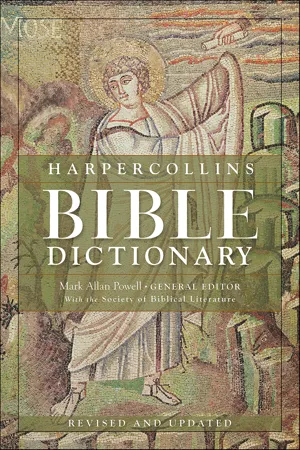
- 1,168 pages
- English
- ePUB (mobile friendly)
- Available on iOS & Android
eBook - ePub
HarperCollins Bible Dictionary
About this book
Information
Topic
Theology & ReligionSubtopic
Biblical ReferenceS
Sabaoth
sabbath
sabbath day’s journey
sabbatical
Sabta
Sabtecha
Sachar
sackcloth
sacrifice
Sadducees
saffron
saints
Salamis
Salecah
Salem
Salim
Sallai
Sallu
Salma
Salmon
Salmone
Salome
Salome
salt
Salt, City of
Salt Sea
Salt Valley
saltwort
salvation
Samaria
Samaria, district of
Samaritan, the Good
Samaritan Pentateuch
Samaritans
Samgarnebo
Samlah
Samos
Samothrace
Samson
Samuel
Samuel, First and Second Books of
Sanballat
sanctification
sanctuary
sand
sandal
Sanhedrin
Sansannah
Saph
Sapphira
sapphire
Sarah
Sarai
sarcophagus
Sardis
Sarepta
Sargon
Sarid
Sarsechim
Satan
satrap
Saul
savior
scapegoat
scarlet
scepter
Sceva
schools
scorpion
scourge
scribe
scripture
scroll
sculpture
Scythians
Scythopolis
sea
seah
seal
Sea Peoples
season
seat, judgment
Seba
Secacah
Second Coming of Christ
second death
Second Quarter
sect
Secundus
seed
seer
Segub
Seir
Seirah
Sela
Selah
Seleucia
Seleucids
self-control
Semites
Senaah
Seneh
Senir
Sennacherib
sentinel
Sephar
Sepharad
Sepharvaim
Sepphoris
Septuagint
Serah
Seraiah
seraphim
Serapis
Sergius Paulus
Sermon on the Mount
serpent
Serpent’s Stone
Serug
servant
service
Seth
seven, seventy
seven words from the cross
Shaalbim
Shaalim
Shaaraim
Shaashgaz
Shabbethai
Shaddai
shades
Shadrach
Shaharaim
Shalisha
Shallum
Shalmai
Shalman
Shalmaneser
shalom
Shama
shame
Shamgar
Shamir
Shamma
Shammah
Shammai
Shammua
Shaphan
Shaphat
Sharai
Sharezer
Sharon
Sharuhen
Shaul
Shaveh
Shaveh-kiriathaim
shaving
Shavsha
Sheal
Shealtiel
Sheariah
Shearjashub
Sheba
Sheba, queen of
Shebaniah
Shebat
Shebnah
Shebuel
Shecaniah
Shechem
Shedeur
sheep
Sheep Gate
Sheerah
Shehariah
shekel
Shelah
Shelemiah
Sheleph
Shelesh
Shelomi
Shelomith
Shelomoth
Shelumiel
Shem
Shema
Shema
Shemaah
Shemaiah
Shemariah
Shemeber
Shemed
Shemer
Shemida
Sheminith
Shemiramoth
Shemuel
Shenazar
Sheol
Shepham
Shephatiah
Shephelah
Shepher
shepherd
Shephi
Shephupham
Sherebiah
Sheshach
Sheshai
Sheshan
Sheshbazzar
Shetharbozenai
Sheva
Shibah
shibboleth
shield
Shiggaion
Shihor
Shihor-libnath
Shiloah
Shiloh
Shilonite
Shilshah
Shimea
Shimeath
Shimeathites
Shimei
Shimeon
Shimon
Shimrath
Shimri
Shimrith
Shimron
Shimshai
Shinab
Shinar
Shion
Shiphi
Shiphrah
Shiphtan
ships
Shishak
Shitrai
shittah
Shittim
Shiza
Shoa
Shobab
Shobach
Shobai
Shobal
Shobek
Shobi
shoes
shofar
Shoham
Shomer
shoot
shovel, altar
showbread
shrine
Shua
Shuah
Shual
Shuham
Shuhite
Shunammite
Shunem
Shuni
Shur
Shushan
Shuthelah
Sia
Sibbecai
Sibmah
sickle
Siddim
Sidon
siege
sign
signet
Sihon
Silas
Siloam
Siloam
Silvanus
silver
Simeon
Simon
sin
Sin
Sin, Wilderness of
Sinai
sinew
Sinites
sin offering
Sirach
Sirah
Sirion
Sisera
Sismai
sister
sit
Sitnah
Sivan
six
skins
sky
slave
slavery in the ancient Near East
slavery in the New Testament
sledge
sling
smith
Smyrna
snail
snake
snare
snow
So
soap
Soco, Socoh
Sodom
sojourn
sojourner
soldier
solemn assembly
Solomon
Solomon, Song of
Solomon, Wisdom of
Solomon’s Pools
Solomon’s Portico
Solomon’s servants
son
song
Song of Ascent
Song of Solomon
Song of Songs
Song of the Three Jews
son of God, Son of God
son of man, Son of Man
sons of God, children of God
sons of prophets
sons of thunder
soothsayer
Sopater
Sophereth
Sophia
sorcery
Sorek
Sosipater
Sosthenes
soul
sowing
Spain
span
sparrow
speaking in tongues
spear
speck
spelt
spices
spies
spinning and weaving
spirit
Spirit, Holy
Spirit of God
spirits, evil
spiritual gifts
spitting
sponge
springs
squad
Stachys
stacte
staff
stairs
stall
stars
stater
stealing
stele
Stephanas
Stephen
steward
Stoicism
stone
stoning
storage
stork
stove
stranger
strangled animals
straw
stripes
stumbling block
Succoth
Succoth-benoth
suffering
Sukkoth
sulfur
Sumer
sun
Supper, Lord’s
surety
Susa
Susanna
Susanna, book of
swaddling
swallow
swearing
swine
sword
sycamore
Sychar
Sychem
Syene
Symeon
synagogue
Synoptic Problem
Syntyche
Syracuse
Syria
Syrophoenician
Syrtis
Sabaoth (sab′ay-oth), Lord of. See names of God in the Hebrew Bible.
sabbath (sab′uhth; Heb. shabbat, “to cease, desist”), the weekly day of rest and abstention from work enjoined upon the Israelites.
Origin: An etiological origin for the sabbath is supplied in Gen. 2:1–3, which speaks of God ceasing from the work of creation on the seventh day, blessing the day, and declaring it holy. The Bible also credits Moses with instituting specific sabbath laws (e.g., Exod. 16:22–30).
Scholars have looked for parallels between Hebrew sabbath observance and days of rest in other religions or cultures of the ancient Near East. Three similarities with Babylonian rites are intriguing, though they ultimately serve to point up the distinctiveness of Israel’s traditions. First, the Babylonian monthly calendar designated certain days on which normal activities of the king and certain professions were restricted. These days, known as “evil days,” were determined by the lunar cycle, corresponding with the quarters of the moon. The biblical sabbath, however, was ordained as a weekly institution with no relation whatsoever to the lunar cycle. Moreover, the somber nature of the Babylonian “evil days” stands in stark contrast to the joyous nature of the sabbath.
Second, in Babylonian culture, the full moon on the fifteenth of the month was known as shapattu, a term possibly related to sabbath. This day was described as a “day of pacifying the heart [of the god]” by certain ceremonies. Apart from the name, however, no significant similarities between this day and the Israelite sabbath have been recognized. Finally, the closest analogy between the biblical sabbath and Babylonian culture is the shared literary motif in Israelite and Babylonian creation stories of the god(s) resting after having created humans (see Enuma Elish 7.8, 34). Even here, however, the parallel is distant. The biblical God rests to signify that the work of creation is completed (nothing more needs to be done), while the Babylonian gods rest because, once humans were created to feed them, they no longer needed to labor to feed themselves.
Observance: The sabbath was a cornerstone of Israelite religious practice from earliest times. This can be seen from the consistent mention of the sabbath throughout all the strata of pentateuchal and extrapentateuchal sources, with the exception of wisdom literature. In the Pentateuch, sabbath observance is legislated repeatedly in general terms (Exod. 20:8–11; 23:12; 31:12–17; Lev. 23:3; Deut. 5:12–15), though the types of work prohibited are relatively limited; those mentioned include gathering food, plowing and reaping, kindling a fire, and chopping wood (Exod. 16:29–30; 34:21; 35:3; Num. 15:32–36). The positive specifications of sabbath observance include giving rest to one’s servants and animals (Exod. 20:10; 23:12; Deut. 5:14).
Outside the Pentateuch, evidence relating to the practical observance of the sabbath is not overabundant, but it is more extensive than that found for most laws. During the monarchic period (ca. 1050–587/6 BCE), the sabbath (as well as the New Moon) was marked by visits to prophet and temple (2 Kings 4:23; Isa. 1:13). Business activity came to a halt (Amos 8:5). The sabbath was a joyous day, much like the festivals (Hos. 2:13; Lam. 2:6). Its desecration was severely attacked by Jeremiah, who lashed out against those who carried burdens from their houses or through the gates of Jerusalem on the sabbath (17:19–27). During the period of postexilic restoration, Nehemiah enforced observance of the sabbath by locking the city gates of Jerusalem in order to prevent traders from selling their wares (Neh. 13:15–22). Contemporary documents from a Jewish colony in Elephantine, Egypt, likewise mention the sabbath, attesting to its recognition by Jews in the Dispersion (i.e., outside the land of Israel) in the fifth century BCE.
In addition to these features of popular observance of the sabbath, one can piece together a picture of sabbath observance in the temple. The pentateuchal prescriptions of additional sacrifices and changing of the bread of the Presence on the sabbath (Lev. 24:8; Num. 28:9–10) apparently reflect accepted practice (cf. Ezek. 45:17; 46:4–5; 1 Chron. 9:32; 23:31; 2 Chron. 2:3; 8:13; 31:3). The sacrificial service may have been accompanied by a special psalm (Ps. 92:1). There is also a somewhat cryptic reference to the changing of the royal guards at the temple on the sabbath (2 Kings 11:4–12).
Purpose: Two major rationales for sabbath observance are presented in the Pentateuch. The concept of the sabbath as a memorial to God’s resting from the work of creation is expressed in Gen. 2:1–3 and repeated in Exod. 20:11; 31:17. The last passage broadens the concept in defining the sabbath as “a sign forever between (God) and the people of Israel.” Although God had already sanctified the seventh day at the time of creation, God did not reveal its special status to humankind at large, but only to Israel. Thus, Israel’s observance of the sabbath underscored its special relationship with God. This rationale was emphasized by Priestly writers.
Along with the theological rationale, a distinctly humanistic approach is to be found in Exod. 23:12 and Deut. 5:14–15, both of which ground the observance of the sabbath on the need to give servants, strangers, and work animals an opportunity to rest. The added reminder in Deut. 5:15 of Israel’s experience in Egypt most likely intends to bolster the ow...
Table of contents
- Editorial Board
- Contributors
- Abbreviations
- Books of the Bible
- Pseudepigrapha and Early Christian Literature
- Dead Sea Scrolls and Related Texts
- Targumic Material
- Mishnaic and Related Literature
- Other Rabbinic Works
- Nag Hammadi Tractates
- Preface
- Pronunciation Key
- A
- B
- C
- D
- E
- F
- G
- H
- I
- J
- K
- L
- M
- N
- O
- P
- Q R
- S
- T
- U V W
- X Y Z
- Credits
- Copyright
- About the Publisher
Trusted by 375,005 students
Access to over 1.5 million titles for a fair monthly price.
Study more efficiently using our study tools.
Frequently asked questions
Yes, you can cancel anytime from the Subscription tab in your account settings on the Perlego website. Your subscription will stay active until the end of your current billing period. Learn how to cancel your subscription
No, books cannot be downloaded as external files, such as PDFs, for use outside of Perlego. However, you can download books within the Perlego app for offline reading on mobile or tablet. Learn how to download books offline
Perlego offers two plans: Essential and Complete
- Essential is ideal for learners and professionals who enjoy exploring a wide range of subjects. Access the Essential Library with 800,000+ trusted titles and best-sellers across business, personal growth, and the humanities. Includes unlimited reading time and Standard Read Aloud voice.
- Complete: Perfect for advanced learners and researchers needing full, unrestricted access. Unlock 1.5M+ books across hundreds of subjects, including academic and specialized titles. The Complete Plan also includes advanced features like Premium Read Aloud and Research Assistant.
We are an online textbook subscription service, where you can get access to an entire online library for less than the price of a single book per month. With over 1.5 million books across 990+ topics, we’ve got you covered! Learn about our mission
Look out for the read-aloud symbol on your next book to see if you can listen to it. The read-aloud tool reads text aloud for you, highlighting the text as it is being read. You can pause it, speed it up and slow it down. Learn more about Read Aloud
Yes! You can use the Perlego app on both iOS and Android devices to read anytime, anywhere — even offline. Perfect for commutes or when you’re on the go.
Please note we cannot support devices running on iOS 13 and Android 7 or earlier. Learn more about using the app
Please note we cannot support devices running on iOS 13 and Android 7 or earlier. Learn more about using the app
Yes, you can access HarperCollins Bible Dictionary by Mark Allan Powell in PDF and/or ePUB format, as well as other popular books in Theology & Religion & Biblical Reference. We have over 1.5 million books available in our catalogue for you to explore.