New York Times-Bestselling Author: This account of Ronald Reagan's political comeback—and rescue of the GOP—is "an engrossing, richly detailed saga" (
Booklist).
Includes a foreword by Pulitzer Prize winner Jon Meacham
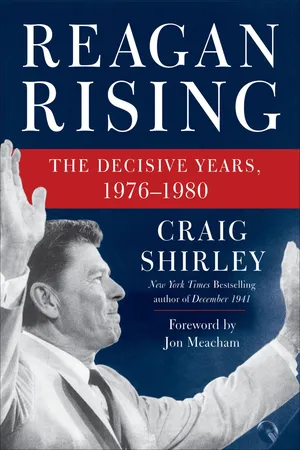
Charting Ronald Reagan's astonishing rise from the ashes of his 1976 presidential bid to overwhelming victory in 1980, Reagan Rising shows how American conservatism—and the nation itself—would never be the same.
In 1976, when Reagan lost his second bid for the GOP presidential nomination (the first was in 1968), most observers believed his political career was over. Yet one year later, at the annual Conservative Political Action Conference, Reagan sounded like a new man. He introduced conservatives to a "New Republican Party"—one that looked beyond the traditional country club and corporate boardroom base to embrace "the man and woman in the factories . . . the farmer . . . the cop on the beat. Our party," Reagan said, "must be the party of the individual. It must not sell out the individual to cater to the group."
Reagan's movement quickly spread, championed by emerging conservative leaders and influential think tanks. Meanwhile, for the first time in modern history, Reagan also began drawing young people to American conservatism.
But it was not only the former governor's political philosophy that was changing. A new man was emerging as well: The angry anticommunist was evolving into a more reflective, hopeful, and spiritual leader. Championing the individual at home, rejecting containment and détente abroad, and advocating for the defeat of Soviet communism, his appeal crossed party lines.
At a time when conservatives are seeking to redefine their identity in light of the Donald Trump phenomenon,
Reagan Rising offers insight into the development of Reagan's optimistic and unifying philosophy, and offers lessons for both established Republican leaders and emerging hopefuls.
"Chronicles the Republicans' emergence from the wilderness . . . [The author] is a sure-footed and entertaining observer of the hurly-burly of national politics." —
The New York Times
"An insightful, thoughtful history that reminds us of the renewal that occurred the last time the Republican Party was near collapse. It is the story of the lifeguard Reagan rescuing a drowning party. If only . . . " —Landon Parvin, former White House speechwriter for Ronald Reagan
- 432 pages
- English
- ePUB (mobile friendly)
- Available on iOS & Android
eBook - ePub
About this book
Information
1
All by Himself
“There is no Soviet domination of Eastern Europe, and there never will be under a Ford Administration.”
Ronald Reagan’s elegant departure from the 1976 campaign reminded some of Democratic nominee Adlai Stevenson’s graceful exit in 1952, after his defeat at the hands of Dwight Eisenhower. “Recalling a Lincoln story, Stevenson said he felt like the boy who had stubbed his toe in the dark; he was too old to cry but it hurt too much to laugh.”1
With the nomination in hand, President Gerald Ford discovered he was running thirty points behind Jimmy Carter in the polls. In fact, the Republicans and the president could count on precious little support anywhere in America in 1976.
The GOP had controlled the White House for sixteen out of the previous twenty-four years. However, the situation was horrible at the state level. Thirty-seven of the nation’s governors were Democratic, and the GOP controlled the legislatures in only four states—Idaho, Vermont, Kansas, and North Dakota. Both houses of Congress had been firmly in the hands of the Democrats since 1954. In 1976 there were states in Dixie that had almost no elected Republican official. Moreover, the “Grand Old Party” was outnumbered better than two to one in the House, had fewer than forty senators, and in a remarkable testament to its fecklessness, only one state in the country, Kansas, had Republican control of both the governorship and the legislature after the Watergate-wipeout elections of 1974. The other forty-nine states had near or total Democratic control.
Newspapers openly speculated on whether the GOP “survives at all,” and even reliable GOP operatives talked frankly about the party’s imminent demise. “The Republican Party may have outlived its usefulness,” declared John Deardourff, a consultant to moderate GOP candidates.2 The Republican Party was so sullied by Watergate, corruption, Vietnam, and its own schizophrenic message that many thought that, at the very least, it should change its name.
* * *
Gerald Ford, even as the long shot against Jimmy Carter, was now holding center stage, not Reagan. Reagan was a man born for the arena, and the thought of simply fading away on someone else’s terms cut him deeply. He admitted as much in his autobiography, An American Life, when he wrote, with not a little understatement, “It was a big disappointment because I hate to lose.”3 He rather liked the idea of dramatically riding off into the sunset after victory, but it was going to be at a moment of his own choosing. Reagan had an actor’s innate sense of timing. He knew how and when to enter (or exit) a political stage.
Back in 1970, when Vice President Spiro Agnew had been performing as Richard Nixon’s pit bull, savaging one Nixon critic after another who had angered the White House, Reagan told aides, “The trouble with Spiro is that he doesn’t know when to stop. A showman should always know when it’s time to leave the stage.”4 Reagan always knew when the curtain had fallen.
Conservatives, furious for years over real and imagined slights at the hands of moderates Tom Dewey, Dwight Eisenhower, Richard Nixon, Ford, and the “Eastern Elites,” were in open revolt against the remaining forces of the GOP. A handful went so far as to hold their own convention in Chicago, after Kansas City, under the banner of the American Independent Party. Their plans backfired, however, when a group of racists took over the convention and the conservatives stormed out.5 Conservatism in America had gained respectability among many as an intellectual force, though it had still not driven out the last dregs of bigots, who’d comprised a small faction twenty years earlier—though, truth be told, racists were still abundant in the Democratic Party of 1976.
What was particularly distressing for conservatives at the time was a Gallup poll showing that though Republicans were about as popular as “ring around the collar,” an apparent calamity for men everywhere if Madison Avenue was to be believed, almost 50 percent of Americans called themselves “conservative,” while less than a quarter called themselves “liberal.” The Wall Street Journal lamented that “the WASP small businessman of the GOP has not found a way to make common cause with the Catholic blue-collar worker despite the latter’s increasingly conservative political perceptions.”6 Carter had an ongoing problem stitching together the urban northern liberals with the southern traditionalists.
Carter also had a problem with Catholics, who were traditional Democratic voters, in part because of his “fuzzy” abortion position. His campaign went so far as to set up an “ethnic desk” at his headquarters in Atlanta, which was staffed by Terry Sunday, formerly with the National Conference of Catholic Bishops.7
Some Catholics, frustrated with their inability to pin down the slippery Carter on cultural hot-button issues, endorsed Ford for president, though the National Coalition of American Nuns supported the Georgian. Carter was also having trouble with Catholics in his own backyard, which was underscored when the wife of the Democratic governor of Louisiana, Edwin Edwards, endorsed Ford over Carter. Elaine Edwards’s endorsement was a lonely one, though, as the GOP struggled for relevance. Many in the conservative chattering classes had settled on the analogy between the current GOP and its predecessors, the Whigs, who had come down with a bad case of confusion in the 1850s and died as a result. Amid these problems, Ron and Nancy headed to the Ranch for the balance of September, for some much-needed rest and relaxation.
Despite the healing powers of ranch time, Reagan and some of his supporters were slow to join the Ford bandwagon. Often, staff and friends would go see the Reagans at Rancho del Cielo on a Sunday, only to find themselves drafted for chores. Nancy Reynolds found herself painting one afternoon when her nine-year-old son, Mike, fell asleep in the back of Reagan’s pickup truck and Reagan drove off, not knowing the boy was in there. Reagan “jumped” when he stopped and discovered the still-slumbering boy.8 The Ranch was Reagan’s port in a storm, and he had little communication with the outside world while there, save a beat-up old television that barely picked up broadcasts from Los Angeles. By day, he would work and ride; by evening, he’d write, read, and go for long strolls with Nancy.
* * *
In early September, the New York Times succumbed to the anti-Reagan spin coming from the Ford campaign. They saw Reagan as a sore loser against Gerald Ford, the real ’76 GOP nominee.9 In fact, neither Reagan nor his staff, and especially Mrs. Reagan, would forget or forgive for a very long time. In the case of some staffers, they would never, ever forgive Ford. The paper had it correct the day before, when it was reported that Reagan “has grown impatient with the White House” over the newest round of backbiting against him by Ford operatives.10
Reagan and his team had learned a timeless lesson the hard way. They had discovered “that presidential campaigns are a lot like clashes on a battlefield.”11 Like his staff, “Reagan admitted he had been ‘naïve,’ had lost a lot of his innocence in Kansas City as he saw with his own eyes how politicians used their muscle to block him from taking over the Republican party, which they had controlled for so many years as their personal fiefdoms.”12
While some Reagan staffers were casting about for jobs, Charlie Black, Lyn Nofziger, and Paul Russo hooked up with Ford’s running mate, Kansas senator Robert J. Dole, whose mission was clear from day one: “To try to keep followers of Ronald Reagan . . . from abandoning the party.”13 Dole’s campaign approach, charitably freestyle as he continually altered the plans he received from the Ford headquarters, was “giddy, repetitive, relaxed about absurdity, high-spirited but quite uncertain whither it is heading, in November or even a day or two ahead of time.”14 Nofziger compared Dole’s campaign style to a “hungry Doberman pinscher.”15
* * *
Governor Carter kicked off the fall campaign in September not in Detroit’s Cadillac Square, as had been the tradition for many Democratic nominees the past decades, but in his home state of Georgia. He wisely chose Warm Springs, where Franklin D. Roosevelt availed himself of the hot baths as he battled polio for many years and where he died early in 1945. Unlike his political heroes, the urbane and urban FDR and John F. Kennedy, Carter sounded a southern populist theme with agrarian overtones, stressing his “farm boy” roots and down-home perspective. Both FDR and JFK were Harvard alumni who had gone to elite New England prep schools and grown up in great wealth. To be sure, Carter had grown up comfortably as a child, and lived even more so as a successful businessman, but he was truly a populist, suspicious of the Washington culture, unlike the majority of his fellow Democrats.
Ford stuck mostly to the White House, “acting ‘Presidential.’”16 He was seen by many, in contrast to the populist Carter, as an elitist. The perceived contrast between the two men was misleading, at least in terms of their relative wealth. Carter had successfully grown the family peanut business and, by 1975, had a taxable annual income of $122,189. Yet he had paid only $17,500 in taxes due to income averaging and an investment tax credit. He and Mrs. Carter also enjoyed, besides the equity in the peanut business, extensive landholdings and a large stock portfolio, which included Coca-Cola.17 In contrast, President Ford earned an annual income of $200,0...
Table of contents
- Dedication
- Contents
- Foreword
- Preface
- Introduction
- 1: All by Himself
- 2: While We Were Marching Through Georgetown
- 3: Into the Wilderness
- 4: The Bear in the Room
- 5: Canal Zone Defense
- 6: Drinking the Kool-Aid
- 7: Reagan on Ice
- 8: Bread and Circuses
- 9: Up from Carterism
- 10: “Big John” Versus “Poppy”
- 11: Georgia Versus Georgetown
- 12: Adrift
- 13: Iowa Agonistes
- 14: Reagan’s Dunkirk
- 15: Sunshine Reaganites
- 16: The Politics of Politics
- 17: Island of Freedom
- Author’s Note
- Acknowledgments
- Bibliography
- Notes
- Index
- About the Author
- Also by Craig Shirley
- Copyright
- About the Publisher
Trusted by 375,005 students
Access to over 1.5 million titles for a fair monthly price.
Study more efficiently using our study tools.
Frequently asked questions
Yes, you can cancel anytime from the Subscription tab in your account settings on the Perlego website. Your subscription will stay active until the end of your current billing period. Learn how to cancel your subscription
No, books cannot be downloaded as external files, such as PDFs, for use outside of Perlego. However, you can download books within the Perlego app for offline reading on mobile or tablet. Learn how to download books offline
Perlego offers two plans: Essential and Complete
- Essential is ideal for learners and professionals who enjoy exploring a wide range of subjects. Access the Essential Library with 800,000+ trusted titles and best-sellers across business, personal growth, and the humanities. Includes unlimited reading time and Standard Read Aloud voice.
- Complete: Perfect for advanced learners and researchers needing full, unrestricted access. Unlock 1.5M+ books across hundreds of subjects, including academic and specialized titles. The Complete Plan also includes advanced features like Premium Read Aloud and Research Assistant.
We are an online textbook subscription service, where you can get access to an entire online library for less than the price of a single book per month. With over 1.5 million books across 990+ topics, we’ve got you covered! Learn about our mission
Look out for the read-aloud symbol on your next book to see if you can listen to it. The read-aloud tool reads text aloud for you, highlighting the text as it is being read. You can pause it, speed it up and slow it down. Learn more about Read Aloud
Yes! You can use the Perlego app on both iOS and Android devices to read anytime, anywhere — even offline. Perfect for commutes or when you’re on the go.
Please note we cannot support devices running on iOS 13 and Android 7 or earlier. Learn more about using the app
Please note we cannot support devices running on iOS 13 and Android 7 or earlier. Learn more about using the app
Yes, you can access Reagan Rising by Craig Shirley in PDF and/or ePUB format, as well as other popular books in Política y relaciones internacionales & Biografías políticas. We have over 1.5 million books available in our catalogue for you to explore.