"Artfully integrates the complex, simultaneous Suez and Hungarian crises of 1956 into a single story of Cold War conflict as no one has before." —
Publishers Weekly
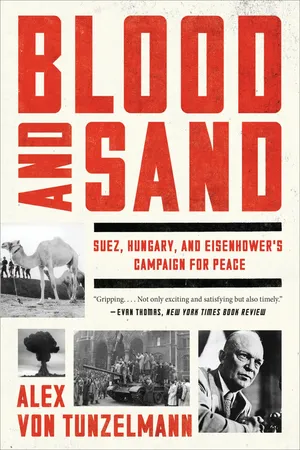
The year 1956 was a turning point in history. Over sixteen extraordinary days in October and November, the Suez Crisis and the Hungarian Revolution pushed the world to the brink of a nuclear conflict and what many at the time were calling World War III.
Blood and Sand relates this story hour-by-hour, through an international cast of characters: Anthony Eden, the British prime minister, caught in a trap of his own making; Gamal Abdel Nasser, the bold young populist leader of Egypt; David Ben-Gurion, the strong-willed founding prime minister of Israel; Guy Mollet, the bellicose French prime minister; and Dwight D. Eisenhower, the American president, torn between an old world order and a new one in the very same week that his own fate as president was to be decided by the American people.
This is a fresh new account of these dramatic events and people, one that for the first time sets both crises in the context of the global Cold War, the Arab-Israeli conflict, and the treacherous power politics of imperialism and oil.
Blood and Sand resonates strikingly with the problems of oil control, religious fundamentalism, and international unity that face the world today, and is essential reading for anyone concerned with the state of the modern Middle East and Europe.
"This thrilling ticktock brings the emotional core of geopolitical maneuvering into dramatic focus, with portraits of leaders variously honorable, pigheaded, irresolute, pusillanimous, and susceptible to mood swings." —
The New Yorker
- 576 pages
- English
- ePUB (mobile friendly)
- Available on iOS & Android
eBook - ePub
About this book
Information
Print ISBN
9780062249258
Subtopic
European History1
MONDAY, OCTOBER 22, 1956
“WE MUST KEEP THE AMERICANS REALLY FRIGHTENED”
0300 Washington DC // 0800 Rabat; London // 0900 Paris // 1000 Cairo
Wearing neat blue lounge suits, five Algerian rebels gathered at the airfield in Rabat, Morocco, to await the arrival of the sultan. Their leader was Ahmed Ben Bella: a farmer’s son, a former football star, and a war hero. He had won the Croix de Guerre for his bravery during the German bombing of Marseilles and later the Médaille Militaire, the highest honor in the Free French forces. A grateful General Charles de Gaulle had presented him with his medal.
VE Day, May 8, 1945, was a turning point. A victory parade in the northeastern Algerian town of Sétif turned into a protest against French rule. There were rapes, mutilations, and murderous attacks on Europeans, leaving over 100 dead and a similar number injured. It was five days before the authorities could restore order. When they did, it was with unprecedented brutality. Muslim villages were bombed from the air and sea by French forces; 5,000 peasants from the Sétif region were forced to grovel on their knees in front of a French flag and plead for forgiveness.1 Summary executions were carried out by the military, and many Algerians were lynched by European vigilantes. An official French report suggested that 1,020 Algerian Muslims were killed. Far greater figures were quoted throughout the Arab world, up to 45,000.
Many politicians in Paris, much of the population in France, and much of the European population living in Algeria (known as pieds-noirs, literally “black feet”), argued that Algeria was an integral part of France: an equal, not a colony. Much of the political elite in Algeria—some Muslims as well as Europeans—believed strongly that Algerian nationhood was an artificial construct. Before French unification, they argued, the territory had been culturally, linguistically, and politically disparate. Their pride expressed itself not in advocating for independence but in achieving their full potential as free citizens of democratic France. Yet many indigenous Algerians outside the political elite did not feel free or equal, observing the generally greater wealth of Europeans, the disproportionate political representation of Europeans, and the fact that European farmers had settled in the most cultivatable parts of the land. Increasing numbers began to consider themselves under French occupation.
Ben Bella left the French army and joined the Algerian political opposition. The French tried to have him assassinated, so he went into hiding. He was found and imprisoned in 1950 but escaped two years later in a plot that seemed to have fallen out of a cartoon. A loaf of bread was delivered to him in prison with a metal file hidden inside. He used it to saw through the bars on his window, then fled to Cairo and to Gamal Abdel Nasser.
Nasser welcomed Ben Bella and other members of the nascent Algerian National Liberation Front (FLN) to Egypt. In 1954, the FLN began an armed uprising against French colonialism in Algeria. Ben Bella remained in exile, coordinating international relations from Egypt and Tunisia and attempting to involve the United Nations on the FLN’s side.2
In February 1956, Guy Mollet—the new socialist prime minister of France, who had been in office for only a week—visited Algeria. He was ambushed by a mob who pelted him with rotten fruit and vegetables. This incident was described by the French and Algerian press as la journée des tomates, the Day of the Tomatoes. In the aftermath of the tomatoes, Mollet assumed a firm position. Describing the rebels as “a handful of maniacs and criminals who take their orders from outside Algeria,” he stated, “The Government will fight, France will fight to remain in Algeria, and she will remain there. There is no future for Algeria without France.”3
Mollet and his government had no doubt who they thought was giving the rebels orders from outside Algeria. An internal French government report on June 13, 1956—six weeks before the nationalization of the Suez Canal—accused Nasser of “a resumption of Egyptian interferences in the affairs of North Africa; outrageous propaganda on ‘Voice of the Arabs’; training commandos under the aegis of Egyptian officers . . . according hospitality to Algerian rebel military staff.”4
Anthony Eden was not the only man in Europe who had decided Nasser was his personal nemesis. According to C. Douglas Dillon, the American ambassador to Paris, Mollet “had almost a fixation about President Nasser.” The French prime minister believed that Nasser “was going to control oil and, therefore, control the world. . . . He was violently concerned about this.”5
Senior figures in the French government were open about their discomfort with Arab and African self-rule. “According to the most reliable intelligence sources we have only a few weeks in which to save North Africa,” Christian Pineau told Foster Dulles on August 1. “Of course, the loss of North Africa would then be followed by that of Black Africa, and the entire territory would rapidly escape European control and influence.”6 The director-general of the French Defense Ministry told the prime minister of Israel, “Black children in Equatorial Africa already bear flags with Nasser’s picture.”7 Canal nationalization affected the situation between France and the Algerian rebels, according to a CIA report: “Suez has hardened attitudes on both sides and dispelled the more favorable atmosphere for negotiations that had been developing.”8
The Algerian rebels had been staying in Morocco as guests of the sultan. The sultan, along with the Tunisian prime minister, Habib Bourguiba, was encouraging them to continue peace talks with the French. These had been going on in secret for a year. Mollet’s government had been pursuing a tough policy of “pacification”—heavy policing—alongside limited social and economic reforms. It was unpopular with the French public, for the cost of keeping the Algerian population subdued was steep. By the autumn of 1956, a blunt CIA memorandum determined that French policy in Algeria “had failed.”9 The talks with the FLN appeared to represent a different approach. The French government promised Ben Bella and his delegation safe conduct by air to meet Bourguiba in Tunis.
As they waited, word came from the palace that owing to a lack of space the Algerians could not share the sultan’s plane and would have to fly in a separate Air Atlas DC-3. “I was very upset by this news,” said Ben Bella afterward. But there was no time to reschedule. As the DC-3 took off from the airfield, Ben Bella carefully stashed his revolver in his seat pocket.
The plane’s route had been planned to avoid flying directly over French-controlled Algerian territory. It made a scheduled stop in Palma de Mallorca in the Mediterranean. Soon after it took off again, Ben Bella began to fear that they were flying too far south. He asked the stewardess what was going on.
“Maybe we’re taking a more direct route,” she replied.
Ben Bella started with alarm. “What do you mean, more direct?” he said. “We’re still not flying over Algerian territory, are we?”
“No, no,” she said hastily.
The plane entered Algerian airspace. As soon as it did, French fighter jets scrambled to meet it. They were not there as an escort. Instead, they forced the plane down.
Ben Bella went for his revolver. “Leave your weapon where it is,” said one of his comrades. “You’re not going to give them this wonderful pretext . . .”
The plane touched down in Algiers. “Then the interior lights went out and we could see armoured cars with spotlights and truckloads of gendarmes with submachine guns following us as we taxied to a halt,” wrote Thomas F. Brady of the New York Times, who was traveling with the rebels.
“All right,” said Ben Bella, as a gendarme with a tommy gun burst into the cabin. “We will come out.” Ben Bella and his companions were taken off the plane, arrested, and handcuffed. “This is how you can trust the French!” Ben Bella exclaimed.10
Two journalists, Brady and a colleague from France-Observateur, were also arrested and questioned—though Brady would soon be released.11 They were packed in a secure van with policemen and escorted away by motorcycles and tanks.12
News of this kidnapping began to spread throughout the Arab world that day, provoking outrage and an immediate demonstration in Tunis against the French. Habib Bourguiba “said that the arrest of the Algerian leaders risked hurling all North Africa into a trial of strength with France,” noted the Times of London.13
On an airfield outside Paris that same damp and misty morning, almost no one’s attention was on another plane: a French DC-4. The scene, Christian Pineau later wrote, “was worthy of a James Bond sequence.”14 The plane touched down on the wet asphalt, and a huddle of men disembarked. Among them was a distinctive figure, his cloud of white hair squashed under a broad-brimmed hat. One of the airfield workers did notice: he thought the figure looked like David Ben-Gurion, prime minister of Israel, and dashed off to tell a journalist friend. The journalist replied that he must have been mistaken. Such a visit was wholly implausible.15
Their cover unblown, Ben-Gurion and his Israeli delegation—Shimon Peres, Moshe Dayan (wearing large glasses instead of his trademark eyepatch), and Lieutenant Colonel Nehemia Argov—got into unmarked black cars and drove to Sèvres. Under Ben-Gurion’s arm was a copy of the History of the Wars of Justinian by the sixth-century Byzantine historian Procopius. It was a hint as to why he was there. The history mentions an island at the southern end of the Gulf of Aqaba, where the tip of what is now Saudi Arabia stretches toward the Sinai peninsula. This island was, according to Procopius, the site of an ancient Jewish community.
Ben-Gurion settled pragmatically on the island of Tiran as the site of the ancient community. His reasons were not entirely drawn from Procopius. Tiran was a strategic point on the sea approach to Eilat, Israel’s only southern seaport, linking it to the Red Sea and opening up potentially valuable trade routes to the Arabian Sea, the Persian Gulf, and beyond. The importance of the Straits of Tiran and the port of Eilat would become plain in 1957, when the Israelis would broker a secret deal with the National Iranian Oil Company to build an oil pipeline known as the Trans-Israel Pipeline, or Tipline, from Eilat to Ashkelon. This could bring Iranian oil through Israel to the Mediterranean and thus to the European market without using the Suez Canal, avoiding potentially hostile Arab territory. It had the potential to make Israel’s security vital to European interests.16 The possibility of this pipeline was discussed by the Israeli ambassador with British politicians as early as July 1956.17 Egypt, which controlled the Straits, had closed them to Israeli shipping in October 1955.18 Since then, Ben-Gurion had been putting together a plan to take Tiran by force.19
At Sèvres, a summit convened in a private villa belonging to a friend of the French minister of defense, Maurice Bourgès-Maunoury. Representing France were Bourgès-Maunoury; Christian Pineau, the minister of foreign affairs; General Maurice Challe; and other senior French military officers. A British representative was to arrive later. The objective was to plan a secret war.
This was a huge moment for Israel: a possible alliance, even in secret, with two major world powers. The Israel of 1956 was a very different state than it is today: physically smaller and militarily far weaker. For its Jewish inhabitants, the Nazi Holocaust was a sharply recent trauma.
The history of Israel and its future hinged at this point on the political maneuverings of David Ben-Gurion. He had been born David Grin (sometimes spelled Grün) in Poland in 1886, at a time when antisemitism was on the rise throughout Europe. He was nine years old at the beginning of 1896, when the Hungarian Jewish writer Theodor Herzl published The Jewish State—suggesting that Jews leave Europe and set up their own country, perhaps in Palestine or Argentina (Uganda later came up as an alternative, but was quickly dropped). “The real, the only, Zionism is a colonization of Palestine,” David wrote to his father; “everything else is just eyewash, blah and a waste of time.”20 Some Zionists did not see the colonization of Palestine as essential to the project of creating a Jewish state. Some Jews continued to reject Zionism altogether, as they had for many years before Herzl revived the idea. As for Palestine itself, it had a population of around half a million people at the time, the great majority of whom were Arabs and Muslims. There was a small minority of Christians and an even smaller minority of Jews, though this soon began to grow as a result of Zionist immigration.
At twenty, David left Poland on a fake passport and made his way to Odessa. From there he took a Russian cargo ship to Jaffa, arriving on September 9, 1906. Palestine was then under the rule of the Ottoman Empire. Life was hard for the European Zionists who turned up. Few could cope with the climate, the unsanitary conditions, the hard labor, or the cool welcome they received from indigenous Palestinian Jews. David became a jobbing farmhand and contracted malaria. In 1912, he went to study law at Istanbul University. Around this time, he chose a Hebrew name: David Ben-Gurion. He returned to Jerusalem but, when World War I broke out, the Ottoman Empire decided that foreign national Jews in Palestine might constitute a fifth column. He and many others were expelled.
Ben-Gurion went to New York City. His prospects and those of Israel changed dramatically in November 1917, when the British foreign secretary, Arthur Balfour, wrote a letter to Lord Rothschild of the Zionist Federation of Great Britain and Ireland (the son of the Lord Rothschild who had lent Benjamin Disraeli the money to buy a stake in the Suez Canal Company). The full Balfour declaration read:
“His Majesty’s Government view with favour the establishment in Palestine of a national home for the Jewish people, and will use their best endea...
Table of contents
- Maps
- Dedication
- Contents
- Author’s Note
- Prologue: “I Want Him Murdered”
- 1: Monday, October 22, 1956: “We Must Keep the Americans Really Frightened”
- 2: Tuesday, October 23, 1956: The Hammer and Sickle Torn Out
- 3: Wednesday, October 24, 1956: A Plan On a Cigarette Packet
- 4: Thursday, October 25, 1956: Bloody Thursday
- 5: Friday, October 26, 1956: The Two Musketeers
- 6: Saturday, October 27, 1956: The Omega Plan
- 7: Sunday, October 28, 1956: No Picnic
- 8: Monday, October 29, 1956: “Sandstorms in the Desert”
- 9: Tuesday, October 30, 1956: Ultimatum
- 10: Wednesday, October 31, 1956: Perfidious Albion
- 11: Thursday, November 1, 1956: “There is Something the Matter With Him”
- 12: Friday, November 2, 1956: “Love to Nasty”
- 13: Saturday, November 3, 1956: “Help the Burglar, Shoot the Householder”
- 14: Sunday, November 4, 1956: Reaping the Whirlwind
- 15: Monday, November 5, 1956: “Hit ’Em with Everything in the Bucket”
- 16: Tuesday, November 6, 1956: Back Down
- Epilogue: “The Curse of the Pharaohs”
- Fates
- Acknowledgments
- Notes
- Bibliography
- Index
- Photo Section
- About the Author
- Also by Alex Von Tunzelmann
- Credits
- Copyright
- About the Publisher
Trusted by 375,005 students
Access to over 1.5 million titles for a fair monthly price.
Study more efficiently using our study tools.
Frequently asked questions
Yes, you can cancel anytime from the Subscription tab in your account settings on the Perlego website. Your subscription will stay active until the end of your current billing period. Learn how to cancel your subscription
No, books cannot be downloaded as external files, such as PDFs, for use outside of Perlego. However, you can download books within the Perlego app for offline reading on mobile or tablet. Learn how to download books offline
Perlego offers two plans: Essential and Complete
- Essential is ideal for learners and professionals who enjoy exploring a wide range of subjects. Access the Essential Library with 800,000+ trusted titles and best-sellers across business, personal growth, and the humanities. Includes unlimited reading time and Standard Read Aloud voice.
- Complete: Perfect for advanced learners and researchers needing full, unrestricted access. Unlock 1.5M+ books across hundreds of subjects, including academic and specialized titles. The Complete Plan also includes advanced features like Premium Read Aloud and Research Assistant.
We are an online textbook subscription service, where you can get access to an entire online library for less than the price of a single book per month. With over 1.5 million books across 990+ topics, we’ve got you covered! Learn about our mission
Look out for the read-aloud symbol on your next book to see if you can listen to it. The read-aloud tool reads text aloud for you, highlighting the text as it is being read. You can pause it, speed it up and slow it down. Learn more about Read Aloud
Yes! You can use the Perlego app on both iOS and Android devices to read anytime, anywhere — even offline. Perfect for commutes or when you’re on the go.
Please note we cannot support devices running on iOS 13 and Android 7 or earlier. Learn more about using the app
Please note we cannot support devices running on iOS 13 and Android 7 or earlier. Learn more about using the app
Yes, you can access Blood and Sand by Alex von Tunzelmann in PDF and/or ePUB format. We have over 1.5 million books available in our catalogue for you to explore.