- 256 pages
- English
- ePUB (mobile friendly)
- Available on iOS & Android
eBook - ePub
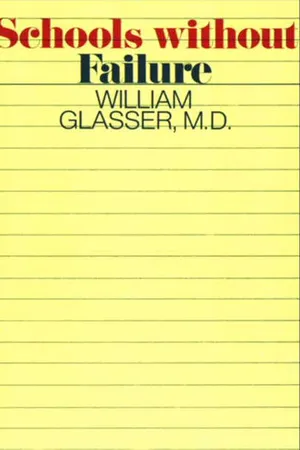
Schools Without Failure
About this book
The author of the bestselling Reality Therapy offers daring recommendations to "shake up educators" (Alexander Bassin).
Information
Topic
EducationSubtopic
Personal SuccessCHAPTER ONE
The Problem of Failure
Because of the widespread interest in the ideas of Reality Therapy,• I conduct many day-long seminars for groups of people who work with problem children. First I discuss the theory of Reality Therapy; then I demonstrate the technique by interviewing a group of adolescents so that the audience can see in practice what I have described. If any reader of this book had been present at a recent demonstration in Portland, Oregon, and had not known that the audience was composed of social workers involved in helping delinquents, he would have been hard-pressed to understand the purpose of the interview. Listening to the attractive, well-groomed, poised, adolescent girls, anyone would have been favorably impressed with the comfort and ease with which they described their life before a large audience packed closely around them. The girls seemed so unlike the image the general public has of a delinquent. During their thoughtful and candid discussion of their problems, we became clearly aware that their attitude, an attitude distressing to both me and the audience, was that of resignation; they believed they would have very little chance to succeed or to be happy in the world as they saw it.
These girls had all been in trouble with the law. Their juvenile offense was incorrigibility. Refusing to obey their parents, the school authorities, or the local juvenile curfew ordinances, they had, for example, stayed out all night, associated with people of whom their parents disapproved, cut school on many occasions, and dabbled in illegal drugs, alcohol, and sex. Although not hard-core delinquents, they had already been put into a local custodial institution; further trouble would lead them to the state reform school. Of the seven girls in the group, five firmly believed that they were failures in life and that they could not reverse this failure; the other two thought they might succeed in the school but had little confidence in success anywhere else. The five said that they would only go through the motions in school, that they had no hope of learning anything that would be valuable now or later in their lives. They realized that without a good education they were handicapped, but when I asked them whether they would work hard in school now that they recognized the gravity of their situation, they said they would only try hard enough to pass. Having accepted school failure, they would make no effort that might lead to success in school.
The girls also described their failure to make warm, constructive relationships with their families or their teachers; they even lacked warm feelings for each other, although they had lived together for several months. As they were resigned to school failure, so were they resigned to the lack of important human relationships. Although they were not happy in the institution they were living in, they predicted that they would do poorly at home, mostly because they had no confidence in their chances of succeeding in school. They readily admitted that most of their problems at home with their parents concerned school failure and their association with in-school or out-of-school failures. In the hour interview, I could not budge their conviction that all they could do now was take one day at a time and hope for the best. They had little interest in doing anything that might lead to a better future, or even in planning for one.
These girls did not have the classical sociological trappings of failure. They were attractive Caucasians from the middle class. Most were average or above in intelligence. Although some were from broken homes, each had at least one parent close to her who she believed loved her Still, they were miserable; they had no confidence in themselves and they had no confidence for success in the future. Several admitted that if men came along who would marry them, they would accept, using marriage as a way out of a situation which seemed impossible for them to change by themselves. Nevertheless, they had little faith that a marriage would be successful. Having seen many broken marriages in her own family and among her friends, each doubted that her marriage would last. They hoped without conviction that it would, but they had no more understanding of how they might work toward a successful marriage than toward anything else successful. Since they had been removed from their homes and placed in an institution in which school was easy and their lives were strictly but, they admitted, pleasantly regulated, they were no longer even rebellious. Lackadaisical or apathetic might be a better description of their mood.
These girls are not unique. I have interviewed similar young people in many states from New York to California. There has sometimes been economic deprivation, sometimes racial discrimination, in rare instances physical impairment or mental retardation. But the primary explanation of their almost total lack of confidence in themselves and in their ability to improve their situation lies elsewhere. Poverty, while important, is not an overwhelming obstacle. Most children, and I now work with many children in poverty areas, don’t really feel that they are poor. They are reasonably well-dressed, they have enough food, they have TV, and they have some of the material rewards that they know are available in our society. This may not be true everywhere, but it is mostly true in the Los Angeles central area I know best. Even for poorer children than those with whom I work or whom I have seen, poverty is not the sole or even the main cause of their hopelessness and resignation toward a future of failure. Similarly color, handicapping as it is to non-Caucasians in our society, is not a total obstacle. Combined with poverty, combined with a broken home and poor relationships with one’s parents, and most of all, in my opinion, combined with school failure, the restricted opportunities that exist for nonwhites can be a very serious contribution to failure. If school failure does not exist, other handicaps can be more easily overcome.
If failing children, and the adults they become, were few, they would have little impact on our society; but they are not few. Congregating in the central section of any major city are increasing numbers of people whose common denominator is failure. This is not my definition of their condition, nor a sociologist’s, a schoolteacher’s, a policeman’s, a probation officer’s, nor a politician’s; it is their definition of themselves. In a society where they are aware that many people are succeeding, they are failing. When pressed for a plan to do better, most will say that they must “work harder,” but just what they are going to do is very vague in their minds. They are giving lip service to an old cliché.
Can this aura of failure be changed? Can we help these Portland girls with few social strikes against them develop goals, form better relationships with the important people in their lives, and start to experience success and gain confidence? Can we in addition find a solution for those who do have more social handicaps? I believe we can and I believe that the best solution, a successful education, can do much to overcome the problem of failure no matter what its social trappings. I do not accept the rationalization of failure commonly accepted today, that these young people are products of a social situation that precludes success. Blaming their failure upon their homes, their communities, their culture, their background, their race, or their poverty is a dead end for two reasons: (1) it removes personal responsibility for failure, and (2) it does not recognize that school success is potentially open to all young people. If students can gain enough responsibility to work hard in school, and if the built-in barriers to success are removed from all schools, many of the detrimental conditions can be overcome.
As a psychiatrist, I have worked many years with people who are failing. I have struggled with them as they try to find the way to a more successful life. As I became involved with them, I have shared their pains and misfortunes and fought against their rationalizations. From these struggles I have discovered an important fact: regardless of how many failures a person has had in his past, regardless of his background, his culture, his color, or his economic level, he will not succeed in general until he can in some way first experience success in one important part of his life. Given the first success to build upon, the negative factors, the ones emphasized by the sociologists, mean little.
From this observation, gained from eleven years of helping delinquent girls in a reform school,• my work has taken me to the public schools. I believe that if a child, no matter what his background, can succeed in school, he has an excellent chance for success in life. If he fails at any stage of his educational career—elementary school, junior high, high school, or college—his chances for success in life are greatly diminished.
From a community standpoint, we will never be able to do much to correct the serious problems in homes and families. Although broken homes will always have a bad effect upon the children they send to school, the schools need not therefore give up. As a nation, however, we can and we must rid ourselves of racial discrimination and increase opportunities for employment, particularly meaningful employment in which the worker feels that he is doing a good, worthwhile job. Racial discrimination and lack of job opportunities presently contribute markedly to the failure we see in our society. However, even if we do correct these grave deficiencies, if we do not simultaneously examine education and find out how to graduate more well-educated and successful students, much of what else we do will be wasted.
We must develop schools where children succeed, not only in our wealthy suburbs, but in all parts of our cities, from uppermiddle-class neighborhoods down through the poverty-stricken central city.• It is the responsibility of each individual child to work to succeed in the world, to rise above the handicaps that surround him; equally it is the responsibility of the society to provide a school system in which success is not only possible, but probable. Too much of our present educational system emphasizes failure and too many children who attend school are failing. Unless we can provide schools where children, through a reasonable use of their capacities, can succeed, we will do little to solve the major problems of our country. We will have more social disturbances, more people who need to be kept in jails, prisons, and mental hospitals, more people who need social workers to take care of their lives because they feel they cannot succeed in this society and are no longer willing to try. It is with the crucial importance of the school system in mind that I have moved from the traditional but limited psychiatric practice of working in prisons, mental hospitals, and clinics into working with children and teachers in school to see whether the concepts of Reality Therapy, especially involvement and responsibility, applied to the public schools, can work as well there as in reform schools and mental hospitals.
No one is more aware of the problems of failing children than those who work in the schools. Almost every teacher and administrator I have spoken to in the past several years has been disturbed, puzzled, and in many cases disheartened over the increasing numbers of children who seem to be totally recalcitrant to the school process. They are rebellious, they do not read, they are unmotivated, they are withdrawn, they are apathetic. They seem to be impossible to educate. Faced with these problem children, those who work in the schools have tried and continue to try many new approaches. They expect that with my experience in working with children who are rebellious, nonconforming, withdrawn, and apathetic, I will be able to contribute some effective procedures to the schools. Coming from a discipline outside the schools, I think I can see some of the problems more clearly than those who are much closer. Perhaps my major contribution up to this time has been that I see that the major problem of the schools is a problem of failure. Therefore, ways must be discovered so that more children can succeed. To discover these ways, we must examine the reasons why children are failing and develop an educational philosophy that leads to an atmosphere in which success is much more possible. We must implement this philosophy in the classroom where it counts, not merely pay lip service to it in schools of education, books, or conferences.
Regardless of the reasons for failure, any recommendations for change must fall within the existing framework of the schools. That is, it will do no good to recommend as the only solution that we hire many more people, that we build better buildings, that we increase the training of teachers, that we hire more specialists, or that we do anything that will greatly increase the school budget. We will continue to have large classes and few specialists in the schools. I do not say that more personnel, better teacher training, smaller classes, and other educational advantages will not help, nor am I opposed to these changes. Far from it; but what I recommend in this book is applicable to the existing conditions in the schools, conditions that I believe can be greatly improved with little additional expense.
I soon discovered that any attempt by the schools to use specialists to work with individual children, or even with small groups of children, would not dent the failure problem that the schools face. Even if each school had its own psychiatrist, if he worked within the traditional framework of seeing children outside of class, individually or in small groups, nothing would change. The traditional psychiatric-sociologic approach is ineffective because it assumes that school problems are almost entirely a reflection of individual personal problems, poor home environment, poverty, and racial discrimination. In contrast, it is apparent to me and to most of the educators I work with that, although external environmental conditions are bad for many children, there are factors inherent within the education system itself that not only cause many school problems but that accentuate the problems a child may bring to school.
In asking for my help, the schools expected that I would follow the traditional approach to problems, one used in every part of our society today. This approach is: don’t investigate the part played by the system in causing difficulties; instead, when difficulties arise, separate those in trouble from the system and treat them by specialists. Separation and treatment by specialists, a concept that guides almost all juvenile correctional and mental health programs in the United States today, has made a serious intrusion into the schools. The concept is somewhat erroneous for juvenile offenders and mental patients, but right or wrong, it makes little difference to the average man or to the country as a whole. For the schools, whose problems dwarf the problems of mental health or juvenile correction in immediacy, concern to the nation, and the numbers of people involved, the concept of separation and treatment by specialists is disastrous. Rather than follow the inadequate, traditional procedure that we too often use unsuccessfully with prisoners and mental patients, we must keep children with educational problems in heterogeneous schools• and, with few exceptions, heterogeneous classrooms. We must and we can find ways to help them gain enough from regular schools and regular classes so that they need not be removed from them for individual and group treatment by specialists. The specialists in the schools—counselors, psychologists, remedial instructors—should help the teacher in the classroom cope with the problems she has, both disciplinary and educational. They should examine in what ways classroom education can be improved and they should implement their ideas in the regular classes in cooperation with the classroom teachers. Children may be removed on occasion for special help, but that help should be directed toward better functioning in the heterogeneous classroom.
Although educational failure is widespread in all communities, it exists in epidemic proportions in the poor neighborhoods of any city. My experience in the central city of Los Angeles reveals that 75 percent of the children do not achieve a satisfactory elementary education. That is, three out of every four children who leave elementary school have not achieved the standard sixth-grade skills in reading and arithmetic. These children will not develop these skills in junior and senior high. Rather, their numbers will grow as the work gets harder and the system less personal. For practical purposes, education in the central city is a failure, producing thousands of young people cut off from any but the most menial employment. • Almost the only way to succeed in America today is to begin with a valid education certified by a valid diploma. Even a nonacademic certificate (that is, a diploma gained by regular attendance and good conduct, although its holder can barely read or write) is much better than nothing at all. Few students, however, can go through school with attendance as their major mark of success. In the central city only a small minority hold academic diplomas; a few more hold nonacademic certificates. Those who fail provide a reservoir of people to populate our jails, mental hospitals, and welfare rolls, people who live their lives in misery and failure, whose only stepping stone to success, an education, is no longer attainable. An increasing burden on the remainder of society, these educational failures are rarely patched up by welfare workers, psychologists, psychiatrists, prisons, or mental hospitals. Convinced of their failure, many live their lives in resignation or sometimes, as we see more recently, in rebellion against the system that has not provided them, from their standpoint, with a chance to succeed.
We will never succeed in patching people up. We must get them responsibly involved from early childhood in an educational system in which they can succeed enough to function successfully in our society. If we are to eliminate black ghettos, racial discrimination, and unequal opportunity, we must have young people who gain valid diplomas and who then go out into a society with more opportunity than ever for people of all races to succeed if they have the educational credentials. Every where in Southern California we see Negroes and Mexican Americans in jobs for which in the past their applications would have been rejected. For the first time (in 1967) I have flown on three major airlines and se...
Table of contents
- Cover
- Title Page
- Dedication
- Contents
- Foreword
- Introduction
- CHAPTER ONE The Problem of Failure
- CHAPTER TWO Reality Therapy and Failure
- CHAPTER THREE The Impact of School
- CHAPTER FOUR Thinking Versus Memory
- CHAPTER FIVE Relevance
- CHAPTER SIX Fact and Memory Education
- CHAPTER SEVEN Preventing Failure—The Preliminary Steps
- CHAPTER EIGHT Preventing Failure—Further Steps
- CHAPTER NINE Implementing New Programs
- CHAPTER TEN Classroom Meetings
- CHAPTER ELEVEN Getting Meetings Started
- CHAPTER TWELVE Keeping the Glass Meetings Going
- CHAPTER THIRTEEN Morality
- CHAPTER FOURTEEN Discipline and School Administration
- CHAPTER FIFTEEN The Pershing School
- CHAPTER SIXTEEN The Upper Grades
- INDEX
- Acknowledgments
- ABOUT THE AUTHOR
- Other Books by this Author
- Copyright
- About the Publisher
Trusted by 375,005 students
Access to over 1.5 million titles for a fair monthly price.
Study more efficiently using our study tools.
Frequently asked questions
Yes, you can cancel anytime from the Subscription tab in your account settings on the Perlego website. Your subscription will stay active until the end of your current billing period. Learn how to cancel your subscription
No, books cannot be downloaded as external files, such as PDFs, for use outside of Perlego. However, you can download books within the Perlego app for offline reading on mobile or tablet. Learn how to download books offline
Perlego offers two plans: Essential and Complete
- Essential is ideal for learners and professionals who enjoy exploring a wide range of subjects. Access the Essential Library with 800,000+ trusted titles and best-sellers across business, personal growth, and the humanities. Includes unlimited reading time and Standard Read Aloud voice.
- Complete: Perfect for advanced learners and researchers needing full, unrestricted access. Unlock 1.5M+ books across hundreds of subjects, including academic and specialized titles. The Complete Plan also includes advanced features like Premium Read Aloud and Research Assistant.
We are an online textbook subscription service, where you can get access to an entire online library for less than the price of a single book per month. With over 1.5 million books across 990+ topics, we’ve got you covered! Learn about our mission
Look out for the read-aloud symbol on your next book to see if you can listen to it. The read-aloud tool reads text aloud for you, highlighting the text as it is being read. You can pause it, speed it up and slow it down. Learn more about Read Aloud
Yes! You can use the Perlego app on both iOS and Android devices to read anytime, anywhere — even offline. Perfect for commutes or when you’re on the go.
Please note we cannot support devices running on iOS 13 and Android 7 or earlier. Learn more about using the app
Please note we cannot support devices running on iOS 13 and Android 7 or earlier. Learn more about using the app
Yes, you can access Schools Without Failure by William Glasser, M.D. in PDF and/or ePUB format, as well as other popular books in Education & Personal Success. We have over 1.5 million books available in our catalogue for you to explore.