![]()
1
MATCH OF THE CENTURY
Funny to be a war correspondent again after all these years.
—ARTHUR KOESTLER
When you play Bobby, it is not a question of whether you win or lose. It is a question of whether you survive.
—BORIS SPASSKY
It is five o’clock in the evening of Tuesday, 11 July 1972. The seats filling the arena of the sports hall, the Laugardalsholl, in Reykjavik’s featureless leisure complex are sold out. On the platform, the world chess champion, thirty-five-year-old Boris Vasilievich Spassky, sits alone at the chessboard. He is playing white. Precisely on the hour, the German chief arbiter, Lothar Schmid, starts the clock. Spassky picks up his queen’s pawn and moves it forward two squares. The Soviet Union’s king of chess has begun the defense of the title that has been his since 1969, and his country’s without interruption since World War II. He glances up at the other side of the board. The expensive, low-slung, black leather, swivel chair, specially provided for his opponent, is empty.
Six minutes later, the American challenger, Bobby Fischer, arrives. A communal sigh of relief gusts through the hall. Because of his refusal to leave New York in time for the match’s opening, the first game has already been postponed and many had feared that he might not appear at all: with Fischer, one can never be sure. Now a large hand reaches across the chessboard, plucks up the black king’s knight, and places it on f6.
In the provincial and normally tranquil Icelandic capital, what is already being called “the Match of the Century” is at last under way.
Why do the games make news on television and stars of commentators? Already a people’s sport in the communist bloc, why does chess now become the rage in the West, the pastime of the moment, like the Charleston, canasta, or the Hula Hoop; what you talk about in the bar with strangers and over the dinner table with friends? The 1972 championship will become immortalized in film, on the stage, in song. It will remain incontrovertibly the most notorious chess duel in history. There will never be another like it.
This has little to do with the games themselves. If it had, the Reykjavik tale could be left to the existing books and myriad reports in chess volumes and articles that analyze the chess, game by game, in every detail. There are scores of them—for the most part, instant works. What turned this championship into a unique and compelling confrontation was off the chessboard, beginning with the conviction that history was being made.
Given the mutual hostility of the two great power blocs of the cold war, such a reading of the encounter was inevitable. But the story can now be retold from a new perspective, stripped of cold war distortions, a story more nuanced and surprising than could be seen in 1972. The end of the cold war has allowed access to people and records that reveal the individuals inside the Soviet monolith. White House, State Department, and FBI sources offer remarkable insights on official attitudes to the match and to Fischer. Far from being a simple ideological confrontation, the championship was played out on many levels, of which chess itself was only one. Reykjavik was the setting for a collision of personalities, of moral and legal obligations, of social and political beliefs.
However, in large measure, the sheer notoriety of the event was due to the presence of Bobby Fischer, a volatile genius, enthralling and shocking, appealing yet repellent.
In 1972, Fischer was still only twenty-nine, but he had already been at the summit of international chess for over a decade and the subject of increasing public fascination since he was a boy.
![]()
2
BROOKLYN BOY
Fischer wants to enter history alone.
— MIGUEL NAJDORF
Robert J. Fischer was born to a life of chess in Chicago at 2:39
P.M. on 9 March 1943. He grew up in a bustling, hustling society that to a great extent saw itself in the image of a Norman Rockwell
Saturday Evening Post cover—the self-portrait of Middle America, prosperous, warmhearted, gainfully employed, family centered, community minded.
The Fischer family’s life would not have made the cover of the Saturday Evening Post. Bobby never knew the person named as his father on his birth certificate, Gerhardt, a German biophysicist. His mother, Regina, of Polish-Jewish descent, was a remarkable woman, clever and domineering. As well as Bobby, there was his sister, Joan, older by five years, to support. Throughout Bobby’s infancy, Regina was constantly short of money, struggling to feed and clothe her children, leading an itinerant existence.
However, in those early years of worry, she was nothing if not resourceful. There were jobs to be had: this was boom time for the American worker. Fueled by federal spending on the military, the combination of manufacturing technology and “can do” attitude was transforming the nation into the most powerful and productive in history. The U.S. economy had long outperformed Europe’s and now per capita income in America was twice as high as in the most developed of Western European countries, only slowly recovering from World War II despite massive injections of American money. Demobilized troops returned from Europe and the Pacific to full employment, high wages, and record growth, to diners and hot-dog stands, to homes with labor-saving machines and Main Street bursting with consumer goods. Television was starting its march through the nation; it was a time of cultural optimism.
The soldiers came back to a government under President Truman that was infused with a sense of mission—a determination to contain Soviet expansionist tendencies and to make the world safe for democracy.
During the war, Regina had gone from Chicago to Washington, D.C., to visit a Hungarian close friend, Paul Nemenyi, then to Idaho for a few months of study (she majored in chemistry and languages), before taking a job as a stenographer in Oregon and then as a shipyard welder. After that the family transferred south to Arizona, where she taught in elementary schools. Then a move east was undertaken so she could study for a master’s degree in nursing and subsequently enter a career as a nurse. They came to rest in Brooklyn, apartment Q, 560 Lincoln Place, small, basic, but habitable. It was in Brooklyn that Bobby spent his formative years. That was fortunate: in so far as America had a chess capital, it was undoubtedly New York.
When Fischer was six, Joan brought him home a chess set—he was a taciturn child, fascinated by board games and puzzles. Together they learned the moves from the instructions. Fischer soon became so engrossed in the game that Regina feared he was spending too much time alone. She sent an advertisement to the local paper, the Brooklyn Eagle, appealing for chess playmates for her son. The ad was never published because the editorial staff could not decide under what category to place it. What they did instead gives them a cameo part in chess history: they forwarded it to veteran chess journalist and official Hermann Helms. He wrote to Regina in January 1951, suggesting she bring Bobby along to the Brooklyn Chess Club.
Over the next few years, Fischer would spend many hours there being coached by the president of the club, Carmine Nigro. Frustrated by his own son’s stubborn resistance to the charms of the game, Nigro was elated by the enthusiasm of his recruit. On nights when the club was closed, Bobby pestered his mother to take him to Manhattan’s Washington Square Park, where the game was a unique leveler of class distinctions; the square acted as a magnet for New York’s social gamut, from wealthy Wall Street stockbrokers to the beer-drinking homeless. To his mother’s distress, Bobby’s obsession showed no sign of abating; she took him to the Children’s Psychiatric Division of the Brooklyn Jewish Hospital. There, he was seen by Dr. Harold Kline. He told her there were worse preoccupations. As Fischer got older, he began to make the trip to Manhattan unaccompanied. His mother traveled into town late into the evening to drag him away.
Rumors about the arrival of a new Wunderkind slowly spread through the chess community. A boy of such potential had not been seen since 1920, when the nine-year-old Polish-born Samuel Reshevsky first toured the United States. At thirteen, Fischer was already receiving invitations to give simultaneous displays, in which he would compete against many players at once. He gave one exhibition in Cuba; his mother chaperoned her little boy. In July 1956, he won the U.S. Junior Chess Championship, the youngest to do so. That same year, he was offered a place in the elite Rosenwald competition, a round-robin (in which each contestant plays all the others) of the nation’s top players, considered the most prestigious event in the U.S. chess calendar. His tactical masterpiece against Donald Byrne (brother of Robert) was instantly, if exaggeratedly, branded the best individual game of the century. A dazzling work of art, multilayered in its complexity, and demonstrating audacious vision, it was pored over across the world. According to international master Bob Wade, the seventeenth move, in which Fischer (black) retreated a bishop, Be6, ignoring the attack on his queen, raised this game to “an immortal level.” In fact, Fischer had no rational alternatives to Be6; all other moves would have led to his defeat—but the swiftness with which his opponent’s position subsequently disintegrated was still a marvel for chess enthusiasts to behold. By move twenty-five, it was already apparent that Byrne’s pieces were in wretched disarray. Soviet grandmaster Yuri Averbakh says that it was after this game that he realized the Soviets faced a threat to their hegemony.
Physically, Fischer was now shooting up into a tall, gangly adolescent—while his chess was evolving and maturing with still greater rapidity. Over the new year of 1957–1958, he once again competed in the Rosenwald tournament. This time the result carried added significance: it served to determine both the U.S. champion and which American players qualified for the next round of the World Chess Championship cycle. Fischer did not lose a single game. Still three months short of his fifteenth birthday, he emerged as U.S. champion. He was to win the U.S. title eight times.
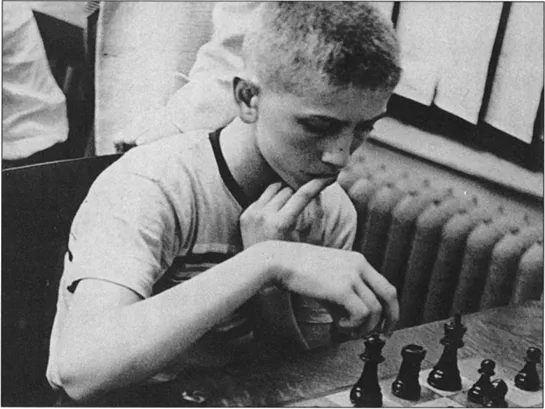
Fischer at fourteen. Already the youngest ever junior U.S. champion, within months he will become the youngest ever U.S. champion. ASSOCIATED PRESS
Now he was capturing headlines. In rapt tones, it was reported how this youngster had the opening knowledge, technical skills, and intuitive judgment of a veteran grandmaster. In 1957, Regina wrote directly to the Soviet leader, Nikita Khrushchev, requesting an invitation for her son to participate in the World Youth and Student Festival. The reply—affirmative—came too late for him to go. Fischer was already convinced of his destiny as world champion; he was still determined to reach Moscow, the Mecca of chess, where he could test himself against the world’s best. A year later, he went. (This time his sister kept him company.)
The quest proved a disaster. It was not that his hosts treated him badly. On the contrary, the Soviets regarded him as an honored guest, putting him up at a showcase hotel and giving him a car, a driver, and an interpreter. They offered to show him the Kremlin and take him to the Bolshoi. Fischer declined all distractions; he was there to play chess. He went to the Moscow Central Chess Club in the morning, returned to the hotel for lunch, then was back in the club until evening, where his opponents included the young Russian masters Aleksandr Nikitin and Yevgeni Vasiukov. He told the head of the Chess Department of the State Sports Committee, Lev Abramov, who had arranged his welcome, that he wished to take on some Soviet grandmasters. Abramov claims that he approached a number of grandmasters, whereupon the teenage American champion inquired how much he was to be paid. Abramov replied that it was not the Soviet custom to pay guests. In the end, Fischer managed only a few speed games with future world champion Tigran Petrosian. Even at that age, Fischer’s demand for recognition was clear. His feeling slighted seems to have been the origin of his life-long antipathy toward all things Soviet, no doubt heavily influenced by the pervasive anticommunist climate in the United States. Fischer’s interpreter complained to the authorities that Fischer was discourteous—the pilgrimage was aborted. American government documents contain reports that in the Moscow Chess Club, Fischer had called the Russians “a bunch of pigs” and that he had written an insulting postcard that the censor might have passed to the Soviet chess authorities.
Having won the U.S. Chess Championship, Fischer had automatically qualified for the 1958 Interzonal, which was to take place in the resort town of Portoroz, Yugoslavia. He announced confidently, to anybody who would listen, that his strategy for making it through to the Candidates was to draw with the strong grandmasters and hammer the weaklings, predictions that were dismissed as youthful bravado. In the event, Fischer did pretty much as he had pledged, winning six games, losing only two, and coming in joint fifth. He thus became an international grandmaster, the youngest in history. It was hailed, rightly, as a staggering performance, as was his fifth place the following year in the Candidates tournament—also held in Yugoslavia.
The contrast between his star status in international chess and his mundane status as a high school student would have been difficult for any fifteen-year-old to manage, even one with the happy background which Fischer lacked. Fischer was now arguing incessantly with his domineering mother. There was much of the mother in the son: for instance, high intelligence. She was a brilliant linguist—in addition to English, she spoke French, German, Russian, Spanish, and Portuguese. Her master’s degree in nursing from New York University was obtain...