- 480 pages
- English
- ePUB (mobile friendly)
- Available on iOS & Android
eBook - ePub
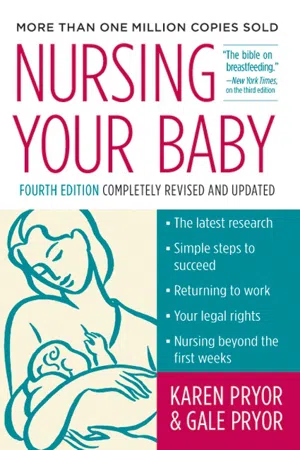
Nursing Your Baby 4e
Information
Topic
MedicinePart One
The Science and History of Breastfeeding
1
The Nursing Couple
The oneness of the nursing mother and her baby has always fascinated mankind. Like lovers, they are united both physically and spiritually. Unlike lovers, their union lacks the ambivalence and tensions of sexuality. The Egyptians portrayed their chief goddess, Isis, with the infant Horus at her breast. Christianity reveres the Madonna, the image of mother and infant, as a symbol of pure love. The Dalai Lama, spiritual leader of Tibetan Buddhism, speaks of compassion and altruism as first learned at a mother’s breast, as the mother gives of herself to her child. Artists through history and across geography have been inspired by the nursing couple to convey, in stone and clay and paint, two souls who are one.
It is brief, this unity. In most cultures, the baby is weaned in a year or two—or much less—and his world expands beyond his mother’s arms. She then becomes a part of her child’s life, sharing its center more each day with other people, other interests, eventually yielding her place of primacy entirely. Yet for all its brevity, the nursing couple is an intense relationship. Mother and child share a rapport so complete that it can exert a profound effect on both. Without this rapport, this mutuality, breastfeeding may cease. Nursing a baby is as much about the giving and taking of self as it is about the giving and taking of milk.
Nursing a baby is an art; a domestic art, perhaps, but one that, like cooking and gardening, brings to a woman the release and satisfaction only creative work can give. The author Anne Morrow Lindbergh wrote, “When I cannot write a poem, I bake biscuits and feel just as pleased.” Nursing gives the same sort of satisfaction and joy. Successful nursing mothers tend to feel that breastfeeding is special, and are thankful for the experience.
Breastfeeding is special for the baby, too. While drinking from a bottle is a passive experience, nursing at the breast is a participation sport. Babies can throw themselves into it with an endearing, almost comical gusto. British novelist Angela Thirkell offers an observation of a grandmother watching her daughter nursing her new baby: “Edith was sitting in a low chair, her baby in her arms, while the said baby imbibed from nature’s fount with quite horrible greed. Her face became bright red, a few dark hairs were dank with perspiration, one starfish hand was clenched on a bit of her nightgown…she was victualling herself as far as her adoring grandmother could make out for a six weeks’ siege at least.” Nobody ever felt that way about a plastic bottle.
THE REWARDS OF NURSING
Before a woman nurses a baby, she may assume that the chief reward of doing so is a sense of virtue, the knowledge that by choosing to breastfeed, she is doing the right thing for her baby’s health. The evidence of the long- and short-term benefits of breastfeeding to both mother and baby’s health and development is indisputable. In fact, for many reasons detailed in the following chapters, breastfed babies in the United States are 20 percent less likely to die before their first birthday; the longer a baby nurses, the lower the risk. If all babies in the United States were breastfed, reports a large study published in the May 2004 issue of Pediatrics, the journal of the American Academy of Pediatrics, approximately 720 infant deaths could be prevented each year.
And yet enduring good health is just one of the gifts of breast-feeding. The nursing mother may be proud that her baby thrives, but her daily reward lies in the peace, even the bliss, of the nursing experience. Nursing feels good. It brings physical comfort to both mother and baby, as it eases the baby’s hunger and floods his mother with oxytocin, the hormone for peaceful and loving feelings, and prolactin, the milk-making hormone that also seems to induce a sense of calm in the mother.
The obvious and lavish love a nursing baby displays for his mother is a special sort of joy. Being in close contact with each other is tremendously rewarding. Nursing babies love to gaze at and touch their mothers. Mothers are gratified that they are just what their babies want. A nursing mother tends to feel that her baby is not a job or a chore, but her little friend, a member of the team. This partnership is the essence of the nursing relationship, an equal exchange of effort and satisfaction.
As any nursing mother would tell you, another tremendous reward is that breastfeeding, once learned, is a lot less trouble than the chores involved in feeding a baby with formula and bottles. A breast is always warm, ready, and available, at home or away, while formula must be bought and mixed, and bottles washed and prepared, packed and carried.
As any working nursing mother knows, breastfeeding comforts with the assurance that no matter how much of each day her baby is with a substitute caregiver and no matter how much her baby adores that caregiver, only Mama can nurse the baby; only Mama has the warm breast full of milk.
Breastfeeding is the fastest way to lose weight and get back in shape after pregnancy, as nursing a baby devours as much as 600 calories a day, the equivalent calorie expenditure of thirty laps in a pool. Nursing your baby causes your uterus to contract after birth, flattening your stomach far sooner than if you were bottlefeeding. During pregnancy the body stores special fat reserves in the hips and abdomen that are intended to be used up during milk production. Lactation draws on these energy supplies. If breastfeeding does not occur, however, these special fat deposits can be difficult to reduce. Losing weight gained during pregnancy is welcomed by most women, but of critical importance for those with gestational diabetes in order to decrease their risk of developing lifelong diabetes. (And for women who do have prepregnancy Type 1 diabetes, breast-feeding tends to lower their sugar levels and they therefore may require less insulin as long as lactation continues.)
Breastfeeding benefits mothers long after nursing is done. Nursing reduces the risk of breast and ovarian cancer. The longer you nurse, the lower the risk. A woman who nurses two babies for a year each reduces her risk of premenopausal breast cancer by 28 to 61 percent. Every additional year of breastfeeding lowers a woman’s lifetime risk of breast cancer by 4.3 percent. Women who have never breastfed not only have higher rates of breast and ovarian cancer, but endometrial cancer as well. Breastfeeding also strengthens a woman’s bones, reducing her vulnerability to osteoporosis and hip fractures. In fact, women over sixty-five who have breastfed their babies have half the risk of fracturing a hip.
Women who breastfeed are one-third less likely to experience depression. Research has not yet explained why this should be so, although the relaxing, peace-giving hormones of lactation are strongly suspected. Experienced breastfeeding mothers might offer this additional explanation: The simple, pleasurable act of putting their baby to the breast, and the knowledge that doing so can keep both baby and mother safer from many risks for years to come, is a deep well of joy.
BEST FOR THE PLANET
Breastfeeding benefits more than the nursing mother and baby; it also contributes to the health of our planet. The most ecologically sound food available, it is produced and delivered and used without pollution or wasteful by-products. It requires no paper, plastic, or tin packaging, or all of the fibers, bleaches, and fuels used in manufacturing and distributing packaged products. It asks for no forests of lumber to be felled or herds of cows to overgraze the land. It does not contaminate water, or require water that may be contaminated to prepare. To breastfeed a baby is to step into our ecosystem, to play a role in a process as old and natural as falling rain and growing green leaves.
THE START OF THE NURSING RELATIONSHIP
The relationship between the nursing mother and her baby begins with a gentle give-and-take. When the mother’s milk starts to flow easily, and the baby’s suck becomes consistent and strong, they become partners in the process, or what psychiatrist M. P. Middlemore named the “nursing couple.” This partnership can spring up at the very first feeding a few minutes after birth, or a few days or even weeks later. If nursing begins slowly, the way it can if the first feeding is delayed for medical reasons or, as happens sometimes, a baby does not develop a gusto for nursing until a few days after birth, a mother may be surprised and dismayed. Our assumption about a behavior as natural as nursing is that it should come to us, well, naturally.
Breastfeeding, however, is a learned skill. In cultures where all babies are nursed, mothers have learned the art of feeding their babies since they were little more than babies themselves. Like all primates, we learn much of what we know as social animals through observation. If a woman grows up watching mothers put their babies to the breast, seeing how they’re held, how nursing is at the beginning and how it changes as the weeks go by, she is likely to pick up, hold, and feed even her first baby as if she’s done it all her life.
In Western industrialized cultures, however, young girls rarely have the opportunity to observe nursing mothers and babies. They and their younger siblings may not have been nursed. The lady next door may not nurse her baby, and when they go shopping with their mothers, girls are even less likely to see a nursing couple. Until recently, nursing in public was on the fringe of legality; many breastfeeding mothers have been ushered out of shopping malls by security guards or scolded by restaurant maitre d’s. Women still endure disapproving stares if they nurse in the presence of strangers. While nursing in public is certainly legal, and even explicitly protected by law in some states, the sight of a breastfed baby is still far from a daily experience for little girls in our culture. Mothers in nations where breastfeeding is not the cultural norm, therefore, must learn to do it on the job, without the learning-by-observation that nature expected.
A LEARNED MUTUAL SKILL
Under these biologically bizarre circumstances, a new mother may misperceive breastfeeding. We behave as if breastfeeding, like giving a bath, were something you do to a baby. In reality, breastfeeding is something you do with a baby, something you learn together. Some babies are born experts, other require time and help.
The baby must learn that milk is what he needs and that his mother’s breast is the place to get it. He must learn how to get a hold on the breast. If the milk is slow to flow, he may have to acquire patience and perseverance. If it flows too quickly, he may have to learn to adjust, to sputter and swallow without falling apart, and to return to the breast for the rest of his meal. Babies are individuals right from the beginning, and their responses to the experience of learning to nurse vary as much as the color of their eyes and the pitch of their cry.
The baby is, of course, amply rewarded for his efforts. The sweet taste of human milk is a nice payoff, as is the easing of hunger—but his mother’s enveloping scent, eyes, voice, touch, and presence reinforce and encourage his nursing skills, too.
His mother, meanwhile, must learn how to be comfortable with her baby, how to read his signals of need, to know when he is hungry, when he is sleepy, and when he would just like to be held. This takes time, too. Breastfeeding, however, provides an introductory course of sorts for reading a baby’s wide range of signals. In the course of one feeding, a baby may signal frantic hunger as he opens his mouth wide and turns his head, followed by sociability as he gazes and gazes at his mother’s face while calmly nursing, and soon enough, fatigue, as his sucking slows and his intense gaze softens and fades to sleep. His mother learns these signs of her baby’s changing needs and moods, developing a sensitivity to his cues even when they are not nursing.
LEARNING TO MOTHER
The sensitivity acquired through nursing lasts long past weaning as a mother reads her toddler’s signs of fatigue, her preschooler’s shyness, and even her teenager’s desire to talk with equal fluency and sensitivity. The breastfeeding relationship becomes the blueprint for a lifelong relationship between mother and child based on give-and-take, mutual satisfaction, and keen sensitivity for each other’s needs and emotions.
When researchers have explored the question of whether breastfeeding creates happier or more well-adjusted children, the complexities of human life have resisted clear data. When evidence in favor of such a result shows up, it is usually challenged on the ground that the breastfed children are happier because they had mothers with more affectionate natures, who were thus more apt to breastfeed. The critics, however, may have it backward. It is not necessarily a mother’s affectionate nature that motivates breastfeeding. It is the breastfeeding experience itself that teaches mothers to be generously affectionate and skilled in showing affection. The learning is built into the system.
CONTAGIOUS EMOTIONS
As Sibylle Escalona, MD, has pointed out, emotions are contagious. Even tiny babies can “catch” emotions from their mothers, and as parents of highly sensitive, highly reactive babies can testify, upset infants have upset parents. Sometimes this can lead to a cycle of difficulties, but the contagion of emotions can also work in favor of mother and baby. The calmed baby is a soothing armful for the mother. The father’s enjoyment of the baby and pride in his partner as she dons motherhood can soothe mother and baby, too. An experienced, relaxed person can sometimes calm a frantic baby simply by holding him. And so when a baby settles down and begins nursing well, his evident enjoyment and relief convey themselves to the mother, so that she, too, begins to enjoy the feeding.
Some care providers—nurses, midwives, physicians, lactation counselors—spread calm; everyone around them, mothers and babies alike, absorbs their peace and cheer. Such a person often has remarkable success in helping mothers and babies become happy nursing couples. Sometimes a grandmother or sister or friend provides the confidence-giving aura of calm; sometimes the baby’s father is the soothing presence. Once lactation is well established, the tranquil joy of mother and baby spreads back to the rest of the household—an extremely valuable contagious emotion.
THE BONDS OF LOVE
An established nursing relationship is not lightly broken. Mother and baby need each other both physically and emotionally. The baby, of course, has a physical need for milk. His emotional need is also great: a need for contact with his mother, and for the love and reassurance he receives through all his senses while nursing, but especially through his highly sensitive mouth.
The mother also has a physical need for the baby to take the milk from her breasts. Moderate fullness is not a discomfort; nevertheless, the letdown reflex that makes the milk flow is relieving, satisfying, like a drink of water when one is thirsty. Mothers’ fondness for nursing comes in part from the rush of hormones associated with the first flow of milk, but also because nursing provides a legitimate excuse to sit down and do nothing for a while. A nursing mother yearns for the satisfaction of feeding her baby, for the break in her busy day it provides, but most of all, she yearns for her baby.
Mothers, like babies, need to be shown that they are loved. The behavior of even a tiny baby at the breast is proof positive of that. His greed flatters, his bliss contagious, and his drunken satiety a comic compliment. As he grows older, his love of his mother becomes conscious and intense. The baby of three months stares and stares at his mother’s face as he nurses, looking into her eyes—loving her with all his soul. At five or six months he plays at the breast, fiddling with a ribbon or button on his mother’s blouse, patting her lovingly. He smiles out of the corner of his mouth, or puts a hand up to her lips to be kissed, showing her at every feeding how much he loves her. It is quite an experience. Life is not so full of true love that one regards it as commonplace in any circumstances.
Of course, the mother and baby who do not breastfeed love each other intensely as well. But a nursing couple has a different sort of intensity; mothers who have bottlefed one child and breastfed a subsequent baby are poignantly aware of the difference. The physical intimacy of breastfeeding dispels the barriers that always exist between individuals who do not have daily skin-to-skin contact, who do not breathe in each other’s scent, knowing its uniqueness the way they know the difference between salt and sweet.
Mothers who have both bottlefed and breastfed infants often say the nursing baby was “easier.” The ease lies not only in being free of the chores of bottlefeeding and the drawbacks of formula, but in feeling consistently companionable with their baby. The nursing baby tends to go along with his mother wherever she goes, not only because he needs his mother’s milk, but because he is so little trouble, and she misses him when they are apart. And the easy rapport of the nursing couple endures long past weaning into the busy years of childhood, when it is often needed most.
THE HAPPY NURSING BABY
A baby whose physical and emotional needs are being met through nursing is a happy baby, and a happy baby is easier on the whole household. He is always around, but seldom in the way. Siblings who have every right to be jealous of any new baby soon become accustomed to the new baby, as for the first six weeks or so the baby is simply an extension of the mother. The nursing couple fits into the family as a unit. The baby nurses as his mother reads to the other children, nurses while she talks over the day with her partner, or while she naps, talks on the phone, or sits down to her own dinner. When nursing becomes this casual, the breastfed baby automatically receives so much physical contact that he demands less attention through fussiness. His smoothly running insides contribute to his cheerful demeanor. The baby may be the least demanding, least troublesome member of the family, and receives in return ample love and approval from all. The social learning fostered by breastfeeding also lasts long past weaning.
The mother who is returning to a job or school within a few weeks after birth will have an added appreciation for her even-tempered baby. Her pleasant baby will enjoy the admiration of his babysitter, and their relationship is likely to become warm and loving. Yet, he reserves his deepest adoration for his mother during breastfeeding. The intimacy of the nursing relationship bridges the hours of separation. Nursing illuminates their daily reunions, and replenishes both their physical and emotional strength. No matter that someone other than Mom cares for the baby during her working hours; breastfeeding is the one thing no one else but she can do for the baby. In preserving this privilege for herself, a mother also preserves the closeness that breastfeeding brings.
THE BRIDGE TO MATURITY
What effect, if any, does the nursing relationship have on the emotions and personality of a child as he grows? The attachment theorists, a body of research established by John Bowlby and Mary Ainsworth, suggest that a high-quality, keenly sensitive, and responsive maternal-infant relationship, epitomized by the nursing couple, is essential to the healthy emotional growth of a baby, and possibly to that of the mother as well. Ashley Montagu, the late anthropologist, suggested that the human infant is born after nine months of gestation because the rapidly growing brain cannot pass through the birth canal much later than that. The newborn, however, is not a “mature” infant until another nine months have passed, when it has teeth and a fair amount of mobility. In this view, our species requires a nine-month period of extrauterine gestation, during which the infant’s needs must be met as fully as they were within the womb during pregnancy. A mother’s breasts and arms become that postbirth womb. Perhaps this perspective helps to explain why some babies wean themselves spontaneously at or around the age of nine months, from breast or bottle. While nursing is o...
Table of contents
- Cover
- Title Page
- Dedication
- Contents: Disclaimer: Preface to the Fourth Edition
- Part One: The Science and History of Breastfeeding
- Part Two: The Art of Breastfeeding
- References
- References
- Resources: Sources of Breastfeeding Information and Supplies
- Searchable Terms
- Acknowledgments
- About the Author
- ALSO BY KAREN PRYOR
- Credits
- Copyright
- About the Publisher
Trusted by 375,005 students
Access to over 1.5 million titles for a fair monthly price.
Study more efficiently using our study tools.
Frequently asked questions
Yes, you can cancel anytime from the Subscription tab in your account settings on the Perlego website. Your subscription will stay active until the end of your current billing period. Learn how to cancel your subscription
No, books cannot be downloaded as external files, such as PDFs, for use outside of Perlego. However, you can download books within the Perlego app for offline reading on mobile or tablet. Learn how to download books offline
Perlego offers two plans: Essential and Complete
- Essential is ideal for learners and professionals who enjoy exploring a wide range of subjects. Access the Essential Library with 800,000+ trusted titles and best-sellers across business, personal growth, and the humanities. Includes unlimited reading time and Standard Read Aloud voice.
- Complete: Perfect for advanced learners and researchers needing full, unrestricted access. Unlock 1.5M+ books across hundreds of subjects, including academic and specialized titles. The Complete Plan also includes advanced features like Premium Read Aloud and Research Assistant.
We are an online textbook subscription service, where you can get access to an entire online library for less than the price of a single book per month. With over 1.5 million books across 990+ topics, we’ve got you covered! Learn about our mission
Look out for the read-aloud symbol on your next book to see if you can listen to it. The read-aloud tool reads text aloud for you, highlighting the text as it is being read. You can pause it, speed it up and slow it down. Learn more about Read Aloud
Yes! You can use the Perlego app on both iOS and Android devices to read anytime, anywhere — even offline. Perfect for commutes or when you’re on the go.
Please note we cannot support devices running on iOS 13 and Android 7 or earlier. Learn more about using the app
Please note we cannot support devices running on iOS 13 and Android 7 or earlier. Learn more about using the app
Yes, you can access Nursing Your Baby 4e by Karen Pryor,Gale Pryor in PDF and/or ePUB format, as well as other popular books in Medicine & Gynecology, Obstetrics & Midwifery. We have over 1.5 million books available in our catalogue for you to explore.