It's Dangerous to Believe
eBook - ePub

It's Dangerous to Believe

Religious Freedom and Its Enemies

  1. 192 pages
  2. English
  3. ePUB (mobile friendly)
  4. Available on iOS & Android
eBook - ePub

It's Dangerous to Believe

Religious Freedom and Its Enemies

About this book

Mary Eberstadt, “one of the most acute and creative social observers of our time,” (Francis Fukuyama) shines a much-needed spotlight on a disturbing trend in American society: discrimination against traditional religious belief and believers, who are being aggressively pushed out of public life by the concerted efforts of militant secularists.

In It’s Dangerous to Believe, Mary Eberstadt documents how people of faith—especially Christians who adhere to traditional religious beliefs—face widespread discrimination in today’s increasingly secular society. Eberstadt details how recent laws, court decisions, and intimidation on campuses and elsewhere threaten believers who fear losing their jobs, their communities, and their basic freedoms solely because of their convictions. They fear that their religious universities and colleges will capitulate to aggressive secularist demands. They fear that they and their families will be ostracized or will have to lose their religion because of mounting social and financial penalties for believing. They fear they won’t be able to maintain charitable operations that help the sick and feed the hungry.

Is this what we want for our country?

Religious freedom is a fundamental right, enshrined in the First Amendment. With It’s Dangerous to Believe Eberstadt calls attention to this growing bigotry and seeks to open the minds of secular liberals whose otherwise good intentions are transforming them into modern inquisitors. Not until these progressives live up to their own standards of tolerance and diversity, she reminds us, can we build the inclusive society America was meant to be.


This powerful diagnosis of the threat to our first freedom explores:


  • The New Intolerance: An unflinching look at how activists, court decisions, and campus intimidation are creating a climate of fear, threatening the jobs and basic freedoms of believers.
  • A Secularist Witch Hunt: Eberstadt's powerful comparison of today's shaming tactics and public pile-ons to historical moral panics like McCarthyism and the Salem trials.
  • Christian Persecution: A detailed account of the 'soft' persecution facing people of faith, from legal attacks on charities to the de-recognition of student groups at religious universities.
  • First Amendment Under Siege: A clear-eyed analysis of the legal and cultural threats to religious freedom, arguing that America's first liberty is facing its greatest challenge in generations.

Trusted by 375,005 students

Access to over 1.5 million titles for a fair monthly price.

Study more efficiently using our study tools.

Information

Publisher
Harper
Year
2016
Print ISBN
9780062454010
eBook ISBN
9780062454034
1
The Roots of the New Intolerance
Today’s historic explosion of intolerance toward religious believers did not erupt out of nowhere. It has a long prehistory, and it behooves us briefly to revisit that history before exploring its newest malign manifestation.
Many historians would locate the beginnings of the story in the Enlightenment, when philosophical sceptics like Voltaire and Thomas Hobbes took on the task of challenging the truth of religious dogma, thus beginning the long process of disentangling church and state and creating new space for secular thought and expression. The contributions of science continued this process by providing a rival mechanistic view of the universe. Astronomy in the sixteenth century, physics in the seventeenth century, and natural science in the nineteenth century—particularly the publications of Charles Darwin—fueled this same project, even as the French Revolution became the bloody prototype demonstrating just how much it could take for a state to try and lay waste to a church.
The urge to delegitimize and crush belief gained new allies in the twentieth century in the form of communist and fascist dictatorships benefiting from technologies that Robespierre and the Jacobins lacked. Not content to wait patiently for the withering away of the churches, both Nazism in Germany and communism in the Soviet Union and elsewhere saw religion as the largest remaining threat to totalitarian rule, a view that largely derived from the fact that the movements were themselves founded on rival faiths of a kind, promising redemption—a secular heaven on earth—for their followers. Therefore both totalitarian sects campaigned vigorously, and with impressive results, to bring believers and their hierarchies to heel. Historian Robert Royal of the Faith and Reason Institute is among several scholars who have argued that the twentieth century produced more martyrs, or people suffering and dying for their Christian faith, than any other in history.1
The anti-religious zeal of both ideologies was shared by other twentieth-century movements inimical to religious belief. Noteworthy among these was the Mexican government’s attempt to crush the Church in the 1920s (among other results, inspiring the English writer Graham Greene to pen one of his best-known works, the 1940 novel The Power and the Glory). In Europe during the decade that followed, and in addition to Nazi and Soviet initiatives aimed at stamping out religious dissent, the particularly savage persecution of Catholics during the Spanish Civil War is judged by some historians to have been worse than any other suppression of the church in history, including even the French Revolution.
In all, Christianity across the world exited the twentieth century with literal casualties and figurative wounds that alone would have put the churches at a profound historical disadvantage, even without the piling on of other adversaries since the turn of the millennium.
In other realms, too, loss became a familiar companion to religious believers. Even in liberal democracies, the preferences of the faithful have been consistently countermanded in a series of public arenas with adverse court decisions and other legally binding changes involving school prayer, contraception, abortion, pornography, marriage, and related subjects long addressed by religious teachings. By 2016, for example, parents in the state of Virginia debate whether they will be permitted to “opt out” of having their children forced to read sexually explicit literature in public schools. One example is Toni Morrison’s novel Beloved, which includes scenes of bestiality, gang rape, and the graphically described murder of an infant. Far from having the power to force their own views upon the world, parents who object to making books like this mandatory reading are plainly and irrefutably acting from a position of defense, not offense.2
Elsewhere, on the broader cultural front, a long-standing tradition of anti-religious satire, drama, and diatribe have been advancing the secularist critique for several centuries. From Voltaire’s picaresque satire Candide, published in 1759, to Clarence Darrow’s righteous drubbing of creationist William Jennings Bryan as portrayed in 1960’s Inherit the Wind; from Monty Python’s Life of Brian to the musical The Book of Mormon; from wildly popular anti-Catholic classics like William of Orange’s Apologie (1581) to the fraudulent Awful Disclosures of Maria Monk (1836), Dan Brown’s The Da Vinci Code (2003), and Hilary Mantel’s Wolf Hall (2009), churchgoers and their leaders have been laughingstocks in all the best places for a very long time now.3
In sum, religious faith has been in retreat for several centuries. It has fought back, to be sure—and it fights back still. It has also known periods of intense revival, like the waves of Great Awakening between the early eighteenth and late nineteenth centuries in the United States; and the post–World War II boom in religiosity that enveloped most nations in the Western world, on account of which Christianity still retained tremendous social and political power right through the last century.4 But something new is in the air. The past ten years in particular have delivered epochal setbacks to men and women of faith, especially Christian faith, throughout the Western world.
Two major cultural events can be blamed for this. One of these was the Catholic priest sex scandals that erupted in 2002 and continued to unfold for several years. This moral catastrophe—dubbed by Richard John Neuhaus the “Long Lent” that many Catholics and other Christians still experience in the present tense—dealt the moral authority of the Church a crippling blow from which it has yet to recover fully even over a decade later, and even with a charismatic, maverick Pope Francis at the helm.
The second of these events was 9/11. Once upon a time, atheism was a boutique phenomenon. Even in a nation with philosophical roots in the Enlightenment, most Americans were believers of some stripe, and even today a majority profess some connection to God.
Still, every village had its atheist, usually regarded as an eccentric or crank. Perhaps the most effective of these figures was Madalyn Murray O’Hair, the founder of American Atheists and a single-minded crusader for stricter separation between church and state. O’Hair was the moving force behind the lawsuit Murray v. Curlett, which led to a Supreme Court ruling in 1963 (Abington School District v. Schemp) ending school-sponsored Bible-reading in American public schools. Another issue of pressing concern to atheists was the presence of the words “one nation under God” in the Pledge of Allegiance. Atheists also campaigned (often successfully) to remove Nativity scenes from town halls and public squares, leading to conservative claims of a secularist “war on Christmas,” as the slogan has it.
For most of the decades of the “culture wars,” such issues did not engage the passions of the vast majority of Americans. But after 9/11, the formerly fringe concern about the overbearing presence of religion in American life entered a new phase of aggressive militancy. In retrospect, it’s not hard to understand why. Fanatical Islamicists had just flown airplanes into the World Trade Center based on their belief in violent jihad as a religious obligation, rewarded by the promise of sensual pleasures in paradise. This unspeakable act of violence, driven by beliefs most people found alien and abhorrent, gave rise to a reaction that was called “the new atheism.”
Thus in the aftermath of 9/11, a wave of atheist tracts appeared corresponding to and feeding public anxiety about the perceived power of a group that had nothing to do with 9/11 but was tarred with the same brush nonetheless: American Christians. According to the new atheists, we in the United States have “our own” fanatics, namely and particularly the traditionalist followers of Jesus Christ. Some of these books, like Christopher Hitchens’s bestselling God Is Not Great, were lively and enthusiastic exercises in Christian-baiting. (This was not Hitchens’s first attack on religion. He had earlier published a book going after Mother Teresa.) Some also managed ebullient digs at other faiths—as in Richard Dawkins’s description of Judaism in The God Delusion as “originally a tribal cult of a single fiercely unpleasant God, morbidly obsessed with sexual restrictions, with the smell of charred flesh, with his own superiority over rival gods and with the exclusiveness of his chosen desert tribe.”5
Earlier such exercises had not been amplified by the anonymity of the Internet and social media. Thanks to both, the new vilification of religious folk proved to be popular sport, like the vilification of much else in an age of instantaneous electronic connection; and these and other polemical, sometimes inflammatory texts exploded into bestsellers.
Among the more earnest offerings were those of Sam Harris, who made his debut with a 2004 anti-theist tract called The End of Faith: Religion, Terror, and the Future of Reason. He followed this up with a manifesto called Letter to a Christian Nation. Addressing what he believed to be a majority Christian society, Harris sounded an alarm about what he considered a “moral and intellectual emergency,” namely, that “the beliefs of conservative Christians now exert extraordinary influence over our national discourse—in our courts, in our schools, and in every branch of government.”6 He added that this power across the culture was “well known.”
Many other people seemed to share this anxiety about the inordinate sway of religious conviction, as the proliferation of related works indicated.
In American Fascists: The Christian Right and the War on America, author Chris Hedges decried a putative “core group of powerful Christian dominionists who have latched on to the despair, isolation, disconnection and fear that drives many people into these churches.” He further argued that these American Christians resembled the fascist movements in Italy and Germany during the 1920s and 1930s.
In American Theocracy: The Peril and Politics of Radical Religion, Oil, and Borrowed Money in the 21st Century, Kevin Phillips argued similarly that “strong theocratic pressures are already visible in the Republican national coalition” and that these had “warped the Republican party and its electoral coalition, muted Democratic voices, and become a gathering threat to America’s future.”7
Also in 2006, The Theocons: Secular America Under Siege, by Damon Linker, formerly an editor at First Things, argued that secularism itself was being endangered by an “enormously influential but little-understood ideology” that he dubbed “theoconservatism.” Led by Father Richard John Neuhaus and other intellectuals around First Things, this tiny but alarmingly powerful movement threatened to “cripple” the United States itself—even to transform the nation into “a Catholic-Christian republic.”8
In fairness, secularist anxieties about American Christians were not wholly unmoored from reality—reality of the past, that is. For most of its history, the United States did know Christianity as a dominant force. One could see a crèche on the village green at Christmas, or the Ten Commandments in a county courthouse. Nor was that all. From George Washington to Abraham Lincoln to George W. Bush, biblical imagery informed political rhetoric from the highest office in the land on down to county clerks.
And not all the signs of Christian influence were ancient history. The 1950s, in particular, saw a nationwide religious revival of such magnitude that Will Herberg, then the country’s leading sociologist of religion, could remark that the village atheist was a vanishing figure on the landscape, and that “anti-religion is virtually meaningless to most Americans today.”9 The so-called Hays Code reflected the dominance of Christian sentiment half a century ago by imposing restrictions on Hollywood films, including limits on profanity, blasphemy, and ridicule of clergy.
Later, in the 1980s and for part of the 1990s, evangelical Christians—and tradition-minded Catholics, and Mormons, and Jews—did have a place at the table in Washington, D.C. Protestant evangelical media expanded via Pat Robertson’s 700 Club and other shows on the Christian Broadcasting Network (CBN); Catholics founded their own Eternal Word Television Network (EWTN); Republican administrations made room for and encouraged the rise of influential groups like Moral Majority and Focus on the Family and others. For a while there in the 1950s, and again in the 1980s and beyond, Christians whatever their interdenominational differences had momentum on their side.
And such is exactly the point: that world is no more. From the perspective of 2016, the idea that the Christian flock now menaces and encircles secular minorities is preposterous—as antiquated as decrying fluoride in the water supply, or the hazards of motorized travel. Exactly a decade after the new atheists declared the Bible Belt to be the epicenter of American power, cultural-political reality is 180 degrees reversed.
Inherit the Wind was transgressive because it appeared at the tail end of a religious boom following World War II. Its portrayal of William Jennings Bryan as a doddering, broken man humiliated by enlightenment apostle Clarence Darrow was daring at the time. Today, when secular rationalism has become the establishment view from Silicon Valley to federal bureaucracies to no-God squads throughout the West, the landsc...
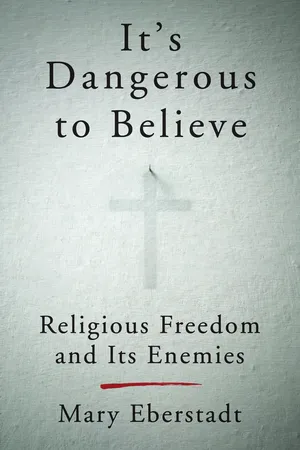
Table of contents

  1. Epigraph
  2. Contents
  3. Introduction: Among the Believers; or, Why I Wrote This Book
  4. 1. The Roots of the New Intolerance
  5. 2. Anatomy of a Secularist Witch Hunt
  6. 3. Acclaiming “Diversity” vs. Hounding the Heretics
  7. 4. Civil Rights Talk vs. McCarthyite Muscle
  8. 5. Inquisitors vs. Good Works
  9. 6. What Is to Be Done; or, How to End a Witch Hun
  10. Acknowledgments
  11. Notes
  12. About the Author
  13. Also by Mary Eberstadt
  14. Credits
  15. Copyright
  16. About the Publisher

Frequently asked questions

Yes, you can cancel anytime from the Subscription tab in your account settings on the Perlego website. Your subscription will stay active until the end of your current billing period. Learn how to cancel your subscription
No, books cannot be downloaded as external files, such as PDFs, for use outside of Perlego. However, you can download books within the Perlego app for offline reading on mobile or tablet. Learn how to download books offline
Perlego offers two plans: Essential and Complete
  • Essential is ideal for learners and professionals who enjoy exploring a wide range of subjects. Access the Essential Library with 800,000+ trusted titles and best-sellers across business, personal growth, and the humanities. Includes unlimited reading time and Standard Read Aloud voice.
  • Complete: Perfect for advanced learners and researchers needing full, unrestricted access. Unlock 1.5M+ books across hundreds of subjects, including academic and specialized titles. The Complete Plan also includes advanced features like Premium Read Aloud and Research Assistant.
Both plans are available with monthly, semester, or annual billing cycles.
We are an online textbook subscription service, where you can get access to an entire online library for less than the price of a single book per month. With over 1.5 million books across 990+ topics, we’ve got you covered! Learn about our mission
Look out for the read-aloud symbol on your next book to see if you can listen to it. The read-aloud tool reads text aloud for you, highlighting the text as it is being read. You can pause it, speed it up and slow it down. Learn more about Read Aloud
Yes! You can use the Perlego app on both iOS and Android devices to read anytime, anywhere — even offline. Perfect for commutes or when you’re on the go.
Please note we cannot support devices running on iOS 13 and Android 7 or earlier. Learn more about using the app
Yes, you can access It's Dangerous to Believe by Mary Eberstadt in PDF and/or ePUB format, as well as other popular books in Politics & International Relations & Political Philosophy. We have over 1.5 million books available in our catalogue for you to explore.