Discover how the same traits that make us feel uneasy in social situations also provide the seeds for extraordinary success.
As humans, we all need to belong. While modern social life can make even the most charismatic of us feel gawky, for roughly one in five of us, navigating its challenges is overwhelming. Psychologist and interpersonal relationship expert Ty Tashiro knows what it's like to be awkward. Growing up, he could do complex arithmetic in his head and memorize the earned run averages of every National League starting pitcher. But he struggled to add up social cues during interactions with other kids and was prone to forget routine social expectations.
In
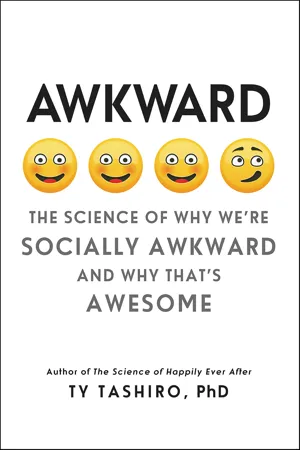
Awkard, Ty unpacks decades of research in the fields of psychology, neuroscience, and sociology to help us better understand this widely share trait and its origins. He considers how awkward people view our complex world and explains how we can more comfortably engage with it, delivering a welcome, counterintuitive message: the same characteristics that make people socially clumsy can be harnessed to produce remarkable achievements.
Interweaving the latest research with personal tales and real-world examples,
Awkward provides valuable insights into how we can embrace our personal quirks and unique talents to realize our awesome potential.
- 288 pages
- English
- ePUB (mobile friendly)
- Available on iOS & Android
eBook - ePub
About this book
Information
PART I
SO THIS IS AWKWARD
1
WHAT DOES IT MEAN TO BE AWKWARD?
My first discovery in graduate school was that I was almost normal. It was the fall of 1999 when I began my graduate studies in psychology at the University of Minnesota. New students were given the option to go through a rigorous psychological assessment that would give us feedback about our personality characteristics, intellectual abilities, and vocational interests. I figured the assessment would be a fun exercise in self-exploration, but after the testing sessions I realized these detailed test results might reveal that I possessed abnormal characteristics that had never troubled me before, in part because I had been blissfully ignorant about their existence.
Two weeks later, I found a yellow envelope in my mailbox with CONFIDENTIAL REPORTS scribbled across the seal. I cautiously pulled open the report feeling nervous about what I might discover, like someone opening the door to a long-neglected attic. There were dozens of charts showing where my scores fell on a bell curve for traits such as introversion, kindness, orderliness, and various forms of intelligence. Each chart was accompanied by a written summary that explained whether I was in a “normal range of functioning” or crossed into a diagnosable range of pathology.
Like Spencer’s psychological testing profiles, my personality and pathology scores never crossed into a clearly diagnosable range, but my scores were uneven. For example, my scores on personality traits such as kindness and curiosity were significantly higher than the average person’s but my scores on patience and orderliness were much lower than average. I wondered for a second what it was like for other people to make sense of someone who was kindly impatient or who possessed a disorderly sense of curiosity.
Overall, the first few pages painted a picture of someone who was relatively normal, but some unusual patterns began to emerge in a section toward the middle of the report titled “Social Development.” This section included interviews with some of my family members, and the testing psychologist had highlighted responses to one particular question: “What is your most prominent memory of Ty before he was twelve years old?” The interviews had been conducted separately, but all of the respondents provided the same answer: “Ty’s mother telling him to concentrate.”
Some interviewees elaborated with a recurring incident that involved pouring a glass of milk. Interviewees reported that this incident began early in childhood and they reported that it continued “for much longer than you would expect.” I would be seated at the kitchen table, my bowl-cut hair framing my brown eyes that were locked onto a milk carton. My mother would stand behind me in one of her tailored suits, her intent eyes locked on the same milk carton and the empty glass to its side. Eventually, I would grip the milk carton and slowly begin to raise it from the table. My mother would start repeating a hyper-enunciated directive, “CON-cen-trate . . . CON-cen-trate . . .” The chant had a Zen-like rhythm, a calming tone, then—
An abrupt action. All of my intent and determination was concentrated into a thrashing movement that looked like someone trying to dislodge ketchup from a glass bottle. The physics of this overly eager motion blasted into the edge of the glass, which went skittering across the table with a generous stream of milk chasing after it. Witnesses recalled that these quart-size debacles were followed by a stunned silence that Ty had had yet another one of his “accidents.”
As the remaining syllable from my mother’s wishful chant fell on to the hopeless situation, she would slowly shutter her eyes to take pause, and maintain her composure. My mother is an elegant and tidy woman. Witnesses of these spilling accidents found the mismatch between my mother’s graceful demeanor and my haphazard nature to be unbearably amusing, but expressing their amusement would have been ill-timed in the immediate aftermath of these incidents. So onlookers quickly averted their eyes and wiped already dried dishes or mixed well-stirred pots. Clearly, a boy who is eight or ten or twelve years old should be able to pour his own drink with more than a 50 percent chance of success. Yet, my mother found a way to say the best thing possible after these public blunders, “That’s all right, Ty, we just need more practice . . .”
“Practice” was a word that was in heavy rotation in our household, especially as it applied to “life skills,” which was also in heavy rotation. My parents were remarkably patient with my clumsiness during routine social situations, but they must have privately felt a growing concern as they watched dozens of my life skills fall further into the “developmentally delayed” range with each passing year. They knew the social immunity I had been afforded as a young child was due to expire when I entered the ruthless world of junior high school.
Yet some of my nonsocial abilities were advanced for my age. I had a propensity for doing long division and multiplication problems in my head. I found it easy to memorize random facts such as the earned-run averages of National League starting pitchers. Although I was a walking baseball statistics encyclopedia, I routinely forgot to bring my baseball mitt to Little League games or remember that it was my turn to bring the snacks and drinks. As I got older, my parents observed that my peers were starting to cast quizzical glances my way when I stood empty-handed when it was time for the post-game refreshments.
My social missteps never arose from malicious intent and they were generally innocuous mistakes, but around ten years old most children make leaps in their ability to form more complex social expectations and begin to judge other kids’ social value based on their ability to meet these expectations. They begin to care more about whether a classmate paints weird things in art class or wears clothing that is not part of the canon of fifth-grade fashion. As my peers’ social thoughts became more sophisticated, my quirks that previously went unnoticed were now as evident as lint under a black light. I had a sense about the social expectations around me morphing, but I did not fully understand the new rules of engagement or how to stop my growing feeling of social awkwardness.
My parents knew that there would be no easy answers when it came to helping their chronically awkward kid navigate social life. Like many awkward kids, I was aloof and very stubborn, which meant that my parents had to work with less information than most parents and they had to choose their battles. They must have been tempted to concentrate their efforts on making me less awkward, but my father was a high school teacher and my mother ran a clinic for kids with learning disabilities. Both of them had seen well-intended parents or teachers inadvertently discourage children’s passionate interests in their pursuit to make them closer to normal.
My parents did a remarkable job throughout my life dealing with the unusual challenges they faced with a kid who was awkward, stubborn, and very private. In hindsight, I can see that my parents decided to take an ambitious approach to my socialization. They instilled a mindset in me that still guides my social deliberations in adulthood and that is best phrased as a question: How do you fit in without losing yourself?
It’s an age-old question worthy of everyone’s consideration and it has been at the forefront of my mind as I wrote this book, considering what I would say about how people can be less socially awkward. In the pages to come, I’ll distill the results from a vast array of research areas, including personality, clinical psychology, neuroscience, and developmental psychology studies of giftedness. My hope is that whether you are an awkward adult, the concerned parent of an awkward kid, or a boss wondering how to connect with an awkward employee with tremendous potential, the chapters to come will provide useful insights into the quirks and unique talents of awkward individuals. To accomplish these ends, the book is divided into three sections:
1.In Part I, I will examine what it means to be awkward and how people can find guidance in navigating social life.
2.In Part II, I will look at how rapidly shifting social norms have made modern social life feel more awkward for all of us, and what we can do to adapt to them.
3.In Part III, I explain why the traits that make someone awkward can also help them strive toward remarkable achievements.
Chronically awkward people can feel like everyone else received a secret instruction manual at birth titled How to Be Socially Competent. For the awkward person, this dreamy manual would provide easy-to-understand, step-by-step instructions on how to gracefully navigate social life, avoid embarrassing faux pas, and rid oneself of the persistent anxiety that comes with being awkward. Of course there is no magic wand for social life, no listicle with ten easy steps to achieve instant popularity. But we will see that there are helpful research findings available for those of us trying to navigate the complexities of social life.
We will discover that the answers to these questions can be counterintuitive and nuanced, but eventually they coalesce into a story about how to find the social belonging we all yearn for while not sacrificing the wonderful quirks that make us unique. To begin our awkward investigation, let’s examine how the evolution of social expectations set the stage for our awkward moments.
Our Fundamental Need to Belong
ONE OF THE few books that captured my attention in junior high school was Lord of the Flies. Like many students, I was fascinated by what would happen if I found myself in the same position as the main characters who were a group of boys trying to survive on an uninhabited island with no adults to govern them. Although some of the tension in this book comes from the characters’ urgency to find food, water, or shelter, the greatest tension is generated by protagonists like Ralph, who struggles to forge alliances that are necessary to survive. He feels a constant concern about others doing their part and remaining loyal.
In real life, much of human history has been about a desperate fight to survive. Although this picture of tenuous survival seems like something far removed from modern life, as recently as the early 1800s more than a third of the deaths in Western Europe were due to lack of access to drinkable water, and malnourishment or death from starvation was much more common. For thousands of years the average life expectancy worldwide was under forty years old, and it’s only in the past two hundred years that life expectancies grew longer.
In the 1950s, psychologist Abraham Maslow proposed that human motivations could be organized in a hierarchy of needs. Maslow thought physical needs like food and water were the most essential, whereas other needs like social belonging and self-esteem were of secondary importance. But recent evidence has challenged this assumption. In 1995, social psychologists Roy Baumeister and Mark Leary published a paper titled “The Fundamental Need to Belong,” in which they reviewed hundreds of studies related to where the drive for social belonging fell in the hierarchy of needs. From their review, they found that humans’ psychological drive to maintain a few gratifying relationships was as fundamental as physical needs such as food or water. In some instances people will forego opportunities to meet their physical needs in the interest of meeting their social needs.
At first glance, the notion that the need to belong is as fundamental as physical needs such as hunger or thirst appears implausible. But for thousands of years, people lived in hunter-gatherer groups of less than fifty people that were tightly bound by collective goals related to survival. The evolutionary bet that humans and other social animals made was to sacrifice their short-term self-interests and cooperate in mutually agreed-upon ways for food gathering, shelter, and protection. Well-coordinated groups divided labor into specialized duties. Some people farmed, others hunted, while some attended to rearing children. For tasks such as harvesting crops or defending against hostile invaders, groups could shift people to these time-sensitive tasks, which greatly increased the resources and protection afforded to each individual and improved all members’ chances of survival.
The survival advantages conferred by a cooperative attitude have been reinforced by the psychological mechanisms that kick in to motivate us to forge mutually gratifying relationships. Like a drink of water when we’re thirsty or a good meal when we’re hungry, when we satiate our need to belong we feel a surge of positive emotion. Ed Diener from the University of Illinois has spent more than three decades studying happiness. Among dozens of possible predictors, Diener and others have found the strongest predictor of happiness is not our job, income, or attaining our fitness goals, but rather the presence of gratifying social relationships. Diener has also found that even in wealthy nations, where food is more abundant and life expectancies have almost doubled, there are still significant benefits associated with a sense of belonging. People with gratifying interpersonal relationships have better physical health and longer life expectancies.
Conversely, there are few things more psychologically devastating than the feeling of social exclusion. Janice Kiecolt-Glaser, the chairperson of the College of Medicine at Ohio State University, has found through decades of research that chronic loneliness is a significant risk factor for compromised immune functioning, cardiac disease, and many other serious medical...
Table of contents
- Cover
- Title Page
- Dedication
- Contents
- Preface
- Part I: So this is Awkward
- Part II: This Is Getting Awkward: How Modern Societal Shifts are Making Everyone Feel More Awkward
- Part III: How The Awkward Become Awesome
- Afterword
- Acknowledgments
- Bibliography
- Index
- About the Author
- Credits
- Copyright
- About the Publisher
Trusted by 375,005 students
Access to over 1.5 million titles for a fair monthly price.
Study more efficiently using our study tools.
Frequently asked questions
Yes, you can cancel anytime from the Subscription tab in your account settings on the Perlego website. Your subscription will stay active until the end of your current billing period. Learn how to cancel your subscription
No, books cannot be downloaded as external files, such as PDFs, for use outside of Perlego. However, you can download books within the Perlego app for offline reading on mobile or tablet. Learn how to download books offline
Perlego offers two plans: Essential and Complete
- Essential is ideal for learners and professionals who enjoy exploring a wide range of subjects. Access the Essential Library with 800,000+ trusted titles and best-sellers across business, personal growth, and the humanities. Includes unlimited reading time and Standard Read Aloud voice.
- Complete: Perfect for advanced learners and researchers needing full, unrestricted access. Unlock 1.5M+ books across hundreds of subjects, including academic and specialized titles. The Complete Plan also includes advanced features like Premium Read Aloud and Research Assistant.
We are an online textbook subscription service, where you can get access to an entire online library for less than the price of a single book per month. With over 1.5 million books across 990+ topics, we’ve got you covered! Learn about our mission
Look out for the read-aloud symbol on your next book to see if you can listen to it. The read-aloud tool reads text aloud for you, highlighting the text as it is being read. You can pause it, speed it up and slow it down. Learn more about Read Aloud
Yes! You can use the Perlego app on both iOS and Android devices to read anytime, anywhere — even offline. Perfect for commutes or when you’re on the go.
Please note we cannot support devices running on iOS 13 and Android 7 or earlier. Learn more about using the app
Please note we cannot support devices running on iOS 13 and Android 7 or earlier. Learn more about using the app
Yes, you can access Awkward by Ty Tashiro in PDF and/or ePUB format, as well as other popular books in Psychologie & Neurosciences cognitives et neuropsychologie. We have over 1.5 million books available in our catalogue for you to explore.