![]()
PART ONE
Create Lasting Change
![]()
CHAPTER 1
Uncover Your Performance Gap
You are unique, and if that is not fulfilled,
then something has been lost.
—MARTHA GRAHAM
Mark is an engineer working with a team in the high-tech industry. Like many managers, he finds himself torn between the people who report to him, and his boss Stefan, the head of his business unit. Mark and Stefan are in a heated exchange:
| STEFAN: | You should never have told the staff about this decision! |
| MARK: | I should have talked to you first, yes. But I needed to tell the team before they took irreversible action. |
| STEFAN: | That’s absurd! You’ve completely tied our hands and damaged management’s credibility. |
| MARK: | Everyone knew something was up, and they won’t trust me if I don’t tell them what’s going on. |
| STEFAN: | Well, be glad you have their trust, because I don’t trust you at all! Don’t expect me to come to you for advice again anytime soon. |
As the shouting match erupted in the hallway, Mark’s stomach was in knots. He tried to stay calm. But he was losing his cool. Part of him knew he should play nice. Stefan was his boss, after all. Another part of him wanted to strike.
Mark could picture a tennis match in his own mind, with balls lobbing back and forth across the mental net:
Take a stand against this jerk.
No, be a team player.
No one should treat you like this and get away with it.
Let it go—he isn’t worth making a scene.
Then the conversation in his head grew heated:
Is he kidding?
He thinks I broke the bad news?
He doesn’t get it.
People have been talking about this for weeks!
Stay calm, or this won’t end well.
This is why no one likes you, Stefan—because you’re a bully!
Shut up! He’s still your manager!
Mark finally gave in to his anger. He couldn’t hold his tongue for one more minute.
“If I’m so untrustworthy, why do I have the highest employee loyalty in the company?” Mark asked Stefan flatly. “Frankly, I’d be glad for you to not come to me for advice. With any luck, I won’t need to talk to you at all. You text me, and I’ll reply. Consider my door closed.”
When he got back to his office, Mark felt relieved. It was good to tell Stefan how he really felt.
But within minutes, a familiar sense of regret washed over him. He knew he should have kept his mouth shut, at least until he calmed down. Telling his boss he’d prefer never to talk to him again wasn’t the greatest idea. Yet time and again, in those hot moments of confrontation, he just couldn’t keep his cool.
If We Don’t Explode, We Withdraw
At the other end of the spectrum, there’s my former student Rafiq. Unlike Mark, Rafiq didn’t explode. In fact, he could hardly speak at all.
For three years, Rafiq had studied at Harvard Law School. After graduation, he’d planned to return to Pakistan and his family. Much to his surprise, while at Harvard, Rafiq fell in love with an American woman from the Midwest. Their relationship was a source of joy, but also dread. Rafiq knew that one day he’d have to tell his mother that he wouldn’t be returning to Pakistan as she assumed. He planned to marry Stacy and live in the United States.
On several occasions, the conversation almost happened. He’d phone home to discuss graduation plans since his mother, father, and extended family were all coming to America for the ceremony. He’d gone over and over it in his head—what he would say, the firm but gentle tone he would take. He visualized the conversation ending well.
But then the real moment would arrive, and he would freeze.
“When are you coming home?” his mother would ask. Rafiq would say nothing. “You’d better buy a plane ticket soon before the fares go up,” his mother continued. More silence.
During these actual conversations with his mother, part of Rafiq urged, “Go on, tell Mom the truth.” But before he could open his mouth, the counter-point emerged: “No! It will kill her.” With each of his mother’s questions, he felt the weight of her expectations. Waves of anguish accompanied opposing thoughts: “You have to tell her sometime,” followed by, “Keep quiet. You’ll break her heart.”
Rafiq wanted to be honest with his mother about his plans to stay in America—he knew he would have to, eventually. But he continued to teeter on the precipice of telling the truth. He deferred questions about plane tickets for later, not even fully aware of all the reasons why, but knowing that he couldn’t bring himself to tell her. Not today.
Succeed from the Inside Out
For many years at the Harvard Negotiation Project, my peers and I taught an Executive Education program in the summer. At the highpoint of the seminar, we ran an exercise to help people develop interpersonal skills. For this special session, we assigned one instructor to every three delegates, in order to provide a high level of individual coaching.
Workshop participants brought a real negotiation challenge from their lives, and we worked with them in trios to help each person improve in their chosen scenario. This all worked just fine, until one day, when a member of my trio was a Supreme Court justice.
Nothing had prepared me to run this high-stakes exercise with such a prominent person. This intimidating seventy-five-year-old gentleman had served on the High Court of his country for the previous thirty-five years.
Before his turn, I strained to imagine the kind of negotiation he would pick to get my advice. Would it involve confrontations with his fellow justices over the rule of law? Do people like him negotiate with the prime minister, I wondered, or members of Parliament? When the time came for his exercise, the judge described a difficult situation that had haunted him for decades.
“Every day for fifty years my wife has picked out my tie,” he told me. “I hate that. I can dress myself. Why does she do that?”
I was stunned. This was the big issue that kept him up at night? I asked the obvious question.
“Have you ever told your wife that you prefer to choose your own tie?”
“That’s exactly my problem,” he said. “No matter how many times I rehearse it in my head, I just can’t bring myself to tell her.”
After years of pondering the same question, something clicked. I got it.
Mark, Rafiq, and the High Court judge are smart people. They’re honest people. They know what makes communication work. Yet they betray themselves: by not holding their ground gracefully, by not telling the truth, and by not standing their ground while also protecting their important relationships.
Usually in the communication skills exercise I did with the Supreme Court judge, we practiced lines people could say when they returned to “real life.” But this time, suggesting to this towering figure that he rehearse the phrase “could you please not pick out my tie” seemed ridiculous. He was an exceedingly powerful person, a man who’d given orders for decades from the bench, issuing opinions that impacted a nation. He didn’t need help with assertiveness skills.
So, practicing behavior was not going to help. He knew the words he could say. The nut to crack was whatever stood in his way from actually saying them.
Working with the justice that day opened my eyes to the problem in a whole new way. Like others before him, when it came to the conversation that truly challenged him, he couldn’t say what he meant, or get what he wanted. But for the first time I saw clearly why focusing on behavior wasn’t the answer.
Beyond the shadow of a doubt, this person possessed the skills that he needed to meet his challenge. The way to help him succeed was to shift something inside him, to work with the voice that told him not to say anything. If he got the green light from that voice inside, he’d have no problem finding the words to talk with his wife. And that is indeed what happened.
Your Current Reaction vs. Your Optimal Reaction
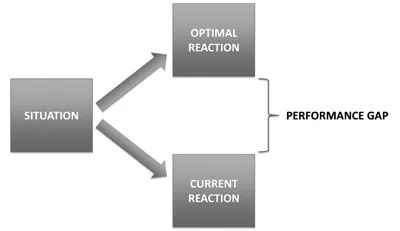
Once I had this insight, I saw the phenomenon everywhere. It turns out that most people find a disparity between what they know they should say and do to behave successfully—their optimal reaction—and what they actually do in daily life—their current reaction. I call this phenomenon The Performance Gap (see Figure 1.1).
Figure 1.1
It doesn’t matter how accomplished you are. Anyone can fall into the Performance Gap. The fact that you’re respected in your career, have a high IQ, or are an eloquent communicator doesn’t necessarily matter. You aren’t mostly falling into the Performance Gap because your problem is beyond your skill set. You’re likely stumbling because of what’s going on inside of you. You’re getting in your own way without even realizing it.
Going Left When We Meant to Go Right
How often do you plan to do one thing, but then in the moment, you do something else?
■ Do you ever plan to listen to your partner, but find yourself yelling—or shutting down—instead?
■ Do you ever intend to collaborate with other people, but then get rigid...