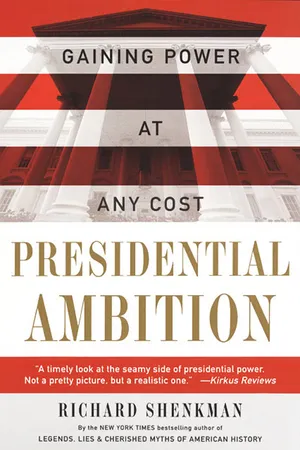
In this timely, illuminating, and often shocking book, Richard Shenkman reveals that it is not just recent presidents but all presidents who have been ambitious--and at times frighteningly so, willing to sacrifice their health, family, loyalty, and values. Presidential Ambition is a book that will permanently alter the way we think about past, present, and future American presidents.
- 384 pages
- English
- ePUB (mobile friendly)
- Available on iOS & Android
eBook - ePub
About this book
Information
1. In the Garden of Eden
How George Washington, alone among the presidents, was able to gain power and get things done without compromising himself or his principles
There was a touching scene at the outset of his presidency that was almost too good to be true. When Charles Thomson, the secretary of the Congress, arrived at Mount Vernon to tell Washington he had been elected president, the two men withdrew to the main room of the house and delivered little speeches to each other. Thomson told Washington that the Congress was delighted he had agreed “to sacrifice domestic ease and private enjoyments to preserve the happiness of your country.” Washington responded that he had accepted in deference to the public’s desires. He couldn’t promise to be a great president, he added, but “I can promise … to accomplish that which can be done by honest zeal.” It was almost comically stilted, like one of those scenes out of a 1930s Frank Capra movie in which Jimmy Stewart stands up and delivers a sincere and selfless sermon on patriotism. But it happened. And Washington came off looking exceptionally decent.1
He hadn’t always seemed so decent.
As a young man there was a certain crassness about him that was almost palpable. Though he was a born aristocrat he was very much a man on the make. Land was everything in Washington’s youth, the symbol of wealth and prestige, and he had set out to acquire as much of it as he could. Through inheritance he had received Mount Vernon and about two thousand acres. But that hadn’t come nearly close to satisfying his appetite. He didn’t want just a lot of land. He wanted more land than anybody else. Which was, apparently, the prime factor in his decision to court Martha. She was, even though youthful, neither particularly pretty nor particularly socially adept. And Washington didn’t love her (not at first anyway); as he admitted in a letter at the time of his engagement, he was actually in love with Sally Fairfax, his best friend’s wife. “You have drawn me,” he wrote Sally, “into an honest confession of a simple Fact.” But keep it a secret: “The world has no business to know the object of my Love, declared in this manner to you, when I want to conceal it.”
But Martha was not without her attractions. One of the richest widows in North America, she possessed thousands of acres of land. Under the laws then in effect, her land became his upon marriage, instantly turning Washington into one of the richest men in America. Through Martha he received a hundred slaves, another six thousand acres, and enough money to buy thousands and thousands of acres more.
Not even all that was enough to satisfy him. In 1767, eight years after his marriage, he made a grab for land expressly set aside for the Indians. It happened to be illegal under laws promulgated by the Crown. Washington didn’t care. He told his surveyor “to keep this whole matter a profound secret.” If anybody asked the surveyor what he was up to, Washington instructed, the surveyor was to lie. Over the next few years he was to acquire another twenty thousand acres from the British government in return for his service as a colonel in the Virginia militia. He wasn’t really entitled to the land; in fact when he had signed up the government had made it clear that the property was supposed to go to soldiers, not officers. But Washington had dextrously arranged for the officers to receive land, too. As the leader of his regiment, Washington had the responsibility of deciding who received which parcels (two hundred thousand acres of land were to be handed out). Washington saw to it that he received the best, “the cream of the Country,” as he subsequently boasted.2
But then the Revolution had come. It changed Washington as it did many of the leading figures in the colonies. Suddenly Washington, the “inveterate land grabber,” as historian John Clark called him, became Washington, the enlightened revolutionary. Acquiring land was no longer enough. Being rich was no longer enough. Believing himself to be in a position to affect history, Washington lifted his sights and became something no one had any right to expect he would. Now, instead of acquiring land, he would seek to acquire what people in the eighteenth century called fame.
In our time fame has taken on a pejorative meaning. But in his day fame was far more sublime. To be famous was to be immortal. It was believed at the time that there were many ways to gain fame. But the most honorable way of all, it was felt, was to found a commonwealth. Thus did Washington, as fired by ambition as ever, decide to dedicate himself to the patriot cause, inspiring his fellow Americans as no one else did.3
He didn’t prove to be a brilliant general. In fact, he never won any major battles. But he kept the army together during awful times, and by strength of character was able to command the people’s respect. At the end of the war he was held in such high esteem that he might very well have been able to crown himself king—as a lot of people wanted. But Washington refused, wouldn’t even consider the subject. All he wanted to do was return to Mount Vernon. When friends in the army demanded that he make himself dictator after Congress refused to pay the soldiers their back wages, he looked upon the proposal with sheer horror.
When the war finally ended and the British evacuated the country Washington, like Cincinnatus, his Roman hero, laid down his sword and went back to his plow. It was his intention to remain at his plow for the remainder of his life. But events intervened: The Confederation collapsed, the Constitution was adopted, and Washington was drafted for president.
The kind of trust Washington inspired is difficult for us to comprehend because no figure today is comparable. Nobody since Washington has been comparable to Washington. He is sui generis. It is not just that he led the country through the Revolution and then at the end willingly surrendered his sword and returned home to his plow. It is not even that he was the Father of His Country, and a country can have just one father. It is that Washington, singly among our presidents, did not want to be president. In his case, and his case alone, the office actually did seek the man. Not only did he not lift a finger to be made president. He actually preferred not to be president. He accepted in the end only because he had no choice. If he failed to accept the presidency there was a good chance that the Republic he had worked so hard to bring about would collapse. All others after him would try to claim that they, too, had no choice, that duty required them to run; for to admit ambition for the office was to prove oneself instantly unworthy of it. But only he really was motivated solely by duty. For what need did he have of the presidency? He already was the Father of His Country. All the presidency could do was possibly put that reputation at risk.
It could be argued, of course, that he agreed to run for president because he feared that that achievement was in jeopardy; if the commonwealth collapsed, his efforts would have been for naught. He would be the founder of nothing. Thus, it could be said, he ran for the same reason all the others would run afterward—because he was ambitious for fame. And yet—there would seem to be a vast difference between someone who eagerly seeks an office and one who, as it were, has had it thrust upon him, as the presidency was indeed thrust upon Washington.
The chief object his first term was to put the country’s financial house in order. The federal government was loaded down with debt. The states were loaded down with debt. And the people were hostile to taxes. Raise taxes, and the people might rebel. Try to ignore the debt, as both state and national governments had been doing for years, and the government would appear weak. Appear weak, and the states would begin to go their own separate ways, and rich people would become alarmed at the instability. Washington himself didn’t have any idea how to solve the problem; he wasn’t very bright, and he knew nothing about economics. But he was terrific at spotting talent, and long ago he had spotted Alexander Hamilton. Hamilton, put in as secretary of the treasury, would know how to fix things.
It was a brilliant choice. Hamilton was a genius at economics as he was at almost everything he put his mind to. And he quickly came up with a brilliant plan. He would have the federal government assume the states’ debts, thereby helping cement the Union together. And he would establish a national bank to help provide the government with money to pay off the debts. Because the bank would be backed by the government, rich people would lend the bank money; as creditors they would then have a stake in the survival of both the bank and the government.
Having come up with its program, the administration still had to sell it to Congress. And that was exceptionally difficult. Difficult because it was a complicated plan and in order to work, all of its various features had to be kept intact; remove one in the course of bargaining and the whole edifice would collapse: Eliminate the bank, and the government couldn’t pay its debts. Refuse to assume the states’ debts, and the government would lose the ability to command the support of the states. And yet every feature was controversial. Strict constructionists argued that the Constitution did not give the government the right to establish a bank. States that had worked hard to pay off their debts didn’t want the states that hadn’t to get a free ride. Further complicating the matter was that most of the states that had paid off their debts were located in the South, the others in the North, which exposed a sharp cleavage between the sections—a cleavage everybody had feared and wanted to hide. If there was one thing that could tear the country asunder, it was sectionalism.
Washington worried—and did nothing. It was his belief that he shouldn’t become involved in political controversies, even controversies that threatened the very foundation of his government. He felt he had to remain aloof. Get involved in the nitty-gritty of politics, and he would begin to look like a politician. And if he looked like a politician the country would no longer rally around him as a symbol of national unity. He would be tainted. Undoubtedly he could win in Congress this time and at countless other times if he put his prestige on the line, but with each victory he would make more enemies, thereby diminishing his stature as a statesman.
Washington could afford to remain above the fray because the other members of the administration, particularly Hamilton and Secretary of State Jefferson, were willing to become deeply engaged in politics. It was Jefferson who dreamed up the compromise that brought the North and South together by creatively joining the debt issue to a second one that also divided the sections: the location of the country’s capital. New York wanted the capital to remain where it was, in New York City. Pennsylvania wanted it moved to Philadelphia. Virginia wanted it moved to the Potomac. Jefferson’s ingenious solution, worked out one night at dinner with Hamilton, was to give the South the capital in exchange for its support of the federal assumption of state debts, the measure the North wanted. To mollify Pennsylvania, the capital would be moved to Philadelphia for ten years.
The wisdom of Washington’s decision to remain aloof from politics became clear when the financial plan suddenly became enmeshed in scandal, the first scandal in the history of the United States government.
What happened was that the plan to pay off the government’s debts made a few people very, very rich.
Much of the money the federal government owed in 1790—more than forty-two million dollars in all—was owed to average people of modest means, including thousands of Revolutionary War veterans whose IOUs had never been redeemed by the government under the old Articles of Confederation. The war certificates they held had fallen dramatically in value, most fetching just fifteen or twenty cents on the dollar in the open market. By any standard of justice the veterans should have been the ones to benefit from Hamilton’s plan, under which the certificates would be paid off at par; after all, the securities they held had literally been purchased with the blood of patriots—their blood. But the veterans by and large weren’t the ones who were to receive the benefit: Rank speculators were.
Just as the debt bill was about to be passed, speculators in New York, Philadelphia, and Boston raced to the countryside in advance of the news and bought up the long-devalued Revolutionary War certificates owned by the veterans. A few congressmen even got into the act, hiring ships to send agents deep into the remote areas of the country. Before the veterans figured out what was happening, the speculators had managed to scoop up the bulk of the once worthless but now valuable certificates.
Hamilton, who never cared for money—he was nearly bankrupt when he was killed in a duel with Aaron Burr—wasn’t personally implicated in the speculation. But he didn’t mind it, either. Eminently practical, he reasoned that the speculation, involving some of the nation’s most important bankers and merchants, would help win them over to the support of the federal government. And anyway he believed that he couldn’t have prevented what happened. It would have been a bureaucratic nightmare, he alleged, to try and find the original certificate holders.
Perhaps it would have been, though it’s been suggested he easily could have avoided the trouble simply by drawing up in advance a list of the people who were owed money. Of greater concern was the effect the scandal had on the administration. Of course, the administration was pilloried, as any administration today would be. But Washington himself escaped largely unscathed, Hamilton bearing the brunt of the criticism. In part that was simply because Washington was such a towering figure that no one wanted to risk taking him on. But mostly it was because of the manner in which he had conducted himself. After approving in secret the broad outlines of the financial plan, he had left its fate up to the cabinet and Congress, neither publicly endorsing it nor lobbying for it. On just a single occasion did he even express his opinion; it was in a letter to a politician—that was as far as he was willing to involve himself in anything as sordid as politics.*
A president taking so passive a role today on so important a piece of legislation is unimaginable. But Washington could because nobody expected him to be involved in politics—nobody even wanted him to be. He hadn’t been elected because he was a politician but precisely because he wasn’t one. If he’d done anything more than he did, he would have risked damaging the very thing that sustained his authority, his image as a man above the fray.
Washington was no mere figurehead. As Henry Graff has pungently observed, he actually called the shots in the government. It was he who picked the cabinet, of course. He who decided to back Hamilton’s financial plan. He who decided, without consulting Jefferson, whom he would send to France and England to represent us. He who decided where the White House would be built.
It was Washington who decided he would not consult with the Senate personally about treaties, a decision that had a profound influence on the presidency. The Founding Fathers had anticipated that the president would use the Senate as a kind of parliamentary sounding board for executive decisions, giving the legislators vast influence over the operation of the government. But Washington had found it impossible to consult with the Senate. He had personally gone to the legislature to brief the body about a treaty being negotiated with the Creek Indians. But things had immediately gone sour. First he had had to sit through two readings of the proposed treaty because the noise outside made it difficult to hear the first reading. Then he had had to face questions about the treaty, an arrangement he found objectionable. Finally, Sen. William Maclay had moved that the Senate should submit the treaty to a committee for additional study. That had so angered Washington that he stood up and stamped out of the chamber, complaining, “This defeats the very purpose of my coming here!” He was to return to the Senate once more, but never again after that, setting the presidency on a decisively different course than anybody had expected.
In another precedent-setting matter, it was Washington who decided that the president should have the right to fire employees of the federal government without having to ask the Congress for permission. Had he not insisted on this right, the presidency would have become wholly subject to the will of the legislature. (A bill giving Congress this right came to a tie vote in the Senate; Vice President John Adams broke the tie by voting against the measure.)
And finally, it was Washington who made the decision that Congress is entitled to see any and all executive documents, even those that might prove embarrassing, a hugely important precedent.
But while Washington was in overall charge, it was Hamilton and Jefferson who did most of the interesting work. It was they who wheeled and dealed and made things happen. In a way it was almost as if there were two administrations, the apolitical administration, headed by Washington, and the political administration, led by Hamilton and Jefferson.
As long as Jefferson and Hamilton worked together, the line between the two administrations, the apolitical and the political, remained firm and clear. But when Jefferson and Hamilton split—Jefferson reaching the opinion that Hamilton wanted to set up some kind of military dictatorship, and Hamilton becoming convinced that Jefferson was out to sabotage him in Congress—Washington found himself increasingly drawn into the political maelstrom. Somebody had to decide ultimately who was to prevail, and that somebody had to be Washington. As might be exp...
Table of contents
- Cover
- Title Page
- Dedication
- Contents
- Introduction
- Prelude
- 1. In the Garden of Eden
- 2. The Birth of the Two-Party System
- 3. The Revolution in the Suffrage
- 4. Manifest Destiny
- 5. The Story of Franklin Pierce
- 6. The Slavery Crisis
- 7. The Story of Abraham Lincoln
- 8. The Birth of Industrial Capitalism
- 9. The Birth of Machine Politics
- 10. The Story of Chester A. Arthur
- 11. The Arrival of the Immigrants
- 12. The Media
- 13. World Power: I
- 14. World Power: II
- 15. World Power: III
- 16. FDR: The Great Depression
- 17. FDR: World War II
- 18. The Cold War
- Conclusion
- Notes
- Index
- Acknowledgments
- Also by Richard Shenkman
- Table of Presidents
- Copyright
- About the Publisher
Trusted by 375,005 students
Access to over 1.5 million titles for a fair monthly price.
Study more efficiently using our study tools.
Frequently asked questions
Yes, you can cancel anytime from the Subscription tab in your account settings on the Perlego website. Your subscription will stay active until the end of your current billing period. Learn how to cancel your subscription
No, books cannot be downloaded as external files, such as PDFs, for use outside of Perlego. However, you can download books within the Perlego app for offline reading on mobile or tablet. Learn how to download books offline
Perlego offers two plans: Essential and Complete
- Essential is ideal for learners and professionals who enjoy exploring a wide range of subjects. Access the Essential Library with 800,000+ trusted titles and best-sellers across business, personal growth, and the humanities. Includes unlimited reading time and Standard Read Aloud voice.
- Complete: Perfect for advanced learners and researchers needing full, unrestricted access. Unlock 1.5M+ books across hundreds of subjects, including academic and specialized titles. The Complete Plan also includes advanced features like Premium Read Aloud and Research Assistant.
We are an online textbook subscription service, where you can get access to an entire online library for less than the price of a single book per month. With over 1.5 million books across 990+ topics, we’ve got you covered! Learn about our mission
Look out for the read-aloud symbol on your next book to see if you can listen to it. The read-aloud tool reads text aloud for you, highlighting the text as it is being read. You can pause it, speed it up and slow it down. Learn more about Read Aloud
Yes! You can use the Perlego app on both iOS and Android devices to read anytime, anywhere — even offline. Perfect for commutes or when you’re on the go.
Please note we cannot support devices running on iOS 13 and Android 7 or earlier. Learn more about using the app
Please note we cannot support devices running on iOS 13 and Android 7 or earlier. Learn more about using the app
Yes, you can access Presidential Ambition by Richard Shenkman in PDF and/or ePUB format, as well as other popular books in History & Historical Biographies. We have over 1.5 million books available in our catalogue for you to explore.