eBook - ePub
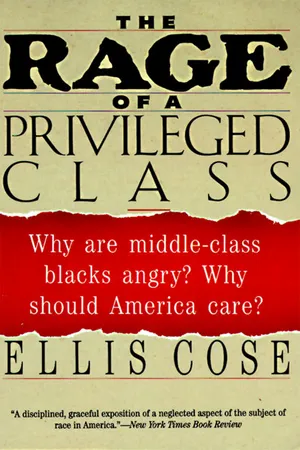
The Rage of a Privileged Class
Why Do Prosperouse Blacks Still Have the Blues?
- 208 pages
- English
- ePUB (mobile friendly)
- Available on iOS & Android
eBook - ePub
About this book
A controversial and widely heralded look at the race-related pain and anger felt by the most respected, best educated, and wealthiest members of the black community.
Information
chapter eight White Racism, Black Racism, and the Search for Our Better Selves
SHORTlLY AFTER THE 1992 RIOTS IN LOS ANgeles, I was asked to appear on a panel before the U.S. Civil Rights Commission to address the subject of racial and ethnic tensions in America. Also on the panel were three prominent academics (two of them white), the director of a nonprofit institution, and another black journalist. It was not an especially memorable morning, as none of us said anything particularly profound; but I was struck that of the people testifying, it was the two white academics who were most insistent that white racism lies at the root of what ails black America.
That the whites were more outspoken than the blacks may simply reflect the passions of the specific individuals on the panel, but it may also reflect something more: that sophisticated blacks have learned that to suggest that whites are racist is not a useful exercise in the current climate—at least when talking to whites. Indeed, a murderer who blamed the devil for his crime would likely receive a more sympathetic hearing from many whites these days than would a black intellectual who railed against racism.
In the eyes of most whites, affluent blacks seem to have no real cause for complaint, and the problems faced by blacks in the underclass seem to have little to do with the actions or attitudes of whites. Street violence, abandoned families, and teenage pregnancies, it has been argued, are less the result of racism than of inner-city pathologies. To the extent that racism is perceived as a problem by whites, it is increasingly seen as an evil perpetrated by blacks—with whites (particularly Jews) serving principally as victims.
Ed Koch, the former mayor of New York, is a strong proponent of that view. When the subject of black-Jewish relations came up over lunch in late 1992, at a time when these relations seemed even more frayed than usual in New York, Koch cited a “shocking statistic” from a recent local poll indicating that 63 percent of blacks were anti-Semitic. Koch brushed aside my questioning of the statistic by arguing that the pollster had designed the questionnaire, not he: “I don’t know whether it’s good or bad; I’m not a pollster. But they’ve used it every year.”
At any rate, Koch quickly abandoned the poll to focus on Brooklyn’s Crown Heights, a neighborhood that at several points in the recent past had been the focus of black-Jewish, racial-religious conflict. In Koch’s eyes, the ongoing strife was partly a consequence of the shortage of housing and other resources in the area: “The Hasidim have families of ten to fifteen kids. They have been told by the Rebbe that they must live in this area. They must walk to the synagogue, therefore they can’t spread out…. The blacks who moved into the area…which, was once a very prosperous white Jewish community…they too are under strain in terms of meeting their housing. So there is that competition,”
But tight resources accounted only for part of the problem, said Koch. Race-based resentments also played a role: “The Jews feel beleaguered and angry…because they’re the only white group that stayed. You can’t find white groups remaining in areas where blacks move in and become the dominant group. Whites move out. The Jews stayed and they think maybe the city ought to give them a little credit for that, including the black community. Instead, they get a lot of resentment. ‘Why don’t you move’ is one of the things that is said to them.”
Such resentment, Koch went on to argue, is not directed only at the Hasidim but at Jews in general. “When I was mayor, you had…[Congressman] Charlie Rangel threaten the Jewish community…. I will take you back ten years, when he referred to me as Bull Connor publicly, when he called me king of the Jews, which is a divisive, blasphemous term…. No one said a word. I said, ‘Is no one going to defend me?’”
That black-Jewish relations should have deteriorated so badly is not something Koch finds terribly shocking, for he does not believe there ever really was much of a “special relationship” between blacks and Jews. Certainly, among the black and Jewish leadership of the civil rights movement, there were some extremely close ties. And certainly, many Jewish individuals, including Koch, got involved in civil rights because it seemed the moral thing to do. But he would have done the same, said Koch, if Eskimos had been the group whose rights were threatened. Moreover, whatever the connection between blacks and Jews in the past, it is the present that primarily concerns him; and that present, as he sees it, is largely defined by a double standard that permits blacks to make racist or anti-Semitic attacks on Jews, attacks that very few groups, including the recognized Jewish leadership (“Court Jews who like to have coffee with the czar or the mayor at Gracie Mansion,” scoffs Koch), dare to oppose. Koch’s are strong sentiments, but they are not atypical. He is only one of many who are fed up with what they see as a new tolerance of black racists and anti-Semites.
But while Koch’s complaint is not without foundation, neither is it fully accurate. The “shocking statistic” he cites comes from a 1992 Roper Organization survey for the American Jewish Committee that did not pretend to measure anti-Semitism. It did find that 63 percent of black respondents thought Jews had “too much influence in New York City life and politics.” The same survey also found that 23 percent of Jews (and 18 percent of whites) thought blacks had “too much influence”—which, by Koch’s reasoning, would make nearly a fourth of New York’s Jews racist.
Another poll, commissioned by the Anti-Defamation League, did attempt to track anti-Semitism, though without claiming to measure anti-Semitism directly. Instead, it listed a series of statements describing Jewish stereotypes or common preconceptions about Jews that interviewees designated as true or false.
(1) Jews stick together more than other Americans. (2) Jews always like to be at the head of things. (3) Jews are more loyal to Israel than America. (4) Jews have too much power in the U.S. today. (5) Jews have too much control and influence on Wall Street. (6) Jews have too much power in the business world. (7) Jews have a lot of irritating faults. (8) Jews are more willing than others to use shady practices to get what they want. (9) Jewish businessmen are so shrewd that others don’t have a fair chance in competition. (10) Jews don’t care what happens to anyone but their own kind. (11) Jews are [not] just as honest as other businessmen. [Bracketed “not” in original.]
Respondents who gave stereotypical responses to six or more of the statements were judged “most anti-Semitic.” The survey, released in November 1992 and conducted by Marttila & Kiley Inc., found that 37 percent of black Americans and 17 percent of white Americans fit into the “most anti-Semitic” category. It also found that well-educated blacks, like well-educated whites, were less likely to buy into such stereotypes.
While the Roper and Marttila & Kiley surveys show a high incidence of prejudice and unfortunate stereotypes, they do not exactly show that most blacks are anti-Jewish. And they certainly don’t show that most blacks are antiwhite. What they do show is something a good deal more complex. The Roper survey, for instance, found that blacks rated Jews higher in intelligence than blacks and thought Jews less likely to be lazy or to “prefer to live off welfare.” Jews themselves came essentially to the same conclusions, but by larger margins. Whites (including Jews) rated Jews as more intelligent, less lazy, and less likely to prefer welfare than blacks, and ranked the Irish and Italians between Jews and blacks on all three traits.
Both surveys indicate (especially after allowing for group chauvinism and ideologically correct though dishonest responses) that Americans are in substantial agreement about their stereotypes. In other words, even black racists and black anti-Semites generally see Jews as bright, ambitious, powerful, and capable people. Conversely, most whites, even those who harbor African Americans no ill-will, tend to see blacks as significantly less intelligent and less motivated than whites.
To those inclined to see black and white racism as different sides of the same coin, the implications should be obvious. While any stereotype is bad, all stereotypes are not the same, either in their conception or in their consequences. A stereotype that casts a group as superior is very different from one that renders a group inferior. To recognize that is to realize that while white racism and black racism and anti-Semitism are all evil things, they do not lead to the same place or spring from the same stream.
As the Anti-Defamation League says in its report, much of the response to the question of whether Jews have “too much power” is complicated by a widespread perception among blacks that whites in general have too much power. Indeed, when a similar question was asked in a 1992 survey by the Los Angeles Times (“Do you think any one of these groups—Whites, Asians, blacks, or Latinos—is getting more economic power than is good for Los Angeles?”), 36 percent of blacks thought whites were too powerful, and 43 percent thought the same of Asians. To conclude from that that 36 percent of black Angelenos are antiwhite and 43 percent anti-Asian would be to make a huge and unjustifiable leap. No doubt some true racists, xenophobes, and anti-Semites were among those polled, but far outnumbering them were a great many people whose response to the survey can be best understood as a plaintive plea, as a way of asking, “Isn’t it time that we got some power, instead of seeing it go to all these others?”
Such sentiments, composed largely of envy, anger, and resentment, are not necessarily inappropriate to the condition in which many blacks find themselves. The problem is that those feelings can sometimes harden into hatred of Asians, whites, or Jews—especially if inflamed by demagogues or pseudoscholars who make certain groups responsible for all the sins of the world. Even that hatred, however, is principally a defensive hatred: the hatred of those who have been kept out. Black racists, for instance, do not generally believe that whites are unintelligent, lazy, or incompetent—at least not because they are white.
The animosity blacks experience from white racists is different. It is the animosity of people who presume themselves to be superior—morally, intellectually, physically, or perhaps in all three ways—and who cannot countenance a world in which that presumption is not shared.
It is right to recognize both brands of racial hostility as problems. It is wrong, however, to assume that the solution is simply to urge people to get along, or somehow to mix members of one camp in with the other. For even if racial peace is maintained, the web of stereotypes is left untouched, and those stereotypes, as already noted, are particularly destructive to blacks. They not only encourage whites to treat blacks as inferiors but also encourage blacks to see themselves as many whites would have them be.
These stereotypes spew forth from every segment of popular culture and constantly find new life in black and nonblack communities across America. Rap music, for instance, routinely portrays black men as “niggaz” and “gangstas” and black women as “bitches” and “hos.” A host of black comedians follow suit, depicting a jive-talking, foul-mouthed, illiterate stud who defines the essence of “black” for many young people. Attachment to this stereotype is so powerful that African Americans who choose not to personify it are often accused by other blacks of trying not to be black. Yet those with a sense of history know that the stud image did not spring from the black community but originated with whites searching for signs that blacks were intellectually inferior and morally degenerate—and therefore suitable for use as slaves. Today, through television, movies, and the innumerable interracial encounters that occur in an increasingly integrated society, blacks and whites in effect conspire to determine whether, and to what extent, the stereotypes can change—in short, what the place of African Americans will be.
Unlike recent immigrants, who are relatively free to define their own place in U.S. society, African Americans are more constrained. John Ogbu, an anthropologist at the University of California, Berkeley, who has studied immigrant and indigenous minorities, writes: “Immigrants generally regard themselves as foreigners, ‘strangers’ who come to America with expectation of certain economic, political, and social benefits. While anticipating that such benefits might come at some cost…the immigrants did not measure their success or failure primarily by the standards of white Americans, but by the standards of their homelands. Such minorities, at least during the first generation, did not internalize the effects of such discrimination, of cultural and intellectual denigration…. Even when they were restricted to manual labor, they did not consider themselves to be occupying the lowest rung of the American status system, and partly because they did not fully understand that system, and partly because they did not consider themselves as belonging to it, they saw their situation as temporary.”
In contrast, Ogbu says, he has observed black and Mexican-American parents encouraging their children to do well in school while unconsciously passing on another, more demoralizing message: “Unavoidably, such minority parents discuss their problems with ’the system,’ with their relatives, friends, and neighbors in the presence of their children. The result…is that such children become increasingly disillusioned about their ability to succeed in adult life through the mainstream strategy of schooling.” The only way some of these kids feel they can succeed, he concludes, is to “repudiate their black peers, black identity, and black cultural frames of reference.”
Few people of any race, of course, have the strength, desire, imagination, or appetite to abandon ideas they have been taught all their lives. Thus, Americans of all races continue to see each other through a prism of distorting colors, and to struggle with the problem of prejudice.
Joe Feagin, a University of Florida sociologist who has extensively studied the black middle class (and who was one of those on the U.S. Civil Rights Commission panel mentioned above), believes that even the subtle displays of prejudice blacks today are more likely to encounter can be devastating. “Today white discrimination less often involves blatant door-slamming exclusion, for many blacks have been allowed in the corporate door. Modern discrimination more often takes the form of tracking, limiting or blocking promotions, harassment, and other differential treatment signalling disrespect.” The result, writes Feagin, is the “restriction, isolation, and ostracism of middle-class blacks who have penetrated the traditionally white workplace” but who find that they are not part of the same networks that “link together not only white co-workers but also white supervisors and, in some situations, clients.” And this more subtle form of exclusion produces repressed rage, inner conflict, and a deep sense of dissatisfaction: “Most middle-class blacks are caught between the desire for the American dream imbedded deeply in their consciousness and recognition that the dream is white at its heart.”
Derrick Bell, civil rights activist and legal scholar, has a perspective that is even more dispiriting than Feagin’s. In Faces at the Bottom of the Well, Bell argues that America’s brand of racism is permanent and that we must set aside the hopelessly idealistic notion that time and generosity will cure it. Since whites will never recognize blacks as equals, blacks must steel themselves for never-ending struggle: “African Americans must confront and conquer the otherwise deadening reality of our permanent subordinate status. Only in this way can we prevent ourselves from being dragged down by society’s racial hostility.”
In an epilogue titled “Beyond Despair,” Bell invokes inspirational images from the time of slavery, when black people, “knowing there was no escape, no way out,…nonetheless continued to engage themselves. To carve out a humanity. To defy the murder of selfhood. Their lives were brutally shackled, certainly—but not without meaning despite being imprisoned.” He argues that blacks today, in accepting their tragic fate, should take a cue from the slaves who managed to beat the odds “with absolutely nothing to help—save imagination, will, and unbelievable strength and courage.”
In outlining his controversial thesis Bell throws out a challenge, declaring that the proposition of permanent inequality “will be easier to reject than refute.” That is certainly true, for it is a prediction about the future, which by definition has not yet arrived and hence is impossible to describe with certainty. But that does not make Bell’s gloomy prognosis correct.
To be sure, there are abundant signs that the concept of equality is under siege: in the popularity of such people as race-baiter David Duke, who lost his bid to be governor of Louisiana but managed to get the majority of the white vote; in the frequency of so-called bias or hate crimes; in the avalanche of academic and government studies that document chronic discrimination in housing, banking, employment, and virtually every other aspect of American life; and in the painful and yet persistent debate over whether, as former Los Angeles Dodgers general manager Al Campanis put it, blacks possess “the necessities” for leadership.
The Campanis spirit periodically reemerges with a vengeance—as it did recently in the person of Marge Schott, owner of the Cincinnati Reds. In 1993 Schott’s widely reported comments (she referred, for instance, to “dumb, lazy niggers” and “money-grubbing Jews”) won her a one-year suspension from baseball and a $25,000 fine. Schott had never hired a minority person for any of the forty-five positions in her front office; but her more serious crime, it seems, was not keeping her insulting opinions to herself, or at least within the owners’ circle, where baseball writers claim such opinions are widely shared.
In a blistering attack on the owners for their seemingly hypocritical treatment of Schott, New York Times columnist Ira Berkow wrote: “They have no business coming down on her for racial and ethnic slurs that were uttered in private, something, to be sure, some if not many of them have said in one way or another themselves. And if they haven’t said it, they have certainly acted as though they believe such racial and ethnic stereotypes are written in stone, or at least the baseball bylaws.”
Whether or not Berkow’s assertion is true, the fact that blacks’ basic abilities are constantly questioned, in all circles of society, is not a matter of much dispute. And nowhere has that questioning been so persistent as in the arena of academic achievement, where those whose basic competencies are in doubt are provided the opportunity to prove the skeptics wrong. The problem, of course, is that for all the individual examples of black academic brilliance, many blacks have performed quite poorly in school and on the standardized tests that are the touchstone of the academy. There has been a relatively small but significant difference between how blacks and whites, on average, score on those tests; and that difference has helped fuel an ongoing debate, not only over whether blacks are in some sense intellectually inferior, but over whether that conjectured inferiority has a genetic base.
I am among those who believe that the test scores shed light on a real difference in academic achievement—and one that cannot be dismissed purely as a function of cultural bias. Anyone who has spent much time in predominantly black public ...
Table of contents
- Cover
- Title Page
- Dedication
- Contents
- Acknowledgments
- Introduction
- One
- Two
- Three
- Four
- Five
- Six
- Seven
- Eight
- Nine
- About the Author
- Praise
- Copyright
- About the Publisher
Trusted by 375,005 students
Access to over 1.5 million titles for a fair monthly price.
Study more efficiently using our study tools.
Frequently asked questions
Yes, you can cancel anytime from the Subscription tab in your account settings on the Perlego website. Your subscription will stay active until the end of your current billing period. Learn how to cancel your subscription
No, books cannot be downloaded as external files, such as PDFs, for use outside of Perlego. However, you can download books within the Perlego app for offline reading on mobile or tablet. Learn how to download books offline
Perlego offers two plans: Essential and Complete
- Essential is ideal for learners and professionals who enjoy exploring a wide range of subjects. Access the Essential Library with 800,000+ trusted titles and best-sellers across business, personal growth, and the humanities. Includes unlimited reading time and Standard Read Aloud voice.
- Complete: Perfect for advanced learners and researchers needing full, unrestricted access. Unlock 1.5M+ books across hundreds of subjects, including academic and specialized titles. The Complete Plan also includes advanced features like Premium Read Aloud and Research Assistant.
We are an online textbook subscription service, where you can get access to an entire online library for less than the price of a single book per month. With over 1.5 million books across 990+ topics, we’ve got you covered! Learn about our mission
Look out for the read-aloud symbol on your next book to see if you can listen to it. The read-aloud tool reads text aloud for you, highlighting the text as it is being read. You can pause it, speed it up and slow it down. Learn more about Read Aloud
Yes! You can use the Perlego app on both iOS and Android devices to read anytime, anywhere — even offline. Perfect for commutes or when you’re on the go.
Please note we cannot support devices running on iOS 13 and Android 7 or earlier. Learn more about using the app
Please note we cannot support devices running on iOS 13 and Android 7 or earlier. Learn more about using the app
Yes, you can access The Rage of a Privileged Class by Ellis Cose in PDF and/or ePUB format, as well as other popular books in Social Sciences & North American History. We have over 1.5 million books available in our catalogue for you to explore.