"Fiery, insightful memoir from the former Iraqi translator who fought alongside US Special Forces during the recent war in Iraq . . . harrowing." —
Kirkus Reviews
As the insurgency in Iraq intensified following the American invasion, US Navy SEALs were called upon to root terrorists from their lairs. Unsure of the local neighborhoods and unable to speak the local languages, they came to rely on one man to guide them and watch their backs. He was a "terp"—an interpreter—with a job so dangerous they couldn't even use his real name.
They named him Johnny Walker. They soon called him brother. Over the course of eight years, the Iraqi native traveled around the country with nearly every SEAL and special operations unit deployed there. He went on thousands of missions, saved dozens of SEAL and other American lives, and risked his own daily. Helped to the U.S. by the SEALs he protected, Johnny Walker's life is so remarkable that his tale reads like fiction. But every word of it is true.
For the first time ever, a "terp" tells what it was like in Iraq during the American invasion and the brutal insurgency that followed. With inside details on SEAL operations and a humane understanding of the tragic price paid by ordinary Iraqis,
Code Name: Johnny Walker reveals a side of the war that has never been told before.
"An amazing story that I feel needs to be told . . . I cannot express how many lives have been touched by Johnny, and how many of us owe him our lives." —Chris Kyle,
New York Times–bestselling author of
American Gun
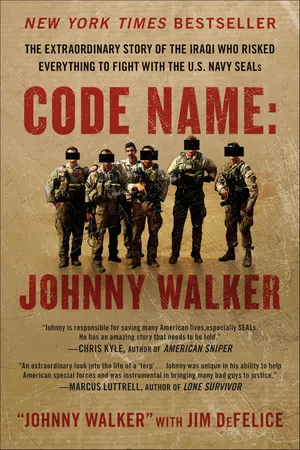
eBook - ePub
Code Name: Johnny Walker
The Extraordinary Story of the Iraqi Who Risked Everything to Fight with the U.S. Navy SEALs
- 304 pages
- English
- ePUB (mobile friendly)
- Available on iOS & Android
eBook - ePub
Code Name: Johnny Walker
The Extraordinary Story of the Iraqi Who Risked Everything to Fight with the U.S. Navy SEALs
About this book
Information
1
Before the Dream
THE IRAQ YOU know is not the Iraq of my youth. The Iraq I know now is not the place where I grew up. Its location on earth may be the same, its essential geography identical. But it is a very different place.
I do not wish to paint a portrait of paradise, for Iraq even then was far from a perfect land. Everyone puts a sheen on their past, their childhood especially; we almost always see it through a window that blocks out the darkness and enhances the light. Looking back, we remember the smiles of our fathers and mothers, our triumphs and successes. The failures seem smaller, the disappointments faded to the margins where they belong.
Eons before the Roman Empire was conceived, the region that is now Iraq gave birth to the civilization of Sumer. The cities that made up Sumer were among the earliest known to us today. Cradled along the rivers, the southern Mesopotamian civilization thrived starting sometime before the twenty-ninth century B.C. Archaeologists credit the people with many inventions, from the simple but radical concept of the wheel, to mathematics that used the number 10 as its base—the same system we use today. Sites related to the Sumerian people dot Iraq, and despite the violence of the country’s recent history, important archaeological discoveries continue to be made.
That past is literally buried by the sands of time. Alexander conquered what is now Iraq in the fourth century B.C.; the Parthians and the Romans followed. Christianity came to the land between the first and third centuries A.D. Assyria—northern Iraq between the Euphrates and Tigris—was an important center for the early Eastern Christian church. In the seventh century, Khālid ibn al-Walīd, one of history’s greatest generals, helped bring Islam to Iraq; it has been the dominant religion ever since.
For the next thousand years, Iraq was part of various kingdoms, settling under Ottoman rule in the sixteenth century and then, following World War I, becoming a League of Nations “mandate” under British control. Though Iraq was formally granted independence in 1932, British influence remained strong until after World War II.
Through much of this time, the most important allegiance a man had was not to the distant emperor or sultan, or even to the local governor or consul, but to his family and tribe. Even today, tribal identity is very important. Experts say there are over one hundred and fifty tribes in the country.
Iraqis are related to tribes in two ways: birth and marriage. If a man marries outside his tribe, as a general rule, his children belong to the tribe he comes from. My own tribe is small but important. (I still have many relatives in Iraq, and mentioning its name will give them troubles they do not need.) Our ancestors and current members include many successful people. My own grandfather was a prominent leader; he had a private militia and was hired by the Turks to fight against the British.
I was born December 4, 1964, in Mosul. The city straddles the Tigris River about 225 miles north of Baghdad. It’s a sprawling city, with parts that date back to the early Mesopotamian civilizations and areas that were among the most modern in Iraq before the war. Some 1.8 million people live in the city, many in densely packed areas of small homes often shared by many adult members of a family.
Americans often don’t realize how urban Iraq really is. The government estimates that more than three-quarters of Iraq’s 31 million people live in cities. More than 7 million of them live in Baghdad. Imagine a country the size of California, but with most of its population clustered into a handful of cities. The vast desert that many Americans think of when they picture Iraq lies west of Baghdad. Lightly populated, it is not the environment most Iraqis experience day to day.
Mosul is a case in point. When I was born it was a large, flat city, a collection of khaki-brown brick and concrete buildings spreading as far as the eye could see. Lush parks with tropical green trees and large lawns added color, while the curved roofs of mosques and minaret towers gave the city depth. Newer buildings in the city center pushed against the old but didn’t obliterate the place’s history, much less imply the frantic pace of Western metropolises. A Westerner might imagine a Mediterranean city without the Mediterranean; a little slower, a little older, not quite as romantic.
For me, Mosul was a wonderful city. The nearby mountains are beautiful. The streets were clean. My family was respected. We lived in an apartment roughly a thousand square feet, cramped for a large family but typical of our street, a dense residential area a block from one of Mosul’s main thoroughfares. The houses were cement and brick, khaki tan, neatly kept but far from fancy or ostentatious. I had an older brother, Hamid, born in 1957; a younger brother, Saif, came in 1973. I have three sisters, all older than me: Samaa, who was born in 1953; Hana, born in 1954, and Muna, born in 1962.
There was one other child in our immediate family, another brother, Ali, a few years older than I was. He was outside the house one day when he was eight, playing near an open cooking fire. Suddenly his clothes somehow caught fire. By the time the flames were extinguished, his body was badly burnt; he died of his injuries.
I was very young at the time, three or four maybe, but I can clearly remember how horribly my mother cried. Her tears came for days and days. The pain in her heart never left her.
After Ali’s death, my mother became very protective of her children, all of us, but most especially me. I couldn’t play near a heater, whether it was outside or in, even if it was electric and didn’t have flames. She watched us all very closely—I felt at times that I had a chain around my leg. As I got older, I pulled at that chain, and soon left it far behind.
Admittedly, I had an adventurous streak. I was far from a delinquent and certainly not a bully, but I never shied from a fight or a confrontation. Mine was a rough-and-tumble childhood.
Living in tiny, cramped houses with lots of relatives, we kids spent most of our time outside on the streets. Unspoken rules governed where you could go and what you could do. It was best not to stray from your own neighborhood, but if you had to for some reason, an errand or something, you had to act a certain way or pay the consequences. You had to be humble in other neighborhoods and kowtow to the kids who lived there. If you acted like you were too tough or looking for a fight, watch out.
Naturally, I went against these rules. I went into other neighborhoods a lot, looking for trouble. It was a challenge, a way to prove myself not to the kids in those neighborhoods, but to the ones where I lived.
Looking back now, I know much of this was silly if not stupid, but as a kid I felt as if I had to prove myself. And I did pretty well in the fights. Not that I won all or even most of the time. Winning and losing wasn’t as important as making a good show of yourself. Not quitting, not giving up, just plain being tough—that was how you got respect.
Word would get back quickly after an encounter. The other kids would nod and smile.
“He’s tough,” they’d say.
“Yeah, he’s a leader.”
Things didn’t always go very smoothly. I remember quite a few beatings at the hands of larger bunches of kids. One day I found myself in another neighborhood, surrounded by seven or eight kids, all around my age. I would have tried fighting them, maybe all at one time, but they were too smart for that. Instead, they formed a loose circle and kept their distance while pelting me with rocks. As soon as I’d get close to one I’d be hit with a couple of stones and have to duck away. Finally I found an opening and was able to run off.
The encounter had brought me nothing but bruises. It demanded revenge—an important concept in Iraq, even today. Whether you’re a kid who’s been surrounded and humiliated by others or an adult whose family has been wronged, avenging your honor is critical. If you let a slight go unanswered, it’s hard to hold your head up on the street, even if you’re the only one who knows what happened.
Feeling wronged because I’d been outnumbered and hit by rocks, I decided I needed to do something to restore my honor. So later that night, I took my trusty slingshot and went back to the street where I’d been pelted. The kids were nowhere to be seen, of course, but I found the house where one of them lived.
There was a white light outside the house . . .
Ping!
A smooth stone from my slingshot broke the light. I had my revenge. I went home a happy boy. I knew the kids would know exactly who broke the light. I hoped they’d venture into my neighborhood, where they would get a proper beating from my gang of friends; we’d use our fists, not rocks. But they never did.
Looking back, it seems silly and petty, but that was the law of kids and the neighborhood. And worse: in time, the insignificant posturing by boys not yet mature would become something more sinister. If you grow up needing to revenge any and all slights, you can’t help but think that way as an adult. If there is no antidote to this—if the government is weak, if education is lacking—then violence surely begets more violence.
Not that I was philosophical as a child. Life was much more immediate and visceral. Truth was what you held in your hand—like my slingshot.
I was pretty good with slingshots. I would carve them from wood I found, shaving them smooth and carving them until they felt just right gripped between my fingers. Then I would soak them in salt and water, which made them tougher—or at least that was our neighborhood theory. I got so good that I made slingshots for all my friends.
I revived my slingshot skills years later while working with the SEALs. When we were operating in cities, we generally went on missions at night. Darkness helped conceal us and offered some protection. Streetlights were therefore an enemy. Rather than shooting them with guns, which of course made noise, I volunteered to ping them with a slingshot. With a little practice, my skills returned, and I was able to hit a lightbulb-sized target fairly regularly from thirty yards. The SEALs got me a high-tech slingshot made of metal, but the real secret to my success was the judicious choice of ammunition: only the roundest, most aerodynamic stones would do. I took to scouring the camps for them, and even naming my favorites. The SEALs may have had a chuckle, but “Fireball” and “Lightning” served them well.
MY FATHER WAS a good man, solid, loving, not a hero and not exceptional. He was also a nice guy, who seemed to get along with everyone. He could be tough when he needed to be—he wasn’t soft—but mostly I remember him being kind to people. He wasn’t a big fan of tribal things, let alone government; he cared about his own wife and kids, and took care of us. If there was an average male in Mosul, he was it.
I remember tagging along with him to his friends’ houses many times. He would show me off proudly, even though looking back I had no special talents. I guess he saw me through a father’s loving eyes.
“Here is my son,” he would say. “Look at him—what a smart boy.”
I was smart, though in all honesty you couldn’t prove it by my grades as I got older.
In Iraq, children start elementary school at age six and spend six years there. Middle school and high school follow; usually students spend three years in each. At the end of high school, exams are held to see if you can qualify for college.
Attitudes toward education were a lot different than they are in the United States. Not that school wasn’t considered important at all, but there certainly wasn’t the sort of emphasis on getting good grades and doing well that there is here.
Even considering that context, my own attitude was not very good. I surely did not value my education as much as I could and should have. Because of this, I spent four years in middle school and another five in high school. Lack of effort, not intelligence, held me back as a young teenager.
And yet I remember high school as an exciting time for learning. I liked science and math, and on my own studied a wide range of subjects from American history to Karl Marx. It was during this time that I began learning about America. I remember reading The Old Man and the Sea, by Ernest Hemingway—a book I can still recall and occasionally cite to my friends.
Hemingway was a genius. He moves you, from emotion to emotion—wave to wave. The Old Man and the Sea has no fat, no wasted words or parts; everything works together to construct a perfect story of a fisherman fighting against the elements—of a simple man fighting to survive against all odds, of a people triumphing just by breathing.
I wish I could write like that.
I read Hemingway in English, but many Western writers’ works were translated into Arabic, which is where I encountered most of them. I still remember a handful of teachers who influenced me, mostly for the better. Ziad, who taught English, and Waad, who instructed Arabic and literature, were the sort of teachers every student should have. Waad in particular was a very forgiving and understanding teacher. He gave you a chance, then a chance and a chance. He was a kind man, and I learned a lot from him. The same was true of Ziad, and I remember both men fondly.
Then there was my math teacher, whom I’ll call Edmund. He was a Christian, unlike the others, but religion had nothing to do with his teaching style. He had a darker nature than the other men, more typical of the teachers in my school, and I would imagine throughout Iraq. Physical punishment was very much accepted at the time, and Edmund regularly delivered beatings in class, even for the smallest offense. I personally don’t object to punishment any more than anyone else, but if a teacher was unfair, that bothered me. Edmund’s punishments were out of proportion to the crime. Years later, I don’t remember the infractions I was beaten for, but I do remember the lack of justice.
I remember one time a friend was late to school. As punishment, the teacher—none of the men I’ve named, though I can’t remember who it was—had my friend hold out his hand so he could smack it with a cane. He hit him so hard I thought his hand was broken.
I decided to get even for him. After we were dismissed, I went home and got my slingshot. Walking back to the school lot, I found my teacher’s green Volvo, stepped back, and took up position.
Fsssshew . . . thwack, crash!
The first stone broke the window. I kept up the bombardment, breaking another window and inflicting a few nice dents until all my ammo was gone. They say justice is sweet, and I have to admit it felt pretty good to mete it out.
To me things had to be balanced. It wasn’t that my friend had been in the right. The problem was, his punishment was out of proportion to his crime. My assault evened the ledger.
The next day, the teacher asked if anyone knew what had ...
Table of contents
- Dedication
- Epigraph
- Contents
- A Note to the Reader
- Introduction
- Prologue: Freedom
- 1. Before the Dream
- 2. Love and War
- 3. Up from the Depths
- 4. Fighting for a Better Iraq
- 5. Trust and Treachery
- 6. My Brother, Mosul, and Baghdad
- 7. Baghdad
- 8. The Seeds of a Dream
- 9. Missions and Decisions
- 10. Fatal Friendlies
- 11. Friends, Neighbors, and Snipers
- 12. Soheila Escapes
- 13. Living the Dream
- Acknowledgments
- Collaborator’s Note
- Photo Insert
- About the Authors
- Credits
- Copyright
- About the Publisher
Trusted by 375,005 students
Access to over 1.5 million titles for a fair monthly price.
Study more efficiently using our study tools.
Frequently asked questions
Yes, you can cancel anytime from the Subscription tab in your account settings on the Perlego website. Your subscription will stay active until the end of your current billing period. Learn how to cancel your subscription
No, books cannot be downloaded as external files, such as PDFs, for use outside of Perlego. However, you can download books within the Perlego app for offline reading on mobile or tablet. Learn how to download books offline
Perlego offers two plans: Essential and Complete
- Essential is ideal for learners and professionals who enjoy exploring a wide range of subjects. Access the Essential Library with 800,000+ trusted titles and best-sellers across business, personal growth, and the humanities. Includes unlimited reading time and Standard Read Aloud voice.
- Complete: Perfect for advanced learners and researchers needing full, unrestricted access. Unlock 1.5M+ books across hundreds of subjects, including academic and specialized titles. The Complete Plan also includes advanced features like Premium Read Aloud and Research Assistant.
We are an online textbook subscription service, where you can get access to an entire online library for less than the price of a single book per month. With over 1.5 million books across 990+ topics, we’ve got you covered! Learn about our mission
Look out for the read-aloud symbol on your next book to see if you can listen to it. The read-aloud tool reads text aloud for you, highlighting the text as it is being read. You can pause it, speed it up and slow it down. Learn more about Read Aloud
Yes! You can use the Perlego app on both iOS and Android devices to read anytime, anywhere — even offline. Perfect for commutes or when you’re on the go.
Please note we cannot support devices running on iOS 13 and Android 7 or earlier. Learn more about using the app
Please note we cannot support devices running on iOS 13 and Android 7 or earlier. Learn more about using the app
Yes, you can access Code Name: Johnny Walker by Johnny Walker,Jim DeFelice in PDF and/or ePUB format, as well as other popular books in History & Military Biographies. We have over 1.5 million books available in our catalogue for you to explore.