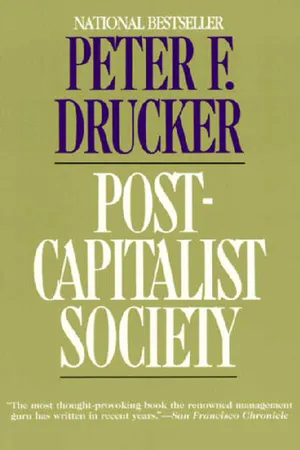
Business guru Peter Drucker provides an incisive analysis of the major world transformation taking place, from the Age of Capitalism to the Knowledge Society, and examines the radical affects it will have on society, politics, and business now and in the coming years. This searching and incisive analysis of the major world transformation now taking place shows how it will affect society,economics, business, and politics and explains how we are movingfrom a society based on capital, land, and labor to a society whoseprimary source is knowIedge and whose key structure is theorganization.
WITHIN ONE HUNDRED FIFTY YEARS, from 1750 to 1900, capitalism and technology conquered the globe and created a world civilization. Neither capitalism nor technical innovations were new; both had been common, recurrent phenomena throughout the ages, in West and East alike. What was brand new was their speed of diffusion and their global reach across cultures, classes, and geography. And it was this speed and scope that converted capitalism into “Capitalism” and into a “system,” and technical advances into the “Industrial Revolution.”
This transformation was driven by a radical change in the meaning of knowledge. In both West and East, knowledge had always been seen as applying to being. Then, almost overnight, it came to be applied to doing. It became a resource and a utility. Knowledge had always been a private good. Almost overnight it became a public good.
For a hundred years—during the first phase—knowledge was applied to tools, processes, products. This created the Industrial Revolution. But it also created what Karl Marx (1818–1883) called “alienation,” new classes and class war, and with them Communism. In its second phase, beginning around 1880 and culminating around the end of World War II, knowledge in its new meaning came to be applied to work. This ushered in the Productivity Revolution, which in seventy-five years converted the proletarian into a middle-class bourgeois with near-upper-class income. The Productivity Revolution thus defeated class war and Communism.
The last phase began after World War II. Today, knowledge is being applied to knowledge itself. This is the Management Revolution. Knowledge is now fast becoming the sole factor of production, sidelining both capital and labor. It may be premature (and certainly would be presumptuous) to call ours a “knowledge society” so far, we have only a knowledge economy. But our society is surely “post-capitalist.”
Capitalism, in one form or another, has occurred and reoccurred many times throughout the ages, in the East as well as in the West. And there have been numerous earlier periods of rapid technical invention and innovation—again in the East as well as the West—many of them producing technical changes fully as radical as any in the late eighteenth or early nineteenth centuries.* What is unprecedented and unique about the developments of the last two hundred fifty years is their speed and scope. Instead of being one element in society, as all earlier capitalism had been, Capitalism—with a capital C—became society. Instead of being confined, as always before, to a narrow locality, Capitalism—again with a capital C—took over all of Western and Northern Europe in a mere one hundred years, from 1750 to 1850. Then, within another fifty years, it took over the entire inhabited world.
All earlier capitalism had been confined to small, narrow groups in society. Nobles, landowners, the military, peasants, professionals, craftsmen, even laborers, were almost untouched by it. Capitalism with a capital C soon permeated and transformed all groups in society wherever it spread.
From earliest times in the Old World, new tools, new processes, new materials, new crops, new techniques—what we now call “technology”—diffused swiftly.
Few modern inventions, for instance, spread as fast as a thirteenth-century one: eyeglasses. Derived from the optical experiments of an English Franciscan friar, Roger Bacon (d. 1292 or 1294), around 1270, reading glasses for the elderly were in use at the papal court of Avignon by 1290, at the Sultan’s court in Cairo by 1300, and at the court of the Mongol emperor of China no later than 1310. Only the sewing machine and the telephone, fastest-spreading of all nineteenth-century inventions, moved as swiftly.
But earlier technological change almost without exception remained confined to one craft or one application. It took another two hundred years—until the early 1500s—before Bacon’s invention had its second application: eyeglasses to correct near-sightedness. The potter’s wheel was in full use in the Mediterranean by 1500 B.C.; pots for cooking, and for storing water and food, were available in every household. Yet the principle underlying the potter’s wheel was not applied until A.D. 1000 to women’s work: spinning.
Similarly, the redesign of the windmill around the year 800, which converted it from the toy it had been in antiquity into a true machine (and a fully “automated” one at that), was not applied to ships for more than three hundred years, after 1100. Until then, ships used oars; if wind was used at all to propel them, it was as an auxiliary power, and then only if it blew in the right direction. The sail that drives a ship works exactly the same way as the sail that drives the windmill, and the need for a sail that would enable a ship to sail cross-wind and against the wind had been known for a long time. The windmill was redesigned in Northern France or in the Low Countries, both regions thoroughly familiar with ships and navigation. Yet it did not occur to anyone for several hundred years to apply something invented to pump water and to grind corn—for use on land—to use offshore.
The inventions of the Industrial Revolution, however, were immediately applied across the board, and across all conceivable crafts and industries. They were immediately seen as technology.
James Watt’s (1736–1819) redesign of the steam engine between 1765 and 1776 made it into a cost-effective provider of power. Watt himself throughout his own productive life focused on one use only: to pump water out of a mine—the use for which the steam engine had first been designed by Thomas Newcomen in the early years of the eighteenth century. But one of England’s leading ironmasters immediately saw that the redesigned steam engine could also be used to blow air into a blast furnace and bid for the second engine Watt had built. And Watt’s partner, Matthew Boulton (1728–1809), right away promoted the steam engine as a provider of power for all kinds of industrial processes, especially the largest of all manufacturing industries, textiles. Thirty-five years later an American, Robert Fulton (1765–1815), floated the first steamship on New York’s Hudson River. Another twenty years later the steam engine was put on wheels and the locomotive was born. And by 1840—or at the very latest 1850—the steam engine had transformed every single manufacturing process from glassmaking to printing. It had transformed long-distance transportation on land and sea, and it was beginning to transform farming. By then, it had penetrated almost the entire world—Tibet, Nepal, and the interior of tropical Africa being the sole exceptions.
The nineteenth century believed—and most people still believe—that the Industrial Revolution was the first time a change in the “mode of production” (to use Karl Marx’s term) changed social structure and created new classes, the capitalist and the proletarian. But this belief, too, is invalid. Between 700 and 1100 A.D., two brand-new classes were created in Europe by technological change: those of the feudal knight and the urban craftsman. The knight was created by the invention of the stirrup—an invention that arose in Central Asia around the year 700; the craftsman by the redesign of water wheel and windmill into true machines which, for the first time, used inanimate forces (water and wind) as motive power rather than human muscle.
The stirrup made it possible to fight on horseback; without it, a rider wielding lance, sword, or heavy bow would immediately have been thrown off his horse by the force of Newton’s Second Law: “To every action there is an equal and opposite reaction.” For several hundred years, the knight remained an invincible “fighting machine.” But this machine had to be supported by a “military-agricultural complex”—something quite new in history. Germans until this century called it a Rittergut, a knight’s estate, endowed with legal status and economic and political privileges, and containing at least fifty peasant families or some two hundred people to produce the food needed to support the fighting machine: the knight, his squire, his three horses, and his twelve to fifteen grooms. The stirrup, in other words, created feudalism.
The craftsman of antiquity had been a slave. The craftsman of the first “machine age,” the craftsman of Europe’s Middle Ages, became the urban ruling class, the “burgher,” who then created Europe’s unique city, and both the Gothic and the Renaissance styles that followed.
The technical innovations—stirrup, water wheel, and windmill—traveled throughout the entire Old World, and fast. But the classes of the earlier industrial revolution remained European phenomena on the whole. Only in Japan, around 1100 A.D., did proud and independent craftsmen evolve, who enjoyed high esteem and, until 1600, considerable power. But while the Japanese adopted the stirrup for riding, they continued to fight on foot. The rulers in rural Japan were the commanders of foot soldiers—the daimyo. They levied taxes on the peasantry but had no feudal estates. In China, in India, in the world of Islam, the new technologies had no social impact whatever. Craftsmen in China remained serfs without social status. The military did not become landowners but remained, as in Europe’s antiquity, professional mercenaries. Even in Europe, the social changes generated by this early industrial revolution took almost four hundred years to take full effect.
By contrast, the social transformation of society brought about by Capitalism and Industrial Revolution took less than a hundred years to become fully effective in Western Europe. In 1750, capitalists and proletarians were still marginal groups; in fact, proletarians in the nineteenth-century meaning of the term, that is, factory workers, hardly existed at all. By 1850, capitalists and proletarians were the dynamic classes of Western Europe, and were on the offensive. They rapidly became the dominant classes wherever capitalism and modern technology penetrated. In Japan, the transformation took less than thirty years, from the Meiji Restoration in 1867 to the war with China in 1894. It took not much longer in Shanghai and Hong Kong, Calcutta and Bombay, or in the tsars’ Russia.
Capitalism and the Industrial Revolution—because of their speed and their scope—created a world civilization.*
THE NEW MEANING OF KNOWLEDGE
Unlike those “terrible simplifiers,” the nineteenth-century ideologues such as Hegel and Marx, we now know that major historical events rarely have just one cause and just one explanation. They typically result from the convergence of a good many separate and independent developments.
One example of how history works is the genesis of the computer. Its earliest root is the binary system, the realization of a seventeenth-century mathematician-philosopher, the German Gottfried Leibniz, that all numbers can be represented by just two: 0 and 1. The second root is the discovery of a nineteenth-century English inventor, Charles Babbage (1792–1871), that toothed wheels, that is, mechanics, could represent the entire decimal system and do all four elementary arithmetic functions: addition, subtraction, multiplication, and division—a genuine “computing machine.” Then in the early years of this century, two English logicians, Alfred North Whitehead and Bertrand Russell, in their Principia Mathematica showed that any concept, if presented in rigorously logical form, can be expressed mathematically. From this discovery an Austro-American, Otto Neurath, working as statistician for the U.S. War Production Board of World War I, derived the idea, then brand new and heretical, that all information from any area is exactly the same when quantified, and can be treated and presented the same way (the idea, by the way, that also underlies modern statistics). A little earlier, just before World War I, an American, Lee De Forest, had invented the audion tube to convert electronic impulses into sound waves, thus making possible the broadcasting of speech and music. Twenty years later it occurred to engineers working at a medium-sized punch-card manufacturer, called IBM, that the audion tube could be used to switch electronically from 0 to 1 and back again.
If any of these elements had been missing, there would have been no computer. No one can say which of these was the essential element. With all of them in place, however, the computer became virtually inevitable. It was then pure accident that it became an American development—the accident of World War II, which made the American military willing to spend enormous sums on developing (quite unsuccessfully until well after World War II) machines to calculate at high speed the position of fast-moving aircraft overhead and of fast-moving enemy ships. Otherwise the computer would probably have become a British development. Indeed, an English company, the food producer and restaurant owner J. Lyons & Co., actually developed the first computer for commercial purposes that really worked, the “Leo,” in the 1940s. Lyons just couldn’t raise the money to compete with the Pentagon, and had to abandon its successful (and much cheaper) machine.
Many separate developments—most of them probably quite unconnected with each other—went into turning capitalism into Capitalism and technical advance into the Industrial Revolution. The best-known theory—that Capitalism was the child of the “Protestant Ethic”—was expounded in the opening years of this century by the German sociologist Max Weber (1864–1920). It has now been largely discredited; there just is not enough evidence for it. There is only a little more evidence to support Karl Marx’s earlier thesis that the steam engine, the new prime mover, required such enormous capital investment that craftsmen could no longer finance their “means of production” and had to cede control to the capitalist.
There is one critical element, however, without which well-known phenomena—capitalism and technical advance—could not possibly have turned into a social and worldwide pandemic. That is the radical change in the meaning of knowledge that occurred in Europe around the year 1700, or shortly thereafter.*
There are as many theories as to what we can know and how we know it as there have been metaphysicians, from Plato in 400 B.C. to Ludwig Wittgenstein (1889–1951) and Karl Popper (b. 1902) in our own day. But since Plato’s time there have only been two theories in the West—and since around the same time, two theories in the East—regarding the meaning and function of knowledge. Plato’s spokesman, the wise Socrates, holds that the sole function of knowledge is self-knowledge: the intellectual, moral, and spiritual growth of the person. His ablest opponent, the brilliant and learned Protagoras, holds however that the purpose of knowledge is to make the holder effective by enabling him to know what to say and how to say it. For Protagoras, knowledge meant logic, grammar, and rhetoric—later to become the trivium, the core of learning in the Middle Ages, and still very much what we mean by a “liberal education” or what the Germans mean by “Allgemeine Bildung.” In the East, there were pretty much the same two theories of knowledge. Knowledge for the Confucian meant knowing what to say and how to say it as the route to advancement and earthly success. Knowledge for the Taoist and the Zen monk meant self-knowledge, and the road to enlightenment and wisdom. But while the two sides thus sharply disagreed about what knowledge actually meant, they were in total agreement as to what it did not mean. It did not mean ability to do. It did not mean utility. Utility was not knowledge; it was skill—the Greek word is techn
.
Unlike ...
Table of contents
Cover
Title Page
Contents
Introduction
Part One
Part Two
Part Three
Acknowledgments
Searchable Terms
Other Books by Peter F. Drucker
Copyright
About the Publisher
Trusted by 375,005 students
Access to over 1.5 million titles for a fair monthly price.
Study more efficiently using our study tools.
Frequently asked questions
Yes, you can cancel anytime from the Subscription tab in your account settings on the Perlego website. Your subscription will stay active until the end of your current billing period. Learn how to cancel your subscription
No, books cannot be downloaded as external files, such as PDFs, for use outside of Perlego. However, you can download books within the Perlego app for offline reading on mobile or tablet. Learn how to download books offline
Perlego offers two plans: Essential and Complete
Essential is ideal for learners and professionals who enjoy exploring a wide range of subjects. Access the Essential Library with 800,000+ trusted titles and best-sellers across business, personal growth, and the humanities. Includes unlimited reading time and Standard Read Aloud voice.
Complete: Perfect for advanced learners and researchers needing full, unrestricted access. Unlock 1.5M+ books across hundreds of subjects, including academic and specialized titles. The Complete Plan also includes advanced features like Premium Read Aloud and Research Assistant.
Both plans are available with monthly, semester, or annual billing cycles.
We are an online textbook subscription service, where you can get access to an entire online library for less than the price of a single book per month. With over 1.5 million books across 990+ topics, we’ve got you covered! Learn about our mission
Look out for the read-aloud symbol on your next book to see if you can listen to it. The read-aloud tool reads text aloud for you, highlighting the text as it is being read. You can pause it, speed it up and slow it down. Learn more about Read Aloud
Yes! You can use the Perlego app on both iOS and Android devices to read anytime, anywhere — even offline. Perfect for commutes or when you’re on the go. Please note we cannot support devices running on iOS 13 and Android 7 or earlier. Learn more about using the app
Yes, you can access Post-Capitalist Society by Peter F. Drucker in PDF and/or ePUB format, as well as other popular books in Economics & Business Development. We have over 1.5 million books available in our catalogue for you to explore.