![]()
![]()
LETTER
In Korea in the 1400s a team of the king’s men invented new letters to perfectly fit Korean speech, replace the script imposed by history. They designed each consonant to mark its own place and manner of articulation. Self and signal working with the resistance of air in the mouth to resist the characters that had clasped over the sounds, barbed. They made Hangul.
Every letter is an evocation before you say it. It holds time the way the sky does: obscurely yet manifest. But these letters do more—embody themselves as seen action. Muscle and the skin around it. Less tangle against the wrought road of why in the mind-mouth.
*
When I create my alphabet. That is not a thought I should have but I do. I’m married. To this script. The way you can’t say wife and husband simultaneously with one tongue.
When I can’t sleep, I say, in my head, the alphabet forward and backward at the same time. Canceling out what can be said to bring me into No Saying.
The letter A/a in English was probably once an ox. The shape is many sounds—sometimes horned, sometimes innocuous as boneless flesh. I don’t wish the ox into my speech. I can only go back so far. But now: ox and ox.
I search out where sound squirms against script as proof of failure. That is my resistance to myself as speech. Instead: thinking, not thinking.
![]()
WITH THE BOY, I’M PLAIN
A feeling, a wash. I want
to be honest but stop
talking, a fist wrapped
in twine is the image
I give to keep my mouth
from embroidering.
Be plain because that
is a word. A feeling like—
no. That’s it.
Just the plain of it.
If I could keep image
down: a metal bowl,
not the rock he hits
it with to make it ring.
![]()
TEN WAYS TO MOURN A DEAD LANGUAGE
1
Intersperse words from the dead language into your speech. When asked the meaning of the dead words say, I never said that.
2
Think of an idea or expression that can only happen in the dead tongue. Repeat it until it becomes a hole. Yell in.
3
Write dead words in sugar or salt inside food. Distribute.
4
Rename the stars with words for body parts in the dead language. Teach neighborhood children to use these names.
5
Nothing stays inside the body forever.
6
7
Use dead syntax with living words when asking for directions to places you’ll never visit.
8
What is the most popular song right now? Translate it into the dead language. Then, if the song plays in your presence, hold your breath.
9
Borrow some clothes from friends. On each label write one grapheme to spell across bodies touch me here in the dead language.
10
Send me your address. I’ll send you a letter.
![]()
BENJAMIN LEE WHORF (1897–1941)
Whorf worked in insurance, studied the causes of fires in the files: faulty wiring, lack of air spaces, a problem of materials.
Additional patterns emerged: Workers took great care around gasoline drums, but not around empty gas drums.
Empty: put your hand in there. Can you feel anything? When the night sky is empty there are still. When the mind is empty there are still. When drums are empty there are still vapors more flammable than gasoline. They are English empty—waiting for the spark.
Limestone considered safe from fire because of the stone. Watch it burn. Watery can’t catch fire, but it does.
These discoveries become a metaphor about language—whip back to being language language. Language shapes experience and kaboom. We must classify so we don’t swarm in the undifferentiated waters of the unsaid. Drown or the risk of fire. But when the habits of category fail: the burnt structure of there once was speech here—faulty. And paperwork, of course.
![]()
WITH THE BOY WHO GAZES
Gaze. A problem word
in the translations.
I don’t know how—
I try to gaze out/in/toward
to teach myself how to close
a distance without words.
To slip gaze into a sentence
like a river into the past.
His gaze, once, it said me.
![]()
SEMANTIC ANALYSIS: WAYS
1
2
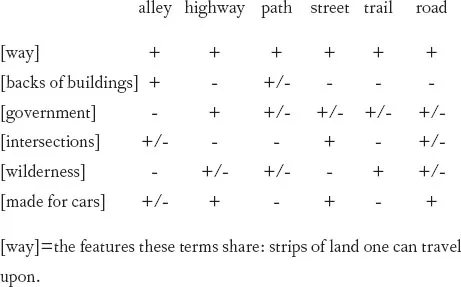
English doesn’t like two words to mean the exact same thing. They become magnetized. Slowly repel each other across sentences in separate rooms in separate towns in the same tongue in different mouths. Then, they warp and alter—a fish growing to the size of its bowl. A fish changing sex when the local males have left. My path, my street, my road, my alley. I own nothing, and yet I own these phrases as traffic in my mind. They own themselves as separate via a word’s talent for singularity. This is how the language owns us: by being specific and general enough to trick us into choosing a way.
![]()
ISOLATES
Someone just proved Burushaski—spoken in remote areas of Pakistan—is not an isolate, as labeled for decades. One man traced body parts to other languaged body parts and built the body back to the Balkans.
If languages carry memory like the body does—all the cells ch...