- 192 pages
- English
- ePUB (mobile friendly)
- Available on iOS & Android
eBook - ePub
Trusted by 375,005 students
Access to over 1.5 million titles for a fair monthly price.
Study more efficiently using our study tools.
Information
Subtopic
Social Science BiographiesPart 1
THE HOME WE KNEW
1
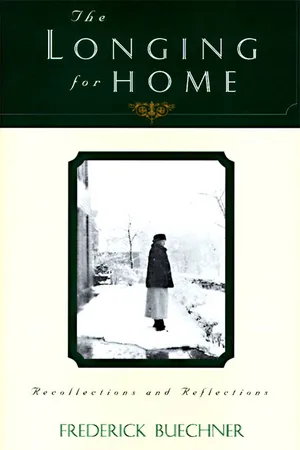
The Longing for Home
Home sweet home. There’s no place like home. Home is where you hang your hat, or, as a waggish friend of mine once said, Home is where you hang yourself. “Home is the sailor, home from sea, / And the hunter home from the hill.” What the word home brings to mind before anything else, I believe, is a place, and in its fullest sense not just the place where you happen to be living at the time, but a very special place with very special attributes which make it clearly distinguishable from all other places. The word home summons up a place—more specifically a house within that place—which you have rich and complex feelings about, a place where you feel, or did feel once, uniquely at home, which is to say a place where you feel you belong and which in some sense belongs to you, a place where you feel that all is somehow ultimately well even if things aren’t going all that well at any given moment. To think about home eventually leads you to think back to your childhood home, the place where your life started, the place which off and on throughout your life you keep going back to if only in dreams and memories and which is apt to determine the kind of place, perhaps a place inside yourself, that you spend the rest of your life searching for even if you are not aware that you are searching. I suspect that those who as children never had such a place in actuality had instead some kind of dream of such a home, which for them played an equally crucial part.
I was born in 1926 and therefore most of my childhood took place during the years of the Great Depression of the thirties. As economic considerations kept my father continually moving from job to job, we as a family kept moving from place to place with the result that none of the many houses we lived in ever became home for me in the sense I have described. But there was one house which did become home for me in that sense and which for many years after the last time I saw it in 1938 or so I used to dream about and which I still often think about although by now I am old enough to be the grandfather of the small boy I was when I first knew it.
It was a large white clapboard house that belonged to my maternal grandparents and was located in a suburb of Pittsburgh, Pennsylvania, called East Liberty, more specifically in a private residential enclave in East Liberty called Woodland Road which had a uniformed guard at the gate who checked you in and out to make sure you had good reason for being there. For about twenty years or so before he went more or less broke and moved away in his seventies with my grandmother to live out the rest of their days in North Carolina, my grandfather was a rich man and his house was a rich man’s house, as were all the others in Woodland Road, including the one that belonged to Andrew Mellon, who lived nearby. It was built on a hill with a steep curving driveway and surrounded by green lawns and horse chestnut trees, which put out white blossoms in May and unbelievably sticky buds that my younger brother and I used to stir up with leaves and twigs in a sweetgrass basket, calling it witches’ brew. It also produced glistening brown buckeyes that you had to split off the tough, thorny husks to find and could make tiny chairs out of with pins for legs or attach to a string and hurl into the air or crack other people’s buckeyes with to see which would hold out the longest.
The house itself had a full-length brick terrace in front and lots of French windows on the ground floor and bay windows above and dormers on the third floor with a screened-in sleeping porch in the back under which was the kitchen porch, which had a zinc-lined, pre-electric icebox on it that the iceman delivered ice to and whose musty, cavelike smell I can smell to this day if I put my mind to it. To the right of the long entrance hall was the library lined with glassed-in shelves and books, some of which I can still remember like the slim, folio-sized picture books about French history with intricate full-page color plates by the great French illustrator Job, and my great-grandfather Golay’s set of the works of Charles Dickens bound in calf like law books with his name stamped on the front cover. To the left of the hall was the living room, which I remember best for a horsehair settee covered in cherry red damask that was very uncomfortable and prickly to sit on and a Chinese vase almost large enough for a boy my size to hide in, and an English portrait done in the 1840s of a little girl named Lavinia Holt, who is wearing a dress of dotted white organdy with a slate blue sash and is holding in her left hand, her arm almost fully extended to the side, a spidery, pinkish flower that might be honeysuckle. In the basement there was a billiard room with a green baize table, which as far as I know was never used by anybody and a moosehead mounted on the wall that my brother and I and our cousin David Wick used to pretend to worship for reasons I have long since forgotten as the God of the Dirty Spittoon and several tall bookcases full of yellow, paper-bound French novels that ladies of the French Alliance, of which my half French-Swiss grandmother was a leading light, used to come and borrow from time to time.
At the end of the entrance hall a broad white staircase ascended to a landing with a bench on it and then turned the corner and went up to the second floor where the grown-ups’ bedrooms were, including my grandparents’, which had a bay window and a sun-drenched window seat where I used to count the pennies I emptied out of a little penny bank of my grandmother’s made like the steel helmet of a World War I French poilu. The stairway then continued on up to the third floor, where you could look down through the banister railing to the carpeted hall, which seemed a dizzying distance below. The third floor was the part of the house that for many years I used to go back to in my dreams. My brother’s and my bedroom was there, with a little gas fire that on winter mornings Ellen, the maid, used to light for us before we got out of bed, and the servants’ rooms, and other rooms full of humpbacked trunks covered with steamship labels and tied-up cardboard boxes and round Parisian hatboxes and all sorts of other treasures my brother and I never fully explored—which is perhaps why for all those years my dreams kept taking me back for another look. The smell of the house that I remember best was the smell of cooking applesauce. Out in the kitchen paneled with dark matchboard, Williams, the cook, put cinnamon in it for flavoring, and the fragrance as it simmered and steamed on top of the stove was warm and blurred and dimly pungent and seemed somehow full of enormous comfort and kindness.
What was there about that house that made it home in a way that all the other houses of my childhood never even came close to being? The permanence of it was part of the answer—the sense I had that whereas the other houses came and went, this one was there always and would go on being there for as far into the future as I could imagine, with Ellen bringing my grandmother her glass of buttermilk on a silver tray just at eleven every morning, and my grandfather going off to his downtown office and returning in time for a cocktail before dinner with the evening paper under his arm and maybe something he’d bought at the bakery on the way home, and the Saturday night suppers when the cook was out and the menu, in honor of the New England half of my grandmother’s background, was always mahogany-colored beans baked with salt pork and molasses, steamed Boston brown bread with raisins in it, and strong black coffee boiled in a pot with an eggshell to settle the grounds and sweetened with lumps of sugar and cream heavy enough to whip.
And beauty was another part of the answer, beauty that I took in through my pores almost before I so much as knew the word beauty—the paintings and books and green lawns, the thunder of water falling in a long, silver braid from the gooseneck spigot into the pantry sink, the lighting of lamps with their fringed shades at dusk, the knee-length silk mandarin’s coat with a coral lining and flowers and birds embroidered all over it that my grandmother sometimes wore in the evenings, and out behind the house by the grassed-over tennis court the white stables that were used to garage, among other cars, the elegant old Marmon upholstered in salmon-colored leather that had belonged to my mother in her flapper days and hadn’t been used since.
But more than all of these things that made that house home, or at the heart of all those things, was my grandmother, whom for reasons lost to history I called Naya. How to evoke her? She loved books and music and the French language of her father, who had emigrated from Geneva to fight on the Union side in the Civil War and eventually died of a shoulder wound he received from a sniper’s bullet at the siege of Petersburg. She loved Chesterfield cigarettes and the novels of Jean Ingelow and a daiquiri before dinner and crossword puzzles and she spoke the English language with a wit and eloquence and style that I have never heard surpassed. She loved to talk about the past as much as I loved to listen to her bring it to life with her marvelous, Dickensian descriptions, and when she talked about the present, she made it seem like a richly entertaining play which we both of us had leading roles in and at the same time were watching unfold from the safety and comfort of our seats side by side in the dress circle. The love she had for me was not born of desperate need for me like my mother’s love, but had more to do simply with her interest in me as a person and with the pleasure she took in my interest in her as the one grandchild she had who was bookish the way she was and who sat endlessly enraptured by the spells she cast.
On my thirty-fourth birthday, when she was going on ninety-one, she wrote me a letter in which she said, “[this] is to wish you many and many a happy year to come. And to wish for you that along the way you may meet someone who will be to you the delight you have been to me. By which I mean someone of a younger generation.” For all its other glories, the house on Woodland Road could never have become home without the extraordinary delight to me of her presence in it and the profound sense of serenity and well-being that her presence generated, which leads me to believe that if, as I started by saying, the first thing the word home brings to mind is a place, then the next and perhaps most crucial thing is people and maybe ultimately a single person.
Can it really, that home on Woodland Road, have been as wonderful as I make it sound, at least to myself, or has my memory reshaped it? The answer is that yes, of course, it was every bit that wonderful, and probably even more so in ways I have omitted from this account, and that is precisely why my memory has never let go of it as it has let go of so much else, but has continually reshaped it, the way the waves of the sea are continually reshaping the shimmering cliff, until anything scary and jagged is worn away, with the result that what has principally survived is a sense—how to put it right?—of charity and justice and order and peace that I have longed to find again ever since and have longed to establish inside myself.
All of this makes me wonder about the home that my wife and I created for ourselves and our three daughters, both of us coming from the homes of our childhood and consciously or unconsciously drawing on those memories as we went about making a new home for the family that we were becoming. For thirty-odd years the five of us lived in the same house, at first just during vacations but eventually all year round, so that there was never any question as to where home was. It was a much smaller white clapboard house than my grandparents’, but it was built on a much higher hill and surrounded not so much by lawns as by the meadows, pastures, and woods of our corner of southern Vermont. The house had a number of small bedrooms in it with a smallish, rather narrow living room, which all the other rooms more or less opened into, so that to sit there was to be aware of pretty much everything that was going on under our roof. For me as the ever watchful and ever anxious father, this had the advantage or disadvantage of letting me keep an eye on my children’s comings and goings without, I hoped, giving them the sense that I was perpetually keeping tabs on them. But as they began to get bigger and noisier, there were times when I yearned for a place to escape to once in a while, so we built on a wing with a large living room paneled in the silvery gray siding of a couple of tumbledown prerevolutionary barns. I don’t th...
Table of contents
- Cover
- Title Page
- Dedication
- Contents
- Introduction
- Part 1: THE HOME WE KNEW
- Part 2: THE HOME WE DREAM
- About the Author
- Other Books by Frederick Buechner: NONFICTION: FICTION
- Copyright
- About the Publisher
Frequently asked questions
Yes, you can cancel anytime from the Subscription tab in your account settings on the Perlego website. Your subscription will stay active until the end of your current billing period. Learn how to cancel your subscription
No, books cannot be downloaded as external files, such as PDFs, for use outside of Perlego. However, you can download books within the Perlego app for offline reading on mobile or tablet. Learn how to download books offline
Perlego offers two plans: Essential and Complete
- Essential is ideal for learners and professionals who enjoy exploring a wide range of subjects. Access the Essential Library with 800,000+ trusted titles and best-sellers across business, personal growth, and the humanities. Includes unlimited reading time and Standard Read Aloud voice.
- Complete: Perfect for advanced learners and researchers needing full, unrestricted access. Unlock 1.5M+ books across hundreds of subjects, including academic and specialized titles. The Complete Plan also includes advanced features like Premium Read Aloud and Research Assistant.
We are an online textbook subscription service, where you can get access to an entire online library for less than the price of a single book per month. With over 1.5 million books across 990+ topics, we’ve got you covered! Learn about our mission
Look out for the read-aloud symbol on your next book to see if you can listen to it. The read-aloud tool reads text aloud for you, highlighting the text as it is being read. You can pause it, speed it up and slow it down. Learn more about Read Aloud
Yes! You can use the Perlego app on both iOS and Android devices to read anytime, anywhere — even offline. Perfect for commutes or when you’re on the go.
Please note we cannot support devices running on iOS 13 and Android 7 or earlier. Learn more about using the app
Please note we cannot support devices running on iOS 13 and Android 7 or earlier. Learn more about using the app
Yes, you can access The Longing for Home by Frederick Buechner in PDF and/or ePUB format. We have over 1.5 million books available in our catalogue for you to explore.