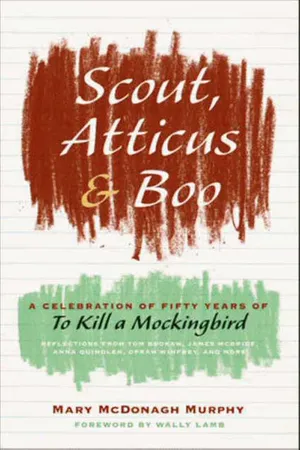
“OUR NATIONAL NOVEL”
Reading To Kill a Mockingbird is something millions of us have in common, yet there is nothing common about the experience. It is usually an extraordinary one. To Kill a Mockingbird leaves a mark. And somehow, it is hermetically sealed in our brains—the memory of it fresh and clear no matter how many decades have passed. If you ask, people will tell you exactly where they were and what was happening to them when they read Harper Lee’s first and only novel. It may be the first “adult” book we read, assigned in eighth or ninth grade. Often it is the first time a young reader is completely kidnapped by a novel, taken on an enthralling ride until the very end. After half a century, To Kill a Mockingbird’s staying power is remarkable: still a best seller, always at the top of lists of readers’ favorites, far and away the most widely read book in high school.
“I think it is our national novel,” Oprah Winfrey told me when I interviewed her for my documentary about To Kill a Mockingbird’s power and influence. “If there was a national novel award, this would be it for the United States. When I opened my school [for girls in South Africa], everybody wanted to know what we can bring and what can we give the girls. I asked everybody to bring their favorite book, and I would say we probably have a hundred copies of this book. Each person who brought the book wrote their own words to the girls about why they believe this book was an important book, and everybody says something different.”
That’s because almost everyone can relate to it—one way or another. Look at all the ground To Kill a Mockingbird covers: childhood, class, citizenship, conscience, race, justice, fatherhood, friendship, love, and loneliness. With all due respect to the wave of social-networking sites, applications, and abbreviations in which we are awash these days, I would like to point out that the community this fifty-year-old novel invites and enjoys is one of the greatest social networks of all time. Try saying “Boo Radley” to the person next to you on the bus. Or say “chiffarobe,” as Mayella Ewell does. Mention Scout, Atticus, Jem, Mrs. Dubose, or Tom Robinson, and see where it takes you. People respond. They connect. Friendships form.
When I met Liz Tirrell, a screenwriter and documentary director, it did not take long to find out she could recite line after line from the book and the movie. We bonded over “Hey, Mr. Cunningham…I’m Jean Louise Finch. I go to school with Walter; he’s your boy, ain’t he?”
When Pulitzer Prize–winning historian Diane McWhorter was growing up in Birmingham, Alabama, she and her schoolmates recited the “Hey, Mr. Cunningham” lines and spoke Scout whenever possible. “Cecil Jacobs is a big wet hen,” and “What in the Sam Hill are you doing?” and other imitations rang out at recess.
Anna Quindlen, the Pulitzer Prize–winning columnist and novelist, said she simply could not be friends with anyone who does not “get” Scout. “I remember someone telling me that they thought Scout was a peripheral character, and I was shocked out of my skin.”
But then, I have another friend, a novelist who teaches fiction writing, who told me that when she mentioned To Kill a Mockingbird as a favorite, a fellow professor said, “We don’t consider that literature here.”
Really?
“YOU HAVE ANOTHER THINK COMING”
That pronouncement sent me right back to the novel. And unlike other favorites from childhood, another reading of To Kill a Mockingbird rewards and reaffirms. The story is as rich as the Alabama soil it comes from; its veins can be mined over and over again. If you think you cannot go back to it and find more, “You have another think coming,” as Scout Finch would say.
My second reading of To Kill a Mockingbird was a revelation. It felt as though I was reading it for the very first time. How could I have forgotten Calpurnia and “It’s not necessary to tell all you know”? Or Dolphus Raymond, the drunk, who was not a drunk at all? Or all the history? And the writing. The writing! The economy was dazzling. My enthusiasm was unbridled, my appreciation immense.
Looking back, I see that the first time, I was blinded by love. For Scout: funny, smart, overall-wearing, fists-flying, lynch-mob-scattering Scout. Scout knew who she was, and she had the greatest father on the planet.
Here she was again—only better.
On her cousin: “Talking to Francis gave me the sensation of settling slowly to the bottom of the ocean. He was the most boring child I ever met.”
On the neighbors: “The Radley Place was inhabited by an unknown entity the mere description of whom was enough to make us behave for days on end; Mrs. Dubose was plain hell.”
On her father: “Atticus was feeble: he was nearly fifty.”
On the caste system in her town: “…to my mind it worked this way: the older citizens, the present generation of people who had lived side by side for years and years, were utterly predictable to one another: they took for granted attitudes, character shadings, even gestures, as having been repeated in each generation and refined by time. Thus the dicta No Crawford Minds His Own Business, Every Third Merriweather Is Morbid, The Truth Is Not in the Delafields, All the Bufords Walk Like That, were simply guides to daily living.”
After I finished, I carried my paperback copy of To Kill a Mockingbird around with me for weeks. I needed to stay in its thrall. I read random pages, sometimes aloud, and was instantly reinvigorated.
Novelist Mark Childress, who wrote Crazy in Alabama, told me he reads To Kill a Mockingbird “as a refresher course” almost every year. “Every time I go back, I’m impressed more by the simplicity of the prose…. Although it’s plainly written from the point of view of an adult, looking back through a child’s eyes, there’s something beautifully innocent about the point of view, and yet it’s very wise.”
Allan Gurganus, author of The Oldest Living Confederate Widow Tells All and other novels, said of his rereading: “What’s marvelous is that you see that sometimes the first things that happen to you are as big as they seemed. And, it’s very moving to see what an evergreen and enduring achievement it’s truly turned out to be.”
“AS RELEVANT TODAY AS THE DAY IT WAS WRITTEN”
My second reading of To Kill a Mockingbird was fifteen years ago. And then, like Scout, I decided to go exploring. I began looking into the novel’s history, stature, and popularity. By any measure, it is an astonishing phenomenon. An instant best seller, winner of the Pulitzer Prize, a screen adaptation ranked one of the best of all time. Fifty years after its publication, it sells nearly a million copies every year—hundreds of thousands more than The Catcher in Rye, The Great Gatsby, or Of Mice and Men, American classics that also are staples of high school classrooms.
No other twentieth-century American novel is more widely read. Even British librarians, who were polled in 2006 and asked, “Which book should every adult read before they die?” voted To Kill a Mockingbird number one. The Bible was number two. Why? What is it about this novel, I asked everyone I interviewed. “I think people want to read something substantial,” answered novelist Lee Smith, author of The Last Girls and eleven other books. “They want to have something to believe in, and To Kill a Mockingbird manages to do that without being too preachy.”
Until she retired from North Carolina State University, Smith taught To Kill a Mockingbird for twenty-five years. “Students are reading it today with the same responses we all had in the sixties,” she said. “It still has a galvanizing effect on a young reader. This is a novel which endures, as opposed to other classics which don’t appeal as much to readers today. The Sun Also Rises is a good example, because students just say, ‘Who are all these people drinking in Spain? What is this about?’ You never get that reaction to To Kill a Mockingbird. It remains as relevant today as it was the day it was written. It never ages. It’s a story of maturing, certainly, and initiation, but told in such beautifully specific terms that it never seems generic.”
Novelist Wally Lamb, author of I Know This Much Is True and The Hour I First Believed, told me he did not enjoy reading in high school. Then he found To Kill a Mockingbird in his sister’s room. “I flipped it open and read the first couple of sentences and…two days later I, the pokiest reader I knew, had finished the book. It was the first time in my life that a book had captured me. That was exciting. I didn’t realize that literature could do that.” And when Lamb went on to teach high school in Connecticut, he saw his students respond the same way. “It was a book they read because they wanted to, not because they had to. It cast the same spell for my students as it had for me.”
Winfrey was a young girl living with her mother in Milwaukee, Wisconsin, when a librarian recommended To Kill a Mockingbird. She remembered “just devouring it,” and climbing right aboard the Scout bandwagon. “I wanted to be Scout, I thought I was Scout. I wanted an accent like Scout and a father like Atticus.”
Who doesn’t want a father like Atticus? Pulitzer Prize–winning novelist Richard Russo did. “Atticus Finch was the father maybe that I longed for,” he said.
Beyond being an ideal father, Atticus Finch is a folk hero to lawyers. When Scott Turow, a lawyer who became famous for writing novels about lawyers, read To Kill a Mockingbird as a student in Chicago, “I promised myself that when I grew up and I was a man, I would try to do things just as good and noble as what Atticus had done for Tom Robinson.”
Lest we forget, Atticus also is the best shot in the county. An understanding single father, an honest and humble lawyer, a respectful neighbor, Atticus is a paragon but never a caricature. “People want to believe in an idealized world, and that has an instructive moral function,” Turow said. “It’s true that there aren’t many human beings in the world like Atticus Finch—perhaps none—but that doesn’t mean that it’s not worth striving to be like him.”
Boo Radley loomed large in all my conversations. The house, and the mystery and suspense built up around it, was familiar territory.
“Boo Radley cannot be overestimated as an important factor in this book,” Smith said. “Every neighborhood has that house that’s overgrown and those neighbors that are weird or that you never ever, ever see. And stories grow up about them. That figure always occupies a place in a child’s imagination. And to demystify that—to make us see that people so radically different from us are OK, and can be helpful and wonderful—this is so important.”
“Boo Radley is now a phrase in the language, [as in] the block’s Boo Radley,” said Gurganus. “Many people who haven’t read To Kill a Mockingbird have that phrase in their lingo.” Indeed, Boo Radley has entered not only our vernacular but also our yellow pages. Novelty stores, bars, and antiques dealers bear his name: Boo Radley’s Store in Spokane; Boo Radley’s Bar in Mobile, Boo Radley’s Antiques in Los Angeles.
“I AM ALIVE, ALTHOUGH VERY QUIET”—HARPER LEE
All of this despite an author who has done nothing to publicize her book for more than forty-five years. In 1993, Harper Lee wrote to her agent, “Although Mockingbird will be thirty-three this year, it has never been out of print and I am still alive, although very quiet.” The same can be said seventeen years later. Still among us, at eighty-four, Nelle Harper Lee, who dropped her first name when she published, was born in the small town of Monroeville, Alaba...