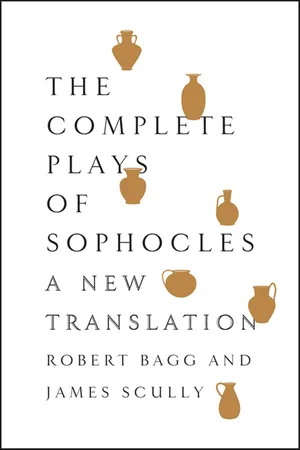
The most celebrated plays of ancient Athens in vivid, dynamic new translations by award-winning poets Robert Bagg & James Scully.
The dominant Athenian playwright in fifth-century BCE Athens, Sophocles left us seven powerful dramas that still shock as they render the violence that erupts within divinity and humankind.
Oedipus the King,
Oedipus at Kolonos, and
Antigone trace three generations of a family manipulated by the inscrutably vindictive god Apollo to commit patricide, incest, and kin murder.
Elektra and
Women of Trakhis begin as studies of women obsessed with hatred and desire but become dissenting critiques of the Greeks' enthusiasm for revenge and ego-crazed heroics. Two hard-hitting dramas set in war zones,
Aias and
Philoktetes, use conflicts among Greek warriors at Troy to thrash out political and ethical crises confronting Athenian society itself.
These translations, modern in idiom while faithful to the Greek and already proven stageworthy, preserve depth and subtlety of Sophocles' characters and refresh and clarify his narratives. Their focus on communities under extreme stress still resonates deeply for us here and now. This is Sophocles for a new generation entering the turbulent arena of ancient Greek drama.
Praise for
The Complete Plays of Sophocles
"Bagg's Oedipus plays and Scully's remarkable
Aias are as finely wrought as one could desire, but they have a spare impact which gets across the moment-by-moment emotion of the plays, and makes plain the moral or political themes." —Richard Wilbur, former U.S. Poet Laureate, winner of the National Book Award and Pulitzer Prize
"Bagg and Scully's renderings strike me as the most performable versions of Sophocles I've ever encountered . . . if you're looking for the translation that best reflects the emotional force and expressive range of the original plays, you would be hard pressed to do better." —
Philadelphia Inquirer
- 880 pages
- English
- ePUB (mobile friendly)
- Available on iOS & Android
eBook - ePub
About this book
Information
Oedipus at Kolonos
INTRODUCTION
“HIS DEATH WAS A CAUSE FOR WONDER”
“HIS DEATH WAS A CAUSE FOR WONDER”
The Oedipus we meet in Kolonos, a lush country village a mile north of Athens, where Sophocles was raised, has suffered through years of blindness, poverty, and exile. He is old and frail, but still recognizable as the fearless, vengeful, and quick-witted hero of Oedipus the King. Traits that characterized his youth (and contributed to his downfall) still energize the aged Oedipus as he repeatedly recalls, and forcefully defends, his earlier conduct. Only at the end of his journey, as he approaches the afterlife that Apollo promised would somehow distinguish him, does Oedipus become a gentler and more loving man.
The Greek word for the grace or favor extended by men and gods to the worthy, the needy, the damaged, and the miserable is charis. By setting Oedipus at Kolonos on the edge of a sacred grove blessed with flowers, grape vines, nightingales, shade trees, and clearings suitable for dancing, Sophocles creates a physical setting where men and gods converge, one that makes manifest the metaphysical space where the human and divine pay their respects and offer charis to each other. Charis becomes a palpable presence onstage, its promise growing more significant as the drama unfolds.
In the sacred grove of the Eumenides, Oedipus will find the mercy, and in a sense the rebirth, Apollo promised him at Delphi—almost as an afterthought—when as a troubled young man he received the worst news any Greek ever heard from a god: he was doomed to kill his father and his mother would bear his children. Now, within the grove’s precincts, the weakened Oedipus will be transformed from a reviled exile into a revered hero. As the classicist John Gould put it, “Nowhere else in Greek tragedy does the primitively mysterious power of boundaries and thresholds, the ‘extraterritoriality’ of the sacred, make itself felt with the fierce precision that Sophocles achieves” in the song the Old Men sing as they arrive on the scene (1973, 90). We sense immediately the primitive dread aroused by the grove’s divine inhabitants. Oedipus, guided by Antigone, hides in the trees as the chorus sweeps angrily onstage. The Old Men denounce the hidden intruder. They scour the grove for signs of him and sing their terror of the all-seeing Furies, whom they refer to circumspectly as the Kindly Ones. To escape the goddesses’ withering glances, the old men walk with their eyes lowered. As even the uttering of the Furies’ names is forbidden, the prayers they mouth are silent.
Oedipus responds to the Old Men’s warnings by emerging from his hiding place in the grove. He gives himself up to them. He won’t reenter the grove until a god’s voice calls to him in the play’s climactic moments. Meanwhile, by dramatizing Oedipus’ claims to deserve the gods’ charis, Sophocles explores a subject that fascinated him—heroes and their deaths as paradigms for the fully empowered human spirit.
Thus the final surviving work by Sophocles, the second of his two dramas about Oedipus, brings his hero’s story to a tantalizing but still satisfying conclusion, one we co...
Table of contents
- Dedication
- Contents
- GENERAL INTRODUCTION - WHEN THEATER WAS LIFE: THE WORLD OF SOPHOCLES
- Aias
- Women of Trakhis
- Philoktetes
- Elektra
- Oedipus the King
- Oedipus at Kolonos
- Antigone
- NOTES TO THE PLAYS
- WORKS CITED AND CONSULTED
- ACKNOWLEDGMENTS
- Also by Robert Bagg
- Also by James Scully
- Credits
- Copyright
- About the Publisher
Trusted by 375,005 students
Access to over 1.5 million titles for a fair monthly price.
Study more efficiently using our study tools.
Frequently asked questions
Yes, you can cancel anytime from the Subscription tab in your account settings on the Perlego website. Your subscription will stay active until the end of your current billing period. Learn how to cancel your subscription
No, books cannot be downloaded as external files, such as PDFs, for use outside of Perlego. However, you can download books within the Perlego app for offline reading on mobile or tablet. Learn how to download books offline
Perlego offers two plans: Essential and Complete
- Essential is ideal for learners and professionals who enjoy exploring a wide range of subjects. Access the Essential Library with 800,000+ trusted titles and best-sellers across business, personal growth, and the humanities. Includes unlimited reading time and Standard Read Aloud voice.
- Complete: Perfect for advanced learners and researchers needing full, unrestricted access. Unlock 1.5M+ books across hundreds of subjects, including academic and specialized titles. The Complete Plan also includes advanced features like Premium Read Aloud and Research Assistant.
We are an online textbook subscription service, where you can get access to an entire online library for less than the price of a single book per month. With over 1.5 million books across 990+ topics, we’ve got you covered! Learn about our mission
Look out for the read-aloud symbol on your next book to see if you can listen to it. The read-aloud tool reads text aloud for you, highlighting the text as it is being read. You can pause it, speed it up and slow it down. Learn more about Read Aloud
Yes! You can use the Perlego app on both iOS and Android devices to read anytime, anywhere — even offline. Perfect for commutes or when you’re on the go.
Please note we cannot support devices running on iOS 13 and Android 7 or earlier. Learn more about using the app
Please note we cannot support devices running on iOS 13 and Android 7 or earlier. Learn more about using the app
Yes, you can access The Complete Plays of Sophocles by Robert Bagg,James Scully in PDF and/or ePUB format, as well as other popular books in Literature & Ancient & Classical Drama. We have over 1.5 million books available in our catalogue for you to explore.