**Updated and expanded with new material from the author and new foreword from Rachel Kushner**
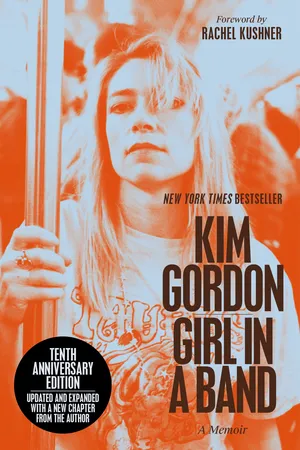
For many, Kim Gordon is the epitome of cool: vocalist, bassist/guitarist and founding member of Sonic Youth—one of the most successful bands to emerge from the post-punk New York scene—despite being famously reserved.
Ten years ago, Gordon distilled that coolness into her groundbreaking memoir, Girl in a Band, speaking openly about her life. From her childhood in the sunbaked suburbs of Southern California, growing up with a schizophrenic sibling, to New York’s downtown art and music scene in the halcyon days of the 80s and 90s and creating Sonic Youth—a band that would go on to pave the way for acts like Nirvana and inspire the Riot Grrrl generation. Girl in a Band is an edgy and evocative portrait of a life in art.
A decade on, Gordon’s exploration of the artists, musicians, and writers who influenced her, and of the relationship that defined her life for so long, remains a deeply intimate self-portrait of a woman who became an icon, and whose stature continues to evolve in and grow. With a new foreword by Rachel Kushner and new chapter from Kim herself ruminating on her career as a solo artist and her two 2025 Grammy nominations, her connection to touring after nearly forty years, and the death of her brother Keller.
This unflinching memoir maps the evolution of an artist, a band, and an era.
Post-Punk New York: From the halcyon days of the 80s and 90s art and music scene to the formation of a band that would define a generation.
Sonic Youth Memoir: An insider's account of the band that paved the way for acts like Nirvana, told from the epicenter of the noise.
Art Scene Memoir: A portrait of a life lived at the intersection of music and visual art, with candid explorations of the artists, writers, and musicians who shaped her worldview.
Unflinching Personal Story: Gordon speaks openly about her Southern California childhood, growing up with a schizophrenic sibling, and the marriage and divorce that defined her life for decades.
IT’S FUNNY WHAT you remember, and why, or whether it even happened in the first place. My first take on Rochester, New York: gray skies, dark, colored leaves, empty rooms, no parents around, no one watching or minding the store. Is it Upstate New York I’m thinking back on, or some scene from an old movie?
Perhaps it is a film my older brother, Keller, and I saw on TV—The Beast with Five Fingers. I was around three or four. Peter Lorre plays a man who’s been left out of the will of his employer, a famous pianist who’s just died. He takes his revenge by cutting off the pianist’s hand, and for the rest of the film, the hand won’t stop tormenting him. It roams and sneaks around the big house. It plays dark notes and chords on the piano, and hides out in a clothes closet. As the film goes on Peter Lorre gets crazier and sweatier until at the end the hand reaches out and strangles him.
“The hand is under your bed,” Keller told me afterward. “It’s going to come out in the middle of the night while you’re sleeping and it’s going to get you.”
He was my older brother so why wouldn’t I believe him? For the next few months, I lived on top of my mattress, balancing there in my bare feet to get dressed in the morning. I fell asleep at night surrounded by an army of stuffed animals, the smallest ones closest to me, a big dog with a red tongue guarding the door, not that any of them could have defended me against the hand.
Keller: one of the most singular people I’ve ever known, the person who more than anyone else in the world shaped who I was, and who I turned out to be. He was, and still is, brilliant, manipulative, sadistic, arrogant, almost unbearably articulate. He’s also mentally ill, a paranoid schizophrenic. And maybe because he was so incessantly verbal from the start, I turned into his opposite, his shadow—shy, sensitive, closed to the point where to overcome my own hypersensitivity, I had no choice but to turn fearless.
An old black-and-white photo of a little house is all I have to prove Rochester was my birthplace. Black-and-white matches that city, with its rivers, aqueducts, manufacturing plants, and endless winters. And when my family headed out west, like any birth canal Rochester was forgotten.
I was five years old when my father was offered a professorship in the UCLA sociology department, and we—my parents, Keller, and I—drove out to Los Angeles in our old station wagon. Once we passed over into the Western states, I remember how excited my mother was to order hash browns at a roadside diner. To her hash browns were a Western thing, a symbol, full of a meaning she couldn’t express.
When we pulled into Los Angeles, we stayed at some dive called the Seagull Motel, one of probably a thousand look-alike places with the same name along the California coast. This Seagull Motel was in the shadow of a Mormon temple, a huge monolithic structure on top of a hill, surrounded by acres of trimmed, saturated green grass no one was allowed to walk on. Everywhere were sprinkler systems, little metallic gadgets here and there twisting and chugging away at all hours. Nothing was indigenous—not the grass, not the sprinkler water, not any of the people I met. Until I saw the movie Chinatown, I didn’t realize L.A. was, underneath everything, a desert, an expanse of endless burlap. That was my first glimpse of L.A. landscaping.
I also had no idea that going to California meant a return to my mom’s roots.
In my family, history showed up in casual remarks. I was in my senior year of high school when my aunt told me that my mother’s family, the Swalls, was one of California’s original families. Pioneers. Settlers. The story went that along with some Japanese business partners, my great-great-grandparents ran a chili pepper farm in Garden Grove, in Orange County. The Swalls even had a ranch in West Hollywood, at Doheny Drive and Santa Monica Boulevard, on land that’s today all car washes and strip malls and bad stucco. At some point the railroad laid down tracks, slicing the street into Big and Little Santa Monica Boulevards. The ranches are all gone today, of course, but Swall Drive is still there, swishing north and south, a fossil of ancestral DNA.
I’ve always felt there’s something genetically instilled and inbred in Californians—that California is a place of death, a place people are drawn to because they don’t realize deep down they’re actually afraid of what they want. It’s new, and they’re escaping their histories while at the same time moving headlong toward their own extinctions. Desire and death are all mixed up with the thrill and the risk of the unknown. It’s a variation of what Freud called the “death instinct.” In that respect the Swalls were probably no different from any other early California family, staking out a new place, lured there by the gold rush and hitting an ocean wall.
On the Swall side also was my mother’s father, Keller Eno Coplan, a bank clerk. The story goes that at one point he forged a check belonging to his own in-laws and went to jail. My dad always laughed when he talked about my grandfather, saying things like “He wasn’t dumb, he just had no sense.” Odd, then, and not exactly a blessing, that my parents would name their only son after him. Family tradition, I guess.
With her husband in jail, my grandmother moved with her five kids, including my mother, who was young at the time, up to Northern California, to be closer to the clan in Modesto. During the Depression my grandmother picked up and moved again, to Colorado this time, where her husband’s family had roots. When her husband wasn’t in jail, he was out roaming the country looking for work. With no money and five kids to feed, she must have put up with a lot.
The only reason I know this is because my aunt figured out that one of his short-term jobs was selling pencils. Turns out only ex-cons got those gigs.
At some point my grandmother and her children ended up making a permanent home in Kansas. This is where my parents met in their early twenties, in a little city called Emporia, where both of them were in college.
My father, Wayne, was a native Kansan, from a big farming family, with four brothers and one sister. He was fragile as a boy, with a middle ear disorder that kept him from enlisting in the military or getting drafted. He was the first child in his family to attend college, his dream being to teach someday at the university level. To help pay his tuition, he taught elementary school in a one-room Emporia schoolhouse, first grade to sixth grade, everything from shapes and colors to spelling, history, and algebra.
My parents were married during college, and after graduating from Washington University in Saint Louis, where Keller was born, it was on to Upstate New York and Rochester, where my dad began writing his Ph.D. Three years later, I came along. The story of how my parents met came out only during cocktail hours, the details always sketchy. My dad was scatterbrained, my mother liked to say, adding that his habit of making popcorn in her house without putting the lid on when they were courting almost made her rethink the idea of marrying him. She always said it with a laugh, though the point she was trying to make, maybe, was that my dad wasn’t as down-to-earth and responsible as he appeared.
The names in our family—Keller, Eno, Coplan, Estella, Lola—always make me wonder whether there’s some Mediterranean in the mix. There is also the de Forrest side from my mom’s mother, who was French and German, but there’s an Italian strain, too, flashing eyes and Groucho brows mixed in with all the Kansan flatness. Kansas is where my mother’s ninety-two-year-old sister—the source of everything I know about my family history—still lives in a farmhouse at the end of a long dirt road. She’s a woman who during her life I never heard utter even one self-pitying word. Her stories are pretty much the only ones I know. My parents told me next to nothing.
2
ONCE WHEN SONIC YOUTH was on tour in Lawrence, Kansas, opening for R.E.M., Thurston and I paid a visit to William Burroughs. Michael Stipe came along with us. Burroughs lived in a little house with a garage, and the coffee table in his living room was crisscrossed with fantasy knives and daggers—elegant, bejeweled weapons of destruction. That day, all I could think of was how much Burroughs reminded me of my dad. They shared the same folksiness, the same dry sense of humor. They even looked a little alike. Coco, our daughter, was a baby, and at one point when she started crying, Burroughs said, in that Burroughs voice, “Oohhh—she likes me.” My guess is he wasn’t somebody who spent much time around kids.
My dad’s academic specialty was sociology in education. In Rochester, he’d done his Ph.D. on the social system in American high schools. He was the first person ever to put a name to various school-age groups and archetypes—preps, jocks, geeks, freaks, theater types, and so on—and then UCLA had hired him to create an academic curriculum based on his research.
One of the conditions for my dad taking the UCLA job was that Keller and I were able to attend the UCLA Lab School. That school was an amazing place. The campus was designed by the modernist architect Richard Neutra, with a large, beautiful gully running through it. One side was grass and the other concrete—for hopscotching or Hula-Hooping or whatever. The gully flowed up into an untamed area where a covered wagon and an adobe house sat beneath some trees. As students, we fringed shawls, pounded tortillas, and skinned cowhides out among those trees. Our teacher drove us down to Dana Point, in Orange County, where we tossed our cowhides down on the beach for imaginary incoming boats, copying what the early traders must have done. There were no grades at that school—it was all very learn-by-doing.
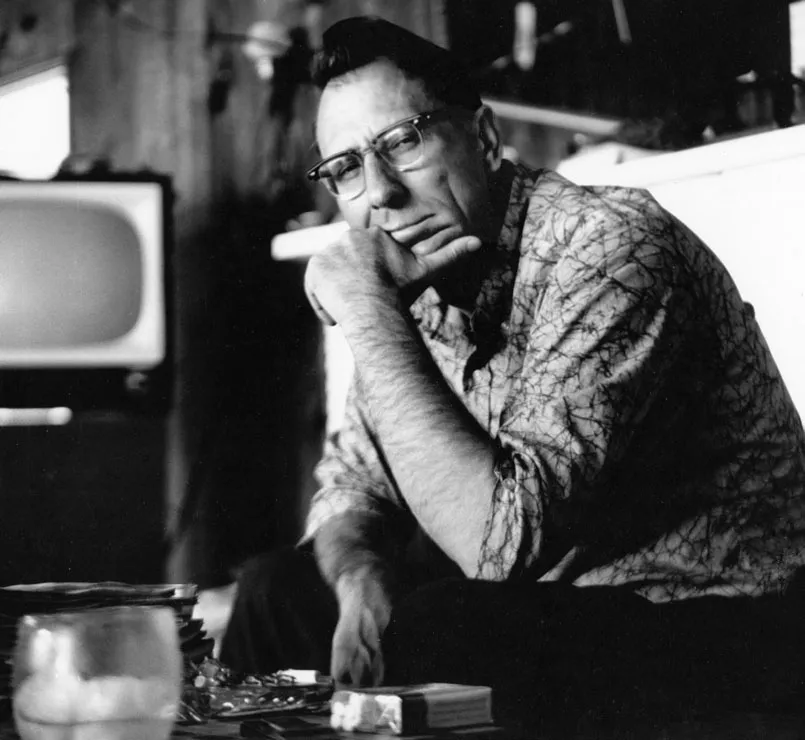
My dad was tall and gentle, with a big expressive face and black glasses. He was a gestural guy, physical, emphatic with his arms and his hands, but incredibly warm, too, though the few times I remember his getting angry at Keller or me were frightening. The angry words seemed to start in the soles of his feet and travel up through his entire body. Like a lot of people who live in their heads, he could be absentminded; there was that popcorn story, after all. Once when I was little he put me in the bathtub with my socks on—he hadn’t noticed—which of course I begged him to do again and again from that point on.
He’d grown up doing chores beside his mother and sister—cooking and gardening, pretty much anything involving his hands—and the habit stayed with him. During cocktail hour, which my mom and he never missed, he made amazing martinis and Manhattans with a chilled martini shaker kept in the freezer at all times. This was the late fifties and early sixties—people took their cocktail hours seriously. The backyard of our house in L.A. was thick and stringy with the tomato plants he grew. My mom liked to tell me that my dad’s skill with his hands was something he’d passed down to me, and I always loved hearing that.
Someone once wrote that in between the lives we lead and the lives we fantasize about living is the place in our heads where most of us actually live. My mom told me once that my father had always wanted to be a poet. It is likely that growing up during the Depression with no money made him want to seek security, pushing him toward a career as a professor instead. But aside from his love of words and the self-deprecating jokes and puns he slung around with his close friends, it was something that until she told me, I never knew about my father, which is striking, especially since my brother later became a poet.
From my childhood I recall days spent home sick from school, trying on my mom’s clothes and watching television show after television show. I remember spooning out chocolate or tapioca pudding from the box—tapioca, a word no one uses anymore. The smell of the house, damp and distinct. The aroma of old indigenous L.A. houses, even inland ones, comes from the ocean twenty miles away, a hint of mildew, but dry, too, and closed up, perfectly still, like a statue. I can still smell the barest trace of gas from the old 1950s stove, an invisible odor mixed with sunshine streaming in from the windows, and, somewhere, eucalyptus bathed in the haze of ambition.
3
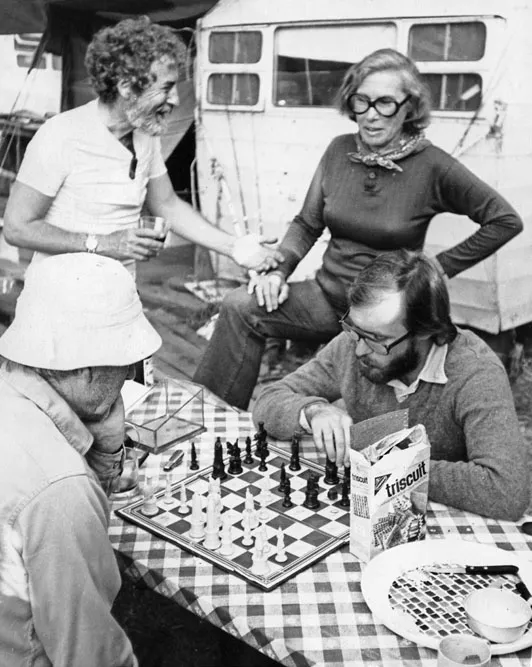
UPSTAIRS IN MY HOUSE in western Massachusetts, I have a stack of DVDs containing old movies of my parents fishing in the Klamath River, just south of the Oregon border. They’re with their best friends, Connie and Maxie Bentzen, and another couple, Jackie and Bill, all of them members of the liberal, food-loving UCLA group my parents belonged to. These were funny, ironic people who also happened to be passionate fishermen.
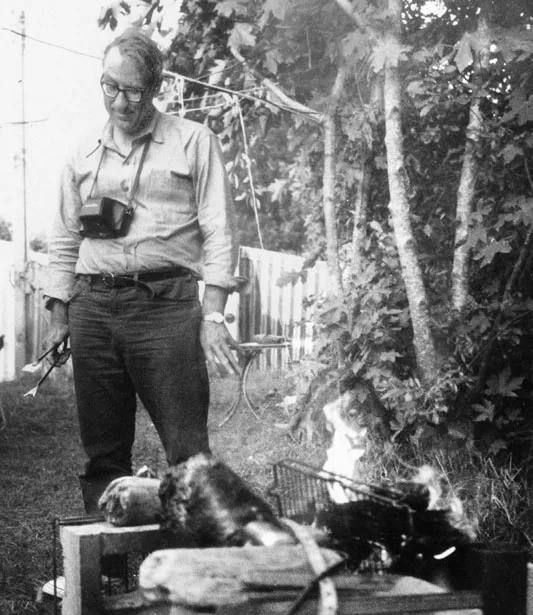
Starting in the late sixties, my parents drove up to Klamath every summer, staying in a rented trailer and spending the next month fishing with this core group of people, others coming and going. Klamath was all about fishing and socializing and cooking and eating, and waking up the next day to start over again. My dad made his own smoking devices—homemade baskets he placed in oilcans and submerged in hot coals to smoke fish, chicken wings, or his famous ribs. There were no social rules except that “good times” were to be had. You ate what you caught, and to this day the salmon right out of the smoker that Connie Bentzen made is the best thing I’ve ever tasted. An actual rule in Klamath: you were only allowed to take home two fish. My mother once smuggled a third fish onto the campsite inside her waders, a story of transgression that turned into an ongoing joke between her and their friends.
The Bentzens were documentary filmmakers, close friends with cinematographers and directors like Haskell Wexler, who worked on films like One Flew over the Cuckoo’s Nest, and Irvin Kershner, who worked on Star Wars. Maxie Bentzen was a funny, lighthearted former grad student of my dad’s, the first woman I knew who wore blue jeans day and night. Her husband, Connie, had the same electric-blue eyes as Paul Newman. During the year they lived in Malibu, in a house on stilts, with Peanuts cartoons and New Yorker magazines on their living room table. If you were spending the night in their guest room, just below the high-tide mark, you could hear the waves fiercely crashing underneath the house, true white noise that sloshed you to sleep. As a kid I remember wanting to be just like the Bentzens, to host dinner parties just like theirs, with my friends’ children ru...
Table of contents
Cover
Title Page
Dedication
Contents
Foreword
The End
Chapter 1
Chapter 2
Chapter 3
Chapter 4
Chapter 5
Chapter 6
Chapter 7
Chapter 8
Chapter 9
Chapter 10
Chapter 11
Chapter 12
Chapter 13
Chapter 14
Chapter 15
Chapter 16
Chapter 17
Chapter 18
Chapter 19
Chapter 20
Chapter 21
Chapter 22
Chapter 23
Chapter 24
Chapter 25
Chapter 26
Chapter 27
Chapter 28
Chapter 29
Chapter 30
Chapter 31
Chapter 32
Chapter 33
Chapter 34
Chapter 35
Chapter 36
Chapter 37
Chapter 38
Chapter 39
Chapter 40
Chapter 41
Chapter 42
Chapter 43
Chapter 44
Chapter 45
Chapter 46
Chapter 47
Chapter 48
Chapter 49
Chapter 50
Chapter 51
Chapter 52
Chapter 53
What Is the End?
Acknowledgments
About the Author
Praise
Copyright
About the Publisher
Trusted by 375,005 students
Access to over 1.5 million titles for a fair monthly price.
Study more efficiently using our study tools.
Frequently asked questions
Yes, you can cancel anytime from the Subscription tab in your account settings on the Perlego website. Your subscription will stay active until the end of your current billing period. Learn how to cancel your subscription
No, books cannot be downloaded as external files, such as PDFs, for use outside of Perlego. However, you can download books within the Perlego app for offline reading on mobile or tablet. Learn how to download books offline
Perlego offers two plans: Essential and Complete
Essential is ideal for learners and professionals who enjoy exploring a wide range of subjects. Access the Essential Library with 800,000+ trusted titles and best-sellers across business, personal growth, and the humanities. Includes unlimited reading time and Standard Read Aloud voice.
Complete: Perfect for advanced learners and researchers needing full, unrestricted access. Unlock 1.5M+ books across hundreds of subjects, including academic and specialized titles. The Complete Plan also includes advanced features like Premium Read Aloud and Research Assistant.
Both plans are available with monthly, semester, or annual billing cycles.
We are an online textbook subscription service, where you can get access to an entire online library for less than the price of a single book per month. With over 1.5 million books across 990+ topics, we’ve got you covered! Learn about our mission
Look out for the read-aloud symbol on your next book to see if you can listen to it. The read-aloud tool reads text aloud for you, highlighting the text as it is being read. You can pause it, speed it up and slow it down. Learn more about Read Aloud
Yes! You can use the Perlego app on both iOS and Android devices to read anytime, anywhere — even offline. Perfect for commutes or when you’re on the go. Please note we cannot support devices running on iOS 13 and Android 7 or earlier. Learn more about using the app
Yes, you can access Girl in a Band (10th Anniversary Edition) by Kim Gordon in PDF and/or ePUB format, as well as other popular books in Media & Performing Arts & Fashion Biographies. We have over 1.5 million books available in our catalogue for you to explore.