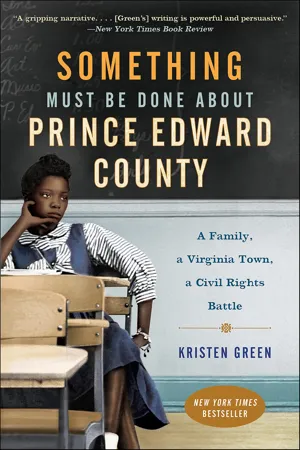
The provocative true story of one Virginia school system's refusal to integrate after the US Supreme Court declared school segregation unconstitutional.
A
New York Times Bestseller
A
Washington Post Notable Book of the Year
In the wake of the Supreme Court's unanimous
Brown v. Board of Education decision, Virginia's Prince Edward County refused to obey the law. Rather than desegregate, the county closed its public schools, locking and chaining the doors. The community's white leaders quickly established a private academy, commandeering supplies from the shuttered public schools to use in their all-white classrooms. Meanwhile, black parents had few options: keep their kids at home, move across county lines, or send them to live with relatives in other states. For five years, the schools remained closed.
Kristen Green, a longtime newspaper reporter, grew up in Farmville and attended Prince Edward Academy, which did not admit black students until 1986. In her journey to uncover what happened in her hometown before she was born, Green tells the stories of families divided by the school closures and of 1,700 black children denied an education. As she peels back the layers of this haunting period in our nation's past, her own family's role—no less complex and painful—comes to light.
Praise for
Something Must Be Done About Prince Edward County
"[Green's] thoughtful book is a gift to a new generation of readers who need to know this story." —
Washington Post
"A gripping narrative. . . . [Green's] writing is powerful and persuasive." —
New York Times Book Review
"Intimate and candid." —
Richmond Times-Dispatch
"Not easily forgotten." —
Minneapolis Star Tribune
eBook - ePub
Something Must Be Done About Prince Edward County
A Family, a Virginia Town, a Civil Rights Battle
- 368 pages
- English
- ePUB (mobile friendly)
- Available on iOS & Android
eBook - ePub
Something Must Be Done About Prince Edward County
A Family, a Virginia Town, a Civil Rights Battle
About this book
Information
PART ONE
Separate but Not Equal
The only places on earth not to provide free public education are communist China, North Vietnam, Sarawak, Singapore, British Honduras—and Prince Edward County, Virginia.
—US ATTORNEY GENERAL ROBERT F. KENNEDY, MARCH 19, 1963, LOUISVILLE, KENTUCKY
CHAPTER 1
A Perfectly Charming Southern Town
It was a crisp autumn day when I stepped off the porch of my parents’ slate-blue house in Farmville and walked a block to the home of a man I had known most of my life, a man who founded the white private school I had attended. It had been fifteen years since I’d graduated and left town.
I passed through the gate in front of his brick colonial, stepped onto his porch, and rang the doorbell. A black nurse answered the door. She escorted me through a formal living room, decorated with Oriental rugs and ornate lamps, to a dark den in the back of the house where Robert E. Taylor was sitting in a recliner, his feet elevated.
Taylor had always been a rotund man with a hearty laugh and a booming voice, a boisterous Southern storyteller who paused only long enough to take a puff of his pipe or to sip a cocktail. On this day, in November 2006, I found a different person. At eighty-seven, Taylor was a tamer, thinner version of himself, breathing with the help of oxygen.
“I got pieces of both kidneys cut out and half a lung removed,” he told me, and he was still hanging on.
For several years, I had wanted to learn more about what had happened in Farmville before I was born, events in which Taylor had played a key role. His daughter-in-law warned me that his health was failing and suggested that if I planned to interview him, I should do it soon. I wanted to talk about his life’s greatest work: the establishment of a whites-only academy, founded under the auspices of the Prince Edward School Foundation, which he oversaw for decades.
Taylor told me he supported the decision to close the public schools rather than integrate them. As a young businessman, he joined forces with other white town leaders, offering to use his contacts as a contractor to build a permanent location for the white school, Prince Edward Academy. “I’ve been on the board from the first day we talked about it,” he said.
He expected me to know the details of the school’s history, a history I was never taught. When I asked why he became involved, he answered as if the question didn’t deserve a response.
“Because I had three little children and the schools were closed,” he snapped, briefly forgetting his Southern manners. “Do you know any better reason to form a school?”
I had flown home to Virginia from Massachusetts, where my husband, Jason Hamilton, was attending graduate school and I was working as a correspondent for the Boston Globe. I’d come to talk with Taylor about what had inspired him to establish a school that excluded half of the community’s kids. I wanted to know why he and other white leaders had preserved this segregated academy for decades, a relic of the past.
I had known Taylor since I was toddling around in diapers. I grew up babysitting his grandchildren and later asking them to join the girls club I had founded. After we all went off to college, when a couple of years’ age difference didn’t mean much, we drank beer together in smoky bars at Thanksgiving and Christmas. Taylor’s daughter-in-law was a close friend of my mother’s. His daughter had been a childhood friend of my aunt’s. My maternal grandparents, Samuel Cecil and Emma Lee Patteson, had known him for decades, too. Papa, my grandfather, had served on the academy’s board with Taylor for twenty-five years and rarely missed a meeting.
Papa died while I was in college and now Mimi, my grandmother, was sick, and we didn’t expect her to live much longer. I wanted Taylor to tell me what Papa couldn’t and Mimi wouldn’t. I needed to know why white county leaders had believed so adamantly that black and white children shouldn’t go to school together.
I was struggling to come to terms with my community’s history and my own grandparents’ beliefs. When I tried to talk to Mimi about how dramatic—and unique—the county’s stance had been, she responded, “It didn’t seem like a big deal at the time.” That was all she would say.
Knowing my hometown’s history seemed particularly compelling after I married a multiracial man of American Indian descent. Jason and I wanted to start a family—a family that would represent what Taylor, my grandfather, and other white town leaders had tried to prevent: the mixing of the races.
I sank into Taylor’s sofa, listening as he described life in small-town Virginia when the schools closed.
“Betty,” he yelled out to his petite, gray-haired wife in the next room. “Betty, where’s that picture of the school board?”
“It’s right over there on the table.”
I hopped up from the sofa and grabbed two enormous three-ring binders. I lugged them over to his recliner, and he flipped through the laminated pages, pointing to people I had known my whole life—many of them already dead. My beloved Papa’s face smiled back at me from the pages.
The scrapbook was filled with newspaper profiles of a younger Robert Taylor. As I examined the photographs and skimmed the headlines, he boasted that he and his friends used public school resources to establish the white school. “We never did let the children miss a year,” he said.
When he didn’t mention the black students who were left out, I asked if he ever regretted that they were denied an education. “Do you feel you have anything to atone for?” I asked.
“Not a damn thing, as far as I’m concerned,” he said. “We were taking care of our children.”
He heard something he didn’t like in my line of questioning. He paused and looked at me as if I were a stranger, someone who had betrayed his Southern sensibilities. “Living around Northerners has changed you,” he said with disdain.
He was right. I had changed. By then, I had lived outside the South for nearly a decade and traveled extensively. After college I moved to Oregon, then California, before crisscrossing the country again, bound for Massachusetts. I had watched a friend get married in Peru, spent four months traveling mostly alone through Central America, and flown to India. I had worked as a reporter since graduating from college, focusing my efforts on people of color and the poor, those that newspapers tend to overlook.
I asked Taylor if, here at the end of his life, he still considered himself a segregationist. He found the question ridiculous. “Of course,” he said. “Always have been.”
His black nurse was in the next room as Taylor told me he was accustomed to spending time around blacks. He described how another black nurse had raised him from birth and how he had regularly played with black children. Growing up in Prospect, a little railroad community ten miles west of Farmville, he noticed there were twice as many black residents as there were whites.
But he believed that black and white people were different, he told me. “The morality in the black school”—the black public schools—“was so low that our white children wouldn’t be able to understand,” Taylor said.
He cited tired stereotypes of how black men behave. “You’ll see high school graduates in legal problems or else they’re living off some black woman—or several black women. They don’t work, but they have money and nice automobiles and all that,” he said. “If I offered seven of ’em jobs, I couldn’t find one who would take one.”
I sat in his den, spellbound, rapidly taking notes as his oxygen machine hummed. This was just the kind of conversation the journalist in me found scintillating. I wondered how these black men he described would have fared if they, or perhaps their parents, had gotten an education. On a personal level, his words stung. I was sad that at the end of his life his beliefs seemed not to have changed since he’d founded the academy nearly fifty years earlier. He had wanted his children to get a quality education. But he had also wanted to maintain the purity of the white race, he told me.
“It doesn’t sound good,” he confessed. “It’s going to make a lot of folks mad. But it’s true.”
I asked why separating black and white children in schools had been important to him. “Do you know how many white girls got pregnant by black guys?” he responded.
During the sixteen years I lived in Farmville and the subsequent four years that I came home during college breaks, I had only one white friend who dated a black teenager. I couldn’t think of anyone who’d gotten pregnant, let alone pregnant with a mixed-race baby. And I didn’t remember seeing mixed-race children in town. It didn’t seem to be an issue. I shook my head.
Taylor didn’t buy it. “You don’t?” he asked again, glaring at me.
“I’ve never heard anybody talk about it,” I told him.
“You’ve never heard anyone talk about it?” Now he sounded incredulous.
White girls aren’t used to “the pressure,” he told me. He meant the pressure to have sex, as if white girls didn’t get that from white boys. Black boys impregnate white girls, he explained, and the girls’ parents end up raising half-black, half-white babies: “pinto” babies that nobody wants. The children are socially ostracized, he said, marked by “a cross to their very soul.”
I’d never heard the term “pinto” applied to a person before, but the minute he said it, I understood what he meant.
Taylor knew my husband was not white. Taylor’s son and daughter-in-law had been guests at our wedding, witnesses to the vows Jason and I had exchanged under an enormous oak tree on a farm at the edge of town. The next day they hosted brunch for our wedding guests at their lakeside cottage.
It dawned on me that Taylor wasn’t talking simply about the mixing of the black and white races anymore. He was talking about my husband, and about the children Jason and I wanted to have. Multiracial babies that Taylor both pitied and reviled.
Disgusted, I wanted to get up and leave, to put this whole interaction behind me. But as I sat across from him, frozen, maintaining my Southern civility, I thought about having this conversation with my own grandfather and what it might have revealed about his beliefs. I wondered if Papa had shared Taylor’s feelings about mixed-race children. And I realized that Taylor believed that I had betrayed them both in some fundamental way by embracing what they had tried to protect me from, what they most feared.
My face flushed in anger as Taylor talked. I wanted to dismiss him as the last of his kind—a closed-minded old man whose time had nearly come. But weeks before his death, he was giving voice to what I knew many whites in my hometown, perhaps even my own dying grandmother, still believed, more than fifty years after the Brown v. Board of Education decision: blacks and whites don’t belong together.
SIX MONTHS LATER, I SAT in the front of Farmville Baptist Church, staring at the sanctuary’s lavender walls, tall ceilings, and enormous brass chandeliers as an uncle delivered my grandmother’s eulogy. He told stories about how Mimi had loved her church, and what a good mother and grandmother she had been. He mentioned her devotion to her mother and to Papa as their health declined. He talked about how generous she was, replacing a needy family’s refrigerator and helping a nurse make rent.
As the minister led the congregation in a series of prayers, I considered that my grandmother would never meet the baby growing in my belly. My mind wandered back to my childhood in Farmville, a childhood Mimi had filled with love, the kind of childhood I wanted for my child.
I remembered sitting in this sanctuary, on these pews, twenty-five years earlier, as Mimi removed peppermint candies from crackling wrappers and handed them to me. Papa, a church deacon, slid down the velvet-cushioned pew to sit next to us after he passed the collection plate. During the hymns and the prayers and the long sermon, I daydreamed about the lunch we would eat together at Cedar Brook Restaurant after the service, the fried chicken that would be my reward for accompanying my grandparents and sitting still during church.
Mimi and Papa were numbers three and four in my life, right behind my parents. To my younger brothers and me, they were perfect—silver helmet hair, boat-sized Bonneville and all. They were generous participants in our lives. They rooted for us on the basketball court and cheered our flips off the diving board. Mimi planned elaborate Easter egg hunts, summer cookouts, and family trips to the beach. After a day at work as a dentist, Papa took us fishing at his farm in neighboring Buckingham County, where he tended a herd of Hereford cattle. We regularly visited their pretty colonial-style brick home on Oak Street, less than a mile away from our house. Decades earlier, they had built the house along a little country road that was later expanded to a four-lane highway. While Mimi gardened, we climbed the hill in the backyard. At dinner, she served us seconds of meatloaf without asking if we cared for more and stuffed us full of hot rolls.
Mimi and Papa had both grown up on farms in Buckingham. Papa’s mother’s family had lived in the county for generations. According to a family history, his great-great-grandfather Colonel Jesse B. Holman had owned “a great many slaves,” and his great-grandfather Samuel Daniel Holman had instructed his children to care for the family’s black employees who lived on the 1,400-acre family homestead when he died in 1905. The family of Papa’s father had arrived in Buckingham County in the eighteenth century and at the time was considered to be among the wealthiest families in Virginia. His father had attended medical school and become a doctor, and Papa, the second of eight children, went on house calls with his dad and helped on the family farm. Papa attended the University of Richmond, then dental school at the Medical College of Virginia. He and Mimi, who met on a double date, married in 1943, and then Papa was sent to China and India, serving as a captain in the US Army Dental Corps. Mimi, whose parents were farmers, had attended Pan American Business School and worked as a teller in a Richmond bank. When Papa returned, they briefly lived with her parents while he established a dental practice. Soon, they built their brick home in Farmville, where Papa moved his business and became active in local civic groups. They had three children, and my mom was the middle child.
Mimi and Papa are the foundation of many of my childhood memories. In 1978, my parents dropped my brother Chaz and me at their house, across from Southside Community Hospital, when my mom went into labor with a third child. I was making construction-paper cards for my soon-to-arrive sibling—one in case it was a girl, and one if it was a boy—when Dad surprised us with the news that Mom had delivered twin boys.
Months later, when I underwent testing for high blood pressure at the University of Virginia hospital, Mimi and Papa appeared in the intensive care unit with a tic-tac-toe game for me. Later that year, when I had surgery to replace a blocked artery to my kidney at Vanderbilt University Medical Center, my grandparents drove to Nashville to visit.
No matter the time of year, we saw them a couple of times a week, usually more. During the winter, Mimi dropped off a pot of beef stew for our dinner. In the summer, she sat in the shade of our backyard in a yellow sundress, watching us play in the pool, rarely wading in. Her coifed hair, styled weekly at the salon, wasn’t meant to get wet. On warm evenings, she drove by the house to find us still playing in the front yard, chasing fireflies and finishing off popsicles, and we ran out to her car in bare feet.
Mom regularly loaded the four of us into her tan 1972 Volkswagen Squareback station wagon and drove to Mimi and Papa’s house, where my brothers and I paraded around the circular driveway ringing their home, twirling bright umbrellas from Mimi’s collection. We counted passing cars, making our own games. We sipped lemonade while rocking in iron chairs on the breezeway—the porch between the back door and garage.
Mimi made a big deal of holidays and birthdays. She hosted two dozen family members at Thanksgiving, seating us all around an oversized table in the dining room, added on to the house for precisely those occasions. For my birthday, she took me to dinner at the Golden Corral, where she told me to select a dessert from dishes of green Jell-O and sliced chocolate cake on the cafeteria line and place it on my plastic tray. While I filled my plate at the salad bar, she slipped away to find the restaurant manager and ask him to wish me a happy birthday over the loudspeaker. When I turned ten, Mimi threw a birthday luncheon for me in the same dining room where we ate our holiday meals, s...
Table of contents
- Dedication
- Contents
- A Note to the Reader
- Prologue
- Part I: Separate but Not Equal
- Part II: The Lost Generation
- Part III: Integration
- Epilogue
- Acknowledgments
- Notes
- Recommended Reading
- Index
- Photos Section
- P.S. Insights, Interviews & More . . . *
- Praise
- Credits
- Copyright
- About the Publisher
Trusted by 375,005 students
Access to over 1.5 million titles for a fair monthly price.
Study more efficiently using our study tools.
Frequently asked questions
Yes, you can cancel anytime from the Subscription tab in your account settings on the Perlego website. Your subscription will stay active until the end of your current billing period. Learn how to cancel your subscription
No, books cannot be downloaded as external files, such as PDFs, for use outside of Perlego. However, you can download books within the Perlego app for offline reading on mobile or tablet. Learn how to download books offline
Perlego offers two plans: Essential and Complete
- Essential is ideal for learners and professionals who enjoy exploring a wide range of subjects. Access the Essential Library with 800,000+ trusted titles and best-sellers across business, personal growth, and the humanities. Includes unlimited reading time and Standard Read Aloud voice.
- Complete: Perfect for advanced learners and researchers needing full, unrestricted access. Unlock 1.5M+ books across hundreds of subjects, including academic and specialized titles. The Complete Plan also includes advanced features like Premium Read Aloud and Research Assistant.
We are an online textbook subscription service, where you can get access to an entire online library for less than the price of a single book per month. With over 1.5 million books across 990+ topics, we’ve got you covered! Learn about our mission
Look out for the read-aloud symbol on your next book to see if you can listen to it. The read-aloud tool reads text aloud for you, highlighting the text as it is being read. You can pause it, speed it up and slow it down. Learn more about Read Aloud
Yes! You can use the Perlego app on both iOS and Android devices to read anytime, anywhere — even offline. Perfect for commutes or when you’re on the go.
Please note we cannot support devices running on iOS 13 and Android 7 or earlier. Learn more about using the app
Please note we cannot support devices running on iOS 13 and Android 7 or earlier. Learn more about using the app
Yes, you can access Something Must Be Done About Prince Edward County by Kristen Green in PDF and/or ePUB format, as well as other popular books in History & History of Education. We have over 1.5 million books available in our catalogue for you to explore.