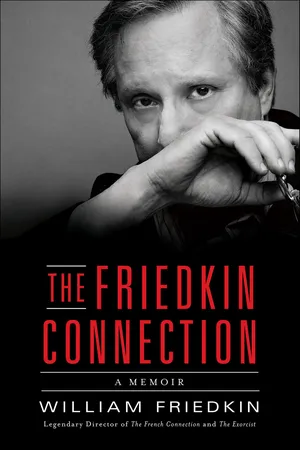
An acclaimed memoir from an American cinema maverick and Academy Award–winning director of such legendary films as
The French Connection and
The Exorcist.
The Friedkin Connection takes readers from the streets of Chicago to the suites of Hollywood and from the sixties to today, with autobiographical storytelling as fast-paced and intense as any of the auteur's films.
Friedkin's success story has the makings of classic American film. He was born in Chicago, the son of Russian immigrants. Immediately after high school, he found work in the mailroom of a local television station, and patiently worked his way into the directing booth during the heyday of live TV.
An award-winning documentary brought him attention as a talented new filmmaker and an advocate for justice, and it caught the eye of producer David L. Wolper, who brought Friedkin to Los Angeles. There he moved from television to film, displaying a versatile stylistic range. In 1971,
The French Connection was released and won five Academy Awards, including Best Picture and Best Director, and two years later
The Exorcist received ten Oscar nominations and catapulted Friedkin's career to stardom.
Penned by the director himself,
The Friedkin Connection takes readers on a journey through the numerous chance encounters and unplanned occurrences that led a young man from a poor urban neighborhood to success in one of the most competitive industries and art forms in the world. In this fascinating and candid story, he has much to say about the world of moviemaking and his place within it.
"Friedkin's against-all-odds success story is compelling reading from the start." —
LA Weekly
- 512 pages
- English
- ePUB (mobile friendly)
- Available on iOS & Android
eBook - ePub
About this book
Information
Print ISBN
9780061775147
PART I
FIRST IMPRESSIONS

1
CHICAGO
My DNA suggested no hint of success at anything. My parents and grandparents came from Kiev in the Ukraine during a pogrom in the first years of the twentieth century. In the early 1900s, Russians were starving, and afraid of a world war or a revolution. They were ruled by the incompetent despot Czar Nicholas II. A violent pogrom in 1903 was fueled by racist literature claiming the Jews drank the blood of Christians at the Passover feast. That’s the year my parents, grandparents, and all their relatives escaped to America in steerage, in the bowels of freighters. My mother had twelve brothers and sisters, my father eleven. They spoke no English and were tradespeople and shop workers. The men in my family were dark-skinned, with handlebar mustaches. The women were short and heavyset. Their apartments smelled of gefilte fish, cabbage, smoked herring, and stale clothes.
I loved my mother, Rachel. She was kind and gentle and seemed to care only about my well-being. She had been an operating-room nurse for many years and lost an eye when a tray of surgical instruments exploded as she was sanitizing them. She had an artificial eye that was so perfectly implanted you’d never know it wasn’t real. She continued nursing until I was born, then stopped work to raise me. All our relatives and neighbors loved “Rae,” as she was called. I never heard her say a bad word about anyone, and she had no interest in gossip or pettiness.
My parents were good people, and we were close. They wanted me to have a happy life, but they didn’t know what I needed to do to prepare for it. They never encouraged me to study music, play sports, or marry a nice Jewish girl. Grammar school and high school never engaged me. I went only because it was mandatory.
My father, Louis, worked all the time. He would leave early in the morning and come back late in the evening. I would look forward to his return, but he had little time for me, except occasionally on weekends. He seemed to have no sense of purpose except day-to-day survival. He had been a semiprofessional softball player in his youth, then a cigar maker, and he worked in a men’s clothing store, owned by his brother-in-law, on South State Street in Chicago. My father owned nothing and made fifty dollars a week. Until he was laid off. Then we lived on welfare, in a one-room apartment with a kitchenette, one toilet, a small closet, and a bed that came out of the wall for them, next to a cot for me, on North Sheridan Road in uptown Chicago; no surprise I was an only child. Our neighbors were Jewish, German, Irish, and Polish, descendants of the Europeans who settled in Chicago in the early part of the twentieth century. We used to sleep in Gunnison Park just off Sheridan with thousands of other families on a summer’s night. Few people in our building or neighborhood had air conditioners—not even the kind that fit into a window. It wasn’t as though I was deprived of anything. We were poor, but I never knew it. All my friends lived the same way.
Faces, bodies, trees, cars, flew by as my three-wheeler bike raced along North Sheridan Road past the grocery store, the movie theater, legs pumping furiously against the wind, ending at the shore of Lake Michigan, watching the ice floes breaking with the onset of an early spring, like pieces of a gigantic jigsaw puzzle. Streaks of pink and orange form in the distant sky over the white lake. I’m five years old, and this will be my last year of freedom before starting kindergarten.
When I was six, my mother took me to the Pantheon Theater on Sheridan Road. We were going to see my first movie. I later learned it was called None but the Lonely Heart. The Pantheon was an ornate old movie palace, seating thousands. When we got to the theater, I had no idea what to expect. I sat in a large red velvet chair next to my mother. The theater was full, and the lights started to dim. I was excited, but apprehensive. Suddenly the theater was plunged into darkness. I could hear the curtains parting, then an enormous black rectangle came alive with a blinding white light and a loud blast of music. The comforting darkness was shattered by words I couldn’t read. My instinctive reaction was to scream at the top of my lungs. I clutched my mother’s arm; I couldn’t breathe.
Strange faces turned scornfully toward us in the half-light, and my mother rushed me out of the theater into the blinding sunlight. We walked home for miles, until I could calm down. That was my first experience of seeing a film.
Miss Dorothy Nordblad’s third-grade public school class at Graeme Stewart School started promptly at 8:00 a.m. We’d line up, about thirty of us, outside the classroom. We had to be early, because Miss Nordblad was never late. She was an attractive brunette, probably in her mid-thirties. She wore tight-fitting pastel suits and sensible heels, and her silken hair fell to her shoulders. Her manner was gentle and direct. She taught Spelling, English, and Math, and she’s the only teacher who made me curious to learn. I don’t remember any of the other teachers or anything specific about any subject. I learned to spell, add, subtract, and multiply, and that was it.
I was eight years old in 1943, but I wasn’t afraid of the war. Miss Nordblad and our parents assured us that American soldiers were fighting in a just cause and would ultimately win. We did our part by bringing in old newspapers and tin foil from gum wrappers to be recycled for the war effort, but we knew from all we had been taught, or heard on the radio, that the enemy would never come to our shores, and that eventually, we would defeat them.
My real enemy wasn’t the Germans or the Japanese but Miss Sullivan, the school principal. To an eight-year-old, she was the enemy within. She was tall, matronly, severe, her gray hair pulled back in a bun. She wore dark floor-length dresses, usually gray or black, with lace cuffs and collars, and she looked like Norman Bates’s mother in Psycho. I remember her charging into classrooms and taking a misbehaving student to hang him by the collar of his shirt in the cloakroom behind the blackboard, where he would stay for the remainder of class. Sometimes two or three of us would hang silently in the closet together. You learned to suppress inappropriate behavior, and there was a price to be paid if you screwed up.
Her name was Nancy Gates, and we were nine years old. Nancy was tall for her age and slim, with blond curls. She had beautiful skin and perfect features, and when I looked at her something warm would come over me, something I didn’t understand. She dressed smartly in white blouses and long skirts, or Victorian-style dresses, and she always came to school in a wide-brimmed hat. It was the hat that first caught my attention, the way it framed her face and provided a soft shadow over her bluish-gray eyes. Her voice had a quiet lilting tone, and she was mysterious and seductive.
One day, standing in the hall outside our classroom, I was staring at her hat and the back of her neck when suddenly she turned around, looked into my eyes, and said, “You’re very handsome, Billy.” The way she held my gaze, her conspiratorial tone, and the way she lightly brushed my chest and smiled, opened a door within me. It was a quiet moment, but to me explosive. From then on we held hands and even kissed passionately in the auditorium during screenings of Encyclopedia Britannica films that warned of the evils of drunkenness, premature sex, and talking to strangers. The rest of that blissful semester, Nancy and I were in love. Among my buddies it wasn’t cool to admit you had a girlfriend or that you had any feelings for the opposite sex. I never talked about Nancy to my parents or anyone else. Sometimes we would meet at Mary Jean Bell’s apartment and listen to records. Mary Jean’s father was “Ding” Bell, who played with the Spike Jones Orchestra. Mary Jean had all the hot 78 rpms, a lot of Spike Jones of course, but also Stan Kenton’s Orchestra, which was considered taboo at our school. Kenton’s music was a sinful, corrupting influence, our teachers told us, much like Elvis’s for a later generation. I remember listening to Kenton’s band on a portable 78 rpm player under the bed at Mary Jean’s apartment. The music was dissonant, rhythmic, surrealistic, compulsive.
One morning I arrived at school, and Nancy wasn’t there. She must be sick, I thought. Two or three days went by, and she didn’t show up. I got up the courage to ask Miss Nordblad if something was wrong with Nancy.
“She left school, William—she transferred.”
My heart sank through the floor, I felt helpless and empty. “But . . . where?” I stammered.
Miss Nordblad was wearing a lipstick-red suit; she put her hand on my shoulder. “I don’t know, William. Really.” For the rest of that day my stomach was in knots. I walked every street near the school looking for her, even though I didn’t know where she lived, then into other neighborhoods, before I came to realize that her loss was permanent. I haven’t seen or heard from her since, but I often think of that little girl in her wide-brimmed hat and Victorian dress, forever nine years old. In the space of that year, I found and lost love, and learned to live with disappointment.
I found I could frighten the neighborhood kids by making up scary stories. I would improvise terrifying scenarios out of whole cloth, and the little girls would listen with rapt attention, often moved to tears, but they kept coming back for more until the effort to invent new stuff taxed my imagination. But I discovered that people, especially young people, liked to be scared. Many years later, Dr. Louis Jolyon West, then head of the Neuropsychiatric Clinic at UCLA, explained to me why he thought people enjoy suspense and horror films. You’re in a dark room with dangerous, life-threatening events happening before your eyes, but as a viewer you’re in a safe place, removed from what’s happening on screen. “A safe darkness,” he called it. A handful of films have terrified me: Psycho, Diabolique, Alien, Jaws, Seven, The Texas Chainsaw Massacre. But even as they make me afraid of the unknown, I can leave the theater when they’re over, and I continue to seek the experience.
Growing up in the homes of my aunts and uncles and in a one-room apartment with my mother and father, I heard no music, read no books, went to movies only on Saturday afternoons (I had gotten over my fear of them). A bunch of us would go to the Modé Theatre near the El station at Irving Park at noon on a weekend, and we wouldn’t get home until six in the evening. The movies were cartoons, short subjects, and serials: Mickey Mouse, Donald Duck, Bugs Bunny, the Green Hornet, Boston Blackie, the Bowery Boys, Don Winslow of the Navy, the Lone Ranger and Tonto, Hopalong Cassidy. The good guys always won, except in the cartoons, where the rascals often triumphed until they got blown up or fell off endless cliffs. My friends and I used to believe that the action was taking place behind the screen and that Hopalong Cassidy would come out of the back of the theater on his white horse after an afternoon of chasing bad guys. Every Saturday we waited behind the theater until we finally got the message that no one was coming out, and so we sadly drifted off to walk home or ride the bus or the El, where life was less glamorous. No movies from my youth left a serious impression on me.
My parents enrolled me in Hebrew school in addition to public school. The Hebrew school was called Agudas Achim. It was in uptown Chicago near Argyle Street, a few blocks north of our apartment. Argyle was a Jewish neighborhood with kosher butcher shops, delicatessens, and grocery stores. I paid little attention to what was taught in Hebrew school, but I was bar mitzvahed at age thirteen.
There was a boy about a year ahead of me whose name was Joel Fenster. He was a classic bully who preyed on those he perceived to be weak and vulnerable. I was his favorite target. When I was eleven, he would seek me out after school and demand the few coins I had in my pocket. He’d grab my books and hold on to them until I produced the ransom. I began to accept his bullying as a punishment I had to endure each day. Embarrassed by my inability to resist, I never told my mother or father about it. I had learned to suppress, and it haunted me before I went to sleep until it dawned on me one day that this was no way to live.
One morning at the age of twelve, I woke up feeling anxious, but with a newly acquired confidence about that afternoon’s confrontation with Fenster. I plotted my strategy and even looked forward to it. As we left school that day, I no longer tried to avoid him; I sought him out, and he started in immediately. “How are you today, asshole?” he sneered.
“Joel, I’ve had enough of your shit.” The words leaped out of my mouth.
He was amazed at this reaction from his punk. “Oh, yeah?” He grabbed my book.
“Give it back.” I stood my ground.
“Make me,” he shouted, then threw the book into the street and put me in a headlock as he had so often before. But I had recently watched the wrestling matches on our little television set, live from Marigold Gardens. Remembering some of the moves, I kneed Fenster in the groin. In shock, he retreated, and I jumped on him with a headlock and squeezed as hard as I could. He screamed in pain as I wrenched him to the ground and began to pummel him, banging his head on the sidewalk until he bled and making up for the years of oppression he had inflicted on me.
“Give up?” I yelled in his face. “Do you give up, you son of a bitch?” I wanted to kill him. I had the distinct impulse to end his life, and I felt it would make me happy if I did. But he gave up, and that was the last trouble I had from him; he had tasted the fear.
At election time the Democratic ward committeeman, in our case the Forty-Eighth Ward, would come around and visit my mother. Drinking coffee in the kitchenette, he would show her a sample ballot and say, “Now, here’s who you vote for, Mrs. Friedkin, and these are the propositions you want to put a check mark next to”—all Democratic candidates and initiatives, of course. My mother would smile, offer him more coffee, and agree to whatever he said. When he had gone over the ballot with her several times to make sure she understood, he would say, “Now, what can I do for you?” When I was twelve and about to start summer vacation from school, she asked him if the Party could possibly find me a job. “How old are you, William?” he asked.
“Twelve, sir.”
“Twelve—well, you know, you have to be sixteen to be eligible for Social Security and a decent job.” Frowns all around. “Do you like baseball, William?” I did; I was a Cubs fan, though I had never been to a game, but I knew the lineup of the 1947 Chicago Cubs by heart. “Let me see what I can do,” he said.
He could do whatever he wanted. The Party ruled Chicago, and though I was an only child, my huge extended family represented a lot of votes. Within a week I had a Social Security card declaring I was sixteen and a summer job selling soda pop at Wrigley Field. I carried thirty bottles of pop in half-moon-shaped cases with a thick strap around my neck. I would make two cents a bottle, sixty cents a load, and during a nine-inning game I could do twelve cases, six or seven bucks. Not chump change. On weeks when there were doubleheaders, I would sometimes bring home sixty dollars, which was more than my dad made as a salesman for the Duke Shirt Company on South State Street.
Goldblatt’s Department Store in the uptown neighborhood was where families could fill all their needs, from kitchen appliances to clothing to vacuum cleaners. My mother did a lot of shopping at Goldblatt’s, a few blocks from our apartment, and she used to take me with her.
As a teenager, I knew the layout of Goldblatt’s pretty well, and I’d go there with two friends and steal stuff. The guys I hung with, like me, had no moral compass. I literally didn’t know the difference between right and wrong. We’d go into candy stores or record stores and sneak out with whatever we could. We used to deface ...
Table of contents
- Dedication
- Epigraph
- Contents
- Prologue: Fireflies
- Part I: First Impressions
- Part II: The ’70s
- Part III: The Tunnel at the End of the Light
- Part IV: An Uphill Climb to the Bottom
- Part V: Fade In
- Acknowledgments
- Filmography
- Photo Credits
- Index
- Photo Section
- Author’s Note: *Spoiler*
- About the Author
- Credits
- Copyright
- About the Publisher
Trusted by 375,005 students
Access to over 1.5 million titles for a fair monthly price.
Study more efficiently using our study tools.
Frequently asked questions
Yes, you can cancel anytime from the Subscription tab in your account settings on the Perlego website. Your subscription will stay active until the end of your current billing period. Learn how to cancel your subscription
No, books cannot be downloaded as external files, such as PDFs, for use outside of Perlego. However, you can download books within the Perlego app for offline reading on mobile or tablet. Learn how to download books offline
Perlego offers two plans: Essential and Complete
- Essential is ideal for learners and professionals who enjoy exploring a wide range of subjects. Access the Essential Library with 800,000+ trusted titles and best-sellers across business, personal growth, and the humanities. Includes unlimited reading time and Standard Read Aloud voice.
- Complete: Perfect for advanced learners and researchers needing full, unrestricted access. Unlock 1.5M+ books across hundreds of subjects, including academic and specialized titles. The Complete Plan also includes advanced features like Premium Read Aloud and Research Assistant.
We are an online textbook subscription service, where you can get access to an entire online library for less than the price of a single book per month. With over 1.5 million books across 990+ topics, we’ve got you covered! Learn about our mission
Look out for the read-aloud symbol on your next book to see if you can listen to it. The read-aloud tool reads text aloud for you, highlighting the text as it is being read. You can pause it, speed it up and slow it down. Learn more about Read Aloud
Yes! You can use the Perlego app on both iOS and Android devices to read anytime, anywhere — even offline. Perfect for commutes or when you’re on the go.
Please note we cannot support devices running on iOS 13 and Android 7 or earlier. Learn more about using the app
Please note we cannot support devices running on iOS 13 and Android 7 or earlier. Learn more about using the app
Yes, you can access The Friedkin Connection by William Friedkin in PDF and/or ePUB format. We have over 1.5 million books available in our catalogue for you to explore.