America Afire is the powerful story of the election of 1800, arguably the most important election in America's history and certainly one of the most hotly disputed. Former allies Adams and Jefferson, president versus vice president, Federalist versus Republican, squared off in a vicious contest that resulted in broken friendships, scandals, riots, slander, and jailings in the fourth presidential election under the Constitution.
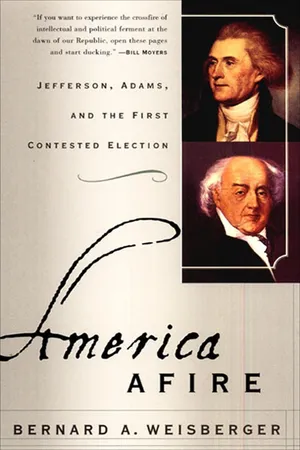
- 352 pages
- English
- ePUB (mobile friendly)
- Available on iOS & Android
eBook - ePub
About this book
Information
PART I
DISCORDS
OF AN UNFINISHED
NATION
OF AN UNFINISHED
NATION
Chapter 1
Philadelphia, Summer 1787
Philadelphia, Summer 1787
IN THE SUMMER OF 1788, a classic statement in defense of the Constitution argued that a “well-constructed Union,” meaning a tightly knit nation rather than the existing loose “Confederation” of states, had one powerful advantage, namely, “its tendency to break and control the violence of faction.” A faction, the writer said, was a number of citizens “actuated by some common impulse of passion, or of interest, adverse to the rights of other citizens, or to the permanent and aggregate interests of the community.” And all “popular governments” showed an alarming “propensity to this dangerous vice.”1
When the Constitutional Convention ended its business on September 17, 1787, it had failed to subdue the vice, and as a result, the “violence of faction” would nearly destroy the new Union in only thirteen short years.
To say as much is not to condemn but to understand. So pervasive is our reverence for the Constitution that we easily overlook its shaky and literally sweaty origins. It is the handiwork of daily meetings among a few dozen men in heavy clothes, cooped up six days a week for most of four months in a stifling Pennsylvania State House with windows shut tight against the swarming flies of a neighboring livery stable. In a moment of enthusiasm Thomas Jefferson called them “an assembly of demigods,”2 no doubt thinking particularly of delegates George Washington and Benjamin Franklin. But far from carrying the stamp of divine inspiration, the “grand convention” of 1787 was bound by human limitations. Its fifty-five members shared a commitment to a stronger nation but were also pleading the special interests of the individual states and classes they represented. The debates, especially among a talented few, were amazingly learned and civil. But there were also moments of hot temper and sulky deadlock, and at least twice there were threatened walkouts when only compromise staved off a breakup. Three of the most active framers never did sign the finished Constitution. So the delegates were far from believing that they were setting down holy writ for the ages. Nor did their fellow Americans think so. It took three quarters of a year to win ratification of the document in the needed minimum of nine states, and that was with promises of early amendments. Even then victory was barely squeezed out in crucial Virginia and New York. The last holdout, Rhode Island, which never even took part in the convention, did not join the Union until May 1790.
The Constitution, in the 1790s, was still considered a fragile work-in-progress—more a provisional outline than a charter for the ages. It didn’t yet have the emotional power to unite people automatically behind it. And it showed early signs of misjudgments and of business unfinished. First of all, since they shared a general coolness toward “democracy,” the framers failed to foresee the growth of a drive toward more widespread participation in “popular governments.” Second, they never anticipated that “factions” could embrace whole sections of the new Union, or that there might be large-scale permanent coalitions of “factions” in the form of political parties. And of course they could not know that the new ship of state would be launched into a wrenching tempest of international warfare caused by a French Revolution that was soon to begin.
All of these developments unleashed the passions of special interest and thwarted the hopes of immediately setting up a national government dedicated purely to the “permanent and aggregate interests of the community.” One result was that the machinery of succession to the presidency would be out of date in the very first election after the most popular man in the country had stepped down from power, and seriously dysfunctional by the time of the second. The seeds of the crisis of 1800 were planted in 1787 in Philadelphia. The Constitutional Convention set the stage for the drama and introduced some of the cast. One delegate, South Carolina’s Charles Cotesworth Pinckney, would become Adams’s running mate. Two others would be far more significant players—James Madison and Alexander Hamilton, friends in 1787, intense foes thirteen years later. The whole story of the nation during that interval reflected their unraveling alliance. Madison was so much at the heart of the convention that he has been called the Father of the Constitution. Hamilton had only one highlighted moment, but it was enough to foreshadow a career whose impact on America’s future may have been the most lasting of all.
BY 1800, Madison was a chief planner for the new Republican Party, which backed Jefferson for president. It strongly supported states’ rights, and history remembers Madison in part for his eloquent defense of that stance. But when he arrived in Philadelphia early in May 1787, days before the scheduled opening session, Madison was still a nationalist and with good reason. He came fresh from months in New York City as a frustrated member of the one-house Congress created by the 1781 Articles of Confederation.
The Articles proclaimed a “firm league of friendship” among thirteen explicitly sovereign states. Each one sent a delegation—chosen by its legislature—to the Confederation Congress, and each delegation, regardless of the state’s size, was entitled to one vote. The league carried the name of the United States of America, but “United” was a fiction. The raising of armies, the collection of taxes, and the exercise of Congress’s few powers depended entirely on the voluntary cooperation of the states. Any important decision required the concurrence of nine, a sure recipe for allowing minority obstruction. There was no likely prospect for such a “nation” to grow or be taken seriously in the world, or even stay free for long.
MADISON WANTED a new government with its own elected officials, courts, currency, and real power to fight wars, conduct diplomacy, and regulate trade. So did other nationalists around the country, who collectively had pushed the Confederation Congress into calling the convention in order to “revise” the Articles. But Madison was on the ground first, organizing the Virginia delegation for the coming debates and drafting most of the nationalization plan that it would present the moment actual business got under way.
He was an unlikely-looking revolutionary. At thirty-five, he was short, balding in front, and so shy that fellow delegates sometimes had to ask him to speak up when he held the floor. His father was a middling-sized planter who sent his bookish boy to private schools and then, in 1769, to Princeton, where James exhausted himself completing the four-year course in two years. He returned home and sank into a year of depression, deprived of the scholarly surroundings he loved and not really interested in running his plantation, Montpelier. The n the revolutionary crisis rescued him from his breakdown. Completely committed to the cause, he was elected at various times to Virginia’s state legislature and state constitutional convention and, when the war ended, to the Confederation Congress. It was there that he made friends with Alexander Hamilton, a young army veteran with a rising law practice, a growing family, and a way of thinking nationally instead of provincially that chimed in perfectly with Madison’s own feelings. It was there, too, in 1783, that he got engaged to the sixteen-year-old daughter of a fellow congressman. She later broke it off and broke his heart. It took eleven more years before he could bring himself to propose to another woman, Dolley Payne Todd.
Madison spent a good deal of time in retreat at Montpelier, reading voraciously in “rare and valuable books,” picked up for him in Paris by his friend Jefferson, on the nature and history of “confederacies.”3 By 1787, he was probably the country’s leading expert on the subject. At the convention someone took note that Madison “blends together the profound politician with the scholar... [and] always comes forward the best informed man of any point in the debate.”4
But behind that professorial facade was an unswerving determination to be in control. Madison kept a private record of the proceedings to have available for his use in later debates. He took a seat at a front table where nothing could escape his notice and scribbled detailed notes that he polished night after night in his boardinghouse in the moments between committee meetings—and he was one of the busiest of all the delegates. They mounted up to hundreds of handwritten pages, an almost verbatim transcript of the proceedings. He kept them private during his lifetime, which ended in 1836, by which time he had outlived all other members of the convention. If his purpose was to avoid embarrassing other delegates by linking them to positions that they later abandoned, his own dramatic postconvention shift toward decentralization made him one of the chief beneficiaries of his own discretion.
THE OPENING WEEKS of the convention rang with a clash between the interests of large states and small ones. It was an issue that turned out to be less crucial than expected once the Constitution was adopted, but it nearly shipwrecked the whole effort at the start. The gathering began in harmony on May 25 during a spring downpour, eleven days late for lack of a quorum. The delegates immediately chose George Washington as presiding officer by acclamation. Washington turned the gavel over to a pro tern chairman, as he would every morning of the working sessions, and retired to Virginia’s table where he sat, dignified and silent, until adjournment. The second day was devoted to adopting rules.
On the third day, Virginia’s governor, E d m u n d Randolph—tall, handsome, melodious-voiced, and only thirty-three—read off the proposed resolutions of Madison’s Virginia Plan to a silent and probably shocked audience. The plan called for a two-house national legislature, representation in both to be by population or wealth—good-bye to the one-state, one-vote equality that protected Delaware, with a population of about 50,000, from the voting power of Virginia and Pennsylvania, with 885,000 people between them. The new legislature would have power to make all laws necessary for the “harmony of the United States,” to veto any conflicting state laws, and to use “the force of the Union” against any state that did not “fulfill its duty.” It would also elect a national executive with “general authority” to carry out its mandates and a national judiciary whose judges would serve “during good behavior,” meaning for life, unless impeached.
The next morning, the radical nature of these ideas was recognized. A flurry of discussion made it plain that the coercive Virginia Plan went far beyond the “revision” of the Articles of Confederation authorized by the call to the convention. In response Edmund Randolph added a forthright preamble: “Resolved that a national government ought to be established consisting of a supreme legislative, executive and judiciary.” It was carried with the approval of six of the eight states whose delegates voted—a big surprise considering the convention itself operated on the one-state, one-vote principle. (If a delegation was tied, the state was counted as not voting.)5 From that moment on, the convention was a runaway body, drafting an entirely new Constitution, with the opening momentum on the nationalist side.
But the small states had not given up, and they hit back hard early in June. Working for them was a time-consuming but indispensable rule that allowed any decision already made to be reopened, so that the whole structure of new government might be freshly reexamined as each piece was added. N o defeat was final until the ultimate adjournment. Gunning Bedford, Delaware’s fat and emotional attorney general, accused Pennsylvania and Virginia of promoting a system designed to give them “enormous and monstrous influence.”6 In truth, those two states plus Massachusetts and New York included more than half of the entire three million free inhabitants of the United States that summer. William Paterson of New Jersey swore that he would rather “submit to a monarch, to a despot” than sit in a legislature with votes apportioned by head count,7 and he offered an alternative small-state plan that made a few changes in the Confederation government but left untouched the state-sovereignty formula that made it so ineffective.
At this point the issue of democratic fairness, which would remain central in the politics of the 1800 campaign, came to the fore. Madison and his large-state allies wanted to know why a small number of Americans living in New Jersey or Delaware should have an equal share of power with three, four, or eight times as many Americans in a larger state. They would not budge from their first position. But to their dismay, the volatile convention now voted for reconsideration of Paterson’s and Randolph’s resolutions. That was how things stood on Monday June 18 when Hamilton, one of New York’s three delegates, took the floor to denounce both plans as inadequate.
STILLA YOUNG MAN—either thirty or thirty-two that June8— Hamilton stirred passions among his contemporaries as surely as he has continued to ignite argument among historians, biographers, and readers down to the present moment. He is impossible to capture in a single image. He was a self-made man who beat the odds in a society where birth and rank still mattered; a foreign-born and rootless adventurer who more or less blueprinted the modern American nation; a brilliant advocate, financial planner, organizer, and administrator; and in the end a very human being who was scheming, unfaithful, quarrelsome, vainglorious, and fatally rash.
His origins on the island of Nevis in the British West Indies are both romantic and sordid. His mother, Rachel Faucett, had fled there from the nearby Danish-owned island of St. Croix and from a husband who later divorced her in absentia—justifiably or not—for having “given herself up to whoring with everyone.” At the time of Alexander’s birth, she was living with James Hamilton, the apparently disowned son of an aristocratic Scottish family, who was trying incompetently to survive as a businessman. She had already borne him another child. The couple later moved back to St. Croix and broke up. He disappeared into poverty. She died of a fever in 1768, leaving her two bastard, orphan boys to the kindness of strangers.
For Alexander, not yet fourteen, these strangers included Nicholas Cruger, who gave him a clerk’s job in the import-export business he ran with a New York partner. As in most things he later undertook, Hamilton quickly proved brilliant at it. Intense reading overcame a spotty basic education and made him a clear writer with a huge fund of information about the markets, materials, and currencies of the Caribbean trade. By the time Alexander was sixteen, Cruger could travel for months and confidently leave him in charge of things. The experience gave Hamilton a hardheaded view of a West Indian world in which sugar planters grew rich on the sweat of brutally worked slaves, and mercantile profits went to sharp and aggressive risk takers. It was not a world big enough for his nonmercantile ambitions. To a young friend he lamented “the groveling and condition of a clerk... to which my fortune, etc. condemns me,” and wished for a war “to exalt my station.”9
He got his war soon enough, along with a cause and a country. In 1773 local St. Croix worthies chipped in to send the local prodigy to King’s College (later Columbia) in New York for more education. Soon he had connected himself with the resistance movement against Britain and was writing deftly argued anonymous pamphlets for the revolutionaries. When fighting broke out he left Columbia—probably its most distinguished dropout—to become an artillery officer in the state forces, and throughout 1776 he saw active service in Washington’s hard-pressed little army. Once again his talents, observed by admiring older men, led to advancement. He was appointed to Washington’s staff, with the rank of lieutenant colonel, early in 1777. He was twenty-two at most.
There he stayed until 1781 as something like a private secretary to the commander in chief, flung into the thick of Washington’s constant struggles to get money, manpower, and supplies from a quarrelsome and headless Continental Congress. The general became another protector and patron, relying on the gifted young man to draft letters, orders, and messages or negotiate with other commanders and political figures. That confidence had a powerful influence on history when Washington, as first president, named Hamilton the first secretary of the Treasury. In the meantime, Hamilton’s acquired status and connections allowed him to take a huge upward step in social rank by marrying Elizabeth Schuyler, daughter of one of New York’s richest and most powerful landholders. After the war Hamilton, like thousands of other American citizen-warriors, took off his uniform and rejoined civil society. He taught himself law in five months and began a shining career at the New York bar and in local politics. But he was never, like his inlaws, a true New Yorker. His sense of America as one nation was not diluted by home-born state loyalties. What he felt for states was contempt, fed by memories of watching soldiers shiver and starve because the state-dominated Continental Congress refused to create a central government competent to clothe and feed them. In fact, while still on Washington’s staff he wrote in confidence to a friend suggesting that a convention was needed to create a “coercive union” that could “destroy all ideas of state attachments in the army.” Such a statement in public would have been political suicide. A shrewd French intelligence agent was later to write to Paris that Hamilton, for all his gifts, had “too little prudence.... In his desire to control everything, he misses his aim.”10
When he rose to speak that June morning in 1787 Hamilton was once again imprudent and risked throwing away the pro-nationalist influence he had been building for several years. He may have been overirritated by the resistance of the small states, or frustrated by the fact that in New York’s three-man delegation he was helplessly outvoted by two anti-nationalists. In any case, the speech lasted all day (a fellow delegate noted of Hamilton, “There is no skimming over the surface of a subject with him”),11 and its highlights, including Anglophilia, distrust of voters, and a wish for a kind of centralized “republican monarchy,” were guaranteed to alienate and infuriate moderates. They would have no immediate impact in Philadelphia, but later they would become building blocks in the political thought of the Federalist Party.
Hamilton saw society as a theater of perpetual conflict rather than cooperation for security. “Men love power,” he said. “Give all power to the many, they will oppress the few. Give all power to the few, they will oppress the many.” A hereditary elite and a hereditary monarch, he believed, with vested interests in stability were the best guarantee against the turmoil of war between classes. He admitted to thinking privately that “the British government was the best in the w...
Table of contents
- Cover
- Title Page
- Dedication
- Contents
- Prologue - Washington, D.C., Inauguration Day, 1801
- PART I - DISCORDS OF AN UNFINISHED NATION
- PART II - PERSONALITIES, PLACES, AND DOMESTIC DISCORD, 1789-1794
- PART III - WAR ABROAD, POLITICS AT HOME, 1793-1796
- PART IV - TOWARD DISUNION, 1797-1800
- PART V - CAMPAIGN AND CONSCIENCE, 1800-1801
- Epilogue - Aftermath and Echoes
- Notes
- Bibliography
- Index
- About the Author
- Also by Bernard A. Weisberger
- Credits
- Copyright
- About the Publisher
Trusted by 375,005 students
Access to over 1.5 million titles for a fair monthly price.
Study more efficiently using our study tools.
Frequently asked questions
Yes, you can cancel anytime from the Subscription tab in your account settings on the Perlego website. Your subscription will stay active until the end of your current billing period. Learn how to cancel your subscription
No, books cannot be downloaded as external files, such as PDFs, for use outside of Perlego. However, you can download books within the Perlego app for offline reading on mobile or tablet. Learn how to download books offline
We are an online textbook subscription service, where you can get access to an entire online library for less than the price of a single book per month. With over 1.5 million books across 990+ topics, we’ve got you covered! Learn about our mission
Look out for the read-aloud symbol on your next book to see if you can listen to it. The read-aloud tool reads text aloud for you, highlighting the text as it is being read. You can pause it, speed it up and slow it down. Learn more about Read Aloud
Yes! You can use the Perlego app on both iOS and Android devices to read anytime, anywhere — even offline. Perfect for commutes or when you’re on the go.
Please note we cannot support devices running on iOS 13 and Android 7 or earlier. Learn more about using the app
Please note we cannot support devices running on iOS 13 and Android 7 or earlier. Learn more about using the app
Yes, you can access America Afire by Bernard A. Weisberger in PDF and/or ePUB format, as well as other popular books in History & Early American History. We have over 1.5 million books available in our catalogue for you to explore.