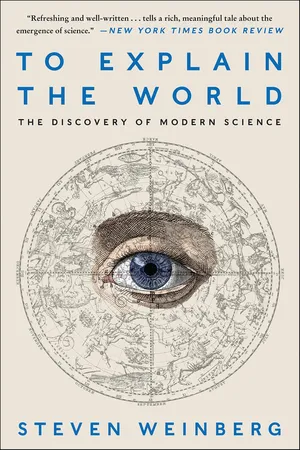
The Nobel Prize–winner shares "a masterful journey through humankind's scientific coming-of-age" from the Greeks to modern times (Brian Greene).
In this rich, irreverent, and compelling history, Nobel Prize-winning physicist Steven Weinberg takes us across centuries of human striving to unravel the mysteries of the world. This sweeping saga ranges from ancient Miletus to medieval Baghdad and Oxford, from Plato's Academy and the Museum of Alexandria to the cathedral school of Chartres and the Royal Society of London.
Weinberg shows that, while the scientists of ancient and medieval times lack our understanding of the world, they also lacked the knowledge, tools, and intellectual framework necessary to go about understand it. Yet over the centuries, through the struggle to solve such mysteries as the curious backward movement of the planets and the rise and fall of the tides, the modern discipline of science eventually emerged.
An illuminating exploration of the way we consider and analyze the world around us,
To Explain the World is a sweeping, ambitious account of how difficult it was to discover the goals and methods of modern science, and the impact of this discovery on human knowledge and development.
- 432 pages
- English
- ePUB (mobile friendly)
- Available on iOS & Android
eBook - ePub
About this book
Information
PART I
GREEK PHYSICS

During or before the flowering of Greek science, significant contributions to technology, mathematics, and astronomy were being made by the Babylonians, Chinese, Egyptians, Indians, and other peoples. Nevertheless, it was from Greece that Europe drew its model and its inspiration, and it was in Europe that modern science began, so the Greeks played a special role in the discovery of science.
One can argue endlessly about why it was the Greeks who accomplished so much. It may be significant that Greek science began when Greeks lived in small independent city-states, many of them democracies. But as we shall see, the Greeks made their most impressive scientific achievements after these small states had been absorbed into great powers: the Hellenistic kingdoms, and then the Roman Empire. The Greeks in Hellenistic and Roman times made contributions to science and mathematics that were not significantly surpassed until the scientific revolution of the sixteenth and seventeenth centuries in Europe.
This part of my account of Greek science deals with physics, leaving Greek astronomy to be discussed in Part II. I have divided Part I into five chapters, dealing in more or less chronological order with five modes of thought with which science has had to come to terms: poetry, mathematics, philosophy, technology, and religion. The theme of the relationship of science to these five intellectual neighbors will recur throughout this book.
1
Matter and Poetry
First, to set the scene. By the sixth century BC the western coast of what is now Turkey had for some time been settled by Greeks, chiefly speaking the Ionian dialect. The richest and most powerful of the Ionian cities was Miletus, founded at a natural harbor near where the river Meander flows into the Aegean Sea. In Miletus, over a century before the time of Socrates, Greeks began to speculate about the fundamental substance of which the world is made.
I first learned about the Milesians as an undergraduate at Cornell, taking courses on the history and philosophy of science. In lectures I heard the Milesians called “physicists.” At the same time, I was also attending classes on physics, including the modern atomic theory of matter. There seemed to me to be very little in common between Milesian and modern physics. It was not so much that the Milesians were wrong about the nature of matter, but rather that I could not understand how they could have reached their conclusions. The historical record concerning Greek thought before the time of Plato is fragmentary, but I was pretty sure that during the Archaic and Classical eras (roughly from 600 to 450 BC and from 450 to 300 BC, respectively) neither the Milesians nor any of the other Greek students of nature were reasoning in anything like the way scientists reason today.
The first Milesian of whom anything is known was Thales, who lived about two centuries before the time of Plato. He was supposed to have predicted a solar eclipse, one that we know did occur in 585 BC and was visible from Miletus. Even with the benefit of Babylonian eclipse records it’s unlikely that Thales could have made this prediction, because any solar eclipse is visible from only a limited geographic region, but the fact that Thales was credited with this prediction shows that he probably flourished in the early 500s BC. We don’t know if Thales put any of his ideas into writing. In any case, nothing written by Thales has survived, even as a quotation by later authors. He is a legendary figure, one of those (like his contemporary Solon, who was supposed to have founded the Athenian constitution) who were conventionally listed in Plato’s time as the “seven sages” of Greece. For instance, Thales was reputed to have proved or brought from Egypt a famous theorem of geometry (see Technical Note 1). What matters to us here is that Thales was said to hold the view that all matter is composed of a single fundamental substance. According to Aristotle’s Metaphysics, “Of the first philosophers, most thought the principles which were of the nature of matter were the only principles of all things. . . . Thales, the founder of this school of philosophy, says the principle is water.”1 Much later, Diogenes Laertius (fl. AD 230), a biographer of the Greek philosophers, wrote, “His doctrine was that water is the universal primary substance, and that the world is animate and full of divinities.”2
By “universal primary substance” did Thales mean that all matter is composed of water? If so, we have no way of telling how he came to this conclusion, but if someone is convinced that all matter is composed of a single common substance, then water is not a bad candidate. Water not only occurs as a liquid but can be easily converted into a solid by freezing or into a vapor by boiling. Water evidently also is essential to life. But we don’t know if Thales thought that rocks, for example, are really formed from ordinary water, or only that there is something profound that rock and all other solids have in common with frozen water.
Thales had a pupil or associate, Anaximander, who came to a different conclusion. He too thought that there is a single fundamental substance, but he did not associate it with any common material. Rather, he identified it as a mysterious substance he called the unlimited, or infinite. On this, we have a description of his views by Simplicius, a Neoplatonist who lived about a thousand years later. Simplicius includes what seems to be a direct quotation from Anaximander, indicated here in italics:
Of those who say that [the principle] is one and in motion and unlimited, Anaximander, son of Praxiades, a Milesian who became successor and pupil to Thales, said that the unlimited is both principle and element of the things that exist. He says that it is neither water nor any other of the so-called elements, but some other unlimited nature, from which the heavens and the worlds in them come about; and the things from which is the coming into being for the things that exist are also those into which their destruction comes about, in accordance with what must be. For they give justice and reparation to one another for their offence in accordance with the ordinance of time—speaking of them thus in rather poetical terms. And it is clear that, having observed the change of the four elements into one another, he did not think fit to make any one of these an underlying stuff, but something else apart from these.3
A little later another Milesian, Anaximenes, returned to the idea that everything is made of some one common substance, but for Anaximenes it was not water but air. He wrote one book, of which just one whole sentence has survived: “The soul, being our air, controls us, and breath and air encompass the whole world.”4
With Anaximenes the contributions of the Milesians came to an end. Miletus and the other Ionian cities of Asia Minor became subject to the growing Persian Empire in about 550 BC. Miletus started a revolt in 499 BC and was devastated by the Persians. It revived later as an important Greek city, but it never again became a center of Greek science.
Concern with the nature of matter continued outside Miletus among the Ionian Greeks. There is a hint that earth was nominated as the fundamental substance by Xenophanes, who was born around 570 BC at Colophon in Ionia and migrated to southern Italy. In one of his poems, there is the line “For all things come from earth, and in earth all things end.”5 But perhaps this was just his version of the familiar funerary sentiment, “Ashes to ashes, dust to dust.” We will meet Xenophanes again in another connection, when we come to religion in Chapter 5.
At Ephesus, not far from Miletus, around 500 BC Heraclitus taught that the fundamental substance is fire. He wrote a book, of which only fragments survive. One of these fragments tells us, “This ordered kosmos,* which is the same for all, was not created by any one of the gods or of mankind, but it was ever and is and shall be ever-living Fire, kindled in measure and quenched in measure.”6 Heraclitus elsewhere emphasized the endless changes in nature, so for him it was more natural to take flickering fire, an agent of change, as the fundamental element than the more stable earth, air, or water.
The classic view that all matter is composed not of one but of four elements—water, air, earth, and fire—is probably due to Empedocles. He lived in Acragas, in Sicily (the modern Agrigento), in the mid-400s BC, and he is the first and nearly the only Greek in this early part of the story to have been of Dorian rather than of Ionian stock. He wrote two hexameter poems, of which many fragments have survived. In On Nature, we find “how from the mixture of Water, Earth, Aether, and Sun [fire] there came into being the forms and colours of mortal things”7 and also “fire and water and earth and the endless height of air, and cursed Strife apart from them, balanced in every way, and Love among them, equal in height and breadth.”8
It is possible that Empedocles and Anaximander used terms like “love” and “strife” or “justice” and “injustice” only as metaphors for order and disorder, in something like the way Einstein occasionally used “God” as a metaphor for the unknown fundamental laws of nature. But we should not force a modern interpretation onto the pre-Socratics’ words. As I see it, the intrusion of human emotions like Empedocles’ love and strife, or of values like Anaximander’s justice and reparation, into speculations about the nature of matter is more likely to be a sign of the great distance of the thought of the pre-Socratics from the spirit of modern physics.
These pre-Socratics, from Thales to Empedocles, seem to have thought of the elements as smooth undifferentiated substances. A different view that is closer to modern understanding was introduced a little later at Abdera, a town on the seacoast of Thrace founded by refugees from the revolt of the Ionian cities against Persia started in 499 BC. The first known Abderite philosopher is Leucippus, from whom just one sentence survives, suggesting a deterministic worldview: “No thing happens in vain, but everything for a reason and by necessity.”9 Much more is known of Leucippus’ successor Democritus. He was born at Miletus, and had traveled in Babylon, Egypt, and Athens before settling in Abdera in the late 400s BC. Democritus wrote books on ethics, natural science, mathematics, and music, of which many fragments survive. One of these fragments expresses the view that all matter consists of tiny indivisible particles called atoms (from the Greek for “uncuttable”), moving in empty space: “Sweet exists by convention, bitter by convention; atoms and Void [alone] exist in reality.”10
Like modern scientists, these early Greeks were willing to look beneath the surface appearance of the world, pursuing knowledge about a deeper level of reality. The matter of the world does not appear at first glance as if it is all made of water, or air, or earth, or fire, or all four together, or even of atoms.
Acceptance of the esoteric was taken to an extreme by Parmenides of Elea (the modern Velia) in southern Italy, who was greatly admired by Plato. In the early 400s BC Parmenides taught, contra Heraclitus, that the apparent change and variety in nature are an illusion. His ideas were defended by his pupil Zeno of Elea (not to be confused with other Zenos, such as Zeno the Stoic). In his book Attacks, Zeno offered a number of paradoxes to show the impossibility of motion. For instance, to traverse the whole course of a racetrack, it is necessary first to cover half the distance, and then half the remaining distance, and so on indefinitely, so that it is impossible ever to traverse the whole track. By the same reasoning, as far as we can tell from surviving fragments, it appeared to Zeno to be impossible ever to travel any given distance, so that all motion is impossible.
Of course, Zeno’s reasoning was wrong. As pointed out later by Aristotle,11 there is no reason why we cannot accomplish an infinite number of steps in a finite time, as long as the time needed for each successive step decreases sufficiently rapidly. It is true that an infinite series like ½ + ⅓ + ¼ + . . . has an infinite sum, but the infinite series ½ + ¼ + ⅛ + . . . has a finite sum, in this case equal to 1.
What is most striking is not so much that Parmenides and Zeno were wrong as that they did not bother to explain why, if motion is impossible, things appear to move. Indeed, none of the early Greeks from Thales to Plato, in either Miletus or Abdera or Elea or Athens, ever took it on themselves to explain in detail how their theories about ultimate reality accounted for the appearances of things.
This was not just intellectual laziness. There was a strain of intellectual snobbery among the early Greeks that led them to regard an understanding of appearances as not worth having. This is just one example of an attitude that has blighted much of the history of science. At various times it has been thought that circular orbits are more perfect than elliptical orbits, that gold is more noble than lead, and that man is a higher being than his fellow simians.
Are we now making similar mistakes, passing up opportunities for scientific progress because we ignore phenomena that seem unworthy of our attention? One can’t be sure, but I doubt it. Of course, we cannot explore everything, but we choose problems that we think, rightly or wrongly, offer the best prospect for scientific understanding. Biologists who are interested in chromosomes or nerve cells study animals like fruit flies and squid, not noble eagles and lions. Elementary particle physicists are sometimes accused of a snobbish and expensive preoccupation with phenomena at the highest attainable energies, but it is only at high energies that we can create and study hypothetical particles of high mass, like the dark matter particles that astronomers tell us make up five-sixths of the matter of the universe. In any case, we give plenty of attention to phenomena at low energies, like the intriguing mass of neutrinos, about a millionth the mass of the electron.
In commenting on the prejudices of the pre-Socratics, I don’t mean to say that a priori reasoning has no place in science. Today, for instance, we expect to find that our deepest physical laws satisfy principles of symmetry, which state that physical laws do not change when we change our point of view in certain definite ways. Just like Parmenides’ principle of changelessness, some of these symmetry principles are not immediately apparent in physical phenomena—they are said to be spontaneously broken. That is, the equations of our theories have certain simplicities, for instance treating certain species of particles in the same way, but these simplicities are not shared by the solutions of the equations, which govern actual phenomena. Nevertheless, unlike the commitment of Parmenides to changelessness, the a priori presumption in favor of principles of symmetry arose from many years of experience in searching for physical principles that describe the real world, and broken as well as unbroken symmetries are validated by experiments that confirm their consequences. They do not involve value judgments of the sort we apply to human affairs.
With Socrates, in the late fifth century BC, and Plato, some forty years later, the center of the stage for Greek intellectual life moved to Athens, one of the few cities of Ionian Greeks on the Greek mainland. Almost all of what we know about Socrates comes from his appearance in the dialogues of Plato, and as a comic ch...
Table of contents
- Dedication
- Epigraph
- Contents
- Preface
- Part I: Greek Physics
- Part II: Greek Astronomy
- Part III: The Middle Ages
- Part IV: The Scientific Revolution
- Acknowledgments
- Technical Notes
- Endnotes
- Bibliography
- Index
- About the Author
- Also by Steven Weinberg
- Credits
- Copyright
- About the Publisher
Trusted by 375,005 students
Access to over 1.5 million titles for a fair monthly price.
Study more efficiently using our study tools.
Frequently asked questions
Yes, you can cancel anytime from the Subscription tab in your account settings on the Perlego website. Your subscription will stay active until the end of your current billing period. Learn how to cancel your subscription
No, books cannot be downloaded as external files, such as PDFs, for use outside of Perlego. However, you can download books within the Perlego app for offline reading on mobile or tablet. Learn how to download books offline
Perlego offers two plans: Essential and Complete
- Essential is ideal for learners and professionals who enjoy exploring a wide range of subjects. Access the Essential Library with 800,000+ trusted titles and best-sellers across business, personal growth, and the humanities. Includes unlimited reading time and Standard Read Aloud voice.
- Complete: Perfect for advanced learners and researchers needing full, unrestricted access. Unlock 1.5M+ books across hundreds of subjects, including academic and specialized titles. The Complete Plan also includes advanced features like Premium Read Aloud and Research Assistant.
We are an online textbook subscription service, where you can get access to an entire online library for less than the price of a single book per month. With over 1.5 million books across 990+ topics, we’ve got you covered! Learn about our mission
Look out for the read-aloud symbol on your next book to see if you can listen to it. The read-aloud tool reads text aloud for you, highlighting the text as it is being read. You can pause it, speed it up and slow it down. Learn more about Read Aloud
Yes! You can use the Perlego app on both iOS and Android devices to read anytime, anywhere — even offline. Perfect for commutes or when you’re on the go.
Please note we cannot support devices running on iOS 13 and Android 7 or earlier. Learn more about using the app
Please note we cannot support devices running on iOS 13 and Android 7 or earlier. Learn more about using the app
Yes, you can access To Explain the World by Steven Weinberg in PDF and/or ePUB format, as well as other popular books in History & World History. We have over 1.5 million books available in our catalogue for you to explore.