"Exhilarating. . . . A precise yet imaginative reading of the past. . . . Readers will love this book, finding it wholly absorbing and rewarding." —Hilary Mantel, Booker Prize winning author of
Wolf Hall
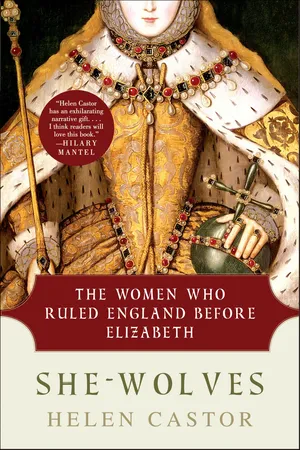
Prize-winning historian Helen Castor delivers a compelling, eye-opening examination of women and power in England, witnessed through the lives of six women who exercised power against all odds—and one who never got the chance.
With the death of Edward VI in 1553, England, for the first time, would have a reigning queen. The question was: Who?
Four women stood upon the crest of history: Katherine of Aragon's daughter, Mary; Anne Boleyn's daughter, Elizabeth; Mary, Queen of Scots; and Lady Jane Grey. But over the centuries, other exceptional women had struggled to push the boundaries of their authority and influence—and been vilified as "she-wolves" for their ambitions. Revealed in vivid detail, the stories of Eleanor of Aquitaine, Isabella of France, Margaret of Anjou, and the Empress Matilda expose the paradox that England's next female leaders would confront as the Tudor throne lay before them—man ruled woman, but these women sought to rule a nation.
"Full of beautiful, imperiled ladies; fearless knights; and remarkable, often unbelievable turns of fortune." —
Cleveland Plain Dealer
"[Helen Castor is] an accomplished and elegant historian." —Miranda Seymour,
New York Times Book Review
"Gripping. . . . A superb history." —Simon Sebag Montefiore,
Daily Telegraph, London
"Fascinating." —
Kirkus Reviews
"[The] turns of fortune will fasten royalty readers to Castor's lively narrative." —
Booklist
"Castor's. . . . tight storytelling makes this unusually fine royal history enjoyable reading." —
Publishers Weekly, starred review
- 496 pages
- English
- ePUB (mobile friendly)
- Available on iOS & Android
eBook - ePub
About this book
Trusted by 375,005 students
Access to over 1.5 million titles for a fair monthly price.
Study more efficiently using our study tools.
Information
Part I
BEGINNINGS

Chapter One
July 6,1553: The King Is Dead
July 6,1553: The King Is Dead
The boy in the bed was just fifteen years old. He had been handsome, perhaps even recently; but now his face was swollen and disfigured by disease, and by the treatments his doctors had prescribed in the attempt to ward off its ravages. Their failure could no longer be mistaken. The hollow grey eyes were ringed with red, and the livid skin, once fashionably translucent, was blotched with sores. The harrowing, bloody cough, which for months had been exhaustingly relentless, suddenly seemed more frightening still by its absence: each shallow breath now exacted a perceptible physical cost. The few remaining wisps of fair hair clinging to the exposed scalp were damp with sweat, and the distended fingers convulsively clutching the fine linen sheets were nailless, gangrenous stumps. Edward VI, by the grace of God King of England, France, and Ireland, Defender of the Faith, and Supreme Head of the Church of England, was dying.
He was the youngest child of Henry VIII, that monstrously charismatic king whose obsessive quest for an heir had transformed the spiritual and political landscape of his kingdom. Of the boy’s ten older siblings, seven had died in the womb or as newborn infants. One brother, a bastard named Henry Fitzroy—created Duke of Richmond and Somerset, Earl of Nottingham, Lord Admiral of England, and head of the Council of the North at the age of six by his doting father—reached his seventeenth birthday before succumbing to a pulmonary infection in the year before Edward’s birth. His two surviving half-sisters, pale, pious Mary and black-eyed, sharp-witted Elizabeth, had each been welcomed into the world with feasts, bells, and bonfires as the heir to the Tudor throne; but they were declared illegitimate—Mary at seventeen, Elizabeth as a two-year-old toddler—when Henry repudiated each of their mothers in turn.
When Edward was born in the early hours of October 12, 1537, therefore, he was not simply the king’s only son, but the only one of Henry’s children whose legitimacy was undisputed. “England’s Treasure,” the panegyrists called him, and Henry lavished every care on the safekeeping of his “most precious jewel.” By the age of eighteen months, the prince had his own household complete with chamberlain, vice chamberlain, steward, and cofferer, as well as a governess, nurse, and four “rockers” of the royal cradle, all sworn to maintain a meticulous regime of hygiene and security around their young charge. If the king could do nothing to alter the fact that Edward was motherless—Jane Seymour, Henry’s third queen, had sat in state at her son’s torchlit christening three days after his birth, but died less than a fortnight later—he did eventually provide him with a stepmother whose intelligence and kindness touched a deep chord within the boy. Katherine Parr, the king’s sixth wife, was a clever, vivacious, and humane woman who befriended all three of the royal children. She was already close to Princess Mary, whom Katherine had previously served as a lady-in-waiting; and to nine-year-old Elizabeth and five-year-old Edward she brought a maternal warmth they had never before known, encouraging their intellectual development and enfolding them within a passable facsimile of functional family life. “Mater carissima,” Edward called her, “my dearest mother,” who held “the chief place in my heart.”
But Henry died, a decaying, bloated hulk, in January 1547. Nor could Edward, king at nine, depend on the continuing support of his beloved stepmother. The bond of trust between them was broken only four months after his father’s death by Katherine’s impetuous remarriage to his maternal uncle, the dashing Thomas Seymour. She died little more than a year later after giving birth to her only child, a short-lived daughter named Mary. The young king now found his family fragmenting around him. Thomas Seymour, reckless and restlessly ambitious, was brought down by his own extravagant plotting six months after the loss of his wife. He was convicted of treason and executed in March 1549 on the authority of the protectorate regime led by his brother Edward, the Duke of Somerset. Just seven months later, Somerset himself fell from power, and was beheaded on Tower Hill in January 1552.
Edward had lost his father, his stepmother, and two uncles in the space of five years. He still had his half-sisters, but his dealings were straightforward with neither of them. He and Mary, twenty-one years his senior, were touchingly fond of one another; but they were irrevocably estranged as a result of the religious upheavals precipitated by their father’s convoluted matrimonial history. In 1527 Henry had been implacably determined to annul his marriage to his first wife, Mary’s mother, Katherine of Aragon. But the pope—at that moment barricaded within the Castel Sant’Angelo while Rome was sacked by the forces of Katherine’s nephew, the Holy Roman Emperor Charles V—had been in no position to grant Henry the divorce he so urgently desired. And if papal authority would not sanction the dictates of Henry’s conscience, then papal authority, Henry believed, could no longer be sanctioned by God. Convinced that the blessing of a son and heir had been denied him because his union with Katherine was tainted by her previous marriage to his brother Arthur—and intent on begetting such a blessing on the bewitching form of Anne Boleyn—Henry broke with Rome, and declared himself Supreme Head of the Church of England.
For the king, this was a matter of jurisdiction, not doctrine. In terms of the fundamental tenets of his faith, Henry remained a Catholic to the end of his life. But, with the ideas of Protestant reformers gaining currency across Europe, it proved impossible to hold the line that the new English Church was simply a form of orthodox Catholicism without the pope. Few of his subjects who shared Henry’s doctrinal conservatism found it as easy as their king to discard the spiritual power of the “Bishop of Rome.” Meanwhile, the most fervent support for the royal supremacy came from those who wished for more sweeping religious change. Thus it was that Edward’s education was entrusted to Protestant sympathisers. Henry, of course, expected them to subscribe exactly to his own idiosyncratic brand of portmanteau theology, but their influence on a boy who later described the pope as “the true son of the devil, a bad man, an Antichrist and abominable tyrant” was unmistakable. Mary, on the other hand, had been brought up a generation earlier, when her father was still engaged in defending the faith of Rome against the challenge of the apostate Luther. The new religion espoused by her brother could be nothing but anathema to her, when vindication of her mother’s honour and of her own legitimacy was inextricably bound up with adherence to papal authority. From 1550, their mutual intransigence embroiled them in a bitter wrangle over Mary’s insistence on celebrating mass in her household, in open defiance of the proscriptions of Edward’s Protestant government.
Between Edward and Elizabeth, there was no such spiritual breach. Elizabeth was the living embodiment of the Henrician Reformation—the baby born to Anne Boleyn after Henry had used his new powers as Supreme Head of his own Church to secure the divorce which the pope had refused him. Just as attachment to Rome was an indissoluble part of Mary’s heritage, so separation from it was of Elizabeth’s. And, like Edward, she had been exposed to the “new learning” both in her humanist-inspired education, and through the evangelical influences in Katherine Parr’s lively household. Conforming to the Protestant Reformation instituted by Edward’s ministers therefore presented Elizabeth with no crisis of conscience. The teenage princess adopted the plain, unadorned dress commended by the reformers with such austerity that Edward called her “my sweet sister Temperance.” (More cynical observers noted not only the political expediency of this ostentatious godliness, but also how well the simple style suited her youth and striking looks—a conspicuous contrast to the unflattering effect of the heavily jewelled costumes favoured by thirty-five-year-old Mary.)
But Elizabeth’s subtle intelligence was of a different stamp from the deeply felt, dogmatic piety of her brother and sister, albeit that this temperamental resemblance between Edward and Mary left them stranded on opposite sides of an unbridgeable religious divide. Elizabeth was cautious, pragmatic, and watchful, acutely aware of the threatening instability of a world in which her father had ordered the judicial murder of her mother before her third birthday. She had no memory of a time when her own status and security had not been at best unpredictable, and at worst explicitly precarious. As a result, she conducted her political relationships and religious devotions with diplomatic flexibility, rather than with the emotional absolutism of her siblings. (“This day,” she said when told of the execution of Thomas Seymour, “died a man with much wit and very little judgement”—a shrewd and startlingly opaque response from a fifteen-year-old girl who had not been immune to Seymour’s charms, and had only narrowly avoided fatal entanglement in his grandiose schemes.)
Despite their ostensible religious compatibility, then, Edward and Elizabeth were not close. They had been brought together in January 1547 to be told of their father’s death—and clung to one another, sobbing at the news—but saw each other only rarely in the years that followed. Still, if the young king lacked the emotional and political support of immediate relatives at his court, it hardly mattered, given that Edward would one day surely marry and father a family of his own. He had been formally betrothed in 1543, at the age of five, to his seven-month-old cousin, Mary Stuart, the infant Queen of Scotland. But the Scots were unhappy about the implications of this matrimonial deal—which threatened to subject Scotland to English rule—for the same reason that the English were keen to pursue it. Unsurprisingly, the Scots resisted subsequent attempts to enforce the treaty through the “rough wooing” of an English army laying waste to the Scottish lowlands, and in 1548 Mary was instead taken to Paris to renew the “Auld Alliance” between Scotland and France by marrying the four-year-old dauphin, heir to the French throne.
A French bride—the dauphin’s sister Elisabeth—was later proposed for Edward himself; but in the meantime he found friendship within his household, in the boys who shared his education. His closest companions were Henry Sidney, whose father was steward of Edward’s household; Sidney’s cousins Henry Brandon, the young Duke of Suffolk, and his brother Charles; and Barnaby Fitzpatrick, son and heir of an impoverished Irish lord. In 1551 Fitzpatrick was sent to France to complete his training as a courtier and a soldier, but Edward maintained an affectionate correspondence with his “dearest and most loving friend”—even if Barnaby failed to comply with some of the king’s more serious-minded requests. “ . . . to the intent we would see how you profit in the French,” Edward wrote earnestly, “we would be glad to receive some letters from you in the French tongue, and we would write to you again therein.”
The young king and his friends were taught by some of the finest humanist scholars in England. Edward mastered Latin before he reached his tenth birthday. Not only could he converse eloquently in the language and compose formal Latin prose, but he read and memorised volumes of classical and scriptural texts. In the years that followed, he acquired a fluent command of Greek and French, and at least a smattering of Italian and Spanish, through training which was not only linguistic but rhetorical, philosophical, and theological. His reading of Cicero, Plato, Aristotle, Plutarch, Herodotus, and Thucydides provided the intellectual basis for his weekly oratio, an essay in the form of a declamation, written alternately in Greek and Latin, which he was required to deliver in front of his tutors each Sunday. He studied mathematics and astronomy, cartography and navigation, politics and military strategy, and music, learning to play both the virginals and the lute.
His “towardness in learning” could not be denied, but his attempts to emulate the easy athleticism for which his ebullient father had been admired were less successful. As a young man, Henry had distinguished himself as an expert in the saddle and on the tournament field. He had been tall and well made, like his maternal grandfather, Edward IV: both stood over six feet, and were famed across Europe for their physical prowess and striking beauty (at least before the appetite for excess which they also shared transformed both their looks and their health). Edward VI, on the other hand, had inherited his mother’s slight build along with her fair hair and grey eyes, with a tendency, by some reports, for his left shoulder to stand higher than his right. He rode well, and hunted regularly; but the surviving records of his first attempts in the tiltyard, where his father had so excelled, suggest that it was not an arena in which he immediately felt at home. In the spring of 1551, Edward led a group of friends dressed in team colours of black silk and white taffeta against challengers in yellow led by the young Earl of Hertford, in a sporting competition to “run at the ring”—that is, to tilt at a metal circlet hanging from a post, victory going to whichever rider succeeded in carrying it off on the point of his lance. “ . . . the yellow band took it twice in 120 courses,” the king noted disconsolately, “and my band touched often, which was counted as nothing, and took never, which seemed very strange, and so the prize was of my side lost.”
But, unlikely though it seemed that he would rival his father’s chivalric exploits, this slender, solemn boy was not noticeably frail. In his early childhood, policy rather than medical scrutiny had dictated the reports of Edward’s health relayed by foreign ambassadors at his father’s court. When a French marriage alliance was under consideration, François I’s envoy told his royal master that four-year-old Edward was “handsome, strong, and marvellously big for his age.” When the negotiations broke down, he observed that the prince had “a natural weakness” and would probably die young. In truth, Edward had suffered only two serious illnesses: malaria, contracted at Hampton Court Palace just after his fourth birthday in the autumn of 1541, from which he recovered completely in a matter of weeks; and an attack of what was diagnosed as measles and smallpox at the beginning of April 1552. Again, his recovery was rapid. By April 23 he was strong enough to shoulder the heavy ceremonial robes of the Order of the Garter on St. George’s Day at Westminster Abbey, and on May 2 Edward wrote to his closest friend, Barnaby Fitzpatrick, to apologise for the break in their correspondence. He had been “a little troubled with the smallpox,” he said, “ . . . but now we have shaken that quite away.”
He knew how lucky he was. A year earlier, he had ridden in full armour through the streets of London to dispel rumours that he had fallen victim to the epidemic of sweating sickness which had taken hold of southern England. But this defiant royal display could not protect his friends from the virulent disease. The mysterious “English Sweat” had arrived on English shores at the same time as the Tudor dynasty only a little more than half a century earlier, perhaps brought across the Channel by the French mercenaries who fought for Edward’s grandfather, the future Henry VII, at Bosworth Field. It was now endemic—the outbreak of 1551 was the fifth since 1485—and deadly. That summer, the terrifying symptoms—fever, dizziness, intense headaches, rashes, pain in the limbs, and a drenching sweat—appeared in Cambridge, where Henry and Charles Brandon, the Duke of Suffolk and his brother, had been sent to study at St. John’s College. They left the town as soon as they could, but it was already too late. Henry Brandon died on July 14. Charles inherited his brother’s title on his sickbed; he was Duke of Suffolk for half an hour before he, too, perished. They were sixteen and fourteen years old.
Edward was already well aware of life’s fragility, and he had his uncompromising faith to sustain him in his grief. Nonetheless, the deaths of the Brandon brothers cast a pall over the court that summer, despite the lavish reception laid on for three noble emissaries sent by the French king, Henri II, to invest Edward with the chivalric Order of St. Michael. The visit went well enough, but several onlookers, French and English, including Edward’s principal tutor, John Cheke, expressed concern about the unremitting demands placed on the thirteen-year-old king by this elaborate diplomatic choreography, on top of the regular pressures imposed by his schooling and the daily meetings of his Privy Council.
Edward’s illness the following spring intensified those worries, but he was robust enough by the summer of 1552 to undertake a stately progress through the southern counties of Sussex, Hampshire, Wiltshire, and Dorset, bestowing on some of his wealthiest subjects the costly honour of entertaining their king and his forbiddingly large entourage for days at a time. Throughout the trip, Edward sent regular bulletins to Barnaby Fitzpatrick, who was now serving with Henri II’s army at Nancy in northeastern France. “ . . . whereas you have all been occupied in killing of your enemies,” he told his friend, “in long marchings, in pained journeys, in extreme heat, in sore skirmishings and divers assaults, we have been occupied in killing of wild beasts, in pleasant journeys, in good fare, in viewing of fair countries, and have rather sought how to fortify our own than to spoil another man’s.” It was apparent—however much Edward himself refused to admit it—that even these delightful diversions could now tax his stamina. But there still seemed no cause for serious concern about his well-being by Christmas 1552, when the court threw itself into extravagant festivities under the direction of the “Lord of Misrule,” a gentleman of the royal household temporarily transformed into the anarchic ringleader of the season’s entertainments.
By Easter 1553, however, the court pageants—and with them the king’s health—had taken a more ominous turn. At the Palace of Westminster that April, the Master of the Revels presented a cavalcade of Greek Worthies wearing headpieces “moulded like lions’ heads, the mouth devouring the man’s head helmetwise,” attended by torch-bearing satyrs, each equipped with a pair of “oxen’s legs and counterfeit feet.” But after the music and the tumbling, to the menacing beat of a single drum, came a “Masque of Death,” a macabre parade of ghastly figures, each one “double visaged, the one side like a man and the other like death,” bearing shields adorned with the heads of dead animals. And by then, as the players capered, the horrifying possibility was emerging that Edward might be watching a tableau of his own fate.
His physicians did not know it, but an attack of measles, such as the one from which the king had recovered a year earlier, serves to suppress the victim’s resistance to tuberculosis. And at the beginning of February 1553—just two months befo...
Table of contents
- Cover
- Title Page
- Dedication
- Epigraph
- Contents
- Preface
- Part I: Beginnings
- Part II: Matilda: Lady Of England
- Part III: Eleanor: An Incomparable Woman
- Part IV: Isabella: Iron lady
- Part V: Margaret: A Great and Strong Laboured Woman
- Part VI: New Beginnings
- Note on Sources and Further Reading
- Index
- List of Illustrations
- Also by Helen Castor
- Copyright
- About the Publisher
Frequently asked questions
Yes, you can cancel anytime from the Subscription tab in your account settings on the Perlego website. Your subscription will stay active until the end of your current billing period. Learn how to cancel your subscription
No, books cannot be downloaded as external files, such as PDFs, for use outside of Perlego. However, you can download books within the Perlego app for offline reading on mobile or tablet. Learn how to download books offline
Perlego offers two plans: Essential and Complete
- Essential is ideal for learners and professionals who enjoy exploring a wide range of subjects. Access the Essential Library with 800,000+ trusted titles and best-sellers across business, personal growth, and the humanities. Includes unlimited reading time and Standard Read Aloud voice.
- Complete: Perfect for advanced learners and researchers needing full, unrestricted access. Unlock 1.5M+ books across hundreds of subjects, including academic and specialized titles. The Complete Plan also includes advanced features like Premium Read Aloud and Research Assistant.
We are an online textbook subscription service, where you can get access to an entire online library for less than the price of a single book per month. With over 1.5 million books across 990+ topics, we’ve got you covered! Learn about our mission
Look out for the read-aloud symbol on your next book to see if you can listen to it. The read-aloud tool reads text aloud for you, highlighting the text as it is being read. You can pause it, speed it up and slow it down. Learn more about Read Aloud
Yes! You can use the Perlego app on both iOS and Android devices to read anytime, anywhere — even offline. Perfect for commutes or when you’re on the go.
Please note we cannot support devices running on iOS 13 and Android 7 or earlier. Learn more about using the app
Please note we cannot support devices running on iOS 13 and Android 7 or earlier. Learn more about using the app
Yes, you can access She-Wolves by Helen Castor in PDF and/or ePUB format, as well as other popular books in History & Historical Biographies. We have over 1.5 million books available in our catalogue for you to explore.