![]()
TO BE OR NOT TO BE
Any one of the previous ten chapters in this book is enough to argue that Shakespeare is the world’s most powerful writer. More: Any chapter of this book is enough to show that he was one of the most powerful figures in world history generally. No other writer is so widely disseminated. No other writer has shaped sex or adolescence or language or racial understanding or literature as much as Shakespeare. This vast power, the stupendous size and scope of his influence, makes the question of Shakespeare’s identity all the more vital and fascinating than it would be if he were merely a beloved poet. About Shakespeare, we need to know: Who is this man whose words have changed the world? Shakespeare is everywhere but who is Shakespeare?
Unfortunately, the question is nearly impossible to answer. We know amazingly little about the man who spread everywhere. Even basic facts are obscure. Take his birthday. Most biographies will tell you that Shakespeare was born on April 23, 1564, but there’s no record of his actual date of birth. The Stratford church recorded his christening on April 26, and everyone accepts April 23 as his birthday because the nineteenth-century biographer Sidney Lee in his classic Life of William Shakespeare assumed that the common practice in the period was for baptism to follow birth by three days. But there’s no three-day rule in The Book of Common Prayer; other birth and christening records from the period show a generally loose attitude to the timing of the event. Baptism could be a day later, could be a week later. So why did Sidney Lee select April 23? Shakespeare died on April 23, 1616. April 23 is also, neatly, the day of St. George, England’s patron saint. Absent solid facts, neatness prevails.
We don’t know when Shakespeare was born, and we don’t know how old he was when he died. We don’t even know how to pronounce his name. He left only six signatures behind, and they’re inconsistent with each other. Even though there was no set authoritative and correct orthography in the period, most people had a way they liked to write their own name and stuck to it. Not Shakespeare. (Or is that Shakespere or Shakspear?)
There are a few, slippery details that we can more or less claim to know. At the age of eighteen, Shakespeare married Anne Hathaway, a woman supposedly seven years his elder, who was pregnant at the time. Other writers love this juicy tidbit. The age gap between William and Anne is the basis of the interpretation of Hamlet in James Joyce’s Ulysses and the plot of Anthony Burgess’s novel Nothing Like the Sun. Scholars sometimes use the story to spice up bland interpretations. They see Shakespeare’s youthful sexual education by the more experienced older woman behind the Arden Wood sexual antics in As You Like It. The difficult marriages in The Winter’s Tale or Taming of the Shrew must be fictionalized versions of his own marriage, begun in unwilling entrapment by a woman on the edge of becoming unmarriageable. I almost hate to be the one to point out that all these fantasies are based on a single piece of evidence. A scrap. Anne’s gravestone, carved in 1623, reads “Being of the age of 67 Yeares.” By no means were the gravestones in this period reliable. It is entirely possible that the 67 should be 61, which would mean that Shakespeare and Anne were roughly the same age, and all of the scholars and all of the novelists have dreamed up a completely incorrect Shakespeare, with a marriage that never existed. The entire biographical edifice might well have been built on a typo. The historical record of early modern England is full of typos. There’s even a second notice of Shakespeare’s marriage, in Worcester, in which he’s marrying an Anne Whately, not an Anne Hathaway. The discrepancy has led to an explosion of fanciful theories—was there another, younger Anne? Was Shakespeare faced with a choice between a young Anne and an old Anne, between love and duty? Or did the clerk just screw up?
Shakespeare’s life was strewn with legal documents that tantalize and disappoint. The reverend Joseph Green, the scholar who transcribed Shakespeare’s will in 1747, was overwhelmed by the insignificance of the find: “The Legacies and Bequests therein are undoubtedly as he intended; but the manner of introducing them, appears to me so dull and irregular, so absolutely void of ye least particle of that Spirit which Animated Our great Poet; that it must lessen his Character as a Writer, to imagine ye least Sentence of it his production.” He left his daughter Judith a nice silver bowl. Can you really bring yourself to care? Famously he left his “second-best bed” to his wife, which does seem strange. What does it mean, though? Is it a postmortem sexual insult, a final jab at his older wife (if she was indeed older)? Or is it the opposite, a gesture of tenderness? Often the best bed in rural homes was reserved for guests. Was the second-best bed the one that Shakespeare and Anne slept in, the bed filled with matrimonial memories? Or does it mean nothing?
Shakespearean biography is a noble but necessarily futile endeavor. How would you feel if a scholar in the future tried to write your biography on the basis of your birth certificate, your will, and a handful of parking tickets? The best biographers, such as the American scholar Samuel Schoenbaum, the ones who stay within the realm of demonstrable reality, flesh out their bare-bones Shakespeares with “portraits of the age,” trying to describe “the typical schoolhouse,” “the world of Shakespeare’s theater,” “the streets of London during the reign of Elizabeth,” and so on. Even this necessarily limited and fastidious approach to the historical record has the danger of slipping into the realm of fiction, especially when the plays are taken as evidence for Shakespeare’s view of the world around him. We know that he attended the King’s New School in Stratford-upon-Avon, for example. We know that Romeo says “Love goes toward love, as school-boys from their books.” We know that Jaques in As You Like It describes
… the whining school-boy, with his satchel
And shining morning face, creeping like snail
Unwillingly to school.
(2.7.145–147)
There are other mentions of unhappy schoolboys in Henry VI, Part 2 and Much Ado About Nothing as well. And so most biographers assume he hated school. And yet he read everything. Everything. He certainly learned his Ovid at King’s New School and used it throughout his career.
More to the point: Who lives typically? Who attends a typical school? Everybody’s experience is extraordinary, and surely that must be doubly true for Shakespeare, the most original mind of his time. We do not know Shakespeare and we probably never will. Generations of scholars have so far uncovered only the blandest and least insightful of details. The man who thrust his work everywhere into the world has left no meaningful trace of himself behind.
The absence of biographical detail has left a huge chasm to fill. As soon as Shakespeare’s body was in the ground, fascinating, dubious legends sprang up about him. Some of these are good fun. He probably did not have a best friend who was equally brilliant but died in childhood, depriving the world of another genius. But it’s amusing to think so. It’s amusing to picture Shakespeare as a butcher’s boy, who, in John Aubrey’s retelling in Brief Lives “when he killed a calf, he would do it in a high style, and make a speech.” Unfortunately, Shakespeare’s father was a glover and not a butcher. Glovers didn’t slaughter their own animals.
The legends of Shakespeare’s childhood in Stratford have a tendency to lessen him, as if, to process the magnitude of the local boy’s talent, the villagers had to diminish the man, to make him more human, one of their own. Nicholas Rowe, a seventeenth-century antiquarian who compiled a collection of local Stratford anecdotes, tells the story of young Shakespeare running with a pack of village toughs caught poaching deer on the property of the local justice of the peace, Sir Thomas Lucy of Cherlecot. After being whipped and imprisoned, so the story goes, Shakespeare composed a nasty ballad about Sir Thomas, which infuriated the bigwig so successfully that Shakespeare had to flee Stratford for London and, incidentally, a brilliant theatrical career. Another Stratford legend portrays Shakespeare as a drunken loser during the years of his retirement from the theater. He had heard that the townsfolk in the adjacent town of Bidford considered themselves champion drinkers, and led a Stratford contingent there to challenge them. Told that the serious drinkers had gone to the Evesham Fair, Shakespeare challenged the lesser Bidford drinkers, the “sippers,” to a battle which he nonetheless managed to lose. Unable to walk back to Stratford, he tumbled unconscious under a nearby crabtree. This crabtree became legendary in Bidford as the place where Shakespeare slept off his big drunk. Souvenir seekers soon tore it to shreds.
Shakespeare fans will do anything for a piece of him. They’ll make up silly stories. They’ll rip down strangers’ trees. Any town in the world called Stratford—you can bet on it—will have a souvenir shop, equipped with keychains that bleat famous phrases when you push a button, mugs bearing the ugly etching from the First Folio, finger puppets of his major characters, sweatshirts, fridge magnets, and Shakespeare action figures. In 1759, when the Reverend Francis Gastrell bought Shakespeare’s house in Stratford-upon-Avon, he grew so tired of strangers taking cuttings from the mulberry tree outside his window that he had the whole thing cut down and sold to a company in Birmingham. The Birmingham woodworkers conveniently found that mulberry tree to be amazingly giving; they were able to make more furniture from that one tree than from any other tree in history except, maybe, the True Cross.
The desire for a glimmer of Shakespeare’s personality naturally attracts frauds and scams, the way a messy kitchen naturally attracts mice. In the nineteenth century, criminal organizations flourished at the business of making fake portraits of Shakespeare. The process was simple enough. Take any half-decent, or even lousy, portrait from the Jacobean period, carve a date and Shakespeare’s name at the bottom (sometimes misspelled for the illusion of accuracy) and then pass it on. The market was insatiable, never ending. And the suckers wanted to believe the lies, that was the beautiful part. One creative forger took to buying family portraits from the period and cutting them up to make several different Shakespeares at a time. Even in the business of Shakespeare portrait forgery, economies of scale are everything.
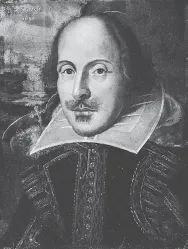
Shakespearean portraiture, like Shakespearean biography, seems designed to flout certainty. The only image of Shakespeare possibly taken during his lifetime was the Flower portrait, though even it may be a fancified copy of the etching in the First Folio, which was definitely posthumous.
Could there be a less revealing, less satisfying portrait of the man? There are police-artist sketches that tell us more about their subjects. It doesn’t even look like a face, much less like the face of the “spirit of his age.” The head is a spherical void. The eyes stare stupidly behind a perspective-experiment nose and brow, transfixed and cold, lacking feeling or judgment.
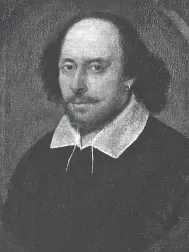
The Chandos portrait, the first acquisition of the National Portrait Gallery in London, looks, at least to me, a little more like the author of Titus Andronicus and Hamlet and The Tempest. Here we have a warm sensualist, capable of daring (with his sharp gold earring), a man clearly connected to the tradition of European humanism, or at least somebody who knew enough to find a decent painter. Unfortunately we don’t really know whether the Chandos portrait is Shakespeare. It could be just some random guy with a similar bald-mullet hairstyle and intelligent eyes. The Duke of Chandos acquired the painting in 1747, along with the story that Sir William Davenant, who claimed to be Shakespeare’s godson, once owned the thing. The key word is claimed. The Chandos could be. Or not.
The Flower portrait.
The Chandos portrait.
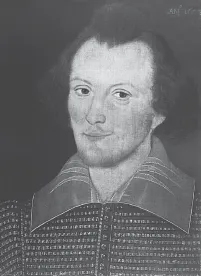
Then there’s the Sanders portrait.
The painting was discovered in an attic in Canada a decade ago, a strange place for Shakespeare to wind up, but as I’m writing this book in a Canadian attic, I’d like to imagine that it’s not impossible. After an immense battery of tests from experts on two continents, there’s no proof that the Sanders portrait isn’t Shakespeare. The image was painted in the correct period and place. It may lack the stately calm and grandeur of the Chandos portrait, but the subject has some Shakespearean qualities, at least to my eye: He’s mischievous, sprightly, energetic to the point of bursting, funny, intelligent, removed, secretive. And balding. I find the Sanders portrait the most tempting to believe in. When I close my eyes and see Shakespeare propped up in a corner of some Elizabethan tavern working through the dialogue between Richard III and Anne in his head while eavesdropping on a conversation about rumors at court, he looks like the fellow in the Sanders portrait. But I know that the Sanders-portrait fellow is, most likely, somebody else. somebody who, while no doubt a fun guy and worth drinking with, did not write Romeo and Juliet and A Midsummer Night’s Dream and Coriolanus.
The Sanders portrait.
History has not given us Shakespeare’s face, which may be for the best. Shakespeare himself had no faith in faces. “God has given you one face and you make yourself another,” Hamlet tells his mother. Innocent Desdemona protests: “I have no judgment in an honest face.” The soon-to-be murdered King Duncan in Macbeth complains: “There’s no art to find the mind’s construction in the face.” If we want Shakespeare, we’re not going to find him in his face. We certainly aren’t going to find him in any of his portraits.
If we’re going to find him, it’s going to be in the plays. Nobody ever left behind a richer or more complete record of thought on every conceivable subject and situation. And yet their very strength as plays limits how much they can tell us about their author. Shakespeare manages to inhabit his characters so perfectly that they leave little trace of himself in their language. He could be anyone in words. His old woman is as convincing as his young man. His murderer is as living as his saint, his thin assassin as precise as his jolly nurse. He realizes the fantasy of a fairy world with the same ease as he manages the hardhearted realism of the Eastcheap brothels. The language is so acrobatic and so varied that establishing consistency is nearly impossible. His plays are sublime mysteries. They point at the world, and Shakespeare himself huddles behind his mirror.
Then there’s the seemingly minor but vital point that we have no idea which version of his plays Shakespeare intended us to read. Just as his biography is incomplete, just as his portraits don’t give us his real face, the texts of his plays are unstable and unreliable and maddeningly incomplete. Almost every play you read in high school or have seen onstage is a conflation, meaning that editors and directors take the multiple versions of the plays’ texts as they originally appeared and smush them together, tucking away the hundreds and thousands of minor decisions they have to make to create a play that normal people (as opposed to professional scholars) can stand to read or see.
The problem is that Shakespeare didn’t leave manuscripts or authorized versions. What we possess of his work is either the product of various fly-by-night publishers who printed, without Shakespeare’s consent or involvement, small quarto editions of his plays, or the version his friends Heminge and Condell published posthumously, a Collected Edition called the First Folio, in 1623. Because most of the plays exist in multiple versions, none of which have an absolute claim to authority, almost every Shakespeare work is a scholarly quagmire.
Even the specific words Shakespeare meant to use are often impossible to establish, for instances, the line from Othello’s final speech when he asks his ...