![]()
1
The Most Wondrous Organ
One of the strangest experiences we can have is to hold a human brain in our hands for the first time. It surprises us for so many reasons, but for me, it was the realization that I could hold something that was once a person not so long ago. Our brain, and the mind it supports, is what makes us who we really are.
As a scientist, the brain has always fascinated me, and yet it is not much to look at. When I first arrived at Bristol University, I used to organize a brain dissection class for my colleagues because, although we had all been taught that the brain plays the critical role in creating our mind, very few of us had ever had the opportunity to examine this wondrously mysterious organ. Some of us had measured the electrical activity of the brain as it goes about its business of thinking. Others had even worked with patients who had lost mental abilities through damaging their brains. But few had actually held another human’s brain.
So, in December, just before we broke up for the Christmas holidays and after the medical students had finished their dissection classes, a group of about 20 fellow faculty members from the psychology department headed down to the medical school for a crash course in human brain anatomy. At the entrance to the dissection suite, we giggled nervously like a bunch of first-year students as we tried on ill-fitting lab coats. White lab coats—now this was real science! However, that jovial mood suddenly changed when we entered the large, chilled dissection suite and were faced with the stark sight of human bodies in various stages of advanced deconstruction on the tables. This was not some fake alien autopsy, but involved real people who had lived real lives. The nervous mirth so boisterous outside the suite was stifled. The faces of our group turned ashen and pale, with that tight expression that you often see at funerals as people try to appear dignified and composed when faced with death.
We split into groups and tentatively approached the lab benches, each of which had been furnished with a white plastic bucket. We put on rubber gloves and removed the lids. After the initial plume of formaldehyde fumes that stung our eyes and assaulted our nostrils had passed, we stared at the human brains inside each bucket.
At first sight, the human brain is rather unappealing. After it has been chemically prepared for dissection, it resembles a large gray walnut with the rubbery consistency of a firm mushroom. Like a walnut, it is obviously shaped in two halves, but beyond that much of the structures are relatively indistinct. And yet, we know that this small lump of tissue is somehow responsible for the most amazing experiences we can ever have in the universe—human thoughts and behaviors. How does this wondrous organ produce them?
The Matrix That Is Your Mind
In the science fiction classic, The Matrix, our hero, computer hacker “Neo,” played by Keanu Reeves, discovers that his reality is not real. He thinks he is living in the United States in the year 1999 but, in fact, he is living in a post-apocalyptic future world hundreds of years later where humans have been battling intelligent machines. His mundane daily reality is actually a computer program called the Matrix that is fed directly into his brain and the brains of other enslaved humans who are imprisoned in pods and harvested for their bioelectrical energy by the intelligent machines. But because all experience is so faithfully simulated, the humans are blissfully unaware of their true state.
This plot may sound too fantastic to believe, but the movie is not that far off the mark when it comes to understanding the nature of the human mind. Of course, we are not enslaved humans controlled by machines—but there again, how would one ever know? These are wonderfully entertaining suppositions, and all students of the mind should watch the movie, but one thing is clear: each of us really does have a matrix in our brain. This is because our brains are constructing simulations or stories to make sense of our experiences because we have no direct contact with reality. This does not mean that the world does not really exist. It does exist, but our brains have evolved to process only those aspects of the external world that are useful to us. We only sense what we are capable of detecting through our nervous system.
We process the outside world through our nervous system in order to create a model of reality in our brains. And, just like the matrix in the science fiction movie, not everything is what it seems. We all know the power of visual illusions to trick the mind into perceiving things incorrectly, but the most powerful illusion is the sense that we exist inside our heads as an integrated, coherent individual or self. As a self, we feel that we occupy our bodies. On an intellectual level, most of us understand that we need our brains, but few of us think that everything that makes us who we are can be reduced down to a lump of tissue. Most of us think that we are not simply our brain. In fact, we are our brains, but the brain itself is surprisingly dependent on the world it processes and, when it comes to generating the self, the role of others is paramount in shaping us.
Brain Reductionism
Some people get awfully upset with statements such as “we are our brains”—as if this reduces or demeans the experience of life by making it material. Others point out that brains need bodies, and so the two are inextricably linked. Still others point out that brains exist in bodies that exist in environments, and so it is illogical to reduce experience down to the brain. All of these objections are valid but, ultimately, we need to start taking a stand on how we think these all concepts work together. The brain seems the most obvious place to start. We can change environments and replace most body parts, but our brain is pretty fundamental to who we are. And who we are includes a sense of self. That said, understanding where the sense of self comes from ultimately needs to involve the consideration of bodies and environments that shape the self.
Back in the dissection suite, it was the brain that had our full attention. This was no ordinary piece of the body. This was more than tissue. Somehow, each brain yielded the agony, the ecstasy, the confusion, the sadness, the curiosity, the disappointment, and every other mental state that makes us human. Each brain harbored memories, creativity, and, maybe, some madness. It is the brain that catches the ball, scores the goal, flirts with strangers, or decides to invade Poland. Each brain that we held in our hands that afternoon in the dissection suite had experienced a lifetime of such thoughts, feelings, and motivations. Each brain had once been someone who had loved, someone who had told a joke, someone who had charmed, someone who had sex, and, ultimately, someone who had contemplated his own death and decided he would donate his body to medical science when he was gone. Holding another’s brain in your hands for the first time is the closest to a spiritual experience I have ever had. It makes you feel humble and mortal at the same time.
Once you have overcome the emotional shock, you are then struck by the absolute wonder of this organ—especially if you have an appreciation of what an amazing thing the human brain is. Although you cannot see them with the naked eye, packed inside this lump of tissue are an estimated 170 billion cells.1 There are many different types of cells, but for our purposes, the nerve cell or neuron is the basic building block of the brain circuits that do all the really clever stuff. There are an estimated 86 to 100 billion of these neurons—the elements of the microcircuitry that create all of our mental life. There are three major types of neurons. Sensory neurons respond to information picked from the environment through our senses. Motor neurons relay information that controls our movement outputs. But it is the third class of neuron that makes up the majority—the interneurons, which connect the input and the output of the brain into an internal network where all the really clever stuff happens. It is this internal network that stores information and performs all the operations that we recognize as higher thought processes. By themselves, neurons are not particularly clever. When not active, they idle along, occasionally discharging an electrical impulse like a Geiger counter that picks up background radiation. When they receive a combined jolt of incoming activity from other neurons, they burst into activity like a machine-gun, sending cascading impulses out to others. How can these two states of relative inactivity and a frenzy of firing create the processing power and intricacy of the human mind?
The answer is that if you have enough of them connected together, this collection of interconnected neurons can produce surprising complexity. Like the legions of soldier ants in a colony, or thousands of termites in one of those amazing earth mounds, complexity can emerge if you have enough simple elements communicating with each other. This was discovered in 1948, by Claude Shannon,2 a mathematician working at Bell Laboratories in the United States on the problem of sending large amounts of data over the telephone. He proved that any pattern, no matter how complicated, could be broken down into a series of on and off states distributed across a network. Shannon’s Information Theory, as it became known, was not a dusty theoretical notion, but rather a practical application that revolutionized the communications industry and gave birth to the Computer Age. He showed that if you connect up a large number of simple switches that could be either “on” or “off,” then you can create a binary code,3 which is the communication platform for all digital systems that control everything from an iPod to the orbiting International Space Station. This binary code is the foundation for every modern computer language. It is also the same principle operating in every living organism that has a nervous system.
The neurons communicate with each other by sending electrochemical signals through connecting fibers. A typical neuron has lots of fibers connecting with local neurons next to it, but it also has a long-distance fiber, called an axon, that connects with groups of neurons much farther away. It’s like having a bunch of friends you talk to regularly in your neighborhood, but also a really good connection with a group of friends who live abroad. The neurons are jam-packed into a 3–4 mm thick layer on the outer surface of the brain, known as the cortex (from the Latin for “bark”). The cortex is of particular interest because most of the higher functions that make us so human appear to rely on what’s going in this tiny sliver of tissue. The cortex is also what gives the human brain its peculiar appearance of a giant walnut with many crevices.4 The human brain is 3,000 times larger than that of the mouse, but our cortex is only three times thicker5 because of the folding. Think about trying to cram a large kitchen sponge into a small bottle. You have to scrunch it up to make it fit. It’s the same with the human brain. Its folded structure is nature’s engineering solution to cram as much brain into a typical skull as possible without humans evolving heads the size of beach balls to accommodate the same cortical surface area. Ask any mother during delivery: she will probably tell you politely that it’s bad enough giving birth to a normal-sized head without it being any larger!
Like some strange alien creature extending tentacles, each neuron is simultaneously connected to up to thousands of other neurons. It is the combined activity of information coming in that determines whether a neuron is active or not. When the sum of this activity reaches a tipping point, the neuron fires, discharging a small chemical electrical signal and setting off a chain reaction in its connections. In effect, each neuron is a bit like a microprocessor because it computes the combined activity of all the other neurons it is connected to. It’s a bit like spreading a rumor in a neighborhood. Some of your neighboring neurons are excitatory and, like good friends, want to help spread the word. Other neurons are inhibitory and basically tell you to shut up. And, every time the neuron has such a conversation with its different neighbors or long-distance pals, it remembers the message either to spread the word or be silent, so that when the rumor comes round again, the neuron responds with more certainty. This is because the connections between the neurons have become strengthened by repeatedly firing together. In the words of the neurophysiologist Donald Hebb, who discovered this mechanism, synchronized neurons that “fire together, wire together.”
These spreading patterns of electrical activity are the language of mental life. They are our thoughts. Whether they are triggered from the outside environment or arise from the depths of our mental world, all thoughts are patterns of activation in the matrix that is our mind. When some event in the external world, such as hearing the sound of music, stimulates our senses, this stimulation is transmitted into a pattern of neuronal impulses that travels to relevant processing areas of the brain. This, in turn, generates a cascading pattern of activation throughout the brain. In the other direction, whenever we have an internal thought, such as remembering the sound of music, patterns of neural activity similarly cascade across the relevant centers of the brain, reconstructing the memories and thought processes related to this particular experience.
This is because the brain deals with distributed patterns. Imagine that the neural patterns in your brain are like domino patterns in one those amazing demonstrations where you topple one domino and trigger a chain reaction. Only, these dominoes can bounce back up again, waiting for the next time they are pushed over. Some dominoes are easily toppled, whereas others need lots of repeated pushes from multiple sources before they activate and set the pattern propagating.
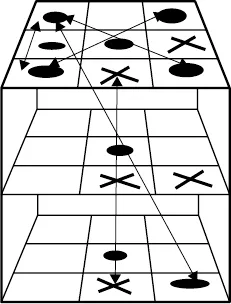
Now imagine that, rather than there being just one pattern of dominoes, instead there are trillions of different patterns of dominoes overlapping and sharing some of the same excitatory and inhibitory neurons. Not all the dominoes topple because the interconnectedness of certain clusters of neurons influences the path a neural activation takes. The fact that each neuron can participate in more than one pattern of activity means that the architecture of the brain is parallel. This is a really important point because it reveals a very crucial clue as to why the brain is so powerful. It can do several tasks simultaneously, using the same neurons. It’s like the three-dimensional game of tic-tac-toe. Imagine that the zero or the cross is like the active or inactive state of a neuron. It can start or stop a line that we will use as a metaphor for a chain of neural activation (Figure (1.1).
Those chains can spread in many directions. If you place a cross in the bottom corner of the lower layer, it also activates the patterns on the middle and top layers simultaneously. If you only consider the layout on one level, you are likely to lose the game. Rather, to play the game well, you have to think of parallel activation on all levels at the same time. Likewise, activation of neurons produces parallel activation in other connected networks of patterns. That is just as well, because the speed at which neural impulses travel from one neuron to the next in real time has been calculated to be simply too slow for the speed at which we know the brain can perform multiple operations. The best explanation for our efficient brain speed at completing tasks is this parallel organization of the neural patterns.6 Our brains really do multitask using the same hardware.
FIGURE 1-1 Parallel processing works like three-dimensional tic-tac-toe.
With such an arrangement, consider how a lifetime of experiences could operate as a multitude of fingers that topple different dominoes, creating different patterns of activation. In this way, the full diversity of what happens to us during our lives could be stored in the complexity of the neural circuitry as distributed parallel patterns. With billions of neurons, each with up to 10,000 possible connections with neighboring neurons, that arrangement has the potential to create an almost infinite number of different patterns of connectivity. The mathematics of brain connectivity is mind-boggling. For example, if you just took 500 neurons all connected together, so that each neuron could either be in a state of on or off, the total number of different patterns is 2500, a number that exceeds the estimated total number of atoms in the observable universe.7 Given that there are billions of neurons, you can understand why the human brain is considered the most complicated structure known to man—or, to be more accurate, rather unknown to man.
So, this is how the brain basically works. Just like Keanu Reeves’ Neo, you have no direct connection with reality. Everything you experience is processed into patterns of neural activity that form your mental life. You are living in your own Matrix. Wilder Penfield, the famous Canadian neurosurgeon who reported how he could induce dreamlike flashbacks in his consc...