![]()
PART ONE
NATURALLY OCCURRING SUBSTANCES IN OUR FOOD SUPPLY
![]()
AN APPLE A DAY
IS THERE A BETTER SUBJECT WITH WHICH TO BEGIN A DISCUSSION OF the relationship between food and health than apples? After all, doesn’t “an apple a day keep the doctor away”? Maybe it does, if you throw it at him or her! There are no single foods that have magical health properties. There are good diets and there are bad diets. It is certainly possible to have a good diet and never eat apples, just as it is possible to gorge on apples and have a horrible diet. What really matters in terms of nutrition is the net effect produced by all of the chemicals that wend their way into our bodies from the food we eat. Yes, chemicals. I can practically see those eyebrows being raised. It may seem unusual to see the word “chemical” without an adjective like “poisonous” in front of it. Actually, without appropriate context, “toxic chemical” is a meaningless term.
Take salicylic acid as an example. It occurs naturally in a variety of fruits and plants, including apples. It is also formed in our body when Aspirin is metabolized. Indeed, salicylic acid is responsible for the physiological effects of Aspirin, which include reducing the risk of blood clot formation. That’s why Aspirin is used to treat a heart attack, and why it is commonly taken in small doses to prevent one. But in an overdose, salicylic acid can kill. Before childproof packaging was introduced, Aspirin poisoning was a common cause of death in children. So how do we react if a test detects salicylic acid in our blood? Panic because of the presence of a “toxic chemical,” or relief because of possible protection against heart disease? Of course, without the proper context there can be no appropriate reaction. To decide whether to laugh or cry, we need to know what blood levels of salicylic acid have been linked to risk and what levels to protection from disease. The mere presence of the chemical says nothing. As Paracelsus insightfully and wisely noted some 500 years ago, “Only the dose makes the poison. And to this we can add, “And only the dose makes the cure!”
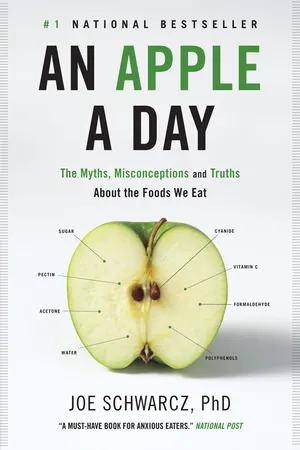
So let’s not get paranoid about chemicals in our food. Everything in the world is made of chemicals, and if you restricted yourself to a diet free of chemicals, you would be dining in a vacuum! With that in mind, let’s investigate the chemicals in an apple. So tell me, would you like some nail polish remover in your diet? Or rubbing alcohol? Then have an apple! Yes, all apples contain acetone and isopropanol. And if these don’t sound toxic enough, you can throw in some cyanide. It’s there too. Added by nature, not by humans! Should you then be worried about eating apples? Of course not! The amounts of these chemicals are too small to be of any consequence. Apples, as already mentioned, contain over 300 naturally occurring compounds, and whatever effect the fruit has on our health is a reflection of all of these. Researchers are particularly excited about one class of compounds, the polyphenols. Why? Because they have powerful antioxidant properties.
Chances are that if you haven’t heard rhyme and verse about antioxidants in recent years, you’ve been spending too much time in the butcher shop. These highly publicized substances are found in fruits and vegetables and can neutralize free radicals, those rogue molecular fragments produced whenever we inhale oxygen. We can’t live without oxygen, of course, but there is a cost to be paid for living with it: illness and eventual death! About 2 to 3 percent of the oxygen consumed by our cells is converted into free radicals that are so reactive, they can rip other molecules apart. When the victims are proteins, fats, nucleic acids or other essential biomolecules, the result can be heart disease, cancer or dementia. Even plain old aging has been linked to cumulative free-radical damage.
Since antioxidants can mop up excess free radicals, they obviously merit serious scientific investigation. One of the difficulties, though, is the large variety of antioxidants that are present in plant products. Vitamins C and E, along with carotenoids, have received a great deal of attention, but most of the antioxidant activity of fruits and vegetables can be attributed to polyphenols. The term “polyphenol” actually refers to several related families of molecules that include the flavonoids, anthocyanins, chalcones and hydroxycinnamates. To complicate things further, each family in turn comprises many compounds that are linked by some common feature of their molecular structure. As one might expect, because these antioxidants have different molecular structures, they also have different degrees of antioxidant activity. Obviously, knowledge about the distribution of polyphenols in our diet, coupled with knowledge about which ones have the most activity, would be very useful.
But before we start jumping on the polyphenol bandwagon, we need to ask a pertinent question: What evidence do we have that polyphenols in the diet can contribute to good health? Demonstrating that these chemicals can neutralize free radicals in a test tube is one thing, showing that they can prevent cancer or heart disease is quite another. The first major study to suggest such a possible benefit appeared in The Lancet in 1993. Dutch researchers measured the amount of flavonoids in various foods, and by means of a dietary questionnaire assessed the flavonoid intake of 805 men ages 65 to 84 who were then followed for five years. Even when adjustments were made for smoking, body weight, cholesterol levels, blood pressure, physical activity, and vitamin and fibre intake, the polyphenol content of the diet was inversely associated with death from heart disease. The major sources of polyphenols in this study were tea, onions and apples. A single apple a day made a difference!
There is evidence for the anticancer effects of polyphenols as well. Researchers at Cornell University found that treating colon or liver cancer cells in the laboratory with apple extract inhibited their proliferation, with extracts from the skin performing even better than extracts from the flesh. The same Cornell team also showed that apples may play a role in reducing the risk of breast cancer. Rats exposed to a substance known to trigger breast cancer were fed apple extract in amounts equivalent to a human eating one, three or six apples a day. Lo and behold, the chance of developing the disease was reduced by 17, 39 and 44 percent respectively! Even when cancer set in, maintaining the apple diet blocked the spread of the disease, and after six months reduced the number of tumours by 25 percent. And that with just one apple a day! These researchers did not stop at investigating cancer. When they exposed rat brain cells to a specific polyphenol, quercetin, they found that the cells resisted oxidative damage more, implying a potential reduction in the risk of developing Alzheimer’s and other such brain diseases. Indeed, a group at the University of South Florida has found a greatly reduced risk of Alzheimer’s disease in seniors who drank fruit or vegetable juices at least three times a week compared with those who drank these less than once a week.
Other studies have found that quercetin reduces the growth of human prostate cancer cells in the lab and that its presence in the diet is inversely associated with the risk of lung cancer. This is not that surprising, given that quercetin has very potent antioxidant activity. And it is found in apples, along, of course, with many other polyphenols. But before we start attributing magical properties to apples, let’s realize that there are foods with higher antioxidant potential. Red kidney beans, blueberries and cranberries all have greater antioxidant capacity per serving. And oregano has 40 times the antioxidant activity of apples. What matters, though, is the total intake of polyphenols. Let’s face it, eating apples every day is easy. Kidney beans are more challenging.
But the real key to antioxidant intake is variety. The more different fruits and vegetables consumed, the greater the chance that we equip ourselves with the complex array of antioxidants that may be needed for good health. Studies indicate we should be aiming for a daily polyphenol intake of around one gram. Apples, depending on the variety, can contribute anywhere from 100 to 300 milligrams. Eating a couple a day is certainly a good idea. And if someone tries to scare you by pointing out that apples contain embalming fluid, you can respond that whatever the detriments of the traces of the naturally occurring formaldehyde may be, they are more than countered by the benefits of the polyphenols. Eat those apples, and make the undertaker wait longer with his embalming fluid.
![]()
TOMATOES AND LYCOPENE
RESEARCHERS ARE REALLY EXCITED ABOUT LYCOPENE, THE COMPOUND responsible for the red colour of tomatoes. So is the public. Prompted by ads in magazines and by seductive promotions in health food stores, lycopene supplements are enjoying brisk sales, especially among men worried about prostate cancer.
Why should lycopene have any effect on prostate cancer? Because studies have shown that men who consume lots of tomato products have a lower incidence of the disease. A study by the Harvard School of Public Health showed that men who had 10 or more servings of tomato-based foods a week had a 45 percent reduction in the rate of prostate cancer. Spaghetti sauce was the most common tomato-based food consumed, and cooked tomatoes seemed to be more protective than raw tomatoes or tomato juice, perhaps because heat releases lycopene and other nutrients from tomato cells. Also, the sauce is commonly made with olive oil, which enhances the absorption of the fat-soluble lycopene. And the sauce is a concentrated tomato product, so it provides more nutrients per gram than fresh tomatoes.
Lycopene is a good candidate for biological activity because the tomato actually uses the compound to maintain its own health. It protects the seeds in the fruit from damage by oxygen and light. Lycopene can absorb ultraviolet light, and its antioxidant activity allows it to neutralize free radicals generated by exposure to oxygen. Of course, there’s more to tomatoes than lycopene. Like other plant products, tomatoes are very complex chemically and contain hundreds of different compounds. Is lycopene the most important one? Researchers at Ohio State University decided to find out.
Since triggering cancer in humans is out of the question, researchers focused on rats, which actually are very good models for human prostate cancer. They caused prostate cancer in about 200 rats by treating them with a cancer-inducing mix of testosterone and N-methyl-N-nitrosourea. Some of the rats were then fed diets that contained whole tomato powder while others were treated to rat chow fortified with lycopene. The lycopene-fortified rats were actually getting more lycopene than the tomato-powder rats. That’s what made the results of the experiment so surprising. The risk of death from prostate cancer was significantly greater in the rats that were fed the pure lycopene extract! This would seem to suggest that there are other components in tomatoes that have a protective effect and that the whole food is beneficial, while isolated components may not be. True, the study was done in rats, but it does send us a message. Eat a balanced diet, with lots of vegetables and fruits, because shortcuts may not work.
There was another significant finding in this study. The researchers also put some of the rats in each group on a calorie-restricted diet. While their colleagues were allowed to eat as much as they wanted, these rats were given a diet that contained 20 percent fewer calories than what rats usually consume. Guess what? These hungry rats lived longer—without getting prostate cancer—than the rats who ate freely. So, just eating less food reduces the risk of prostate cancer. What’s the overall message for human beings? We should reduce our calorie intake and eat lots of tomato products. And eating those tomato products may even play a role in protecting the heart. At least that’s one conclusion that can be drawn from an intriguing Italian study.
Imagine being admitted to a hospital with a heart attack and a doctor asking how many times a week you eat pizza. We’re not talking about a hypothetical situation here; we are talking about the actual question that was asked of 507 heart attack victims and 478 others who had been admitted to a hospital in Milan, Italy, between 1995 and 1999. Why? To find out if most Italian foods had any role to play in heart disease. We’ve all heard about the benefits of the highly touted Mediterranean diet, and Italian researchers decided to find out if pizza specifically played a role in protection against cardiovascular disease.
After admission to the hospital, the patients were interviewed about their lifestyle habits and their diets. They filled out a 78-item food frequency questionnaire on the basis of which they were divided into non-pizza eaters, occasional pizza eaters (one to three portions a month) and regular pizza eaters (more than one portion per week). Heart attack victims reported they exercised less than controls, smoked more often, consumed more coffee and drank less alcohol. No surprise here. They also had more of a history of high blood pressure, consumed more calories, and ate fewer fruits and vegetables. Still no surprise. But the surprise came when pizza eating was considered. Regular pizza eaters were 40 percent less likely to suffer a heart attack than those who never ate pizza! Why this should be so is somewhat of a mystery. Perhaps pizza eating is just an indicator of following a Mediterranean diet, which tends to be lower in fat than the North American diet.
We have to remember that we are talking about pizza as served in Italy, not the American version. No double cheese, no cheese-filled dough, no piles of pepperoni or globs of trans fat–laden shortening. The dough is thin, the pizza is dressed with olive oil and cheese, and there is plenty of fresh tomato sauce. The answer to this pizza mystery may lie not in what the people are eating, but rather in what they are not eating. Perhaps the pizza is displacing high-fat hamburgers and fries from the diet. Let’s note that a portion of pizza in the Italian study was defined as 200 grams and even the so-called regular eaters averaged only 500 grams (just over a pound) of pizza per week. Indeed, pizza may be displacing higher-calorie foods from the diet. Or maybe it’s the yellow stuff around the tomato seeds that matters. This fluid contains flavonoids that have anti-clotting properties, and could, at least in theory, reduce the risk of heart attacks.
The producers of Fruitflow certainly think this is the case. This patented tomato-extract product is being added to various drinks with hopes of improving cardiovascular health. In one study, blood “stickiness” was reduced by an average of 70 percent in 220 volunteers who drank a juice containing Fruitflow, with the effect lasting for 18 hours. Tomato juice itself may provide a similar benefit. And it may be especially helpful on long-distance flights, where a potentially life-threatening condition called deep vein thrombosis can occur. Sitting in one position, such as in an airline seat, without moving for extended periods increases the chance of blood clots forming in the legs. These clots can travel to the heart or lungs and cause a catastrophe. So loading up on the tomato juice (without the vodka) is a good idea on long flights. Fruitflow is not the only tomato extract under investigation. Israeli researchers found that a supplement sold as Lyc-O-Mato, capsules that contain nutrients equivalent to those found in about four tomatoes (along with some fat to aid absorption), reduced moderately elevated blood pressure significantly. Hmm … tomatoes and fat … bring on the pizza! And dress it with broccoli!
University of Illinois nutrition professor John Erdman fed a diet containing 10 percent dehydrated tomato powder, or 10 percent broccoli powder, or a combination of both to rats implanted with human prostate-cancer cells. Another group of rats was treated with supplemental lycopene, and yet another group was castrated, a possible treatment for prostate cancer. After 22 weeks, Erdman’s team found that the tomato-broccoli combination was most effective in reducing the size of tumours. This was an animal study, so it is more meaningful than a test tube experiment, but more importantly, the dose of broccoli and tomato needed to achieve the reduction in tumours is within the norms of the human diet. Conversion of the amounts fed to the animals to a human dose suggests that a cup and a half of broccoli a day coupled with two and a half cups of fresh tomato, or a cup of tomato sauce, can be effective in reducing the growth of prostate tumours and probably in reducing their occurrence as well. Why a combination of broccoli and tomato works better than the individual foods is not known, but compounds in foods can inhibit cancer in various ways, ranging from stimulating detoxicating enzymes to triggering cell death. Maybe there is a market out there for broccoli-flavoured tomato ketchup.
Eating tomatoes may not only make you healthier, it may also make you look better. Lycopene is fat soluble and concentrates in fatty tissue, such as the fatty layer just underneath the skin. Since the molecule is an efficient absorber of ultraviolet light, it offers some protection against sun-induced skin damage. In conjunction with the BBC television series The Truth About Food, two dermatologists in Britain put this notion to a test. They recruited 23 women aged 20 to 50 who were willing to bare their bottoms and expose them to ultraviolet light for the sake of science.
Half the volunteers consumed 16 milligrams of lycopene daily, the amount contained in three teaspoons of tomato paste, along with 10 grams of olive oil to help with absorption of the fat-soluble lycopene. The other volunteers got only the olive oil. Otherwise, both groups had identical diets. The results? Less reddening of the skin and less DNA damage in the lycopene group. And if you don’t like tomato paste, a glass of tomato juice or a cup of tomato soup will do. But as for fresh tomatoes, well, you would need to eat at least half a dozen to achieve the same effects.
All of these intriguing studies have prompted producers to petition the Food and Drug Administration in the U.S. to allow health claims on the labels of tomato products. After all, foods containing soy and oats can have labels that claim they reduce cholesterol, and calcium supplement labels can claim that the supplements reduce the risk of osteoporosis, so why shouldn’t tomato product labels be allowed to make claims about reducing the risk of cancer? The FDA responds that there simply is not enough evidence to support the cancer-reduction claim. But the FDA does agree that there may be some health benefits to eating tomatoes. So it allows the tomato product labels to include statements such as this: “Very limited and preliminary scientific research suggests that eating one-half to one cup of tomatoes and/or tomato sauce a week may reduce the risk of prostate cancer. The FDA concludes that there is little scientific evidence supporting this claim.” Of course, the tomato producers believe that the FDA is too stringent in its requirements and that there is enough evidence about lycopene to warrant a stronger health claim.
Researchers at the National Cancer Institute and The Fred Hutchinson Cancer Research Centre share the FDA’s skepticism about lycopene. If lycopene does indeed offer protection from cancer, then people who have higher levels of this compound in their blood should have a reduced risk of cancer. But this does not appear to be the case. Researchers followed over 28,000 men between the ages of 55 and 74 who had no history of prostate cancer. During eight years of follow-up, 1,320 of the men were diagnosed with prostate cancer, but no relationship was found between the blood levels of lycopene and occurrence of the disease.
Of course, this research does not signal the end of the debate. We cannot just dismiss the studies that have shown an association between consuming tomatoes and protection from cancer. Let’s remember tha...