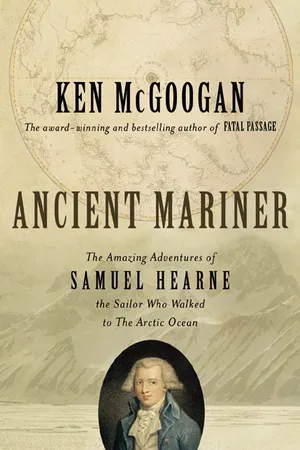
Published to great reviews in Canada, the US and the UK, Ancient Mariner tells the riveting story of how Samuel Hearne—a sailor at 12, a northern explorer at 24, an admirer of Native peoples—became the first European to reach the Arctic coast of North America. Yet, as Ken McGoogan reveals, Samuel Hearne's place in the history books has been a subject hotly disputed over the past two centuries. This fascinating saga, a skillful blend of literary detective work and finely imagined narrative, delights and surprises as it restores Hearne's rightful place in history.
eBook - ePub
Ancient Mariner
The Amazing Adventures of Samuel Hearne, the Sailor Who Walked to the Arctic Ocean
- 352 pages
- English
- ePUB (mobile friendly)
- Available on iOS & Android
eBook - ePub
Ancient Mariner
The Amazing Adventures of Samuel Hearne, the Sailor Who Walked to the Arctic Ocean
About this book
Information
Part One
MR. MIDSHIPMAN HEARNE
1
THE BOY FROM BEAMINSTER
EARLY ONE EVENING in January 1757, a strapping youth wearing the blue jacket, off-white pantaloons, round tarpaulin hat, and square-buckled shoes favoured by Young Gentlemen of the Royal Navy, the entire sparkling outfit purchased earlier that day, swung down High Street in Portsmouth, wide eyed and incapable of hiding it. After an exhausting stagecoach journey from Beaminster, four days to the west in Dorset, twelve-year-old Samuel Hearne had arrived with his mother the previous evening.
They had spent their first night in Dorchester, seventeen miles southwest of Beaminster, having avoided the journey through Hooke, which was cheaper but meant following a winding, steep, muddy road thick with caravans of walkers, poor people who had been ordered by overseers to move to another parish lest they become a burden. Instead, from the King’s Arms in Beaminster, Hearne and his mother had caught the morning stage to Bridport, six miles south. That coach had been slowed by lumbering wagons, but from Bridport they had travelled to Dorchester by six-horse carriage, following the Great West Road that ran from Exeter to London.
On that fine road, a stagecoach might cover thirty miles in a day. Well-to-do travellers in private carriages could hardly do better, not unless they hired fresh post horses every twelve or fifteen miles. Hearne and his mother, journeying by regular coach, had covered twenty-five miles the second day, arriving in Bournemouth too late and too tired to see much.
The third day, on yet another coach, they had rolled steadily eastward through low, flat country, crossing creeks and inlets and
resorting three times to ferries before reaching Southampton. There, Hearne had remarked on the crowds, the spacious square, the impressive French cathedral. But even that bustling city had not prepared him for the unruly energy of Portsmouth during another war with France.
Last night, hanging onto the outside of the coach as it turned onto High Street, young Hearne had registered the tumult and din spilling out of shops, taverns, and coffee houses, and wondered, had they arrived during an annual fair? High Street rang with shouts and laughter and the cries of pedlars hawking their wares. Even the sidestreets were choked with people—women selling fruit and men hauling carts piled high with luggage, meat, or vegetables. Hearne saw livestock being driven down an alleyway: cows bawling, chickens squawking.
On descending from the coach at the Globe Inn, just off High Street, they had found themselves surrounded by porters clamouring to know where they were bound and if they needed a room, and offering to take them to “quality premises.” Taller than most men despite his youth, Hearne placed a protective arm around his mother, who called out, “The Mary Rose? Anyone from the Mary Rose Inn?”
A burly porter stepped forward and glowered at his competitors until they melted away. The big man loaded their luggage into a one-horse cart and then helped Hearne’s mother into the seat. With Hearne walking alongside, the porter led them by way of St. Thomas Street, a slightly quieter roadway. The Mary Rose, grander even than the King’s Arms, had been built in 1742. From a posted sign, Hearne learned that the inn took its name from a ship that had sunk off Portsmouth harbour in 1545 while, from the wall of a nearby castle, a horrified King Henry VIII watched through a looking glass.
The next day, with his mother, Hearne plunged into the city, which was virtually encircled by a great stone wall. Not long ago, according to Daniel Defoe, the back entrance had been guarded with a double moat, double palisades, and several “ravelins,” or freestanding barricades designed to retard attack. The city posted sentries and nobody could enter or leave after nine o’clock at night. Now, it was far more accessible.
From the Mary Rose Inn, waving off sedan-chair carriers, Hearne and his mother walked into the grey afternoon. They stood and admired the Portsmouth Grammar School, an impressive brick building now fifteen years old, situated almost directly across the road from their inn. Then, swinging down High Street with the crowds, they realized that the town hall doubled as a marketplace and sat right in the middle of the street, traffic flowing past on both sides.
At Oyster Street, they recognized the Globe Inn, where they had debarked, and they continued past the bustling Parade Coffee House. From here, they could see King James Gate, beyond which lay Portsmouth Point, a bent finger of land that sheltered the Camber, the ancient harbour that still served all vessels except those of the Royal Navy. Hearne had expected to carry on but his mother demurred. “No respectable woman would venture through that gate, Samuel. Come! Let’s get you fitted out.”
Now, not six hours later, as the young man strode alone down High Street marvelling at what a figure he cut, he was making straight for The Point. Having passed the Portsmouth Theatre and the Spotted Dog, where in 1628 the Duke of Buckingham had been murdered, he approached the George Hotel, three storeys high and frequented by senior naval officers. Drawing himself up to his full height, Hearne stepped smartly. Perhaps here he would spot Captain Hood, under whose protection he would join the Royal Navy. Outside the George, three naval officers stood reading a notice and debating its meaning. As Hearne strode past, one of them cried, “Agreed, then—to London I must go!” He climbed into a waiting chaise-and-four and, to the cheers of his fellows, thundered away up High Street.
As Hearne crossed Pembroke Road, he could not help admiring the majestic Portsmouth Cathedral. St. Mary’s Church, the glory of Beaminster, simply could not compare. Out front of the Fountain Hotel, cock-hatted junior officers jostled each other, placing wagers on some looming contest. And there, directly across the road, blazed the shop that had fitted him out—a place called Morgan’s, with a handwritten sign in the window: “Sailors rigged complete from stem to stern.”
Hearne passed the Parade Coffee House, noisier now even than it had been in the afternoon, and at the foot of High Street approached the Square Tower—since the fifteenth century, a semaphore station. He stared up at a bust of King Charles I mounted in a recess, and read the words beneath it: “After his travels through France into Spain and having passed many dangers both on sea and land, he arrived here on the 5th day of October 1623.” History was everywhere.
Hearne climbed the stairs to the ramparts and gazed east toward Spithead, a channel mouth ten miles wide, dotted with scores of sailing ships, and separating the mainland from the Isle of Wight. Catching a whiff of sewage on the salt sea breeze, he recalled that Portsmouth Point was sometimes called Spice Island—and realized this was a bad joke.
Before leaving Beaminster, Hearne had rummaged through his dead father’s books, among them Defoe’s Tour Through the Whole Island of Great Britain. The author had described Portsmouth as “the largest fortification, beyond comparison,” in the entire country. He had especially admired this harbour entrance, observing that it was guarded from both sides by platforms of powerful guns, including those cannons that Hearne could now see for himself.
From the foot of the stairs, immediately to the west, Broad Street ran through King James Gate, a passageway separating the respectable city from its disreputable quarter—Portsmouth Point. Once, that name had conjured up an ominous warren of pubs and brothels, press gangs and cutthroats. The reputation lingered still, though mitigated by the Royal Navy’s well-fortified dockyards, which lay across the Outer Camber to the northeast.
Hearne strode through the Gate and crossed a seventy-five-foot wooden drawbridge suspended above a moat, realizing as he did so that The Point was not really a peninsula but an island. To his left stood the Round Tower, bristling with cannons. Built in 1417, it protected the harbour entrance and anchored the heavy chain that ran across that expanse to Gosport Point. Hearne could see how men had used the capstan, a round drum on a ratchet, to pull the chain taut across the harbour entrance and so prevent hostile ships from entering.
Across Broad Street stood a three-storey hostelry with a series of bright blue pillars flanking the entrances to a tavern and a stable yard. He recalled that the Blue Posts was popular among Young Gentlemen like himself, and indeed, during the next few years, he would come to know the place intimately. One day, Captain Frederick Marryat would write of “the Blue Postesses, where the midshipmen leave their chestesses, call for tea and toastesses, and sometimes forget to pay for the breakfastesses.”
Hearne had believed High Street the epitome of bustle, but now he discovered what a crowd could be. He flowed along Broad Street with the mob, amazed at the diversity of shops and businesses—tailors, drapers, pawnbrokers—and astounded at the number of taverns, thirty-five or forty at least. Tough-looking sailors carrying great mugs of beer reeled drunkenly from one alehouse to another. A couple of them jeered at him, hurling a good-natured insult he didn’t catch.
Ducking through a “sally port” in the stone wall, Hearne marvelled at the continuing bustle of the Inner Camber, the original, well-sheltered harbour developed by Normans in the twelfth century and then used by Lombard and Saxon traders. Now, barges, launches, and gigs came and went, and boatmen wrangled with customers, some of whom were cursing the boatmen for not pushing off, while others implored them to wait a bit longer.
Back on Broad Street, Hearne continued north to the tip of The Point. Beyond it lay the entrance to the Outer Camber, a floating forest of tall masts and furled sails. In the deepening twilight, a brigantine moved slowly seaward, sails flapping in the breeze, making for the harbour entrance and Spithead. Beyond the Outer Camber, Hearne could see the Royal Navy dockyards, where tomorrow he would meet Captain Hood.
Turning to the noisy spectacle behind him, he noticed a muscular midshipman striding from the Blue Anchor to the Star and Garter, accompanied by several husky seamen, all of them sober and serious. He watched them confront a group of sailors, and deduced that they were gathering their ship’s crew, separating men from their sweethearts, who were clearly new found. From out of the Still Tavern, directly ahead, tumbled a trio of young men no older than himself, laughing and waving tankards of beer. With them came several young women—not their sisters. One of the girls called to him, inviting him to join the party.
Ignoring this jovial crew, Hearne started back toward King James Gate, flowing this time through Bath Square, the alternative channel. Glancing down alleyways not quite lost in darkness, he glimpsed such scenes, men and women together, as he had never yet imagined. So this was what his mother had been trying to protect him from.
Hearne realized that before long, he would probably return to The Point with raucous shipmates of his own. But even as he made his way through Bath Square, the steamiest quarter of the wildest seaport in Europe, he vowed never to be distracted. He was joining the Royal Navy not just to have adventures, but also to restore the name Hearne to its rightful lustre. He was joining the Navy to make his mark, and from that nothing would distract him.
AN ARTICLE published in The European Magazine and London Review in June 1797, while self-contradictory and not wholly reliable, is an important source on the early life of Samuel Hearne.
Mr. Samuel Hearne was born in the year 1745. He was the son of Mr. Hearne, Secretary to the Waterworks, London Bridge, a very sensible man, and of a respectable family in Somersetshire; he died of fever in his 40th year, and left Mrs. Hearne with this son, then but three years of age [sic], and a daughter two years older. Mrs. Hearne, finding her income too small to admit her living in town as she had been accustomed to, retired to Bimmester, in Dorsetshire (her native place), where she lived as a gentlewoman, and was much respected.
Samuel Hearne, Sr., died in January 1750. A record of his burial, at Bunhill Fields, suggests that he was a non-conformist—a Christian who dissented from certain Church of England teachings. He had been born in Somerset in southwestern England, perhaps in Crewkerne, Chard, or Yeovil, towns within fifteen miles of Beaminster. His branch of the Hearne family clearly enjoyed some position and influence, for employment as secretary and engineer to the London Bridge Water Works would be open only to someone of respectable family and advanced education. Many positions like this one also had a property qualification, which meant that incumbents had to own property that generated a minimum income—for example, £100 or £200 a year.
The Water Works, a private company subject to the Metropolitan Water Board, supplied two million gallons of water each day to eight thousand London homes, drawing it from the River Thames and pumping it through wooden pipes made of hollowed logs. While overseeing workers and handling accounts, this capable, ambitious man designed and installed improved waterwheels and also wrote a detailed analysis of the waterworks—“a thing never attempted by any of my predecessors.”
At age twenty-seven, the engineer felt sufficiently established to take a wife. There is a record of a marriage taking place on January 7, 1737, at St. Bennett Church in Paul’s Wharf, London, between Samuel Hearne and Diana Rown or Rowan. The birth records covering the period when Diana was born have long since disappeared, probably destroyed by fire.
In 1743, Diana gave birth to a daughter, Sarah Hearne. The following year, to accommodate the chief engineer and his growing family, the Water Board bought them a house near the west side of London Bridge, between Thames Street and the river. And there, in 1745, Diana gave birth to her second child, Samuel Hearne, Jr. The future looked bright. Comfortably ensconced near the Thames, the Hearnes would have kept a couple of servants. They would have entertained regularly, and probably attended theatrical performances in the Strand.
Eighteenth-century London was notoriously unhealthy, however. Outbreaks of typhoid, typhus, and smallpox—all contagious, all potentially lethal—frequently swept the city. Late in 1743, when Samuel Hearne, Sr., prepared his last will and testament, he mentioned that he did so in perfect health and sound memory, and “knowing the uncertainty of life and the certainty of death.” He bequeathed all his worldly possessions to his “dear and loving wife Diana Hearne,” including lands, houses, moneys, household goods, bills, and bonds.
Early in 1750, when Samuel Hearne was nearing five, his engineer father contracted a fever and passed away. For mother and children, this proved not just a human tragedy but an economic disaster. The concept of insurance was still in its infancy. Samuel Hearne, Sr., left some money—his will was “proved” April 14, 1750—but most of his assets remained in property. The Water Works now required its house for the new chief engineer. Diana Hearne took her two children, aged seven and four, and moved back to the town in which she had grown up.
Beaminster (pronounced “Bemminster”) lies 130 miles southwest of London in a wide valley at the head of the River Brit. Surrounded by rolling hills, it is today recognized as one of the loveliest old towns in England—a peaceful place of stone cottages, quaint shops, and a parish church built mostly in the fifteenth century whose tower soarsone hundred feet into the sky. Despite having been devastated by fires in 1644, 1684, and 1781, Beaminster today contains two hundred listed buildings—so many that the town’s historic centre has been designated a conservation area. In the nineteenth century, author Thomas Hardy, who lived near Dorchester, seventeen miles away, would use Beaminster as the model for Emminster, the hometown of a central character in Tess of the D’Urbervilles.
In the mid-eighteenth century, when Samuel Hearne lived here, the population was just under two thousand, and the surrounding hills, downs, and plains sustained great herds of cows and sheep. For almost five hundred years, Beaminster had been conducting a weekly market, specializing in woollens and various kinds of cloth, as well as shoe-thread, rope, and twine. Outside the town lay villages and hamlets where peasants did the requisite spinning of wool. The master clothiers lived in Beaminster. Each week, they would send servants to bring wool to the spinners and collect finished yarn, which they fitted to the loom in their shops. According to Daniel Defoe, writing in the 1720s, Beaminster specialized in fine medley, or mixed, cloths worn by the better sort of people.
In the 1750s, any boy growing up in Beaminster or nearby Nether-bury would attend the Tucker Free School, situated in a one-room schoolhouse on the grounds of St. Mary’s Church. This was not fatally constricting: Thomas Spratt, eventually bishop of Rochester, attended this institution. In the seventeenth century, a Beaminster heiress named Frances Tucker had endowed the school with funds, providing for the maintenance of the schoolmaster, for educating poor boys of the parish, and for apprenticing three or four boys annually, “whereof one at least if not two shall be every yeare sent to sea when they are fitted for it.”
According to the 1797 article in The European Magazine and London Review,
It was her [Mrs. Hearne’s] wish to give her children as good an education as the place afforded, and accordingly [she] sent her son to school at a very early period, but his dislike to reading and writing was so great that he made very little progress in either. His masters, indeed, spared neither threats nor persuasion to induce him to learn, but their arguments were thrown away on one who seemed predetermined never to become a learned man; he had, however, a very quick apprehension, and, in his childish sports, showed unusual activity and ingenuity; he was particularly fond of drawing, and though he neve...
Table of contents
- Cover Page
- Title Page
- Dedication
- Epigraph
- Table of Contents
- Author’s Note
- Prologue COLERIDGE AT WORK
- Part One MR. MIDSHIPMAN HEARNE
- Part Two MAKER OF HISTORY
- Part Three ANCIENT MARINER
- Epilogue TRACKING THE MARINER
- BIBLIOGRAPHY
- INDEX
- Acknowledgements
- About the Author
- Praise for Ancient Mariner
- Copyright
- About the Publisher
Trusted by 375,005 students
Access to over 1.5 million titles for a fair monthly price.
Study more efficiently using our study tools.
Frequently asked questions
Yes, you can cancel anytime from the Subscription tab in your account settings on the Perlego website. Your subscription will stay active until the end of your current billing period. Learn how to cancel your subscription
No, books cannot be downloaded as external files, such as PDFs, for use outside of Perlego. However, you can download books within the Perlego app for offline reading on mobile or tablet. Learn how to download books offline
Perlego offers two plans: Essential and Complete
- Essential is ideal for learners and professionals who enjoy exploring a wide range of subjects. Access the Essential Library with 800,000+ trusted titles and best-sellers across business, personal growth, and the humanities. Includes unlimited reading time and Standard Read Aloud voice.
- Complete: Perfect for advanced learners and researchers needing full, unrestricted access. Unlock 1.5M+ books across hundreds of subjects, including academic and specialized titles. The Complete Plan also includes advanced features like Premium Read Aloud and Research Assistant.
We are an online textbook subscription service, where you can get access to an entire online library for less than the price of a single book per month. With over 1.5 million books across 990+ topics, we’ve got you covered! Learn about our mission
Look out for the read-aloud symbol on your next book to see if you can listen to it. The read-aloud tool reads text aloud for you, highlighting the text as it is being read. You can pause it, speed it up and slow it down. Learn more about Read Aloud
Yes! You can use the Perlego app on both iOS and Android devices to read anytime, anywhere — even offline. Perfect for commutes or when you’re on the go.
Please note we cannot support devices running on iOS 13 and Android 7 or earlier. Learn more about using the app
Please note we cannot support devices running on iOS 13 and Android 7 or earlier. Learn more about using the app
Yes, you can access Ancient Mariner by Ken McGoogan in PDF and/or ePUB format, as well as other popular books in History & Early Modern History. We have over 1.5 million books available in our catalogue for you to explore.