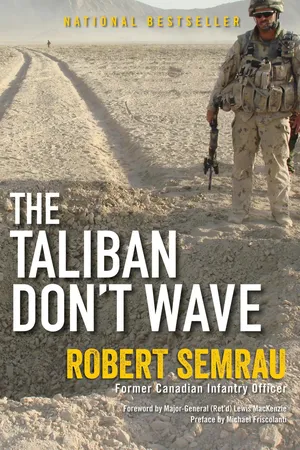
Captain Robert Semraus military trial made international headlines—a Canadian soldier serving in Afghanistan arrested for allegedly killing a grievously wounded Taliban soldier in the field. The trial and its outcome are a matter of public record. What you are about to read about the tour of duty that inspired this book is not. What you are about to read is an emotionally draining and mind-snapping firsthand account of war on the ground in Afghanistan. It's raw and explosive. Names have been changed to protect the brave and not so brave alike. What you are about to read is an account of soldiers who live, fight and die in a moonscape of a country where its sometimes hard to tell your friend from your enemy. It's about trying to hold it together when a mortar attack is ripping your friends and allies apart, and your world unravels before your eyes. Rob Semrau wrote this book to tell us about the sheer hell that is the Stan, but also to recognize the incredible courage and compassion he witnessed in the heat of battle. The soldiers you are about to meet and the events that befall them will linger on in your mind long after you have closed these pages.
- 312 pages
- English
- ePUB (mobile friendly)
- Available on iOS & Android
eBook - ePub
The Taliban Don't Wave
About this book
Information
Subtopic
Military & Maritime HistoryIndex
HistoryChapter 1
If the commercials are true and Disneyland is truly the happiest place on earth, and if everything in life must have an opposite, then the saddest place on earth must be Afghanistan. I once heard it described as the dark side of the moon, but with mines.
I had been in Afghanistan once before, as a member of the British Army's Second Battalion, The Parachute Regiment, so I had a better clue than most of what we were about to get into. I was on an operation in Macedonia when 9/11 happened, and right then and there, we all knew the world had changed. Within a couple of months, my parachute battalion joined the first coalition troops to form ISAF, the International Security Assistance Force. We landed in Afghanistan at Bagram, north of Kabul, on January 7, 2002, and the Royal Marines we were replacing, who were meant to hand over their ammunition to us, got onto our Hercules transport aircraft and took off, leaving us with nothing. No bullets, no grenades, nothing. I told the lads I'd be okay, because I knew how to shoot mind bullets. No one laughed. We then made the long, scary drive down from Bagram to Kabul with no ammo. Nice. Chalk up another reason why the Paras hate Marines.
On our tortuously slow, winding route through the hills north of Kabul, we passed several burned-out Russian tanks, and quickly sped through the obvious ambush and choke points. Thankfully nothing happened—that time. That was my first taste of the Stan, and as any sane person could imagine, it tasted awful. Passing through the towns and villages we saw—up close—extreme poverty and utter despair, with almost every single building bombed or burned out to the point where it was uninhabitable. It was brutal to have to see people living in such terrible conditions.
The choking dust coupled with the smell of garbage and raw sewage made your eyes sting and your throat gag. I found out that most of the damage to Kabul was actually done by the Afghans fighting each other in their civil war, after they'd kicked the Russians out.
A story that nicely summed up the Stan for me came out of that tour. We'd been there a few months when somebody at the coalition headquarters in Kabul asked a bunch of famous British soccer players to come and play a fun game of footy against the Afghan national team. The day of the match would coincide with Afghanistan's recently scheduled first-ever “Day of Peace.” There would be a band, some doves, a few speeches, and then a great game of soccer. So a group of brave footballers (and because I was an ignorant colonial I hadn't heard of any of them) came down to practise a bit and then play a match.
We were posted outside of the stadium in Kabul (where the Taliban used to publicly execute people) on the day of the game to act as a quick reaction force if the Taliban decided to attack. More likely, however, we would act as riot police since there were ten thousand angry spectators locked out of the stadium because only government lackeys and their families were invited to sit inside to watch the game.
Shortly after the opening ceremonies we all knew things were going Pete Tong wrong. If Paras have a gift, it's the ability to sense danger and smell violence in the air. I had just looked at one of my friends and said something along the lines of, “It's going to kick off here, big time!” when I heard a sound like cattle stampeding, and then people screaming. I spun around and looked up at the stadium just in time to see several people get violently pushed over the railing at the top. They seemed to tumble in slow motion as they fell at least three storeys to the hard cement below, where their bodies made a wet smacking noise when they hit the ground. Some Dutch troops who were also on duty casually walked over to the pile of twisted, broken bodies and started commenting on their injuries and debating the order in which to triage them, as though seeing people fall to their deaths was no big deal. I guess that sort of thing happens all the time in Amsterdam. Being from Moose Jaw, Saskatchewan, this was a new experience for me.
Things quickly began to escalate out of control. The crowd on the outside of the stadium, eager to see the action from the inside, started pushing up against us. I gently started shoving people back with my 7.62mm general-purpose machine gun, when this Afghan cop/thug came up to me. If I was reading his body language right, he was saying, “You're doing it all wrong.” He then started swinging his AK-47 by the barrel like a baseball bat, violently cracking people on the head and face with it.
I couldn't believe what I was seeing; this was a policeman, one of the so-called good guys, and he was dropping people left and right with his AK-Louisville Slugger! I ran over to stop him but people in the crowd started shouting and running all over the place, knocking into me and trying to pull my weapon out of my hands. Angry Afghans began climbing up on to a German armoured vehicle, but the wily Krauts (like all good Germans) had a contingency plan. One of their soldiers popped out of the hatch with a fire extinguisher and started hosing down the civvies, spraying them in the face with chemical fire retardant.
A Para friend of mine screamed, “Fuckin' 'ell lads, it's kickin' off! Up your jumpers!” and started delivering vicious kicks to anyone within boot-stomping range. Now the Paras' love of a good riot was almost matched by their love of putting down a good riot, but this was too much. It was utter madness!
Later that day, I got the story as to how the whole thing started from a friend of mine who was posted inside the stadium. It seems the crowd had seen too many news clips of soccer hooliganism and decided that starting riots (if the rest of the world was anything to go by) was just the sort of thing that one does whilst watching a footy match. So after a brass band played a few notes, the mayor of Kabul gave a flowery speech and then stepped down from his podium to release a bunch of caged pigeons to celebrate the Day of Peace. The poor pigeons, however, having been locked up in this tiny cage for weeks on end, didn't soar for the sky like at the Olympics, but fluttered rather half-heartedly the few feet to the ground and collapsed in sheer exhaustion right in front of their cage.
It was too much for the crowd in the stands. They couldn't get the image of public executions out of their mind. During the Taliban's black reign of terror, the stadium had been transformed into a coliseum. And coliseums were all about blood. Now the crowd wanted blood. Any blood. Pigeon blood!
So like a ten-thousand-strong human wave, they bum-rushed the field and, in their eagerness to take home a memorial pigeon, literally ripped the birds apart in the struggle for possession. My friend told me it was one of the damnedest things he'd ever seen, and he was from east London, so that's saying something. Blood and feathers flew in all directions and people started beating and kicking each other to get a piece, any piece, of the torn-apart pigeons to put on their mantels back home.
By some miracle a small boy managed to capture a live bird and make a break for it. He was halfway across the field when the crowd quickly gave chase and tackled him to the ground. Twenty hands shot in to steal his beloved pigeon, quickly ripping it to shreds as the boy screamed and cried over his murdered pet. My friend saw the young boy later, all bruised and bloodied, crying as he picked up flesh and feathers, as though he'd be able to put the mangled pigeon back together.
Then people began getting shoved over the balcony railing as the crowd in the upper decks fought to get down to the action on the field. That's around the time I saw people falling for three storeys and heard the sickening crunch as their bodies smacked into cement. People were screaming and running in all directions; children were crying because they'd lost their parents; complete strangers were fighting to the death, rolling on the ground, choking and eye-gouging. AK-47s were swinging in parabolic arcs until they made hard contact with soft heads. Crumpled, broken civilians were all over the ground as German soldiers screamed “Aussteigen! ” in their angry, guttural tones, spraying down civilians in the face with fire-retardant foam. It was total anarchy and chaos.
Sadly, and not surprisingly, it all took place on Afghanistan's first Day of Peace. Needless to say, this didn't bode well for the country.
But that was another time, and on August 25, 2008, as I was reminiscing, the ramp on my Herc came down at Kandahar Airfield (KAF), and there it was again, the stink of the Stan, which I had tried so hard to forget. It was a gruesome combination of burning garbage and raw sewage, and it always brought the Stan back to my mind whenever I smelled it anywhere else in third world countries. It hit me square in the face, and for a moment, I was right back in Kabul, smothered in a flood of memories and bad emotions. I looked over at a sergeant I'd never met before, and judging by the look in his eyes, I knew he'd been in the Stan before as well, and that the stink was bringing him back to another time and place, one he'd evidently preferred to have forgotten.
He looked at me, shook his head, and quietly said, “Fuck, I hate this place.”
“Tell me about it,” I replied and walked down the ramp, into the burning heat, dust, and odours that made your nose sting and your eyes water. I thought to myself, Ya gotta love it!
I looked over at my team as they exited the Herc. Warrant Officer Longview, a very switched-on professional, was my second-in-command (2 I/C); Private Fourneau would be our driver; Corporal Hetsa would be our vehicle's gunner and light-machine-gun-toting killer on the ground; and then there was me, their newly minted captain. Most of the guys were from the First Battalion, The Royal Canadian Regiment (1 RCR) from Canadian Forces Base Petawawa, in Ontario. But a few guys, like myself, had come over from 3 RCR (also located at CFB Pet) to make up the numbers. Our Canadian OMLT, consisting of four 4-man teams, would be called 72 Kandak. Kandak means battalion in Dari, the language of the Afghan National Army (ANA), and the Canadian Forces (CF) had implemented the word in a show of solidarity with them. My four-man team's designation, or call sign, would be 72 Alpha (pronounced seven two, not seventy-two).
I looked over and made eye contact with my buddy, Rich, who was also in charge of a four-man OMLT team. He smirked and scratched his eyebrow, giving me the finger at the same time. Originally from Cape Breton, he was now a reservist fighting out of Hamilton, Ontario. We'd immediately hit it off when he arrived at CFB Pet and discovered that if I sat in the front seat of his car, I could navigate our way to the Tim Hortons on base and he wouldn't have to drive off the base by accident any more. After a series of self-described disastrous life choices, he found himself attached to a regular force unit, about to deploy to Afghanistan to mentor and guide the Afghan National Army during combat operations. His dubious navigational skills aside, he was an incredibly switched-on soldier. All the guys loved him, and we took the piss out of each other constantly.
Rich was what soldiers in the infantry lovingly called a shit magnet. Later on during our tour, almost every time I patrolled next to him and his call sign, bad things happened. The enemy was drawn to him; they smelled him from afar and travelled from wonderful places just to kill him and his men. I never liked patrolling with him; I was scared I was going to get caught up in his vortex of death. I labelled him call sign “Bad Karma” because Death seemed to be stalking him.
A logistics (loggy) sergeant had just marched up and was shouting at us to follow her to the tent city, our new home away from home, when a couple of black Hilux Toyotas with tinted windows and cab covers screeched to a halt right next to us, spitting up dust. The window slowly lowered and a full-bearded face glared out the window, spit out some tobacco juice, looked me in the eye, and said in a voice eerily similar to Clint Eastwood's, “You guys OMLT?”
You'd better say “yes,” I thought to myself. He's probably got the drop on ya!
“Yeah,” I said back, not sure who or what the hell I was looking at. He looked like he was in the special forces, the only place you'd be allowed to grow a three-month beard like that. His eyes had big bags under them, like he'd been in the shit (seen serious combat) recently and was just in Kandahar Airfield for a day's R&R (rest and relaxation) before he had to go back to killing the Taliban with his bare hands and tobacco breath.
He snorted and spit another wad of juice into the dirt. “Get in,” was all he said, looking straight ahead again as his window rolled back up.
I shouted out to the OMLT boys next to me, “You heard the man—pack your gear in the trucks and let's get outta here!” I moved to the back of the truck with my bags and shouted, “Warrant, police up our men, we're pulling a Jeffersons!”
“What's a Jeffersons?”
“We're movin' on up! Better digs! C'mon, let's go.” I threw open the back of the truck, pushed in my gear, and helped Fourneau and Hetsa with theirs. We all crammed into the cab. The rest of the boys piled into the other trucks and we sped off into the night.
“Where're we going?” I asked Grizzly Adams. His passenger, an equally bearded man, spoke into a cellphone.
“Yeah, we got 'em; coming to you now.” He clicked the phone shut. He leaned over the back of his seat and said, “OMLT don't stay in that shithole! We've got you suites at the vip centre.” (He pronounced it “vip,” not “v-i-p.”) “You'll stay there for two days, listen to the stupid briefings, and then go off to the Panj to win the war for us. We're on our way out, you boys are relieving us; name's Mike,” and with that quick explanation, he looked forward again.
“Fair enough,” I said, and looked over at Fourneau and shrugged. VIP accommodation sounded a lot better than the surly loggy's tent. The three trucks came to a screeching halt outside a long two-storey block and kicked up enough dust to choke us all out.
“Here we are,” Mike said. “Go inside to the first floor; your names are on the doors, the rooms are unlocked, keys are on the desks.” He pointed down the street. “Walk down this road for about fifteen minutes, follow the curve, that'll lead you to the American DFAC. It's open from zero-six hundred. Break down your rifles and lock 'em in your army boxes. Just carry your pistols. Then come back for briefings at building Zulu-3 at zero-eight-thirty.”
“Cool, but where's Zulu-3?” I asked, having never been to KAF before.
“Can't miss it, you'll walk by it on your way to the DFAC. After your briefings, we'll come and grab you guys and get you squared away for kit.”
“Okay, thanks for the pickup and the rooms. Just one more question—what's a DFAC?”
“Whats'a matter?” Mike smirked, “Not up on your TLAs?”
“Apparently not,” I said, not really sure what he was talking about.
“TLAs: three-letter acronyms! The army's full of 'em, and you'd better figure 'em out most ricky-tick if you wanna survive here! DFAC stands for dining facility. There's like seven of 'em, but the American one's the best.”
“Cool, thanks,”...
Table of contents
- Cover
- Title Page
- Table of Contents
- Dedication
- Map
- Foreword
- Preface
- List of Abbreviations
- Prologue
- Chapter 1
- Chapter 2
- Chapter 3
- Chapter 4
- Chapter 5
- Chapter 6
- Chapter 7
- Chapter 8
- Chapter 9
- Chapter 10
- Chapter 11
- Chapter 12
- Chapter 13
- Chapter 14
- Chapter 15
- Chapter 16
- Chapter 17
- Chapter 18
- Chapter 19
- Epilogue
- A Letter to Our Veterans
- Copyright
- About the Publisher
Trusted by 375,005 students
Access to over 1.5 million titles for a fair monthly price.
Study more efficiently using our study tools.
Frequently asked questions
Yes, you can cancel anytime from the Subscription tab in your account settings on the Perlego website. Your subscription will stay active until the end of your current billing period. Learn how to cancel your subscription
No, books cannot be downloaded as external files, such as PDFs, for use outside of Perlego. However, you can download books within the Perlego app for offline reading on mobile or tablet. Learn how to download books offline
Perlego offers two plans: Essential and Complete
- Essential is ideal for learners and professionals who enjoy exploring a wide range of subjects. Access the Essential Library with 800,000+ trusted titles and best-sellers across business, personal growth, and the humanities. Includes unlimited reading time and Standard Read Aloud voice.
- Complete: Perfect for advanced learners and researchers needing full, unrestricted access. Unlock 1.5M+ books across hundreds of subjects, including academic and specialized titles. The Complete Plan also includes advanced features like Premium Read Aloud and Research Assistant.
We are an online textbook subscription service, where you can get access to an entire online library for less than the price of a single book per month. With over 1.5 million books across 990+ topics, we’ve got you covered! Learn about our mission
Look out for the read-aloud symbol on your next book to see if you can listen to it. The read-aloud tool reads text aloud for you, highlighting the text as it is being read. You can pause it, speed it up and slow it down. Learn more about Read Aloud
Yes! You can use the Perlego app on both iOS and Android devices to read anytime, anywhere — even offline. Perfect for commutes or when you’re on the go.
Please note we cannot support devices running on iOS 13 and Android 7 or earlier. Learn more about using the app
Please note we cannot support devices running on iOS 13 and Android 7 or earlier. Learn more about using the app
Yes, you can access The Taliban Don't Wave by Robert Semrau in PDF and/or ePUB format, as well as other popular books in History & Military & Maritime History. We have over 1.5 million books available in our catalogue for you to explore.