- 150 pages
- English
- ePUB (mobile friendly)
- Available on iOS & Android
eBook - ePub
Futility, Or The Wreck Of The Titan
About this book
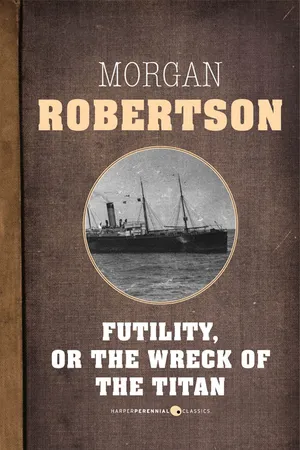
Futility, or The Wreck of the Titan is Morgan Robertson's 1898 novella about the unsinkable ship Titan, which goes down after striking an iceberg in the North Atlantic. Disgraced former naval lieutenant John Rowland is working as a deckhand on the Titan when it strikes an iceberg and capsizes. Saving the younger daughter of a former lover by jumping onto the iceberg with her, Rowland and his charge are eventually rescued and return to their homes.
HarperPerennial Classics brings great works of literature to life in digital format, upholding the highest standards in ebook production and celebrating reading in all its forms. Look for more titles in the HarperPerennial Classics collection to build your digital library.
Frequently asked questions
Yes, you can cancel anytime from the Subscription tab in your account settings on the Perlego website. Your subscription will stay active until the end of your current billing period. Learn how to cancel your subscription.
No, books cannot be downloaded as external files, such as PDFs, for use outside of Perlego. However, you can download books within the Perlego app for offline reading on mobile or tablet. Learn more here.
Perlego offers two plans: Essential and Complete
- Essential is ideal for learners and professionals who enjoy exploring a wide range of subjects. Access the Essential Library with 800,000+ trusted titles and best-sellers across business, personal growth, and the humanities. Includes unlimited reading time and Standard Read Aloud voice.
- Complete: Perfect for advanced learners and researchers needing full, unrestricted access. Unlock 1.4M+ books across hundreds of subjects, including academic and specialized titles. The Complete Plan also includes advanced features like Premium Read Aloud and Research Assistant.
We are an online textbook subscription service, where you can get access to an entire online library for less than the price of a single book per month. With over 1 million books across 1000+ topics, weâve got you covered! Learn more here.
Look out for the read-aloud symbol on your next book to see if you can listen to it. The read-aloud tool reads text aloud for you, highlighting the text as it is being read. You can pause it, speed it up and slow it down. Learn more here.
Yes! You can use the Perlego app on both iOS or Android devices to read anytime, anywhere â even offline. Perfect for commutes or when youâre on the go.
Please note we cannot support devices running on iOS 13 and Android 7 or earlier. Learn more about using the app.
Yes, you can access Futility, Or The Wreck Of The Titan by Morgan Robertson in PDF and/or ePUB format, as well as other popular books in Literature & Classics. We have over one million books available in our catalogue for you to explore.
Information
The Wreck of the Titan
Chapter I
She was the largest craft afloat and the greatest of the works of men. In her construction and maintenance were involved every science, profession, and trade known to civilization. On her bridge were officers, who, besides being the pick of the Royal Navy, had passed rigid examinations in all studies that pertained to the winds, tides, currents, and geography of the sea; they were not only seamen, but scientists. The same professional standard applied to the personnel of the engine room, and the stewardâs department was equal to that of a first-class hotel.
Two brass bands, two orchestras, and a theatrical company entertained the passengers during waking hours; a corps of physicians attended to the temporal, and a corps of chaplains to the spiritual, welfare of all on board, while a well-drilled fire company soothed the fears of nervous ones and added to the general entertainment by daily practice with their apparatus.
From her lofty bridge ran hidden telegraph lines to the bow, stern engine room, crowâs-nest on the foremast, and to all parts of the ship where work was done, each wire terminating in a marked dial with a movable indicator, containing in its scope every order and answer required in handling the massive hulk, either at the dock or at seaâwhich eliminated, to a great extent, the hoarse, nerve-racking shouts of officers and sailors.
From the bridge, engine room, and a dozen places on her deck the ninety-two doors of nineteen watertight compartments could be closed in half a minute by turning a lever. These doors would also close automatically in the presence of water. With nine compartments flooded the ship would still float, and as no known accident of the sea could possibly fill this many, the steamship Titan was considered practically unsinkable.
Built of steel throughout, and for passenger traffic only, she carried no combustible cargo to threaten her destruction by fire; and the immunity from the demand for cargo space had enabled her designers to discard the flat, kettle-bottom of cargo boats and give her the sharp dead-riseâor slant from the keelâof a steam yacht, and this improved her behavior in a seaway. She was eight hundred feet long, of seventy thousand tonsâ displacement, seventy-five thousand horsepower, and on her trial trip had steamed at a rate of twenty-five knots an hour over the bottom, in the face of unconsidered winds, tides, and currents. In short, she was a floating cityâcontaining within her steel walls all that tends to minimize the dangers and discomforts of the Atlantic voyageâall that makes life enjoyable.
Unsinkableâindestructible, she carried as few boats as would satisfy the laws. These, twenty-four in number, were securely covered and lashed down to their chocks on the upper deck, and if launched would hold five hundred people. She carried no useless, cumbersome life rafts; butâbecause the law required itâeach of the three thousand berths in the passengers,â officers,â and crewâs quarters contained a cork jacket, while about twenty circular life buoys were strewn along the rails.
In view of her absolute superiority to other craft, a rule of navigation thoroughly believed in by some captains, but not yet openly followed, was announced by the steamship company to apply to the Titan: She would steam at full speed in fog, storm, and sunshine, and on the Northern Lane Route, winter and summer, for the following good and substantial reasons: First, that if another craft should strike her, the force of the impact would be distributed over a larger area if the Titan had full headway, and the brunt of the damage would be borne by the other. Second, that if the Titan was the aggressor she would certainly destroy the other craft, even at half-speed, and perhaps damage her own bows; while at full speed, she would cut her in two with no more damage to herself than a paintbrush could remedy. In either case, as the lesser of two evils, it was best that the smaller hull should suffer. A third reason was that, at full speed, she could be more easily steered out of danger, and a fourth, that in case of an end-on collision with an icebergâthe only thing afloat that she could not conquerâher bows would be crushed in but a few feet further at full than at half speed, and at the most three compartments would be floodedâwhich would not matter with six more to spare.
So, it was confidently expected that when her engines had limbered themselves, the steamship Titan would land her passengers three thousand miles away with the promptitude and regularity of a railway train. She had beaten all records on her maiden voyage, but, up to the third return trip, had not lowered the time between Sandy Hook and Dauntâs Rock to the five-day limit; and it was unofficially rumored among the two thousand passengers who had embarked at New York that an effort would now be made to do so.
Chapter II
Eight tugs dragged the great mass to midstream and pointed her nose down the river; then the pilot on the bridge spoke a word or two; the first officer blew a short blast on the whistle and turned a lever; the tugs gathered in their lines and drew off; down in the bowels of the ship three small engines were started, opening the throttles of three large ones; three propellers began to revolve; and the mammoth, with a vibratory tremble running through her great frame, moved slowly to sea.
East of Sandy Hook the pilot was dropped and the real voyage begun. Fifty feet below her deck, in an inferno of noise, and heat, and light, and shadow, coal-passers wheeled the picked fuel from the bunkers to the fire-hold, where half-naked stokers, with faces like those of tortured fiends, tossed it into the eighty white-hot mouths of the furnaces. In the engine room, oilers passed to and fro, in and out of the plunging, twisting, glistening steel, with oil-cans and waste, overseen by the watchful staff on duty, who listened with strained hearing for a false note in the confused jumble of soundâa clicking of steel out of tune, which would indicate a loosened key or nut. On deck, sailors set the triangular sails on the two masts, to add their propulsion to the momentum of the record-breaker, and the passengers dispersed themselves as suited their several tastes. Some were seated in steamer chairs, well wrappedâfor, though it was April, the salt air was chillyâsome paced the deck, acquiring their sea legs; others listened to the orchestra in the music-room, or read or wrote in the library, and a few took to their berthsâseasick from the slight heave of the ship on the ground-swell.
The decks were cleared, watches set at noon, and then began the never-ending cleaning-up at which steamship sailors put in so much of their time. Headed by a six-foot boatswain, a gang came aft on the starboard side, with paint-buckets and brushes, and distributed themselves along the rail.
âDavits anâ stanchions, menânever mind the rail,â said the boatswain. âLadies, better move your chairs back a little. Rowland, climb down out oâ thatâyouâll be overboard. Take a ventilatorâno, youâll spill paintâput your bucket away anâ get some sandpaper from the yeoman. Work inboard till you get it out oâ you.â
The sailor addressedâa slight-built man of about thirty, black-bearded and bronzed to the semblance of healthy vigor, but watery-eyed and unsteady of movementâcame down from the rail and shambled forward with his bucket. As he reached the group of ladies to whom the boatswain had spoken, his gaze rested on oneâa sunny-haired young woman with the blue of the sea in her eyesâwho had arisen at his approach. He started, turned aside as if to avoid her, and raising his hand in an embarrassed half-salute, passed on. Out of the boatswainâs sight he leaned against the deckhouse and panted, while he held his hand to his breast.
âWhat is it?â he muttered, wearily; âwhisky nerves, or the dying flutter of a starved love. Five years, nowâand a look from her eyes can stop the blood in my veinsâcan bring back all the heart-hunger and helplessness, that leads a man to insanityâor this.â He looked at his trembling hand, all scarred and tar-stained, passed on forward, and returned with the sandpaper.
The young woman had been equally affected by the meeting. An expression of mingled surprise and terror had come to her pretty, but rather weak face; and without acknowledging his half-salute, she had caught up a little child from the deck behind her, and turning into the saloon door, hurried to the library, where she sank into a chair beside a military-looking gentleman, who glanced up from a book and remarked: âSeen the sea serpent, Myra, or the Flying Dutchman? Whatâs up?â
âOh, Georgeâno,â she answered in agitated tones. âJohn Rowland is hereâLieutenant Rowland. Iâve just seen himâhe is so changedâhe tried to speak to me.â
âWhoâthat troublesome flame of yours? I never met him, you know, and you havenât told me much about him. What is heâfirst cabin?â
âNo, he seems to be a common sailor; he is working, and is dressed in old clothesâall dirty. And such a dissipated face, too. He seems to have fallenâso low. And it is all sinceââ
âSince you soured on him? Well, it is no fault of yours, dear. If a man has it in him heâll go to the dogs anyhow. How is his sense of injury? Has he a grievance or a grudge? Youâre badly upset. What did he say?â
âI donât knowâhe said nothingâIâve always been afraid of him. Iâve met him three times since then, and he puts such a frightful look in his eyesâand he was so violent, and headstrong, and so terribly angry,âthat time. He accused me of leading him on, and playing with him; and he said something about an immutable law of chance, and a governing balance of eventsâthat I couldnât understand, only where he said that for all the suffering we inflict on others, we receive an equal amount ourselves. Then he went awayâin such a passion. Iâve imagined ever since that he would take some revengeâhe might steal our Myraâour baby.â She strained the smiling child to her breast and went on. âI liked him at first, until I found out that he was an atheistâwhy, George, he actually denied the existence of Godâand to me, a professing Christian.â
âHe had a wonderful nerve,â said the husband, with a smile; âdidnât know you very well, I should say.â
âHe never seemed the same to me after that,â she resumed; âI felt as though in the presence of something unclean. Yet I thought how glorious it would be if I could save him to God, and tried to convince him of the loving care of Jesus; but he only ridiculed all I hold sacred, and said, that much as he valued my good opinion, he would not be a hypocrite to gain it, and that he would be honest with himself and others, and express his honest unbeliefâthe idea; as though one could be honest without Godâs helpâand then, one day, I smelled liquor on his breathâhe always smelled of tobaccoâand I gave him up. It was then that heâthat he broke out.â
âCome out and show me this reprobate,â said the husband, rising. They went to the door and the young woman peered out. âHe is the last man down thereâclose to the cabin,â she said as she drew in. The husband stepped out.
âWhat! that hang-dog ruffian, scouring the ventilator? So, thatâs Rowland, of the navy, is it! Well, this is a tumble. Wasnât he broken for conduct unbecoming an officer? Got roaring drunk at the Presidentâs levee, didnât he? I think I read of it.â
âI know he lost his position and was terribly disgraced,â answered the wife.
âWell, Myra, the poor devil is harmless now. Weâll be across in a few days, and you neednât meet him on this broad deck. If he hasnât lost all sensibility, heâs as embarrassed as you. Better stay in nowâitâs getting foggy.â
Chapter III
When the watch turned out at midnight, they found a vicious half-gale blowing from the northeast, which, added to the speed of the steamship, made, so far as effects on her deck went, a fairly uncomfortable whole gale of chilly wind. The head sea, choppy as compared with her great length, dealt the Titan successive blows, each one attended by supplementary tremors to the continuous vibrations of the enginesâeach one sending a cloud of thick spray aloft that reached the crowâs-nest on the foremast and battered the pilothouse windows on the bridge in a liquid bombardment that would have broken ordinary glass. A fog-bank, into which the ship had plunged in the afternoon, still enveloped herâdamp and impenetrable; and into the gray, ever-receding wall ahead, with two deck officers and three lookouts straining sight and hearing to the utmost, the great racer was charging with undiminished speed.
At a quarter past twelve, two men crawled in from the darkness at the ends of the eighty-foot bridge and shouted to the first officer, who had just taken the deck, the names of the men who had relieved them. Backing up to the pilothouse, the officer repeated the names to a quartermaster within, who entered them in the logbook. Then the men vanishedâto their coffee and âwatch-below.â In a few moments another dripping shape appeared on the bridge and reported the crowâs-nest relief.
âRowland, you say?â bawled the officer above the howling of the wind. âIs he the man who was lifted aboard, drunk, yesterday?â
âYes, sir.â
âIs he still drunk?â
âYes, sir.â
âAll rightâthatâll do. Enter Rowland in the crowâs-nest, quartermaster,â said the officer; then, making a funnel of his hands, he roared out: âCrowâs-nest, there.â
âSir,â came the answer, shrill and clear on the gale.
âKeep your eyes openâkeep a sharp lookout.â
âVery good, sir.â
âBeen a man-oâ-warâs-man, I judge, by his answer. Theyâre no good,â muttered the officer. He resumed his position at the forward side of the bridge where the wooden railing afforded some shelter from the raw wind, and began the long vigil which would only end when the second officer relieved him, four hours later. Conversationâexcept in the line of dutyâwas forbidden among the bridge officers of the Titan, and his watchmate, the third officer, stood on the other side of the large bridge binnacle, only leaving this position occasionally to glance in at the compassâwhich seemed to be his sole duty at sea. Sheltered by one of the deckhouses below, the boatswain and the watch paced back and forth, enjoying the only two hours respite which steamship rules afforded, for the dayâs work had ended with the going down of the other watch, and at two oâclock the washing of the âtween-deck would begin, as an opening task in the next dayâs labor.
By the time one bell had sounded, with its repetition from the crowâs-nest, followed by a long-drawn cryââallâs wellââfrom the lookouts, the last of the two thousand passengers had retired, leaving the spacious cabins and steerage in possession of the watchmen; while, sound asleep in his cabin abaft the chartroom was the captain, the commander who never commandedâunless the ship was in danger; for the pilot had charge, making and leaving port, and the officers, at sea.
Two bells were struck and answered; then three, and the boatswain and his men were lighting up for a final smoke, when there rang out overhead a startling cry from the crowâs-nest:
âSomething ahead, sirâcanât make it out.â
The first officer sprang to the engine room telegraph and grasped the lever. âSing out what you see,â he roared.
âHard aport, sirâship on the starboard tackâdead ahead,â came the cry.
âPort your wheelâhard over,â repeated the first officer to the quartermaster at the helmâwho answered and obeyed. Nothing as yet could be seen from the bridge. The powerful steering-engine in the stern ground the rudder over; but before three degrees on the compass card were traversed by the lubberâs-point, a seeming thickening of the darkness and fog ahead resolved itself into the square sails of a deep-laden ship, crossing the Titanâsbow, not half her length away.
âHâl and dââ growled the first officer. âSteady on your course, quartermaster,â he shouted. âStand from under on deck.â He turned a lever which closed compartments, pushed a button markedââCaptainâs Room,â and crouched down, awaiting the crash.
There was hardly a crash. A slight jar shook the forward end of the Titan sliding down her fore-topmast-stay and rattling on deck came a shower of small spars, ...
Table of contents
- CONTENTS
- Chapter I
- Chapter II
- Chapter III
- Chapter IV
- Chapter V
- Chapter VI
- Chapter VII
- Chapter VIII
- Chapter IX
- Chapter X
- Chapter XI
- Chapter XII
- Chapter XIII
- Chapter XIV
- Chapter XV
- Chapter XVI
- Prologue
- Chapter I
- Chapter II
- Chapter III
- Chapter IV
- Chapter V
- Chapter VI
- Chapter VII
- Chapter VIII
- Chapter IX
- Chapter X
- Chapter XI
- Chapter XII
- Chapter XIII
- Chapter XIV
- Chapter XV
- Chapter XVI
- Chapter XVII
- Chapter XVIII
- Chapter XIX
- Chapter XX
- Chapter XXI
- Chapter XXII
- Chapter XXIII
- Chapter XXIV
- Chapter XXV
- Beyond the Spectrum
- In the Valley of the Shadow
- About the Series
- About the Author
- Copyright
- About the Publisher